Systemic Insecticides for Scale: When to Use Them

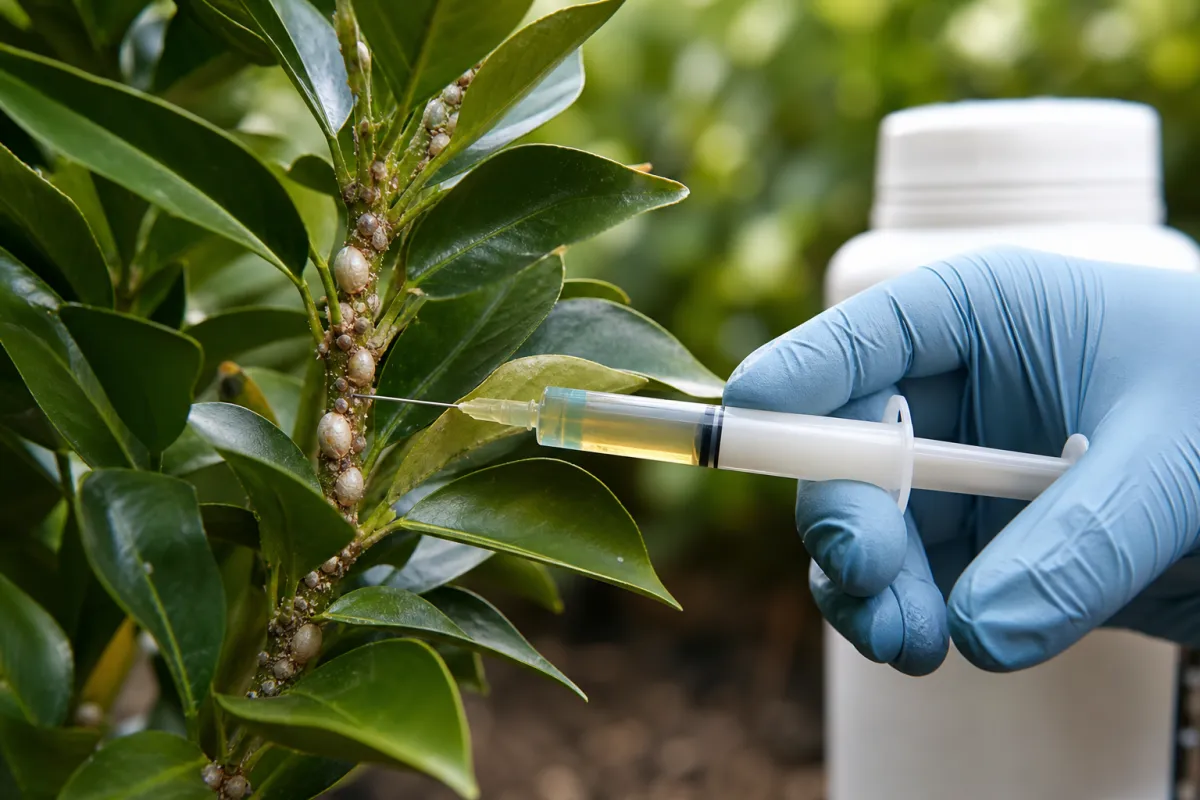 Learn when systemic control is justified for scale insects, how insecticides move through plants, which scales respond, and how to use drenches, granules, or trunk treatments. Covers timing, dosage, plant size, restrictions, precautions, combos, and success checks.
- When systemic control is actually justified
- How systemic insecticides move through the plant
- Which scale insects respond to systemic treatment
- Soil drenches, granules and trunk applications
- Best timing for systemic scale control
- How plant size affects dosage and treatment speed
- Restrictions for flowering and edible plants
- Pollinator, pet and environmental precautions
- Combining systemic and contact treatments
- How to judge whether the treatment succeeded
A plant-absorbed insecticide can help control scale when wiping, pruning, or horticultural oil no longer keeps the pests in check. Still, it should not be the first solution for every sticky leaf, yellowing plant, or bumpy stem. This guide explains when systemic treatment may be useful, when it is better avoided, and how to consider plant type, timing, pollinator risk, and infestation severity before choosing the safest and most effective approach.
When systemic control is actually justified
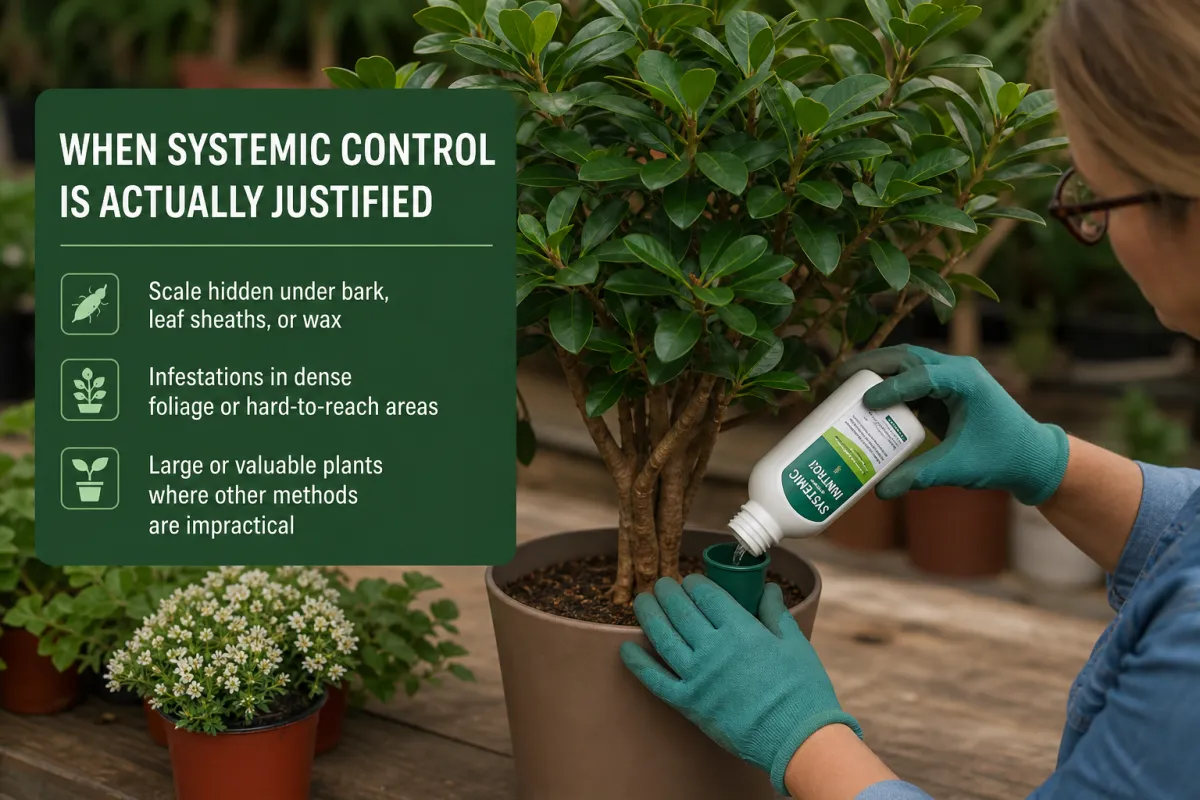
Systemic insecticides are best treated as a targeted tool, not the first response to every scale problem. They move into plant tissues and poison insects while they feed, which can be useful when scale is hidden under bark, leaf sheaths, dense foliage, or waxy covers that sprays cannot reach. They are less appropriate for a few visible insects on a small plant that can be pruned, wiped, or treated with a contact product.
Situations where systemics make sense
Consider systemic control when the infestation is widespread, recurring after careful cleaning, or located on a plant too large or dense to spray thoroughly. This is common on mature ficus, citrus kept in containers, camellia, euonymus, magnolia, hollies, palms, and many woody houseplants.
- A large shrub or tree has scale on inner branches where spray coverage is poor.
- Honeydew, sooty mold, or sticky floors return within a few weeks of cleaning.
- Soft scale is feeding on stems, petioles, and leaf undersides in numbers too high to remove by hand.
- The plant has value worth protecting, such as an established landscape specimen or an older indoor tree.
- Contact sprays would be impractical because the plant is 2 m (6.5 ft) tall or larger, densely branched, or positioned where overspray is risky.
For small indoor plants, systemics are usually a second-line option after physical removal, quarantine, and close follow-up. If the infestation is on a houseplant collection, review sanitation and isolation steps before treating every pot; a practical guide to indoor scale treatment can help you decide whether the problem is isolated or spreading.
Field note: if a plant is already declining from drought, root rot, compacted soil, or low light, a systemic product will not fix the underlying stress. Improve watering, drainage, and light first, then treat only if the plant is stable enough to keep growing and moving water through its tissues.
How systemic insecticides move through the plant
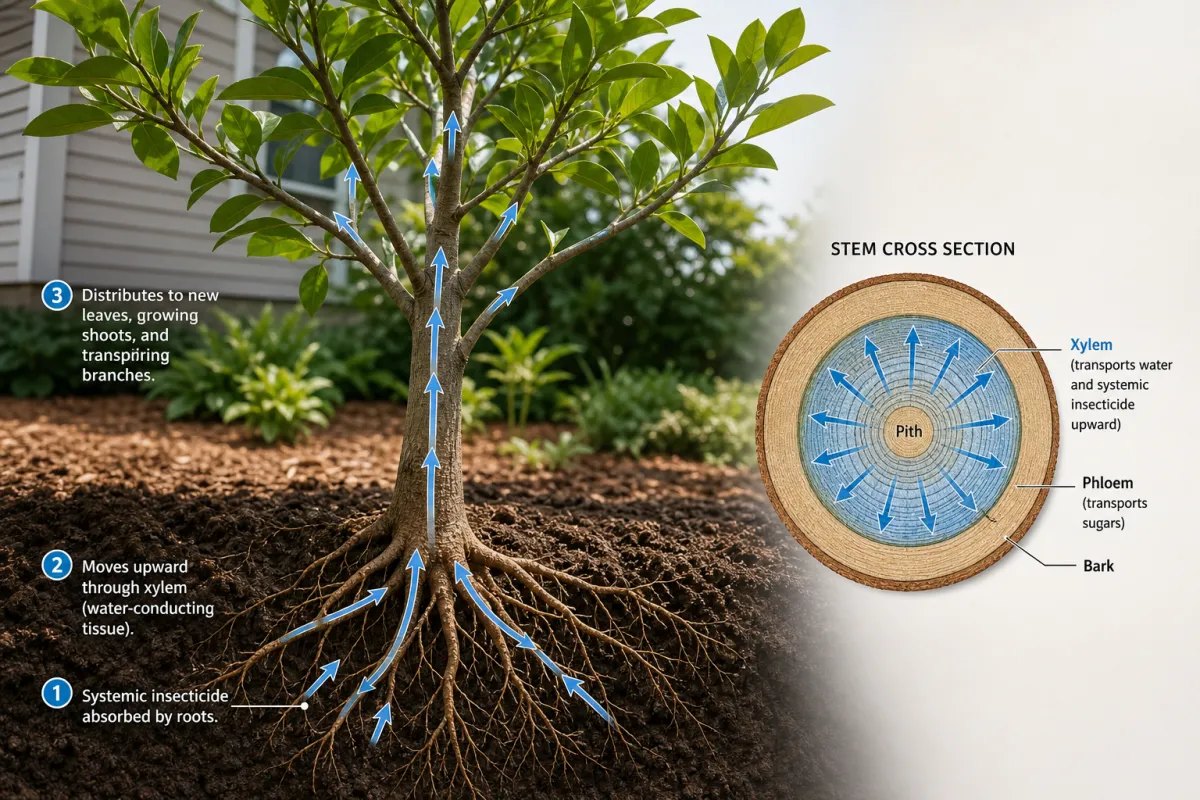
Systemic insecticides are absorbed by roots, bark, or vascular tissues and transported with the plant’s internal flow of water and nutrients. Most home-garden systemic products move upward mainly through the xylem, the water-conducting tissue. That means new leaves, actively growing shoots, and transpiring branches may receive more active ingredient than old, shaded, or poorly hydrated sections.
Why plant condition matters
A thirsty or root-damaged plant absorbs and distributes systemic products slowly. Overwatered soil can be just as problematic because oxygen-starved roots do not function well. Before applying a drench or granule, the root zone should be evenly moist but not saturated. For containers, water normally the day before treatment if the top 2.5 cm (1 in) is dry, then apply the product according to the label.
Light also affects movement. A plant in bright, appropriate light transpires more than one in a dim corner, so uptake tends to be faster. This does not mean placing a shade plant in hot sun; it means correcting poor placement so the plant is actively growing within its normal comfort range.
What systemics do not do
A systemic treatment does not dissolve old scale shells, remove sooty mold, or instantly stop all honeydew. Dead scale may remain attached for weeks, and sticky residue can persist until leaves are washed or replaced by new growth. The treatment works only when feeding insects ingest enough active ingredient, so crawlers and actively feeding stages are generally more vulnerable than dormant, protected, or nonfeeding stages.
- Systemics are slower than contact sprays; visible improvement often takes several weeks.
- Distribution may be uneven in plants with dead branches, girdled stems, or root damage.
- Old armored covers can remain on bark even after the insect underneath has died.
Which scale insects respond to systemic treatment
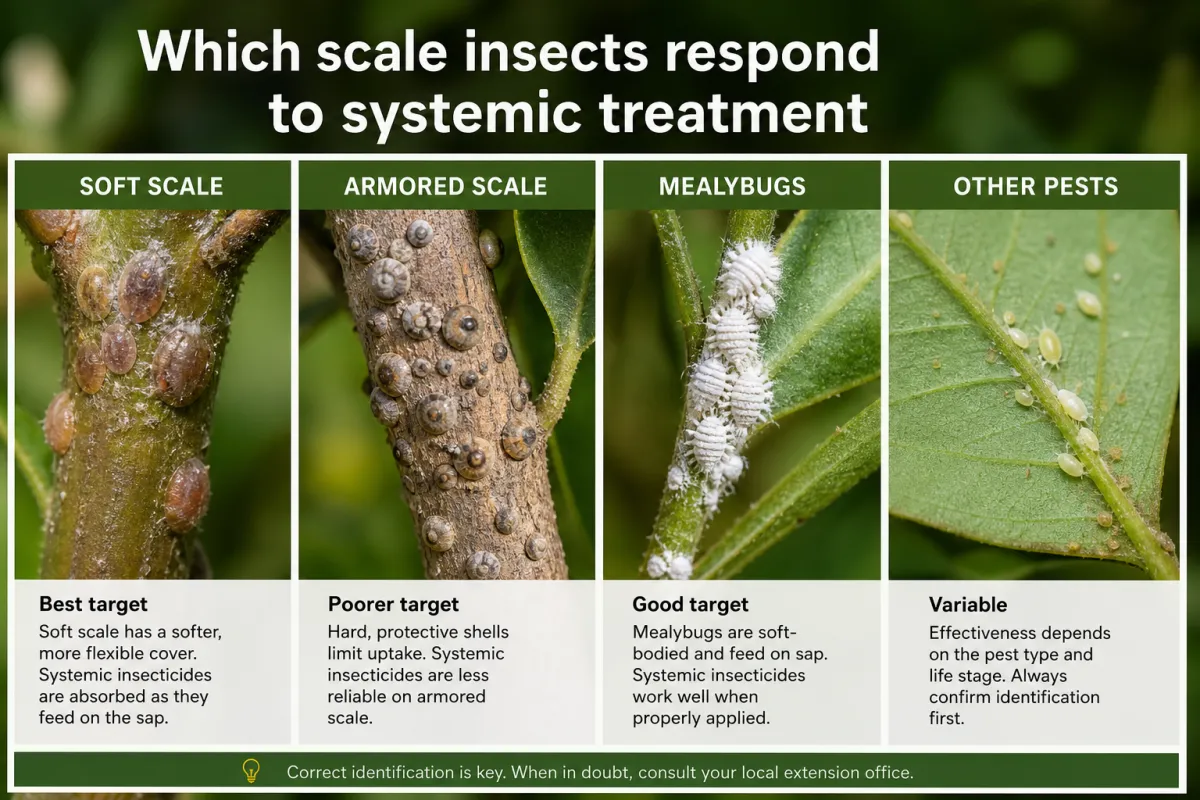
Scale insects are not all equally vulnerable to systemic insecticides. The difference is important because using a drench against the wrong type may waste time while the infestation expands. Before choosing a product, confirm whether you are dealing with soft scale, armored scale, mealybugs, or another pest. A good starting point is careful scale identification, especially if the plant has both bumps and sticky residue.
Soft scale is usually the best target
Soft scale feeds on plant sap and often produces honeydew, which leads to shiny leaves, sticky surfaces, ants, and black sooty mold. Because these insects ingest sap from vascular tissue, they are generally more responsive to systemic products than armored scale. Brown soft scale, hemispherical scale, cottony cushion scale, and many lecanium-type scales may decline noticeably after a well-timed systemic treatment.
Armored scale is more difficult
Armored scale insects sit under a hard, separate cover and do not produce honeydew. They feed differently and are often less affected by common soil-applied systemics. Some professional products may help in certain situations, but home gardeners should not assume a drench will solve oystershell scale, euonymus scale, tea scale, or San Jose scale. For these pests, timing contact treatments to the crawler stage is often more reliable.
- Likely to respond better: soft scales that produce honeydew and remain actively feeding on sap.
- Less predictable: armored scales with hard covers, especially on older bark and woody stems.
- Often confused with scale: mealybugs, whitefly pupae, fungal bumps, edema, and natural corking on stems.
If you are unsure, press one suspect bump gently with a fingernail or the edge of a card. Soft scale often crushes and may leave moist residue; armored scale covers may lift like tiny shells. Do not rely on color alone, because both groups can be brown, tan, white, or gray depending on species and age.
Soil drenches, granules and trunk applications
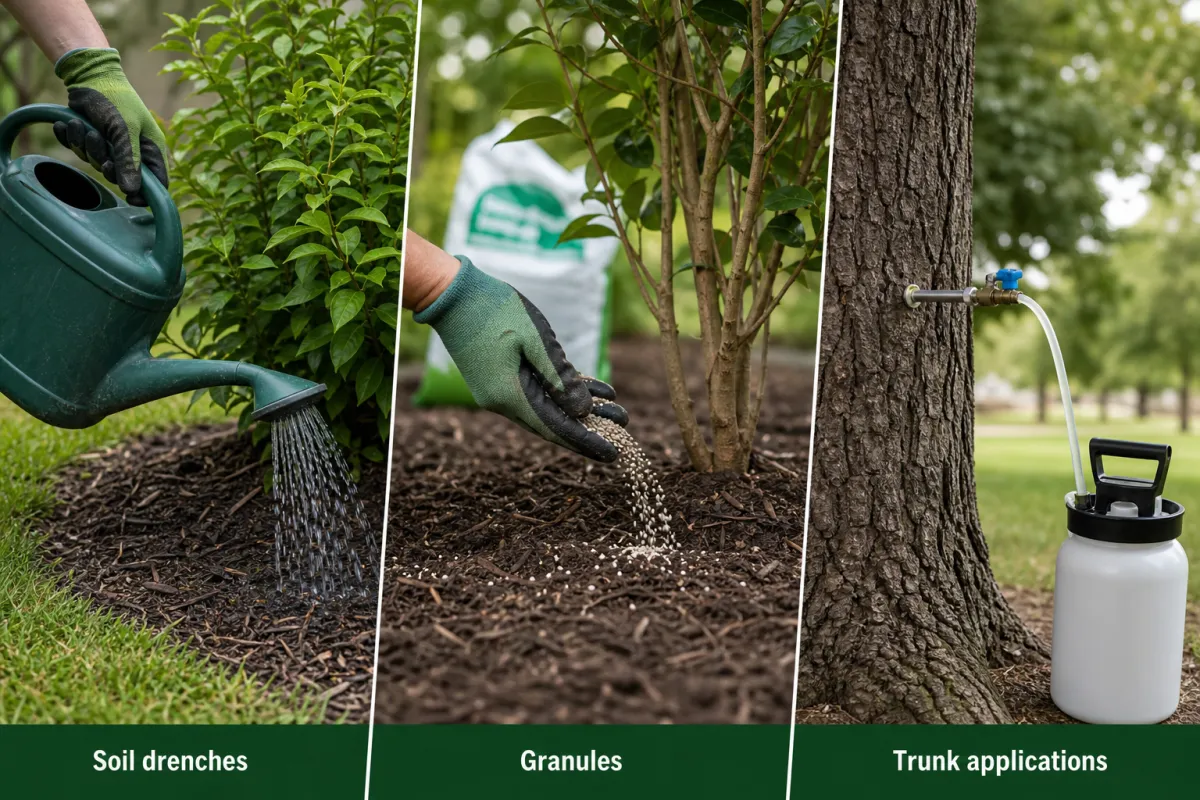
Systemic products are applied in several ways, and the best method depends on plant type, site, product label, and applicator experience. For home gardeners, soil drenches and granules are the most common. Trunk sprays or trunk injections are usually reserved for landscape trees and may require professional equipment or licensing, depending on the active ingredient and local rules.
Soil drenches
A soil drench is mixed with water and poured evenly over the root zone. In containers, the solution should wet the potting mix rather than run down the inside wall of a dry, shrunken root ball. Outdoors, apply over the feeder-root area rather than directly against the trunk. For many woody plants, that means treating beneath the canopy and slightly beyond the drip line, not just a 10 cm (4 in) circle at the base.
Granules
Granular products are scattered on the soil surface and watered in. They are convenient but can be misused when granules are left exposed, washed into drains, or applied to compacted mulch instead of soil. Pull mulch back before application if the label directs soil contact, then replace it after watering. Keep granules out of saucers, patios, and areas where pets may investigate.
Trunk-based treatments
Some landscape treatments are applied to trunks as basal sprays or injections. These can reduce drift compared with foliar spraying, but they are not automatically safer or gentler. Poor injection technique can wound trees, and repeated drilling may create entry points for decay. For valuable trees, especially those over 15 cm (6 in) trunk diameter, consult a certified arborist or licensed applicator.
How-to tip: when treating a container plant, water once lightly if the mix has pulled away from the pot edge, wait 15 minutes, then apply the drench. A slightly rehydrated root ball absorbs more evenly than a bone-dry one that channels liquid straight out the drainage holes.
Best timing for systemic scale control
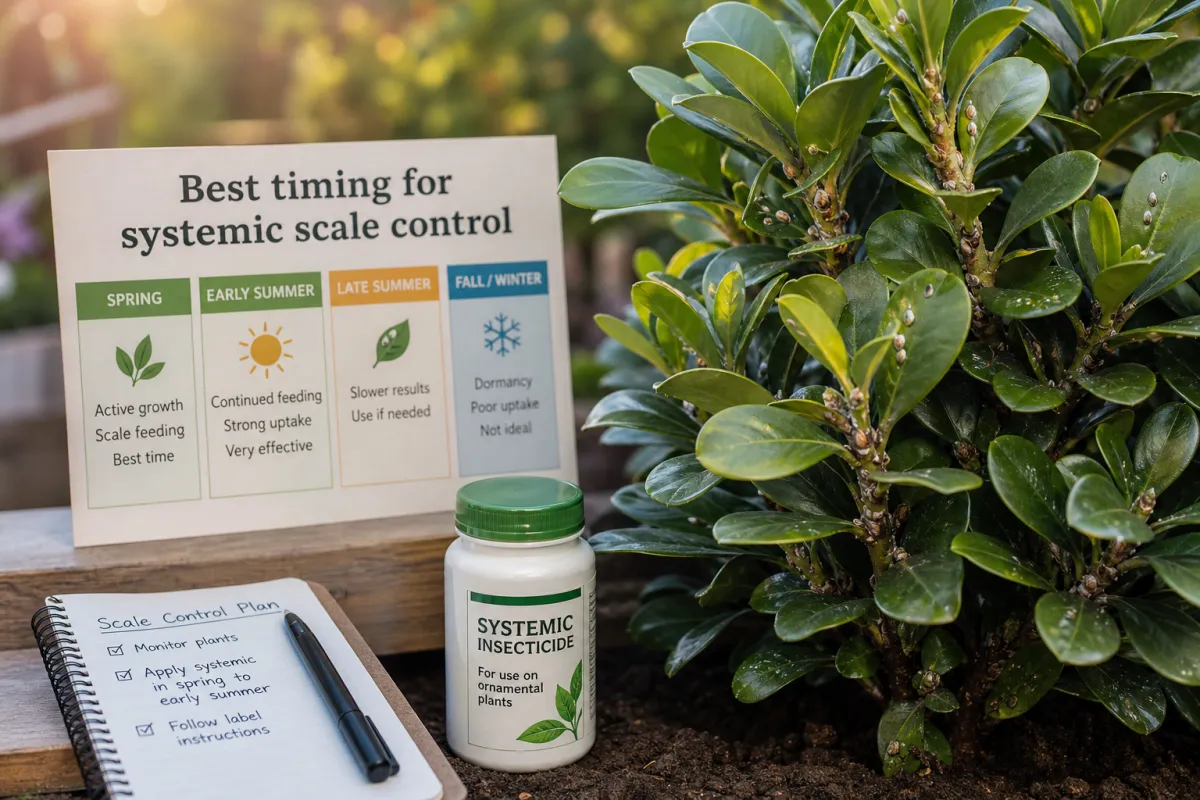
The most effective timing is usually when the plant is actively growing and scale insects are feeding. For many outdoor plants, this means spring through early summer, once leaves have expanded and roots are taking up water steadily. Late-season applications may be slower, especially as temperatures drop below 10°C (50°F) or plants begin to harden off for dormancy.
Match timing to scale biology
Systemic products are not instant knockdowns, so waiting until leaves are black with sooty mold or branches are already dying reduces your margin for success. Treat early enough that the plant still has strong sap flow. If you know when crawlers appear in your area, time treatment so active ingredient is present as new generations begin feeding.
- For indoor plants, spring and early summer are often best because light levels and growth are improving.
- For evergreen shrubs, treat when soil is warm and the plant is not drought-stressed.
- For deciduous plants, avoid applying after leaf drop because uptake will be limited.
- Do not apply immediately before heavy rain if the product could move off-site or out of the root zone.
Soil temperature matters as much as air temperature. Roots in cold, wet soil absorb slowly even if the afternoon air feels mild. In containers, uptake often improves when the potting mix stays in the plant’s preferred range, commonly 18–24°C (64–75°F) for many tropical houseplants.
Practical observation: sticky honeydew may continue for 10–21 days after treatment because surviving insects and old residue are still present. Mark the treatment date on a tag or calendar; judging too early often leads to unnecessary repeat applications.
How plant size affects dosage and treatment speed
Plant size strongly affects both the legal dose and the time needed for visible results. Systemic labels may base dosage on pot diameter, shrub height, trunk circumference, or soil area. Guessing is risky: underdosing may fail, while overdosing can injure plants, increase residues, and create unnecessary environmental exposure.
Containers and houseplants
For potted plants, measure the container across the top from rim to rim. A 15 cm (6 in) pot and a 30 cm (12 in) pot may require very different amounts even if the plants look similar above the soil. If a plant is root-bound, uptake can be uneven because water runs around the root mass. Repotting into fresh, well-drained mix may be more useful than increasing pesticide strength.
Shrubs and trees
Woody plants take longer because the treated solution must move through a much larger vascular system. A small 60 cm (24 in) shrub may show reduced honeydew within a few weeks, while a mature tree can take a month or more. Trunk diameter also matters because bark thickness, canopy volume, and root distribution all influence movement.
- Measure before mixing; do not estimate from memory.
- Use the label’s measuring method, not a different size calculation.
- Calibrate watering cans or sprayers so you know whether they hold 1 L (34 fl oz), 2 L (68 fl oz), or another amount.
- Treat each plant individually rather than mixing one strong batch for a whole row.
Large plants with severe infestations may need integrated care: pruning dead wood, improving irrigation, washing honeydew from leaves, and monitoring crawlers. A systemic product can reduce feeding pressure, but it cannot rebuild a canopy that has been weakened for several seasons.
Restrictions for flowering and edible plants
Restrictions are especially important on plants that bloom, produce food, or are visited by pollinators. Many systemic insecticides can move into nectar, pollen, leaves, fruit, or sap depending on the active ingredient and application method. The label is the legal authority: if the product is not labeled for an edible crop, do not use it on that crop, even if the pest appears on the label for ornamentals.
Flowering ornamentals
Avoid applying systemic insecticides to plants in bloom or just before bloom unless the label specifically allows it and pollinator risk is addressed. This is particularly important for bee-attractive plants such as citrus, linden, lavender, salvia, roses, camellia, and many native shrubs. If flowers are present on a non-food ornamental and treatment is unavoidable, removing blooms before application may reduce immediate pollinator exposure, but it does not override label restrictions.
Edible plants
Vegetables, herbs, fruit trees, and citrus require extra caution. Some systemics have long pre-harvest intervals or are not permitted for home edible use. A product sold for ornamental houseplants may not be appropriate for a potted lemon, bay laurel, rosemary, or chili pepper. When in doubt, choose non-systemic options, physical removal, pruning, or crop-specific products with clear edible-plant directions.
- Check whether the exact crop is listed, not just the pest.
- Follow the pre-harvest interval if one is given, such as 7, 14, or 30 days.
- Do not compost treated edible leaves unless the label allows disposal that way.
- Keep treated ornamentals separate from herbs or salad greens where water runoff could collect.
Editor’s caution: many gardeners think “houseplant systemic” means “safe indoors on anything in a pot.” It does not. A decorative ficus and a dwarf lime may sit side by side, but the legal uses and residue concerns can be completely different.
Pollinator, pet and environmental precautions
Systemic insecticides deserve careful handling because their value is also their risk: they persist long enough to be taken up by the plant. The goal is to keep the active ingredient in the target plant and out of flowers, waterways, bare patios, pet areas, and beneficial insect habitat. Read the label before buying, again before mixing, and again before storing or disposing of leftovers.
Protecting bees and beneficial insects
Pollinator protection starts with plant choice and timing. Do not treat blooming plants that are actively attracting bees, hoverflies, butterflies, or other pollinators. Be careful around plants with extra-floral nectar or honeydew-producing pests that attract beneficial insects. Ants tending soft scale may also move through treated areas, so manage ants with baits or barriers rather than broad spraying whenever possible.
Pets, children, and household safety
Keep pets and children away during application and until the treated area is dry or as long as the label specifies. With granules, the concern is not only wet foliage but also exposed particles on the soil. For indoor pots, avoid applying on kitchen counters, dining tables, or near aquariums. Measure and mix outdoors or in a ventilated utility area when possible.
- Wear the protective gear listed on the label, which may include gloves, long sleeves, and eye protection.
- Do not pour leftover drench into sinks, storm drains, ponds, or street gutters.
- Water in only as directed; excessive irrigation can push product below the active root zone.
- Store pesticides in their original container, away from heat, food, pet supplies, and children.
- Never use agricultural or professional concentrates indoors unless the label explicitly permits that use.
Environmental care also includes cultural prevention. Healthy plants with correct light, spacing, irrigation, and pruning are less likely to develop chronic scale outbreaks. Overfertilizing with high-nitrogen feeds can produce soft, pest-prone growth, so feed moderately and avoid forcing weak plants into rapid growth.
Combining systemic and contact treatments
Systemic and contact treatments can complement each other when used thoughtfully. The systemic reduces hidden or ongoing feeding, while contact methods remove exposed insects, crawlers, honeydew, and sooty mold. This combined approach is often better than repeating one method until the plant is stressed or residues build up.
Start with physical cleanup
Before applying any insecticide, prune dead twigs, remove heavily infested leaves if the plant can spare them, and wipe stems where practical. On outdoor shrubs, a firm water spray can dislodge crawlers and wash away honeydew. For detailed outdoor sanitation and pruning strategy, see guidance on removing scale outdoors.
Use contact products where they add value
Horticultural oils, neem-based products, and soaps work by contacting the pest, so coverage and timing matter. They are especially useful against crawlers and exposed soft-bodied stages. If you use neem, follow temperature and plant-sensitivity precautions; guidance on using neem oil safely is relevant because the same burn risks apply to many scale treatments.
Soap sprays can help with young crawlers but may spot tender foliage or stressed plants. Test a small area first, especially on ferns, palms, succulents, and plants under high light. A practical reference on insecticidal soap can help you understand why direct contact and repeat coverage are essential.
- Do not apply oil or soap to drought-stressed plants; water appropriately and wait until foliage is no longer wilted.
- Avoid spraying oils when temperatures exceed 29°C (85°F) or when strong sun could cause leaf burn.
- Space treatments according to labels; mixing multiple pesticides on the same day can increase phytotoxicity.
- Do not assume “natural” contact sprays are harmless to beneficial insects when sprayed directly.
The best combinations are planned, not improvised. For example, you might apply a labeled systemic drench to a large soft-scale-infested shrub, then use a water wash and selective oil treatment two to three weeks later if crawlers are still active. Always check product compatibility and label restrictions before combining methods.
How to judge whether the treatment succeeded
Success is measured by new pest activity, not by whether every old bump disappears. Scale covers and dead bodies can remain attached long after the insects stop feeding. A treated plant may look unchanged at first, but honeydew should decline, new growth should emerge cleaner, and crawler numbers should drop over time.
What to inspect
Check the same branches or leaves each time so you are comparing like with like. Use a hand lens if possible, especially for crawlers that may be only 1–2 mm (0.04–0.08 in) long. Press a few scale insects gently; dead soft scale is often dry or hollow, while live ones may be moist. On armored scale, lift a cover and look for a plump body underneath rather than judging from the shell alone.
- Less sticky honeydew on leaves, floors, cars, or patio furniture.
- Reduced ant activity around stems and branch tips.
- Fewer crawlers on tape traps, white paper taps, or inspected leaf undersides.
- Clean new leaves that are not quickly colonized.
- No further twig dieback after watering and light problems have been corrected.
When to reassess
For small, actively growing plants, reassess after 3–4 weeks. For large shrubs and trees, allow 6–8 weeks before deciding the treatment failed, unless the plant is rapidly declining. If the infestation is unchanged after the expected interval, revisit the basics: species identification, label match, dose measurement, soil moisture, plant health, and whether the product was applied to the active root zone.
A second application should never be automatic. Many systemic labels limit how often a product can be used per year, and repeated use of the same active ingredient can encourage resistance. If treatment did not work, the better next step may be changing tactics: prune more aggressively, target crawlers with oil, manage ants, improve plant vigor, or ask a local extension office or certified arborist to confirm the scale species.