Potting Soil & Mix Calculator for Any Pot Size

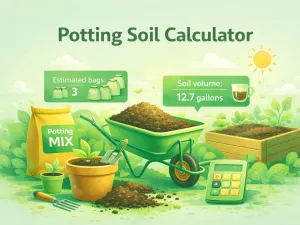
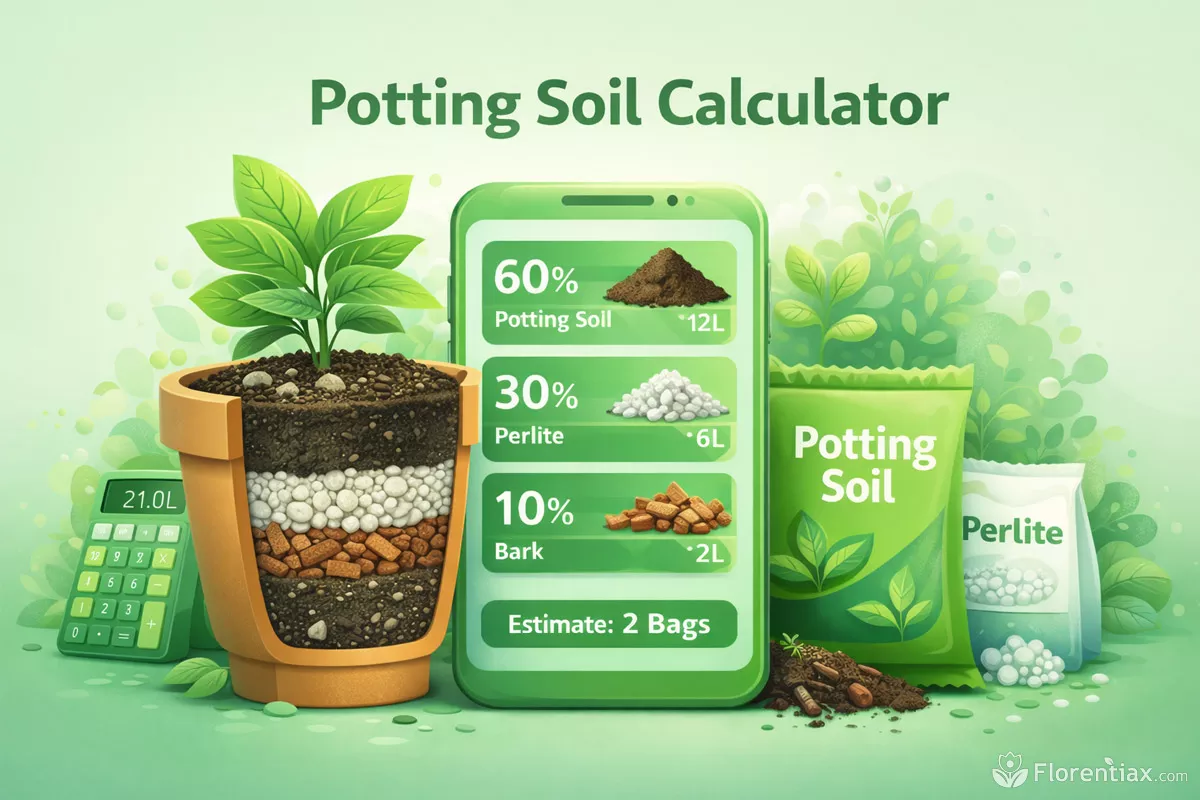 This potting soil and mix calculator shows exactly how much soil you need based on pot shape, inner dimensions, and quantity. Choose a ready recipe for houseplants, aroids, succulents, or orchids, or set custom mix percentages. The tool converts totals into liters (L), cubic feet (cu ft), and gallons (gal), and estimates bag counts for each soil component.
- What Is a Potting Mix Calculator?
- How to Use the Potting Mix Calculator
- Pot Volume and How to Measure Pots
- Soil Mix Recipes and Ratios
- Optional Additives: When Charcoal Makes Sense
- How to Mix Potting Soil Components
- How the Bag Estimate Works
- Example Potting Mix Calculations
- Common Soil Mixing Mistakes to Avoid
- Frequently Asked Questions
This potting soil mix calculator helps you figure out exactly how much potting soil and mix you need based on pot shape, inner dimensions, and quantity. As a practical potting soil calculator, it lets you choose a ready recipe or set custom soil mix ratios to get a clear component breakdown and bag estimates in liters (L), cubic feet (cu ft), and gallons (gal).
What Is a Potting Soil Mix Calculator?
A potting soil mix calculator helps you determine exactly how much soil and mix you need for repotting one or many plants using a repotting calculator. It calculates the internal volume of your containers based on their shape and dimensions, then splits that volume into individual components using either a ready-made recipe or your own custom mix.
This solves three common problems at once: underestimating soil volume, mixing incorrect ratios, and buying the wrong amount of materials. Instead of guessing, you get clear numbers you can use immediately when preparing or purchasing your mix.
| Problem | How the calculator helps |
|---|---|
| Not sure how much soil fits in a pot | Calculates internal container volume based on shape and size |
| Mix ratios feel confusing or inconsistent | Splits total volume into clear component amounts by percentage |
| Repotting many plants at once | Combines all pots into one total volume automatically |
| Buying too much or too little material | Estimates how many bags are needed for each component |
| Switching between metric and US units | Shows results in liters, cubic feet, and gallons |
How to Use the Potting Mix Calculator
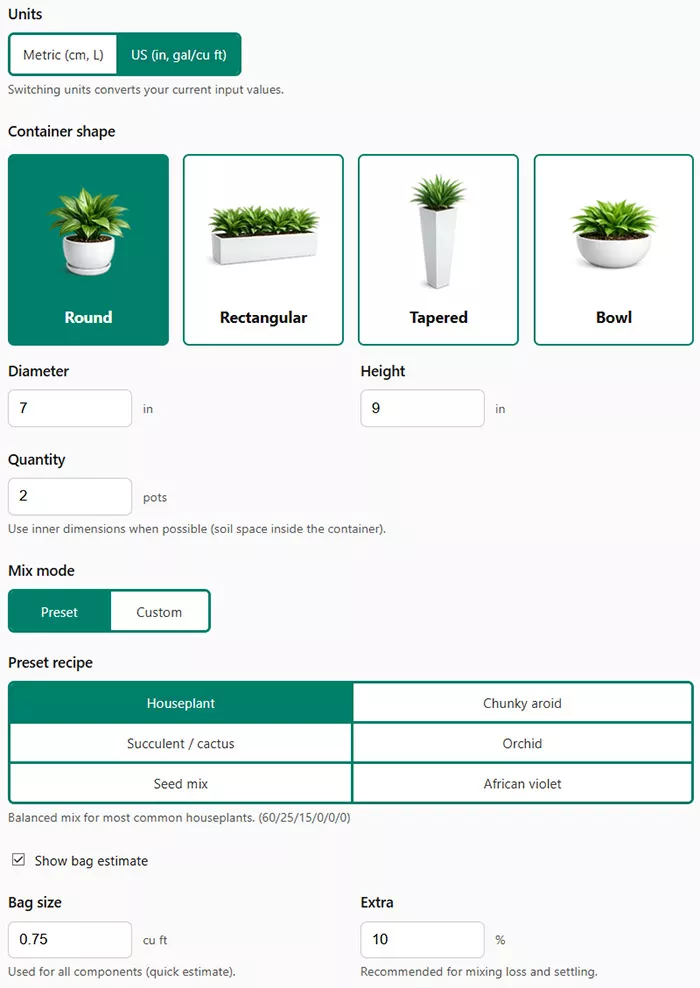
The potting soil calculator follows the same logic you would use when mixing soil by hand, but removes the guesswork. This free tools helps you define container volume first, then decide how the mix should be composed.
- Choose the unit system — Metric or US, depending on how your pots and soil bags are labeled.
- Select the pot shape — Round, rectangular, tapered, or bowl-shaped containers use different volume formulas.
- Enter inner dimensions — Measure the actual soil space inside the pot, not the outer walls or decorative rim.
- Set the number of pots — Useful when preparing one large batch for multiple plants.
- Select a mix mode — Use a preset recipe for common plant types or enter your own percentages.
- Review the results — Use the total volume for planning and the component list for mixing or shopping.
Many gardeners use this tool simply as a potting soil calculator to plan soil volume before repotting or buying materials.
| Input type | Why it matters |
|---|---|
| Inner pot dimensions | Outer measurements can overestimate volume and waste materials |
| Pot shape | Different shapes hold very different soil volumes at the same height |
| Preset recipes | Provide proven ratios for common plant groups |
| Custom percentages | Allow precise control when following a specific mix formula |
| Bag estimate option | Helps plan purchases without manual conversion |
Pot Volume and How to Measure Pots
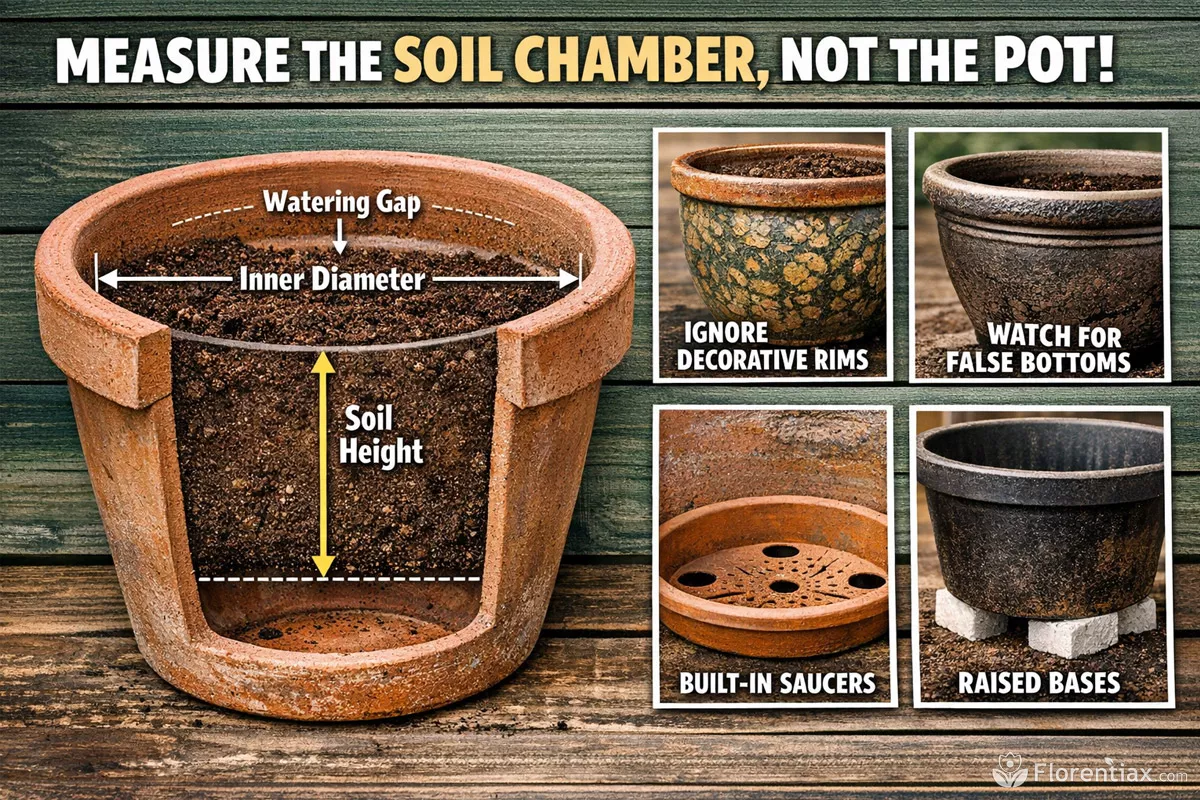
This calculator is only as accurate as your measurements. The goal is not the “pot size on the label”, but the fillable soil space inside the container. If you measure outer walls or full depth to the bottom, you will overestimate volume and buy too much mix.
Measure the soil chamber, not the pot:
- Inner diameter / inner length / inner width — measure from inside edge to inside edge where soil will sit.
- Soil height — measure only the depth you will actually fill with mix, not the full pot depth. Leave a watering gap at the top.
- Ignore decorative rims — thick ceramic walls and wide lips do not add soil volume.
- Account for false bottoms — drainage domes, built-in saucers, and raised bases reduce fillable depth.
| Shape to choose | When it fits | Measure these (inside) | Most common input mistake | Fix that works |
|---|---|---|---|---|
| Round | Straight sides, top and bottom are close in diameter | Diameter + soil height | Using outside diameter or full depth | Measure inside diameter and fill height only |
| Rectangular | Planter boxes, troughs, window boxes | Length + width + soil height | Measuring the top opening while the inside narrows | Measure the inside base area where soil actually sits |
| Tapered | Most decorative pots: top wider, bottom clearly smaller | Top diameter + bottom diameter + soil height | Entering as Round (overestimates volume) | If bottom is smaller — always use tapered |
| Bowl | Low, wide, shallow planters (dish gardens) | Diameter + soil height (shallow layer) | Entering too much height “because the pot is deep” | Use real soil layer thickness you plan to fill |
Two quick sanity checks before you buy materials:
- If one “small” pot suddenly needs multiple large bags, your height is overstated or the pot should be tapered.
- If you are repotting around an existing root ball, you usually need less than the full pot volume because the root ball occupies space.
Soil Mix Recipes and Ratios
With a potting soil mix calculator, planning recipes becomes much easier because everything is calculated in percentages by volume. Once you know your total mix volume, the potting soil calculator splits it into components so you can prepare or purchase materials without guesswork.
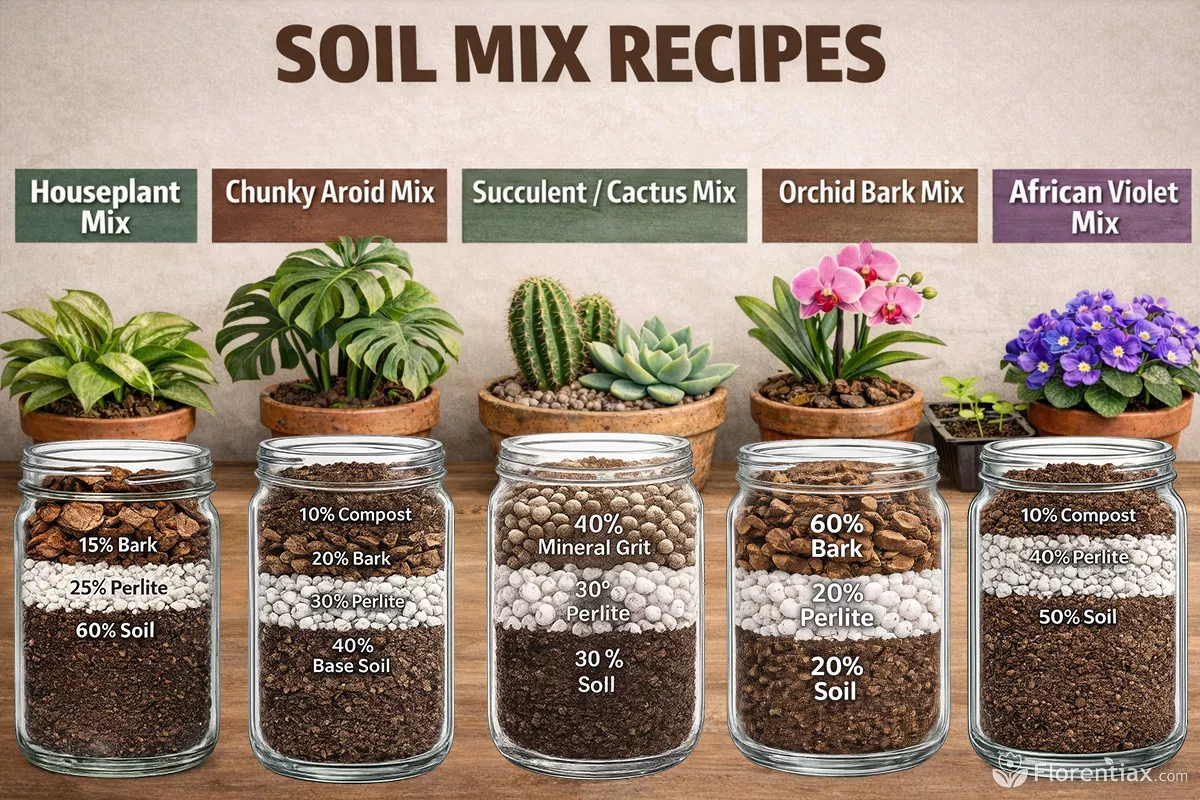
Simple rule: keep your recipe to 2–4 components. Too many small ingredients usually makes the mix inconsistent and hard to reproduce.
| Recipe | Best for | Base (soil / coco) | Aeration (perlite / pumice) | Bark | Compost / castings | Mineral grit / sand |
|---|---|---|---|---|---|---|
| Houseplant (balanced) | Most foliage houseplants, general repotting | 60% | 25% | 15% | 0% | 0% |
| Chunky aroid | Monstera, philodendron, anthurium (airier roots) | 40% | 30% | 20% | 10% | 0% |
| Succulent / cactus | Succulents, cactus, very fast drying setups | 30% | 30% | 0% | 0% | 40% |
| Orchid (bark-forward) | Many orchids and epiphytes that need airflow | 20% | 20% | 60% | 0% | 0% |
| Seed mix | Starting seeds, small cuttings, fine roots | 70% | 30% | 0% | 0% | 0% |
| African violet | Violets and similar plants that like airy mix | 50% | 40% | 0% | 10% | 0% |
How to choose quickly:
- If you want “works for most plants” — start with Houseplant.
- If roots need lots of air and you hate soggy soil — choose Chunky aroid.
- If your plant rots easily or you water too often — choose Succulent / cactus.
- If you grow bark-loving orchids — choose Orchid (bark-forward).
- If you start seeds — choose Seed mix (no big bark chunks).
Custom ratios (without mistakes): your percentages must add up to 100%. Think in roles, not ingredients:
- Base holds moisture and nutrients (soil or coco).
- Aeration creates air pockets and prevents compaction (perlite or pumice).
- Bark adds chunkiness and structure (especially for aroids and orchids).
- Mineral grit speeds drying and adds weight (useful for succulents).
Fast custom templates you can copy:
- Water-holding (dry home / small pots): Base 65–75%, Aeration 20–30%, Bark 0–10%.
- Airy (aroids / overwatering risk): Base 35–45%, Aeration 25–35%, Bark 20–35%, Compost 0–10%.
- Fast-drying (succulents): Base 20–35%, Aeration 20–35%, Mineral 30–50%.
- Bark-heavy (many orchids): Bark 50–70%, Base 10–30%, Aeration 10–30%.
Practical tweaks that actually help:
- If your mix stays wet too long — shift 10% from Base to Aeration (or Mineral for succulents).
- If the mix dries too fast — shift 10% from Aeration/Bark to Base.
- If the pot feels unstable or top-heavy — add 10–20% Mineral grit (or use heavier pumice instead of perlite).
- If you use dusty perlite — rinse it, otherwise it coats the mix and reduces airflow.
Optional Additives: When Charcoal Makes Sense
Charcoal is not included in the standard recipes above because it is not required for most houseplants. In practice, it is an optional additive used only in specific situations, not a default component.
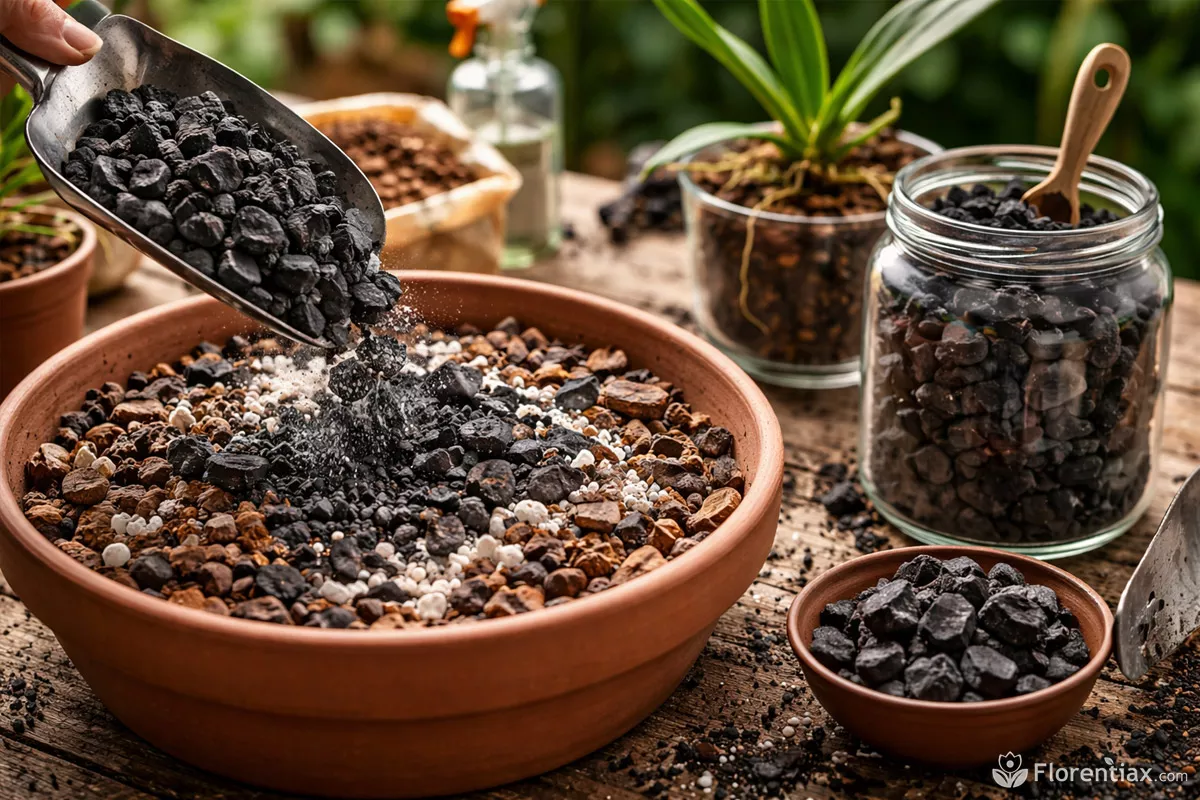
What charcoal actually does
Horticultural charcoal (or biochar) is a porous, carbon-based material. It does not improve drainage by itself and does not replace aeration components like perlite or bark. Its main roles are odor control, minor moisture buffering, and long-term structural stability in very airy mixes.
When charcoal can be useful
- Orchid and epiphyte mixes — small amounts (5–10%) can help stabilize bark-heavy blends.
- Terrariums or closed containers — helps reduce odor and slow organic breakdown.
- Semi-hydro or very chunky setups — used as a structural filler, not as soil.
When charcoal is unnecessary
- Standard houseplant mixes with soil and perlite.
- Seed-starting mixes.
- Succulent mixes that already rely on mineral grit.
How much to use (if at all)
If you choose to use charcoal, treat it as part of the structure, not nutrition. Typical ranges are 5–10% by volume, replacing a portion of bark or aeration — never the base soil.
How to Mix Potting Soil Components (No Layers)
All recipe ingredients are meant to be mixed evenly before potting so the root zone behaves predictably and supports how roots grow through the entire container. If you see “layered jar” visuals, treat them as a volume guide only — they show percentages, not the order you should place materials inside a pot.
Mixing rule: one uniform blend
For any recipe (soil, perlite, bark, compost, grit), the correct method is simple: measure by volume, combine everything in one container, then mix until the texture looks consistent. A uniform blend gives even drainage, even airflow, and consistent moisture throughout the root zone.
Why layering inside the pot is a common mistake
Many people assume coarse materials should be placed at the bottom or that bark should sit on top. In practice, layering creates sharp boundaries that change how water moves. Water tends to perch above a fine-to-coarse boundary, and roots often stall at layer transitions. The result can be an uneven wet zone and an uneven dry zone inside the same pot.
Should bark be mixed or placed as a layer?
Bark belongs in the mix. Bark works by creating air pockets throughout the root zone. If you keep bark as a layer, most of the pot becomes a finer, denser zone while bark sits separately and dries faster. Mixed bark distributes airflow evenly and helps the whole pot drain more predictably.
Do I need a “drainage layer” at the bottom?
In most cases, no. A drainage layer reduces usable soil volume and does not improve drainage the way people expect. What matters is having drainage holes and a mix with the right balance of base and aeration for your plant and pot type.
When it is okay to put something on top
Only treat a top layer as optional finishing, not part of the recipe. A thin top dressing can be used for appearance or minor moisture control, but it should not replace proper mixing:
- Decorative mulch: a thin layer of bark or stones for looks.
- Top dressing: a small amount of compost or castings added after potting as a light surface refresh.
Quick Q&A (most common confusion)
- Do I mix everything in one pile? Yes. Combine all recipe components and mix evenly before filling the pot.
- Should perlite go on the bottom? No. Perlite is an aeration component and should be distributed throughout the mix.
- Should bark be only on top? No. Bark should be mixed in so airflow is spread through the root zone.
- Why do jar images show layers then? To visualize volume percentages. They are a planning reference, not a planting method.
How the Bag Estimate Works
The bag estimate feature of the potting soil calculator helps you plan purchases before mixing. Instead of converting volumes manually, the potting soil mix calculator divides the required mix volume by your chosen bag size and rounds up.
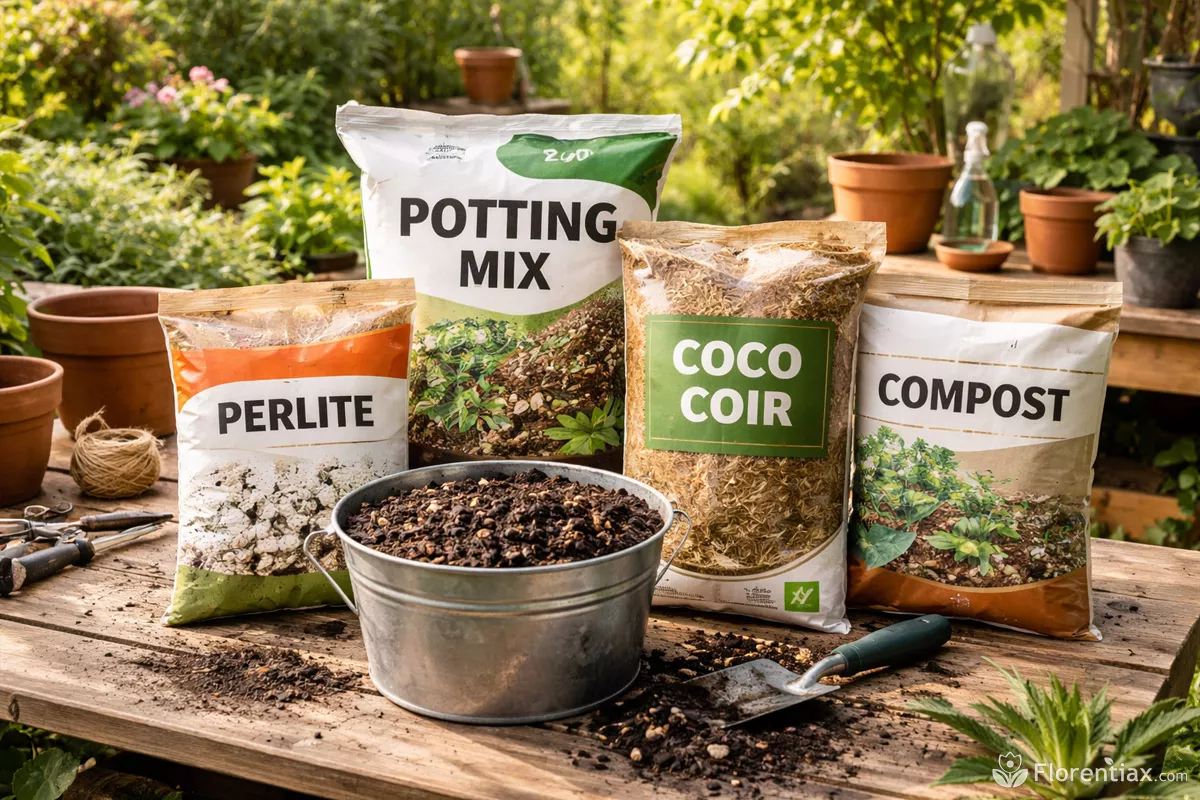
This is a planning estimate, not a packing guarantee. Potting materials vary in compression, particle size, and moisture content, which affects how much usable volume you get from each bag.
| Factor | What it affects | What to do |
|---|---|---|
| Bag size (L / cu ft) | Final bag count | Match the size sold in your local store (for example 20 L or 0.75 cu ft) |
| Extra percentage | Buffer for settling and loss | Add 5–15% for most mixes |
| Material type | Real usable volume | Expect less volume from fine or moist mixes |
| Chunky components | Air gaps between particles | Bark and pumice usually give closer-to-label volume |
When to add extra volume:
- You are mixing dry coco coir that will expand after wetting.
- You use fine compost or peat-based soil that compresses easily.
- You are filling tall or narrow pots where settling is noticeable.
When extra is less important:
- Very chunky mixes with bark, pumice, or lava rock.
- Shallow planters where soil depth is small.
As a rule of thumb: for normal houseplant mixes, 10% extra is a safe default.
Example Potting Mix Calculations
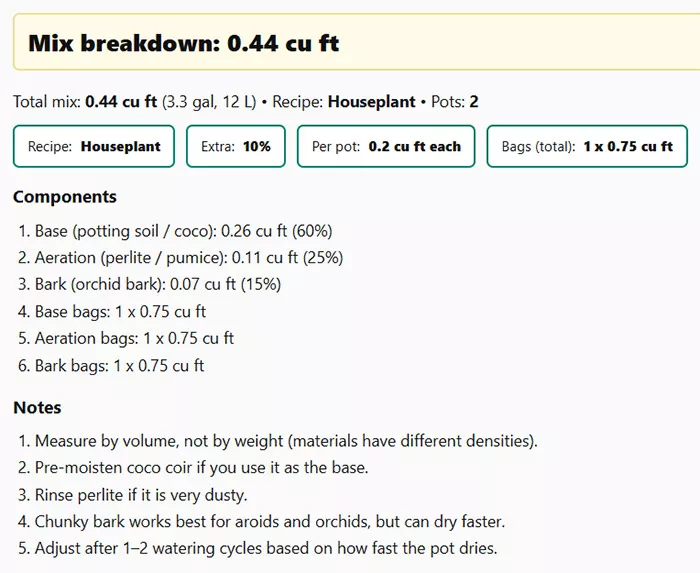
The examples below show how the calculator translates pot dimensions into total mix volume and then into component amounts. Dimensions and volumes are shown in both metric and US units.
| Scenario | Input | Total mix needed | Result breakdown |
|---|---|---|---|
| Single round pot | 20 cm (7.9 in) diameter × 18 cm (7.1 in) soil height | ≈ 5.6 L (0.20 cu ft / 1.5 gal) | Houseplant mix: base 3.4 L, aeration 1.4 L, bark 0.8 L |
| 3 tapered ceramic pots | Top 22 cm (8.7 in), bottom 16 cm (6.3 in), height 18 cm (7.1 in) | ≈ 13.5 L (0.48 cu ft / 3.6 gal) | Chunky aroid: base 5.4 L, aeration 4.1 L, bark 2.7 L, compost 1.3 L |
| Succulent bowl planter | 30 cm (11.8 in) diameter × 10 cm (3.9 in) soil depth | ≈ 7.0 L (0.25 cu ft / 1.9 gal) | Succulent mix: base 2.1 L, aeration 2.1 L, mineral 2.8 L |
| Rectangular window box | 60 × 20 × 18 cm (23.6 × 7.9 × 7.1 in) | ≈ 21.6 L (0.76 cu ft / 5.7 gal) | Seed mix: base 15.1 L, aeration 6.5 L |
How to read these results:
- Start with the total mix volume (liters or cubic feet).
- Use the component volumes when scooping or measuring by container.
- Use the bag estimate only for shopping, not for precise mixing.
If your real-world mix looks slightly off after filling the first pot, adjust before filling the rest — small corrections early prevent big waste later.
Common Soil Mixing Mistakes to Avoid
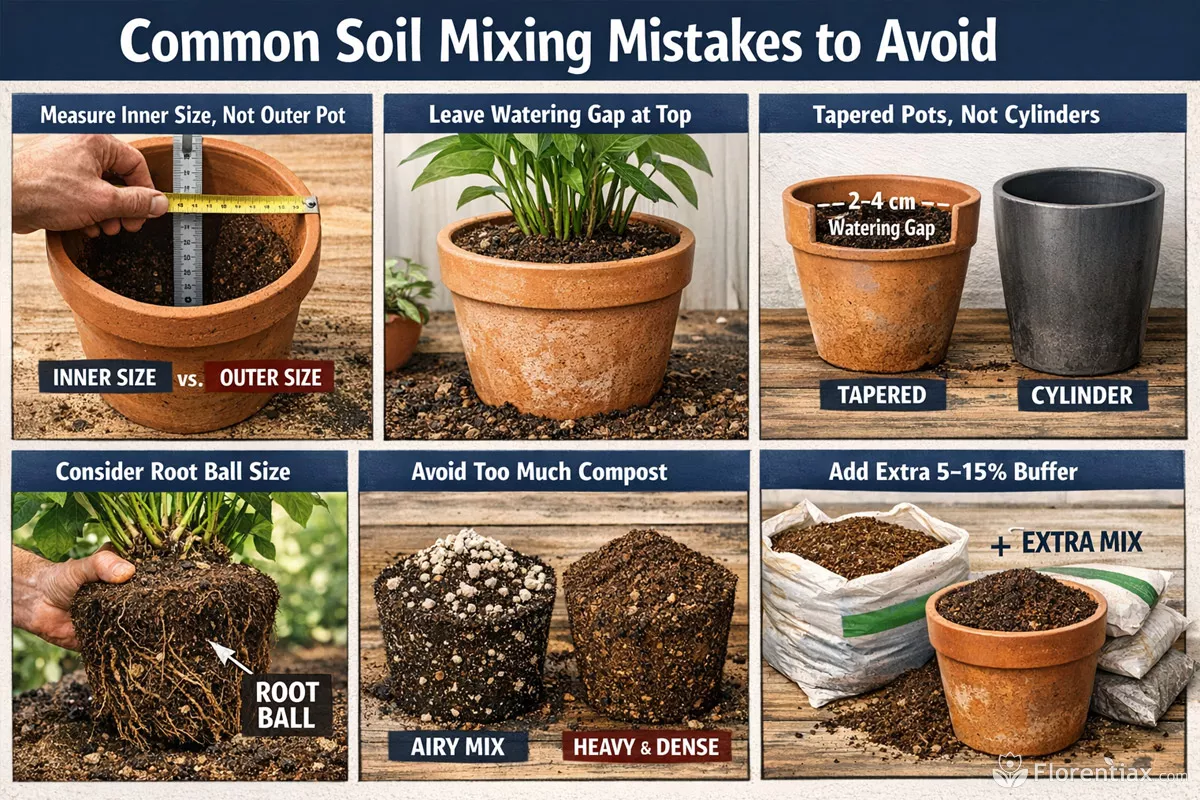
Most problems with potting mix come from small planning mistakes, not from the recipe itself. Fixing these early saves soil, money, and plant stress.
- Measuring outer pot size instead of inner space. This overestimates volume, especially with thick ceramic walls. Always measure the soil chamber inside the pot.
- Using full pot depth as soil height. Pots need a watering gap at the top. Subtract about 2–4 cm (0.8–1.5 in) from the total depth to get real soil height.
- Entering a tapered pot as round. Decorative pots are usually narrower at the bottom. Treating them as cylinders can inflate volume by 15–35%.
- Ignoring the root ball when repotting. The calculator gives full pot volume. If a large root ball is already inside, you will need less mix than the total value.
- Overloading the mix with fine materials. Too much compost or peat compresses over time, reduces airflow, and increases the risk of overwatering.
- Skipping a buffer when buying materials. Some mixes settle after watering. Adding 5–15% extra volume prevents running short mid-repot.
If drainage and aeration are off, early symptoms often include leaf yellowing before root damage becomes visible.
Quick fix mindset: if soil stays wet too long, reduce the base and increase aeration. If it dries too fast, shift volume back toward the base.
Frequently Asked Questions
This section answers the most common questions about pot measurements, soil volume, mix ratios, and real-world use of the calculator. These clarifications help avoid typical mistakes when planning and mixing potting soil.
1. Should I measure pots in centimeters or inches?
You can use either system. Measure pots in centimeters (cm) or inches (in), depending on what is printed on your pots or what tool you have. The calculator converts everything automatically and shows results in liters (L), cubic feet (cu ft), and gallons (gal).
2. Should I measure the inside or outside of the pot?
Always measure the inside of the pot. Outer dimensions include wall thickness, decorative rims, and lips that do not hold soil. Using outer measurements can overestimate soil volume, especially with ceramic and clay pots.
3. What height should I use for soil depth?
Use the height of the soil layer you actually plan to fill, not the full pot depth. Leave a watering gap at the top — usually about 2–4 cm (0.8–1.5 in) — to prevent overflow during watering.
4. Why does a tapered pot need different measurements?
Tapered pots are wider at the top and narrower at the bottom. Treating them as round cylinders exaggerates volume. Measuring both the top and bottom inner diameters produces a much more realistic soil estimate.
5. Why does the calculator show more soil than I actually used?
The calculator shows total pot capacity. If you are repotting an existing plant, the root ball already occupies space. In that case, you will need less mix than the full calculated volume.
6. Is potting mix measured by weight or by volume?
Potting mix is measured by volume, not weight. Materials like perlite, bark, and coco coir have very different densities, so weight-based measurements are unreliable for mixing.
7. How accurate are bag size labels?
Bag labels such as 20 L or 0.75 cu ft are approximate. Moisture content, compression, and particle size can reduce usable volume. Fine or wet mixes usually provide slightly less usable soil.
8. How much extra soil should I plan for?
For most houseplant mixes, adding 5–15% extra volume is sufficient. This covers settling after watering and small losses during mixing. Chunky mixes usually need less extra than fine mixes.
9. Can I use the same mix for all plants?
A general houseplant mix works for many plants, but not all. Succulents, orchids, and aroids often need different drainage and airflow. Preset recipes provide a safe starting point for these groups.
10. Does pot material affect the soil mix?
Yes. Plastic pots retain moisture longer and often benefit from more aeration. Unglazed clay or terracotta pots dry faster and may need a higher proportion of base material to hold moisture.
11. Can I reuse old potting mix?
You can reuse old mix if it is disease-free, but it should be refreshed. Add new base material and aeration components, as reused mix is usually compacted and drains poorly on its own.
12. What if my plant still dries too fast or stays wet too long?
Adjust your recipe gradually and reassess how often to water before changing the entire mix. Shift 5–10% of volume between base and aeration components rather than changing everything at once. Small adjustments are easier to control and observe over time.