Pot Size Calculator for Repotting Plants

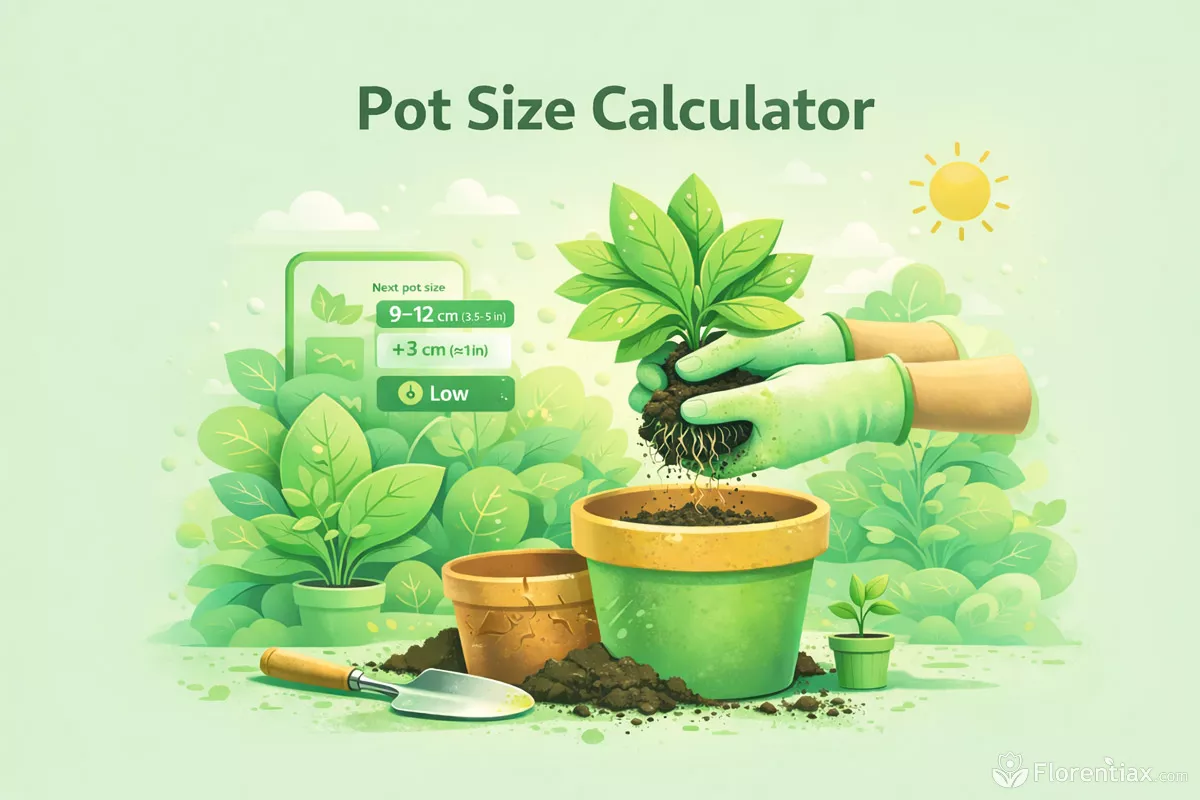 This guide explains how the Pot Size Calculator for Repotting Plants works and how to use it correctly. Learn how to enter your current pot size, choose plant and soil settings, and interpret the recommended next pot range and risk level. You will also find practical repotting advice, common mistakes to avoid, and clear answers to popular questions about repotting indoor plants, flowers, and small trees.
Choosing the correct pot size is one of the most important factors for healthy plant growth, yet it is also one of the most misunderstood. This pot size calculator for plants suggests a safe next pot size for repotting, helping you avoid overwatering and keep roots growing steadily.
How the calculator works
The Pot Size Calculator for Repotting Plants evaluates several biological and environmental factors to recommend a safe container size increase. Instead of using a fixed rule, it adapts the result based on plant growth rate, soil moisture retention, root density, container material, and season.
The main principle behind the calculation is simple: roots need both moisture and oxygen. When a pot is too large, excess soil holds water longer than roots can absorb it. This reduces oxygen levels and may cause root rot, fungal growth, or stalled development. A controlled size increase prevents these issues while still giving roots room to expand.
Core logic behind the recommendation
- Small pots usually increase by about 2–3 cm (≈0.8–1.2 in).
- Medium pots increase by about 3–5 cm (≈1.2–2 in).
- Large containers increase by about 5–8 cm (≈2–3 in).
- Succulents and orchids use smaller jumps because they prefer tighter root zones.
- Fast-growing plants can safely handle slightly larger upgrades.
| Input parameter | What you select | How it affects calculation | Practical meaning |
|---|---|---|---|
| Current pot diameter | Measured top width in cm (in) | Sets baseline size | All recommendations are calculated relative to this value |
| Plant type | Houseplant, succulent, orchid, tree, fast or slow grower | Adjusts growth tolerance | Fast growers can move up faster than slow species |
| Root condition | Light, rootbound, severely rootbound | Changes allowed size jump | Tighter roots can safely move into slightly larger pots |
| Soil type | Fast-draining, balanced, moisture-retentive | Controls moisture safety margin | Water-holding soils require smaller containers |
| Pot material | Plastic, terracotta, ceramic, fabric | Alters evaporation rate | Breathable pots dry faster than sealed ones |
| Watering habits | Careful, average, heavy | Modifies risk tolerance | Heavy watering increases overpotting danger |
| Season | Spring, summer, fall, winter | Adjusts recovery capacity | Plants adapt faster during active growth seasons |
How to use it step-by-step
The tool is designed so that anyone — even a beginner — can determine the correct next pot size in less than a minute. If you’re asking, “What size pot should I use?”, start here and follow the steps exactly. You only need basic information about your plant and its current container.
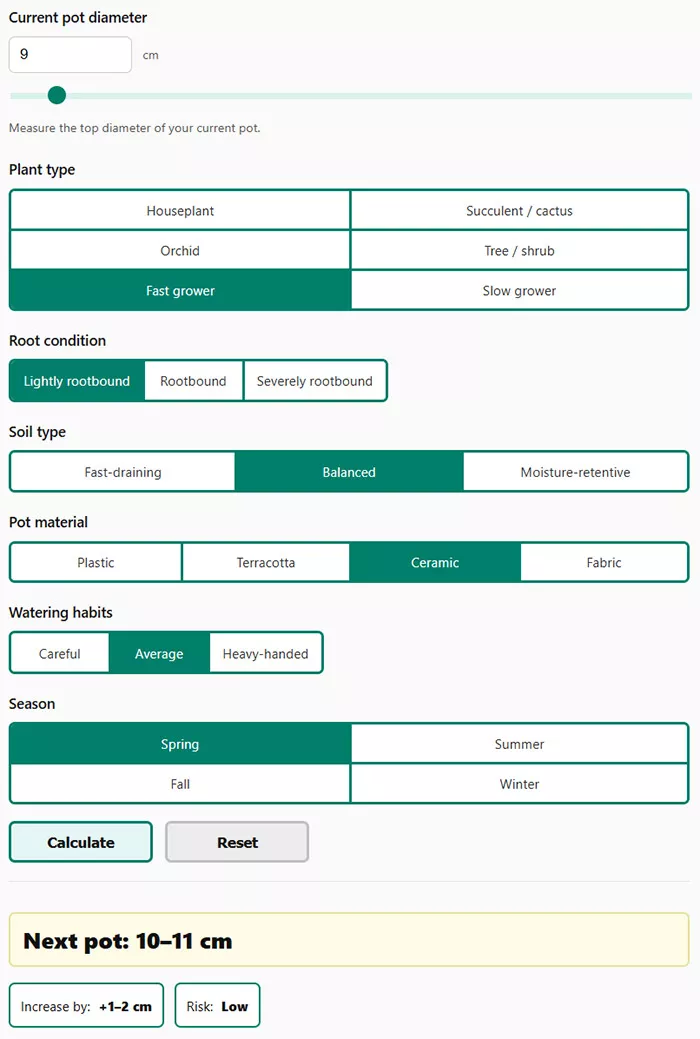
- Select measurement units — choose centimeters (cm) or inches (in).
- Enter current pot diameter — measure across the top rim, not the base.
- Choose plant type — pick the closest growth category.
- Set root condition — estimate whether roots are loose or tightly packed.
- Select soil type — match your potting mix moisture level.
- Pick pot material — different materials affect drying speed.
- Adjust watering habits — be realistic about how often you water.
- Choose season — growth stage affects recovery speed after repotting.
- Click Calculate — the system instantly shows your recommended range.
After calculation, the results panel displays three important indicators:
- Next pot size — the safe diameter range in cm (in).
- Increase by — how much larger the new pot should be.
- Risk level — likelihood of problems if you choose the maximum size.
How to interpret quickly:
- If risk is Low — any size in the range is safe.
- If risk is Medium — choose the smaller end of the range.
- If risk is High — repotting into a smaller upgrade is safer.
When in doubt, always choose the smaller container. Plants usually tolerate slightly tight roots better than excess wet soil, especially indoors where evaporation is slower.
How to interpret results
After you use the pot size calculator for plants, the result panel shows a recommended next container range, a size increase value, and a risk indicator. Understanding these three outputs correctly is essential if you want to choose the right pot size for repotting and avoid common mistakes that slow plant growth. Think of this tool as a pot size recommendation tool: it suggests the safest next pot size, not the biggest pot you can buy.
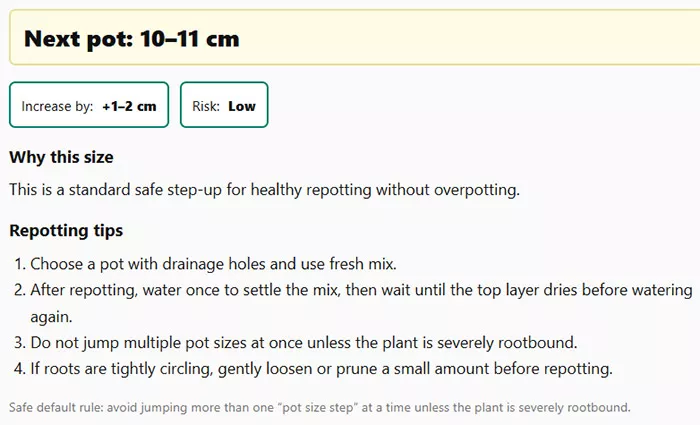
The calculator does not give a single number because plant containers are manufactured in standard size increments. Instead, it suggests a safe diameter range that reflects real-world pot availability and biological limits of root expansion.
Meaning of each result field
- Next pot size — a recommended diameter range in cm (in) that keeps soil moisture balanced.
- Increase by — how much larger your new container should be compared to the current one.
- Risk level — probability of overpotting problems if you choose the upper size.
| Result output | What it means | What you should do | Why it matters |
|---|---|---|---|
| Next pot range | Safe diameter interval in cm (in) | Choose any pot within this range | Prevents oversizing and keeps moisture stable |
| Increase value | Recommended size jump | Match closest standard pot size | Controls root expansion speed |
| Low risk | Safe upgrade | Any size in range is fine | Low chance of root stress |
| Medium risk | Slightly large step | Prefer smaller option | Prevents water retention issues |
| High risk | Oversized container | Choose smaller pot | Reduces risk of root rot |
Important interpretation rule: the calculator shows a safe maximum, not a required size. Many users searching for “what size pot should I use” assume bigger is always better, but in reality the safest choice is usually near the lower end of the suggested range. If your plant is severely rootbound, selecting the upper range is acceptable. Otherwise, choosing a moderate increase ensures faster root adaptation, better drainage balance, and stronger post-repot growth.
For a deeper explanation of what “safe watering” actually looks like in real life, see our guide on balanced soil moisture for healthy root growth and how to keep the root zone lightly moist without staying wet.
When you should repot plants
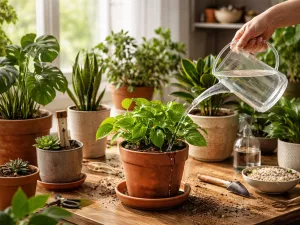
Knowing when to repot plants is just as important as knowing how big the next pot should be. Even the best plant pot size calculator cannot compensate for poor timing. Repotting at the wrong moment can slow growth, damage roots, or cause transplant shock.
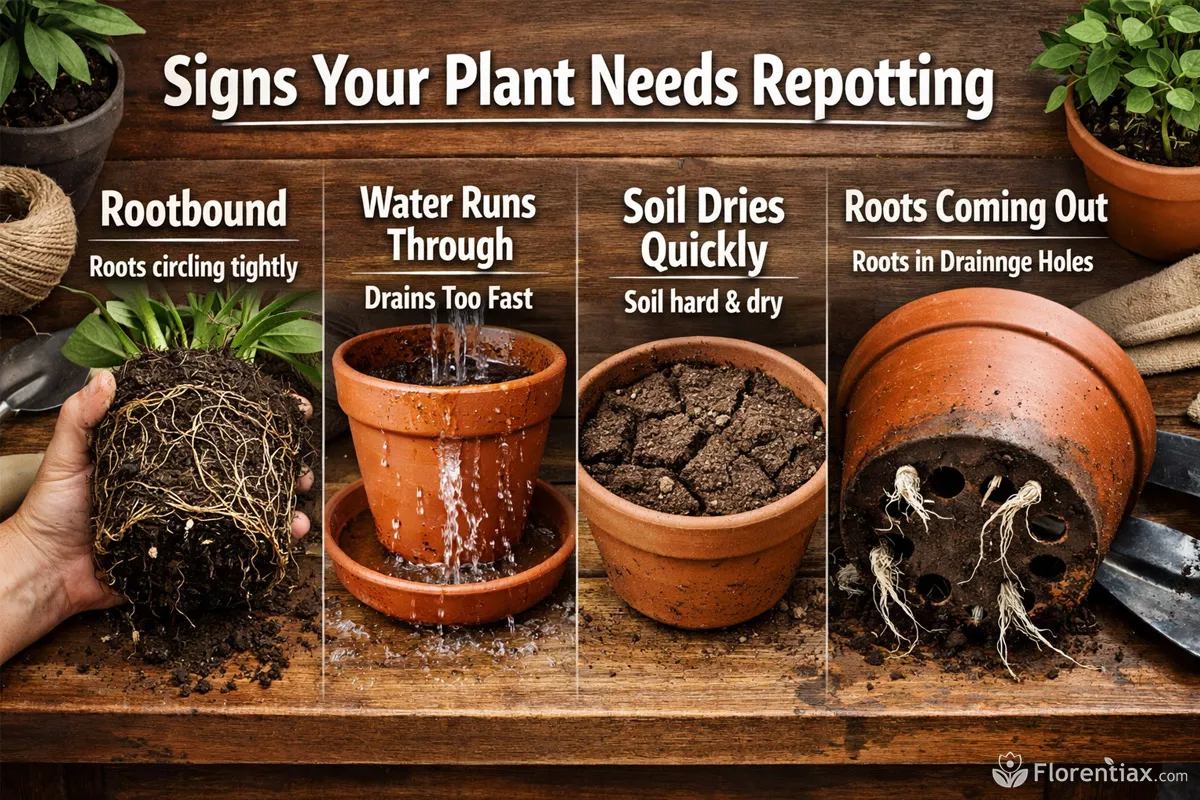
Plants usually signal when they need a new container. Recognizing these signs early allows you to repot before stress occurs while still keeping root development controlled.
Clear signs a plant needs repotting
- Roots circle tightly around the root ball.
- Water runs straight through the pot without absorbing.
- Soil dries out unusually fast.
- Growth slows despite proper light and nutrients.
- Roots emerge from drainage holes.
These symptoms indicate that the root system has filled the available soil volume and can no longer access enough nutrients or moisture.
Best time of year for repotting
The safest period for most plants is early spring or early summer, when active growth begins. During this phase, roots regenerate quickly and adapt to new soil faster. Repotting during winter dormancy is possible, but only when a plant is severely rootbound or soil conditions are poor.
Indoor plant owners often search for “when should I repot houseplants” because timing strongly affects recovery speed. Warm temperatures around 18–26°C (65–79°F) with moderate humidity provide the best conditions for successful repotting.
Choosing the right pot size
Selecting the correct container is the core goal of any repotting pot size calculator. While many growers search for answers like “how big pot does my plant need,” the safest approach is not choosing the largest possible pot, but the most appropriate next size based on root volume, growth rate, and soil behavior.
The general rule used by professionals is simple: increase container diameter gradually, not dramatically. This method keeps soil moisture balanced and prevents roots from sitting in wet substrate for too long.
Safe size progression principle
- Small pots require smaller increases.
- Larger containers can handle slightly bigger jumps.
- Plants with thick roots tolerate more space than delicate-root species.
- Indoor plants usually need smaller upgrades than outdoor plants.
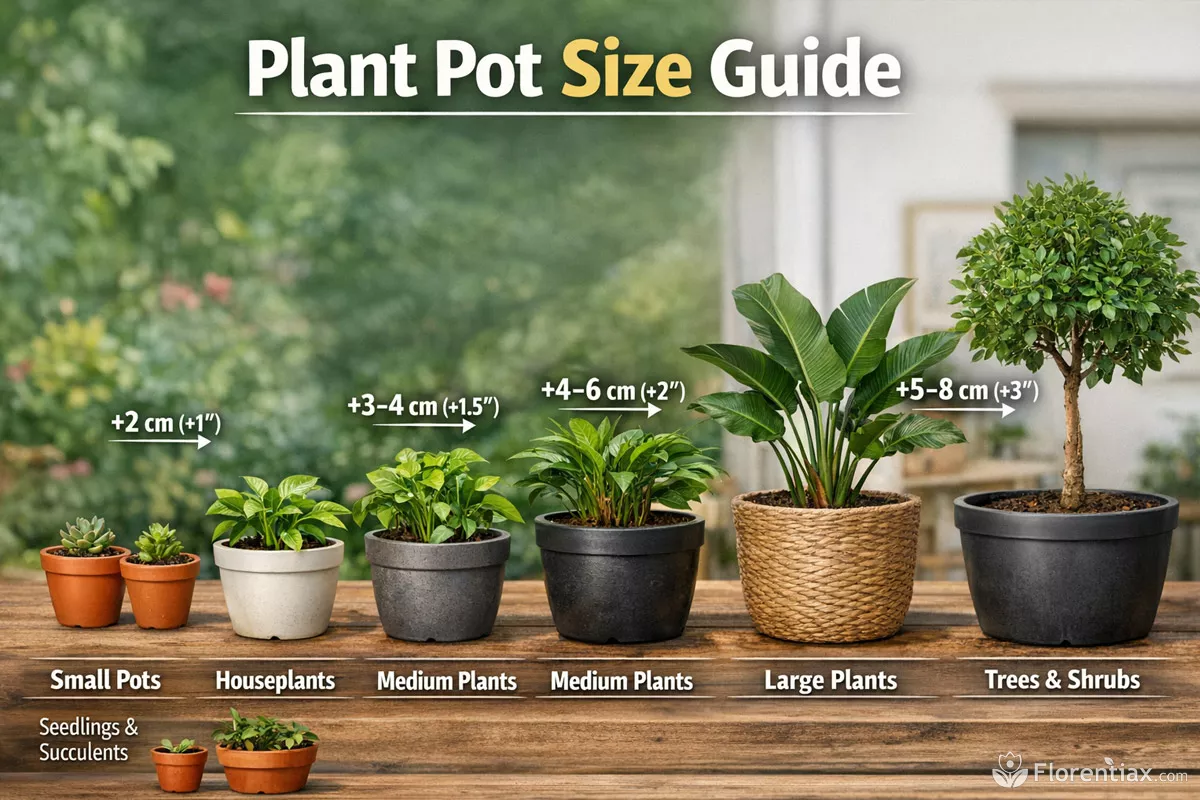
Use the table below as a quick plant pot size chart when shopping for standard container sizes:
| Current pot diameter | Recommended next size | Increase range | Best for plant type |
|---|---|---|---|
| 6–10 cm (2.5–4 in) | 8–12 cm (3–5 in) | +2 cm (≈1 in) | Seedlings, small succulents |
| 12–18 cm (5–7 in) | 15–22 cm (6–9 in) | +3–4 cm (≈1.5 in) | Most houseplants |
| 20–30 cm (8–12 in) | 25–35 cm (10–14 in) | +4–6 cm (≈2 in) | Medium foliage plants |
| 30–45 cm (12–18 in) | 35–55 cm (14–22 in) | +5–8 cm (≈3 in) | Large indoor plants |
| 50+ cm (20+ in) | 55–70 cm (22–28 in) | +6–10 cm (≈4 in) | Small trees, shrubs |
Why gradual sizing works: soil volume increases exponentially as pot diameter increases. Doubling diameter can nearly quadruple soil volume, which dramatically changes watering dynamics. This is why plant experts recommend step-up sizing instead of jumping multiple pot sizes at once.
When choosing between two container options, the safest decision is almost always the smaller one. Plants adapt faster to slightly tight conditions than to excess soil moisture, especially indoors where evaporation is slower.
Common repotting mistakes
Most issues come from choosing the wrong container size — which is why a plant container size calculator is useful even for experienced growers. Even experienced plant owners make errors when repotting. Many of the problems people search for — such as “why did my plant wilt after repotting” or “why is my plant dying after repotting” — are caused not by the process itself, but by incorrect container size or technique.
If you notice chlorosis or sudden leaf color changes, read why leaves turn yellow after repotting plants to separate normal adjustment from true root stress and overwatering symptoms.
Understanding these mistakes helps you use any plant container size calculator more effectively and avoid the most common causes of transplant failure.
| Mistake | What happens | Why it’s harmful | How to fix it |
|---|---|---|---|
| Choosing too large pot | Soil stays wet | Roots suffocate and rot | Use smaller container size |
| Repotting too often | Root disturbance | Growth slows or stops | Repot only when rootbound |
| Poor drainage | Water accumulates | Fungal diseases develop | Use pots with drainage holes |
| Wrong soil type | Moisture imbalance | Roots cannot regulate oxygen | Match soil to plant species |
| Watering immediately too much | Soil compaction | Reduced airflow to roots | Water lightly after repotting |
| Repotting during dormancy | Slow recovery | Plant stress increases | Repot during growth season |
Key takeaway: most repotting failures are not caused by the act of repotting itself, but by incorrect pot size selection or moisture management. Using a structured tool to calculate the next pot size dramatically reduces these risks and helps maintain stable root health.
Expert repotting tips
Professional growers agree that successful repotting depends less on the act itself and more on preparation, timing, and aftercare. Even when using a pot size calculator for plants to determine the correct container, following expert techniques ensures faster recovery, stronger roots, and steady growth.
Prepare the plant before repotting
Healthy roots handle transplanting stress much better than weakened ones. Water the plant lightly 12–24 hours before repotting so the root ball holds together but is not soaking wet. Ideal room conditions during repotting are about 18–26°C (65–79°F) with moderate humidity — this range supports active root metabolism without excessive evaporation.
- Never repot completely dry plants.
- Avoid repotting immediately after heavy watering.
- Do not fertilize right before repotting.
Inspect and handle roots correctly
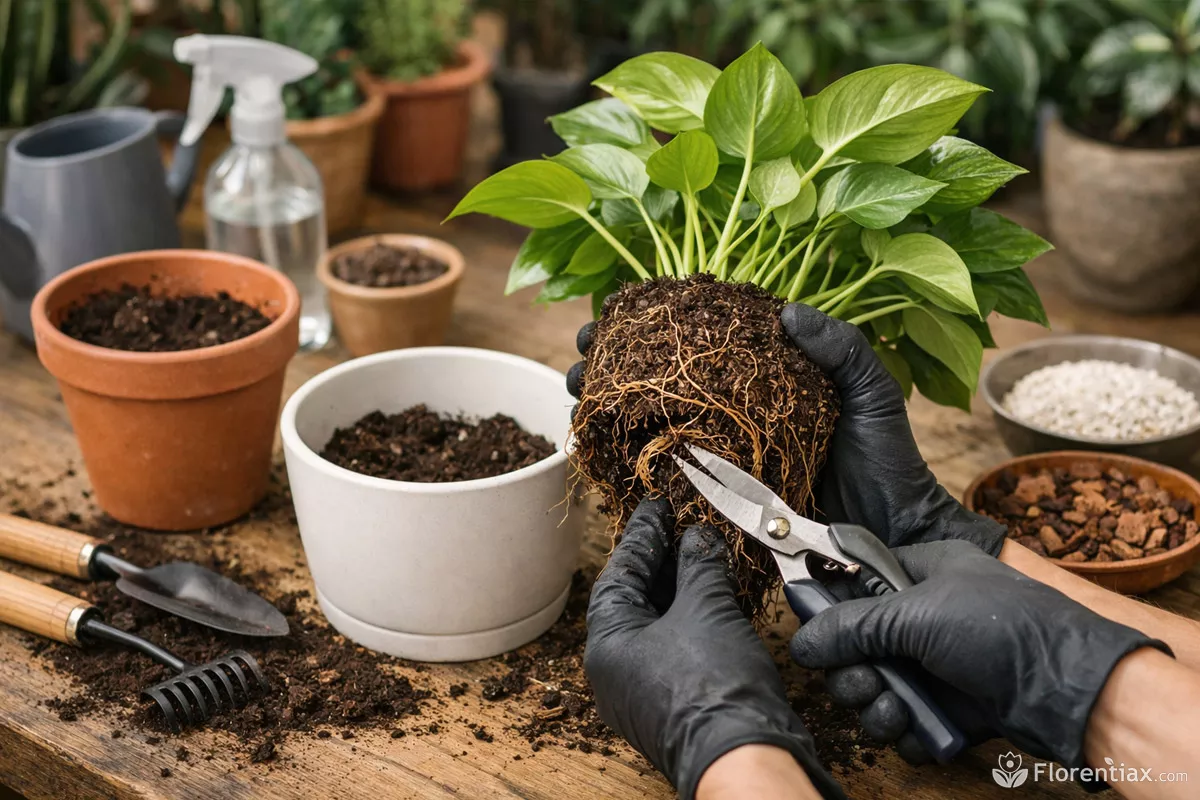
When removing a plant from its pot, gently loosen circling roots instead of pulling them apart. Roots that spiral tightly around the root ball prevent outward growth. If roots are extremely dense, trim a small portion — usually no more than 10–15% — to stimulate new branching.
Important: root pruning should only be done on vigorous plants. Weak or stressed plants should be repotted without trimming.
Use the correct soil structure
The right soil mix is just as important as choosing the right container size. Many repotting failures happen because soil texture does not match plant needs. A well-structured mix should hold moisture while still allowing air pockets for oxygen flow.
- Succulents: fast-draining mix with coarse particles.
- Tropical foliage plants: balanced mix with organic matter.
- Orchids: chunky bark-based substrate.
- Small trees: structured soil with mineral components.
Choose container material strategically
Pot material affects how fast soil dries. This is why many growers search for guidance like “best pots for indoor plants” or “plastic vs terracotta pots.” The material you choose can either increase or decrease watering safety margin.
- Terracotta — breathable, dries faster, safer for heavy watering habits.
- Plastic — retains moisture longer, good for dry environments.
- Ceramic — decorative but often less breathable.
- Fabric — excellent aeration and root oxygenation.
Repot using the correct technique
- Place fresh soil at the bottom of the new container.
- Position plant so root crown sits at same height as before.
- Fill gaps with fresh mix without compressing heavily.
- Tap pot lightly instead of pressing soil down.
- Water gently once to settle soil.
Many beginners press soil firmly, which reduces oxygen pockets. Roots need air just as much as water, so loose structure is essential.
Aftercare determines success
The first 7–14 days after repotting are critical. During this period, roots are adjusting to their new environment and cannot absorb water efficiently. Proper aftercare prevents transplant shock and helps plants resume growth faster.
If you want a safer routine right away, use our plant watering calculator to avoid overwatering after repotting and match your schedule to pot size, soil type, and season.
- Keep plant in bright indirect light.
- Avoid strong sun for 1–2 weeks.
- Delay fertilizing for about 2–3 weeks.
- Water only when top layer dries.
Pro insight: plants usually show temporary slowdown after repotting. This is normal and not a sign of failure. As long as leaves remain firm and roots are healthy, growth will resume once the root system expands into the new soil.
Advanced tips experienced growers use
- Repot in morning hours when plant metabolism is highest.
- Match pot depth to root type (shallow vs deep roots).
- Use mesh or filter layer over drainage holes to prevent soil loss.
- Label newly repotted plants with date for tracking growth cycles.
- Use slightly smaller upgrades indoors than outdoors.
Final expert rule: the best container is not the biggest one — it is the one that matches the current root system. Correct sizing, balanced soil, and gentle handling together create the ideal conditions for healthy plant development.
FAQ about repotting plants
Repotting raises many questions, especially for beginners trying to understand how pot size, soil, and timing affect plant health. Below you’ll find clear, practical answers to the most common questions people search for when learning how to repot plants safely and how to choose the correct container size.
1. Can a pot be too big for a plant?
Yes. An oversized container holds more soil than roots can use, which means excess moisture remains trapped for longer. This reduces oxygen around roots and increases the risk of rot. A pot that is slightly larger than needed is fine, but jumping several sizes at once is one of the most common causes of plant decline after repotting.
2. How much bigger should the next pot be?
For most plants, the safest increase is about 2–5 cm (≈1–2 in) wider than the current pot. Larger plants can handle increases up to about 8 cm (≈3 in), but delicate species such as succulents or orchids often need smaller steps. Gradual sizing helps roots adapt quickly without moisture imbalance.
3. When is the best time to repot plants?
Early spring through early summer is ideal because plants are entering active growth. During this phase, roots regenerate quickly and adjust to new soil conditions. Repotting in winter is usually safe only if the plant is severely rootbound or soil quality has deteriorated.
4. How often should plants be repotted?
Most indoor plants need repotting every 12–24 months. Fast growers may need it sooner, while slow-growing species can stay in the same pot for several years. The best indicator is root condition rather than time. If roots fill the pot or circle tightly, repotting is usually necessary.
5. Should I water immediately after repotting?
Yes, but lightly. A gentle watering helps settle fresh soil around roots and removes air pockets. However, soaking the plant right away can oversaturate new soil. After the first watering, wait until the top layer dries before watering again.
6. What happens if I don’t repot a rootbound plant?
If roots become too crowded, they cannot absorb enough water or nutrients. Growth slows, leaves may yellow, and watering becomes ineffective because water passes through quickly. Eventually the plant may stop growing entirely until repotted.
7. Do plants grow faster in bigger pots?
Not necessarily. Growth depends on root health, light, nutrients, and moisture balance. A slightly larger pot encourages growth, but a pot that is too large can actually slow development because roots struggle to regulate water in excess soil.
8. Should I loosen roots when repotting?
Yes, gently. Loosening tightly circling roots encourages them to grow outward into fresh soil. This improves nutrient uptake and stabilizes the plant. However, aggressive pulling or tearing can damage the root system, so handle roots carefully.
9. What soil should I use when repotting?
Choose soil that matches your plant’s natural habitat. Succulents need fast-draining mixes, tropical plants prefer balanced organic blends, and orchids require bark-based substrates. Using the wrong soil type is one of the main reasons repotted plants struggle.
10. Can I repot a plant right after buying it?
It depends. If the plant is healthy and not rootbound, it is usually better to let it acclimate for a few weeks before repotting. However, if roots are crowded or the original soil is poor quality, repotting sooner may be beneficial.
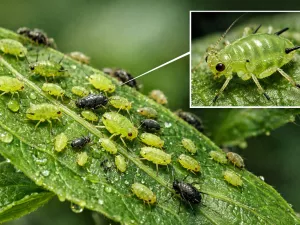
Also, newly purchased plants sometimes carry pests — to protect plants from stress and pests after repotting, inspect leaf undersides and treat aphids early before they spread.
11. How do I know if my pot has good drainage?
A proper pot should have at least one drainage hole at the bottom so excess water can escape. Without drainage, water accumulates and suffocates roots. You can also test drainage by watering once — if water does not flow out within a few seconds, drainage may be insufficient.
12. Is it better to choose plastic, terracotta, or ceramic pots?
Each material has advantages. Plastic retains moisture longer, terracotta dries faster and improves airflow, ceramic offers insulation and stability, and fabric pots provide maximum aeration. The best choice depends on watering habits, climate, and plant type rather than appearance alone.
Conclusion: choosing the right pot size and repotting correctly are essential skills for maintaining healthy plants. By understanding root behavior, soil moisture balance, and container sizing, you can prevent common problems and support steady growth. Using a structured tool like a pot size calculator together with proper repotting technique gives plants the best possible environment to thrive long term.