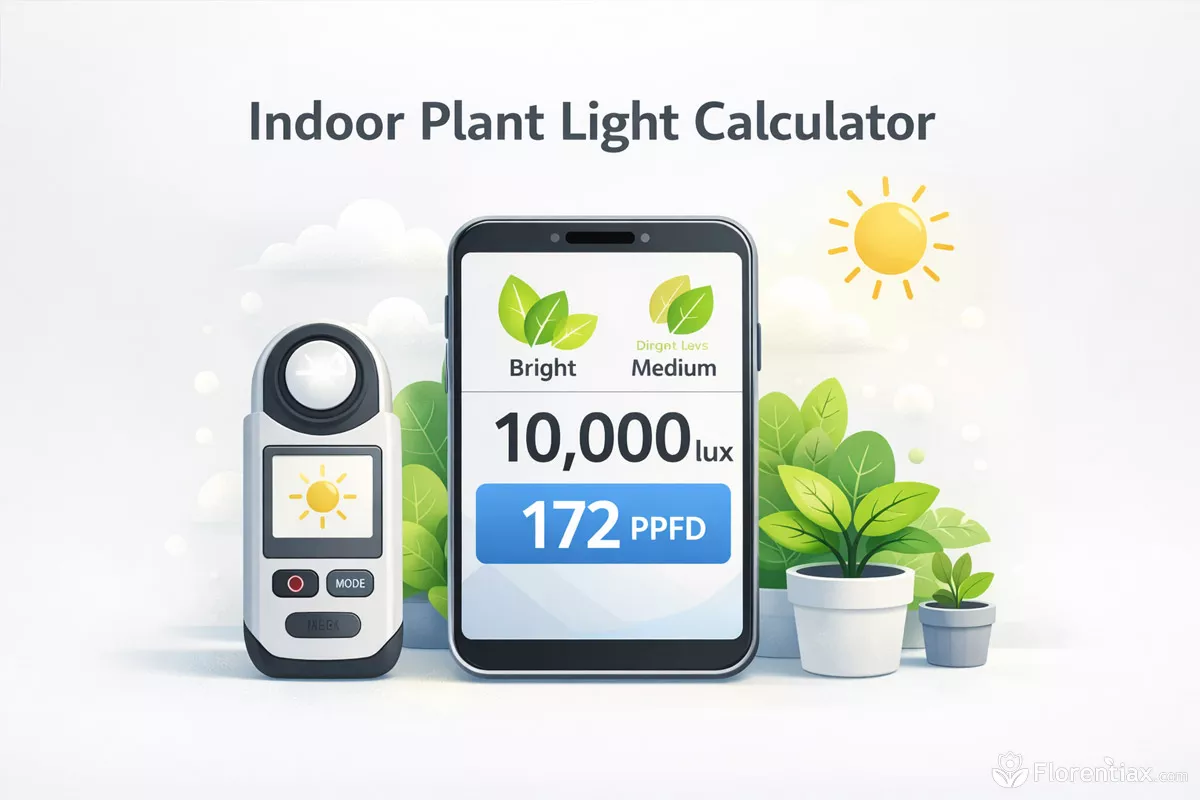
 This indoor plant light calculator helps you understand how much light your plant actually receives near a window. Enter direction, distance, season, shading, or even a measured lux value to get an estimated lux, foot-candles, and approximate PPFD result. The guide explains how to interpret Low, Medium, or Bright levels and what adjustments to make so your plants grow healthier indoors.
Indoor Plant Light Calculator: Lux to PPFD

Estimate your indoor light level (Low / Medium / Bright) and get placement tips for healthy plant growth. You can use a measured value (lux or foot-candles) if you have one.
Metric (lux, cm)
US (fc, in)
Values will be converted when you switch units.
North
East
South
West
Standard
Large
Two windows
Small
cm
Measure from the glass to the plant (same height as leaves).
Morning
Midday
Afternoon
Evening
None
1–2 h
3–5 h
6+ h
None
Sheer curtains
Thick curtains
Outdoor shade
Spring
Summer
Fall
Winter
Not sure whether your plant gets enough light? This free indoor plant light calculator helps you estimate brightness near a window using direction, distance, season, and shading. You will get lux, foot-candles, and an approximate PPFD value — plus clear guidance on what to adjust for healthier growth.
About this calculator
This indoor plant light calculator helps you estimate how much light your plant actually receives near a window. Instead of guessing what “bright indirect light” means, you can enter practical details — window direction, distance from the glass, season, shading, and direct sun exposure — and get a clear light level result.
The calculator provides:
- Lux (Metric) and foot-candles (fc) (US) values
- An approximate PPFD estimate (light usable for photosynthesis)
- A simple classification: Low, Medium, or Bright
- Clear guidance on what to adjust if needed
What this calculator estimates
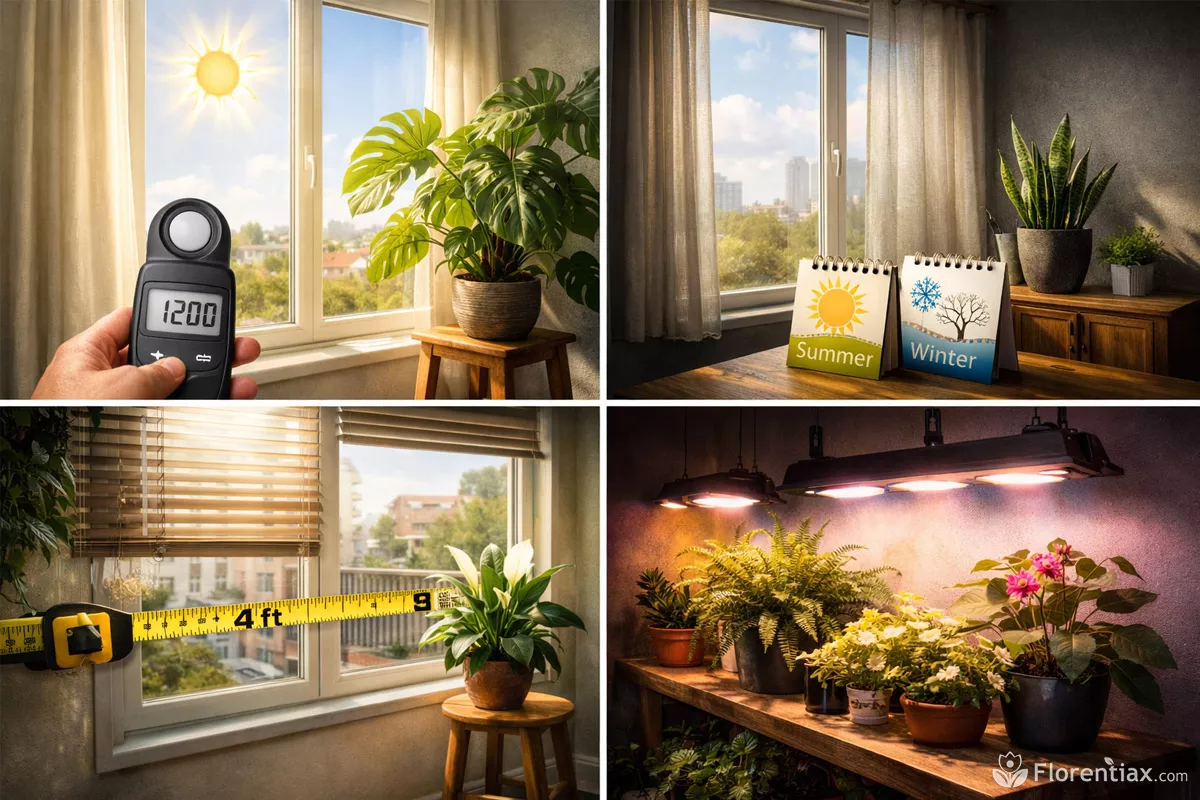
This tool models typical indoor light conditions based on real-world factors that strongly affect plant growth:
- Window direction — south-facing windows are usually brightest, north-facing the dimmest
- Distance from the glass — light intensity drops quickly as you move away
- Time of day and season — midday and summer produce more light than evening and winter
- Direct sun exposure — even 1–2 hours of direct sun can significantly increase intensity
- Obstructions — curtains, blinds, or outdoor shade reduce available light
You can also enter a measured lux or foot-candle value if you use a phone light meter app or a dedicated device. In that case, the measured value becomes the main reference for the result.
Who this tool is for
This calculator is designed for practical indoor plant care, not laboratory research. It is especially helpful for:
- Apartment plant owners choosing the best window placement
- Beginners who are unsure what “bright indirect light” means in numbers
- People comparing multiple rooms or windows
- Grow light users who want to understand how natural and artificial light combine
It is not a scientific PAR meter replacement, but it provides a realistic and useful estimate for everyday plant placement decisions.
How to use the calculator
Using the calculator takes less than a minute. Enter real conditions around your plant, not ideal assumptions. The more accurate your inputs, the more useful the result.
- Select units – Choose Metric (lux, cm) or US (foot-candles, inches). The calculator converts values automatically when you switch systems.
- Choose window direction – South-facing windows usually provide the strongest light, north-facing the weakest. East and west vary depending on time of day.
- Select window size – Larger windows or two windows increase total available light in the room.
- Set distance from the glass – Measure from the window glass to the plant leaves at the same height. Light drops quickly even within 30–60 cm (12–24 in).
- Choose time of day – Midday typically gives the highest indoor brightness.
- Select season – Winter light can be significantly lower than summer light.
- Add direct sun exposure – If your plant receives direct sun for several hours, select the correct range.
- Include obstructions – Sheer curtains, thick curtains, or outdoor shade reduce usable light.
- Optional: Enter measured light – If you have a lux or foot-candle reading from a meter or phone app, enter it. The calculator will use it as the primary reference.
- Click “Calculate” – Review lux, foot-candles, approximate PPFD, light level category, and placement advice.
Which factors affect light the most?
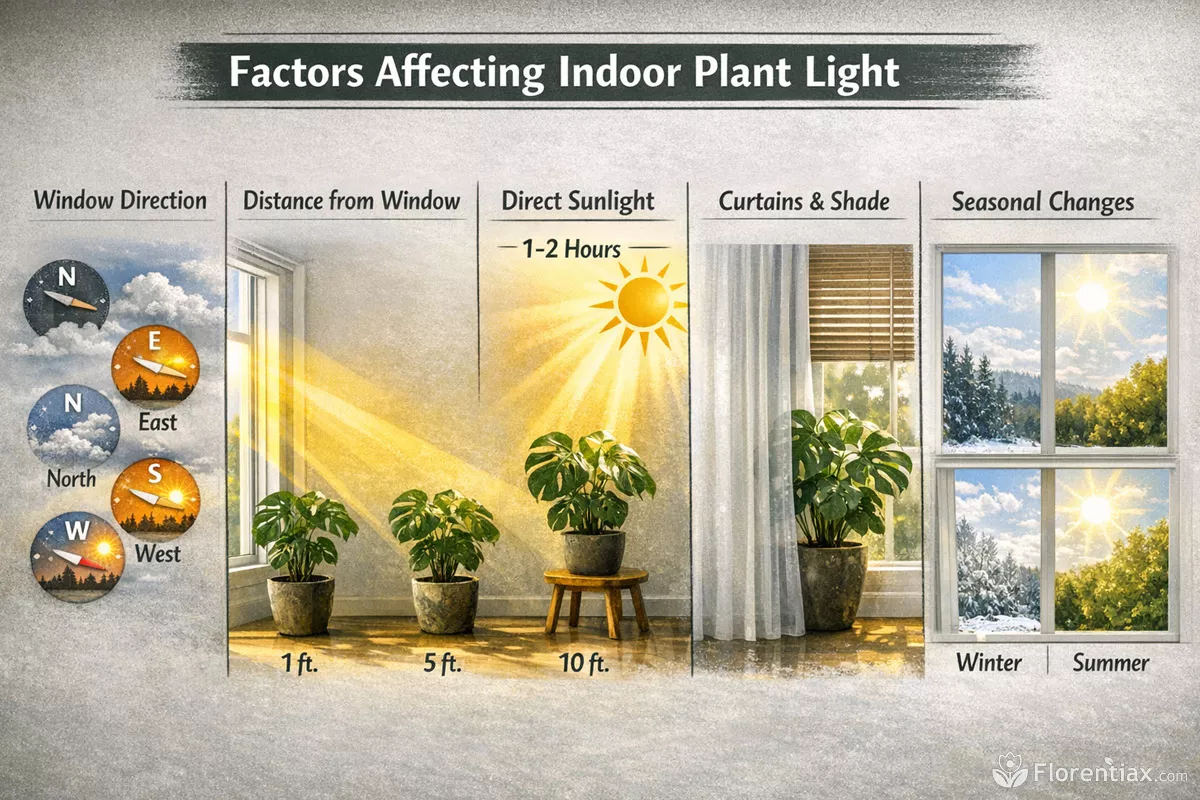
Some inputs influence brightness more than others. The table below shows which variables typically create the biggest changes in indoor plant light levels.
| Factor | Why It Matters |
|---|---|
| Window direction | Determines the baseline intensity entering the room (south is usually strongest, north weakest). |
| Distance from glass | Light intensity decreases rapidly as you move away from the window. |
| Direct sun | Even 1–2 hours of direct sunlight can significantly increase total light exposure. |
| Curtains / shade | Filters and blocks part of the available light before it reaches the plant. |
| Season | Winter daylight is shorter and weaker; summer daylight is longer and stronger. |
For best results, measure distance carefully and be honest about shading and sun exposure. After optimizing light levels, you can also use our plant watering schedule calculator to adjust watering frequency based on your plant’s new conditions.
How to interpret the results and what to do next
After clicking “Calculate,” you will see several values and a light level category. The goal is not just to see numbers, but to understand whether your plant is in the right spot — and what to adjust if needed.
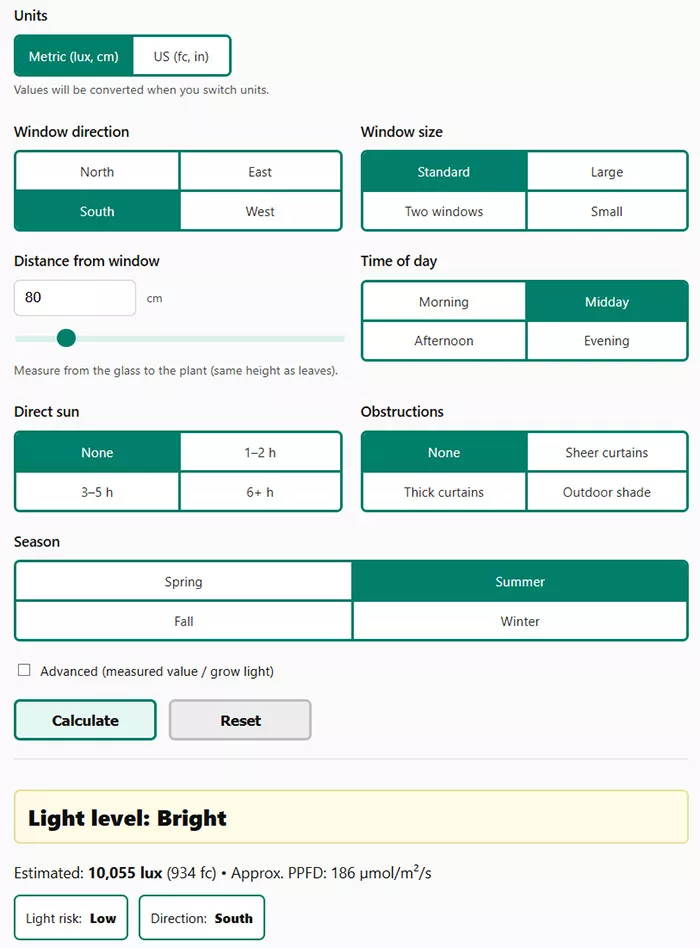
What the numbers mean
- Lux / foot-candles (fc) – These show how bright the spot is. Lux is the Metric unit; foot-candles are commonly used in the US. They describe the same brightness using different scales.
- PPFD (approx.) – This estimates how much light in the photosynthetically active range reaches the plant. It helps compare intensity more directly for plant growth.
- Light level (Low / Medium / Bright) – A simplified category to help you decide placement quickly.
- Light risk – A warning indicator if light may be too weak for growth or too strong for sensitive leaves.
Light levels and what to do
| Light Level | Lux Range (approx.) | What It Means | What To Do |
|---|---|---|---|
| Low | Below ~1,500 lux | Insufficient for most sun-loving plants; growth may slow or stems may stretch. | Move 30–60 cm (12–24 in) closer to the window, choose a brighter window, or add a grow light 8–12 hours/day. |
| Medium | ~1,500 – 9,000 lux | Suitable for many common houseplants and foliage plants. | Maintain placement; rotate weekly. If stretching occurs, move slightly closer (20–40 cm). |
| Bright | Above ~9,000 lux | Strong light, suitable for succulents, cactus, and flowering plants. | Monitor for leaf scorch. If leaves bleach or crisp, use sheer curtains or move back 20–60 cm. |
How to adjust placement safely
When changing a plant’s position, avoid sudden dramatic moves. Plants adapt to light gradually.
- Move in small steps (20–40 cm at a time).
- Observe for 7–10 days before making further changes.
- Watch for stretching (too little light) or crisp/brown patches (too much direct sun).
- Rotate the pot weekly for balanced growth.
Remember: numbers guide decisions, but plant response confirms them. Light levels directly affect evaporation and growth speed, so you may also need to adjust your watering indoor plants correctly routine after moving a plant to a brighter or darker spot.
What are lux and PPFD
Understanding lux and PPFD helps you make better decisions about plant placement. Both relate to light intensity, but they measure different aspects of it.
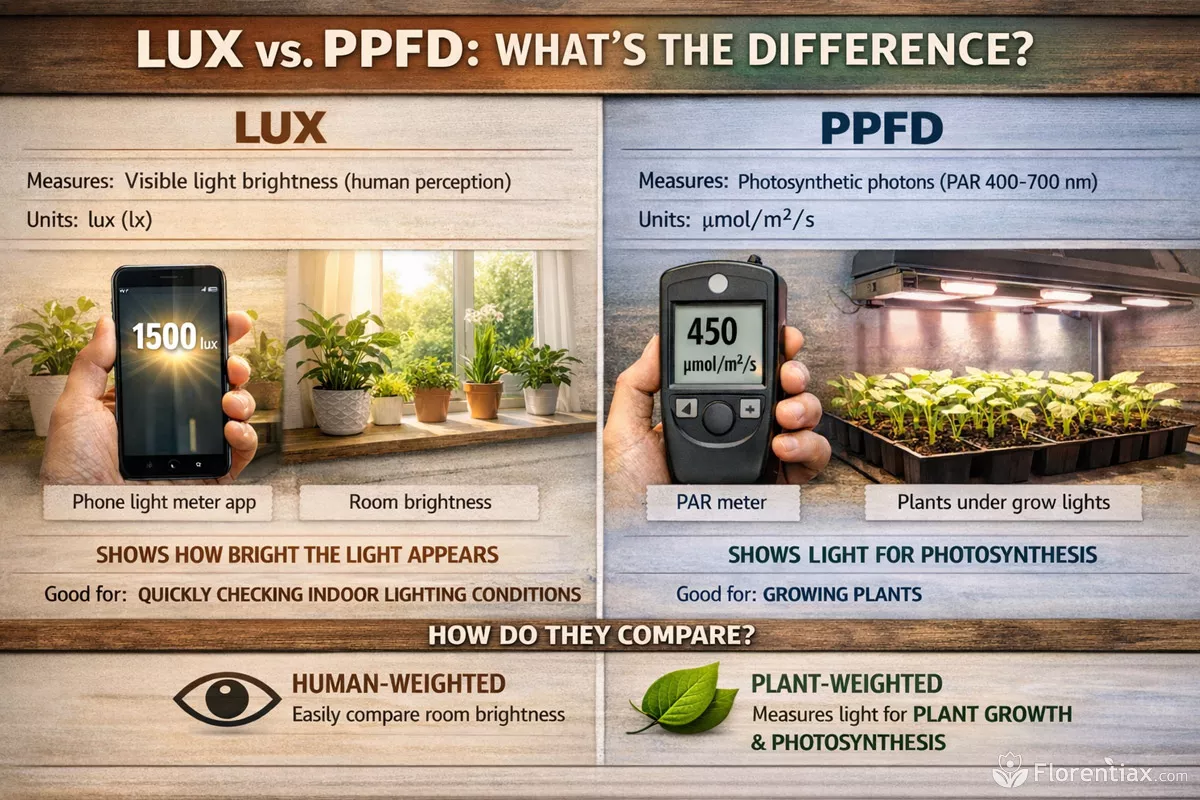
What is lux?
Lux measures visible light intensity as perceived by the human eye. It tells you how bright a surface appears. Indoors, lux is practical because:
- Most phone light meter apps display lux.
- It is easy to compare different spots in your home.
- It gives a fast approximation of plant lighting conditions.
However, lux is weighted toward human vision, not plant biology. That means it does not perfectly represent how much light plants can use for photosynthesis.
What is PPFD?
PPFD (Photosynthetic Photon Flux Density) measures the amount of light in the PAR range (400–700 nm) that reaches a surface per second. It is expressed in µmol/m²/s.
PPFD is more directly related to plant growth because it measures photons usable for photosynthesis. Accurate PPFD normally requires a PAR meter, but indoor lux values can be converted to a rough PPFD estimate for practical comparisons.
How lux, foot-candles, and PPFD compare
| Measurement | What It Measures | Common Use | Best For |
|---|---|---|---|
| Lux | Visible light intensity (human-weighted) | Metric system | Quick indoor brightness comparison |
| Foot-candles (fc) | Same as lux (different unit scale) | US system | Users working with imperial measurements |
| PPFD | Photosynthetically active photons | Horticulture and grow lights | Estimating light useful for plant growth |
In everyday indoor plant care, lux or foot-candles are sufficient for placement decisions. PPFD becomes more important when working with grow lights, seedlings, or high-light plants where precision matters.
Popular questions and answers
These FAQs cover practical situations people run into when placing indoor plants near windows or using a light meter app. Use them to troubleshoot real problems and make better placement decisions.
1. My plant is stretching toward the window. What does it mean?
Stretching (also called “leggy growth”) usually means the plant is not getting enough usable light. The stems grow longer as the plant tries to reach a brighter spot.
- Move the plant closer to the window in small steps (about 20–40 cm / 8–16 in).
- Rotate the pot weekly so the plant grows evenly.
- If the brightest available spot is still dim, add a grow light for 8–12 hours/day.
2. Leaves are turning pale or developing crispy brown edges. Too much light?
It can be too much direct sun, especially through a south or west window. Pale patches can be bleaching; crispy edges can indicate scorch or dehydration from heat and sun intensity.
- Use sheer curtains to soften direct sun.
- Move the plant back 20–60 cm (8–24 in) from the glass.
- Check for heat spikes near the window (radiators, hot glass in summer).
3. Why does my plant look fine in summer but struggle in winter?
Winter light is weaker and days are shorter. Even if the plant stays in the same place, the total daily light can drop enough to slow growth or cause stretching.
- Move the plant closer to the window during winter.
- Open blinds/curtains more consistently during daylight hours.
- Consider a grow light for high-light plants or fast growers.
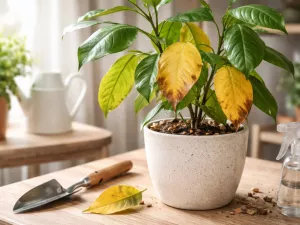
If you notice discoloration during seasonal light changes, learn more about why plant leaves turn yellow and how to diagnose whether the cause is light stress, watering imbalance, or nutrient deficiency.
4. How accurate are phone lux meter apps for plants?
They are useful for comparing spots in your home, but they can vary by phone model, sensor, and app calibration. Treat the number as an estimate, not a lab reading.
- Measure in the same way every time (same phone, same app, same angle).
- Measure at leaf height where the plant sits.
- Compare relative differences between locations rather than chasing a perfect number.
5. Should I measure light at the window or at the plant?
Always measure at the plant. Light changes dramatically with distance, especially indoors. Measuring at the window often overestimates what the leaves actually receive.
- Hold the phone sensor at leaf level.
- Measure at the same distance where the plant stays.
- If the plant has a wide canopy, take a couple of readings across the leaf area and average them.
6. Why do two spots in the same room show very different readings?
Indoor light is highly directional. A small shift can change how much sky and window area the plant “sees.” Shadows from walls, furniture, balconies, or buildings can also cut light sharply.
- Compare readings at the exact plant position, not “nearby.”
- Check for outdoor shade (trees, overhangs, adjacent buildings).
- Look for indoor shadows from shelves, curtains, or window frames.
7. Does glass reduce plant light?
Yes. Standard window glass reduces some light intensity and filters parts of the spectrum. For most houseplants, the bigger issue is not the glass itself but distance from the window and shading.
- Keep higher-light plants closer to the glass.
- Use clean glass and open curtains during the day.
- Avoid placing sun-loving plants deep in the room.
8. My plant gets direct sun for 1–2 hours. Is that safe?
It depends on the plant and how intense the sun is (season, window direction, heat). Many foliage plants tolerate gentle morning sun, but harsh midday or late-afternoon sun can burn sensitive leaves.
- Introduce direct sun gradually over 1–2 weeks.
- Watch the newest leaves first; they show stress earlier.
- If you see bleaching or crisp patches, filter with sheer curtains.
9. Can I place a plant permanently far from the window if it “survives”?
Many plants can survive low light but grow slowly, lose variegation, or become leggy over time. “Surviving” is not the same as “thriving.”
- If growth is weak, move closer or add supplemental light.
- Reduce watering in low light to avoid root issues.
- Choose shade-tolerant species for deeper room placement.
10. What is the easiest way to improve light without changing windows?
The simplest improvements often come from small placement and habit changes rather than major equipment.
- Move the plant closer to the glass (even 20–40 cm helps).
- Keep curtains open during daylight hours.
- Use a light-colored wall or reflective surface nearby.
- Add a basic grow light for 8–12 hours/day if needed.
11. Should I change watering when I move a plant to brighter light?
Yes. Brighter light usually increases growth and water use. After moving a plant closer to the window or adding a grow light, the soil may dry faster.
- Check soil moisture more often for the first 1–2 weeks.
- Avoid overwatering immediately after a move; let the plant adjust.
- Watch leaves: limp leaves can indicate thirst; soft yellowing can indicate excess water.
12. Why do my plants lean even when the light level seems “good”?
Leaning usually happens when light is coming strongly from one direction. Even if total light is adequate, the plant will grow toward the brightest side.
- Rotate the pot weekly.
- Give the plant more even exposure by moving slightly away from extreme side-light.
- For tall plants, use gentle support while they strengthen.
Related articles

Have a question?