USDA Plant Hardiness Zone Finder by ZIP Code

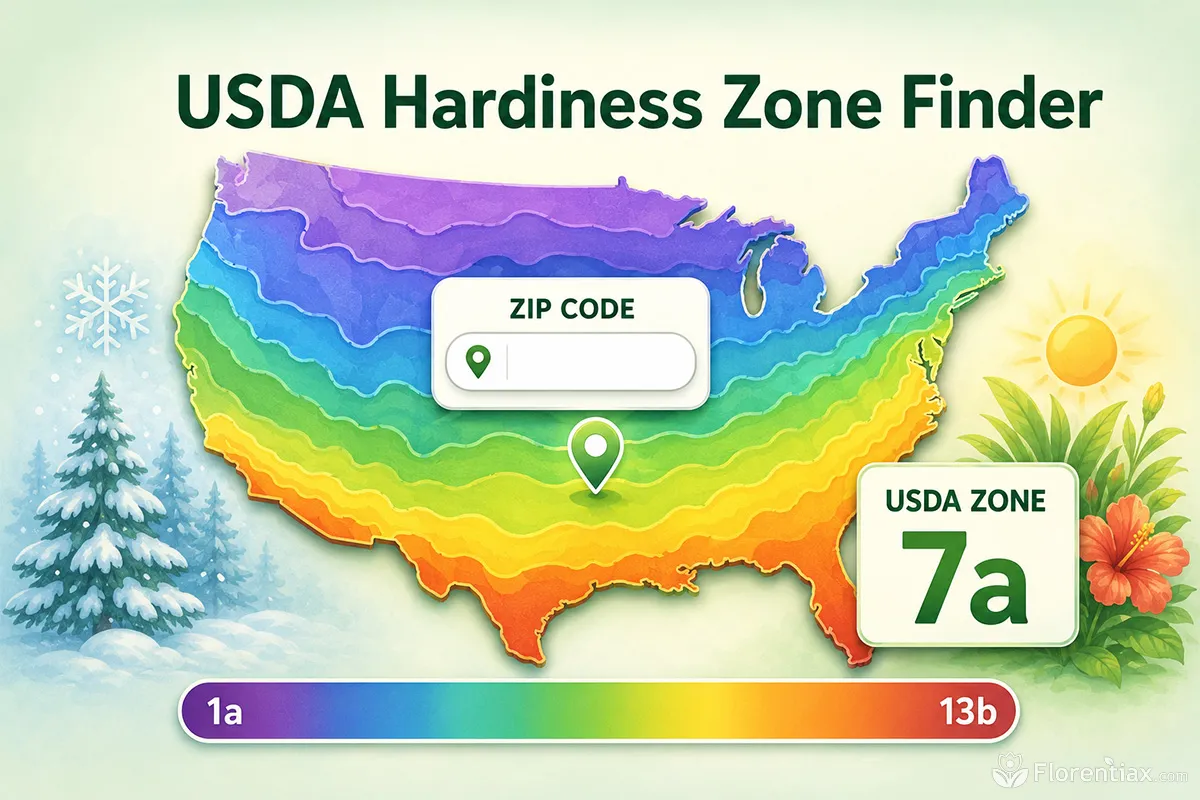 Enter a U.S. ZIP code to find your 2023 USDA plant hardiness zone, see its winter temperature range, locate it on the national map and check whether a perennial suits your local climate.
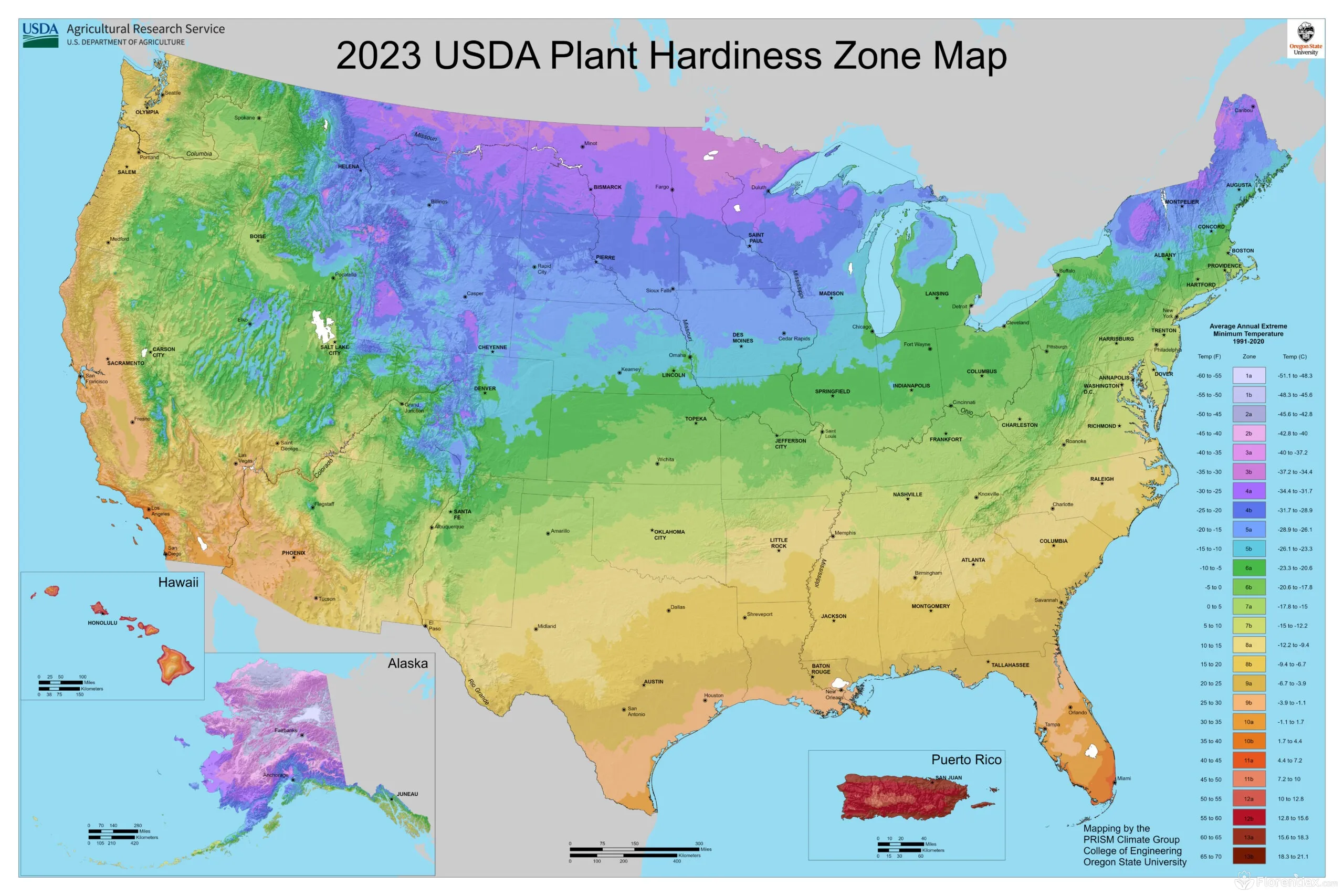
The USDA Hardiness Zone Finder identifies the 2023 plant hardiness zone assigned to a U.S. ZIP code. Enter five digits to see the local USDA zone, its average annual extreme minimum winter temperature in Fahrenheit and Celsius, its position on the national hardiness scale and the edition of the map used for the result.
The zone definitions and temperature data follow the official 2023 USDA Plant Hardiness Zone Map produced by the USDA Agricultural Research Service with the PRISM Climate Group at Oregon State University. The map uses weather data from 1991–2020. After finding a zone, the calculator can also compare it with the minimum and maximum zones printed on a plant label.
A hardiness zone is a practical first filter for choosing perennial plants. It helps answer whether winter cold is likely to be tolerable, but it does not replace checks for summer heat, sunlight, soil, moisture and the conditions within your individual garden.
How to use the USDA Hardiness Zone Finder
The finder updates automatically after a valid ZIP code is entered. There is no separate search button, and no address, account or location permission is required.
1. Enter a U.S. ZIP code
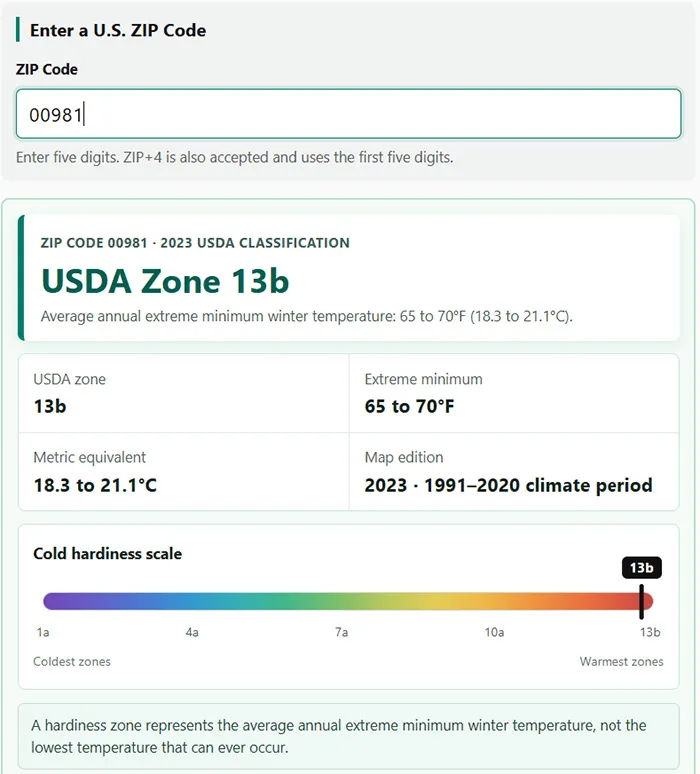
Type the five-digit ZIP code for the planting location. ZIP+4 is also accepted, but the finder uses the first five digits for the lookup.
Use the ZIP code of the property where the plant will grow rather than a nearby nursery, workplace or mailing address in another community. Zone boundaries can cross counties and metropolitan areas, so even relatively short distances may produce different results.
2. Review the USDA zone
After the ZIP code is found, the result displays:
- USDA zone: The numbered zone and its a or b half-zone.
- Extreme minimum: The corresponding winter temperature range in degrees Fahrenheit.
- Metric equivalent: The same range converted to degrees Celsius.
- Map edition: The 2023 USDA classification based on the 1991–2020 climate period.
- Scale position: The location of the result between the coldest and warmest USDA zones.
3. Check a plant against your zone
Plant labels and nursery descriptions commonly list a range such as USDA Zones 5–9. Enter the coldest listed zone as the plant minimum and the warmest listed zone as the plant maximum.
If the label uses whole zone numbers, include both halves of the stated range. For a plant rated for Zones 5–9, select 5a as the minimum and 9b as the maximum.
The compatibility result can show three outcomes:
- Suitable by hardiness zone: Your location falls within the listed plant range.
- Too cold for this plant: Your location is colder than the plant’s minimum zone.
- Warmer than the listed range: Winter cold may not be the main problem, but summer heat or insufficient winter chilling could affect the plant.
Always check the exact species and cultivar. Plants within the same genus can have very different cold limits, and a newer cultivar may be rated for a different zone range than the general species description.
| Calculator field | What it means | How to use it |
|---|---|---|
| ZIP Code | Five-digit U.S. postal area | Enter the ZIP code for the planting location |
| USDA zone | Local cold-hardiness classification | Compare it with the range on the plant label |
| Extreme minimum | Average annual extreme minimum winter range | Use it as a winter-survival reference, not a guaranteed absolute low |
| Plant minimum zone | Coldest zone listed for the plant | A colder location may require protection or container growing |
| Plant maximum zone | Warmest zone listed for the plant | A warmer location may have excessive heat or insufficient chilling |
How to read the calculator results
The zone number becomes higher as winter conditions become warmer. Zone 4 is colder than Zone 7, and Zone 10 is warmer than Zone 8. Within each numbered zone, the a half is colder than the b half.
For example, Zone 7a represents an average annual extreme minimum winter temperature of 0–5°F, equivalent to approximately −17.8 to −15°C. Zone 7b is slightly warmer at 5–10°F, or approximately −15 to −12.2°C.
The displayed temperature is not the average temperature for the entire winter. It represents the range into which the average coldest temperature of the year falls over the map’s 30-year climate period.
Example of a plant compatibility check
Suppose the finder returns Zone 7a and a perennial is labelled for USDA Zones 5–9. Enter 5a as the plant minimum and 9b as the maximum. Zone 7a falls within that range, so the plant is considered suitable by hardiness zone.
If the same plant were checked for a Zone 4b garden, the location would be colder than the listed minimum. The plant might be damaged or killed during winter unless it is moved indoors, protected or grown as a seasonal plant.
In Zone 10a, the result would be warmer than the plant’s listed range. This does not mean the plant will freeze. Instead, it may struggle with high summer temperatures, warm nights or a lack of winter chilling.
When I compare a plant with a location, I first check the minimum zone because it indicates the immediate winter-survival risk. I then check the maximum zone and the plant’s heat requirements, because a winter that is mild enough does not automatically make the summer suitable.
Why the result is guidance rather than a guarantee
The USDA map uses long-term averages. A location can occasionally experience a temperature below its displayed zone range. A plant growing at the coldest edge of its rated range may perform well for several winters and still be damaged during an unusual cold snap.
Plant condition also matters. A healthy, established specimen in well-drained soil generally enters winter in a stronger position than a recently transplanted, drought-stressed or overfertilized plant of the same species.
What USDA plant hardiness zones mean
The USDA Plant Hardiness Zone Map divides the United States and Puerto Rico according to average annual extreme minimum winter temperature. Gardeners, nurseries and plant suppliers use the zones as a standard way to describe the expected cold tolerance of perennial plants.
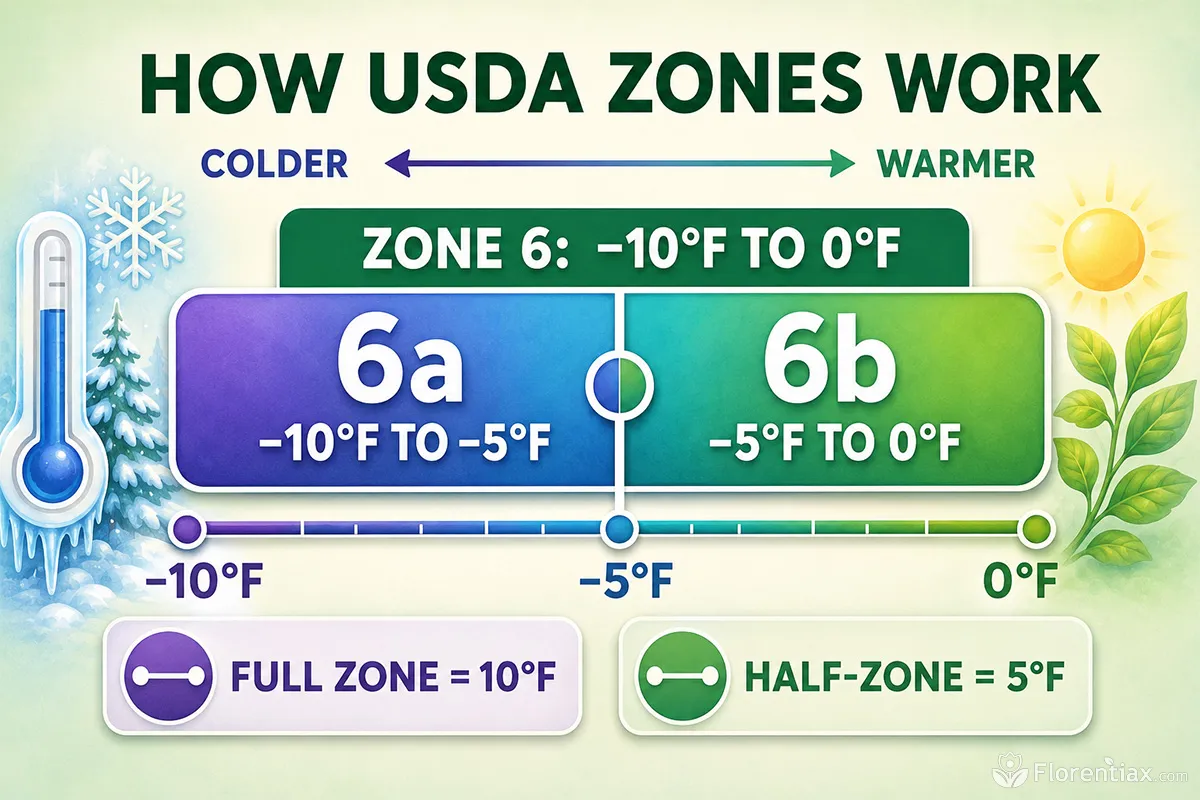
Each numbered zone covers a range of 10°F. It is then divided into two 5°F half-zones:
- Zone a: The colder half of the numbered zone.
- Zone b: The warmer half of the numbered zone.
For example, Zone 6 covers −10 to 0°F. Zone 6a covers −10 to −5°F, while Zone 6b covers −5 to 0°F.
Why zones are mainly used for perennials
Perennials, shrubs and trees remain outdoors for more than one growing season, so their ability to survive winter is essential. A perennial may grow vigorously through summer but fail to return in spring if its crown, roots, buds or stems cannot tolerate local winter temperatures.
Annual flowers and vegetables normally complete their life cycle within one season. Their planting dates are influenced more by frost dates, soil temperature and growing-season length than by the USDA hardiness zone.
Houseplants are also not usually selected by the outdoor USDA zone unless they will remain outside permanently. Tropical plants placed on a patio for summer should be brought indoors before temperatures reach their cold-damage threshold.
Hardiness is not the same as frost tolerance
A hardy dormant plant may survive deep winter cold but still lose new shoots or flowers to a late spring frost. Conversely, a tender plant may tolerate a brief cool night but fail after prolonged freezing.
The zone describes a long-term winter temperature statistic. It does not provide the first autumn frost date, last spring frost date, number of frost-free days or duration of freezing weather.
USDA hardiness zone temperature chart
The following table shows the average annual extreme minimum temperature range assigned to each USDA half-zone.
| USDA zone | Temperature range, °F | Temperature range, °C |
|---|---|---|
| 1a | −60 to −55 | −51.1 to −48.3 |
| 1b | −55 to −50 | −48.3 to −45.6 |
| 2a | −50 to −45 | −45.6 to −42.8 |
| 2b | −45 to −40 | −42.8 to −40 |
| 3a | −40 to −35 | −40 to −37.2 |
| 3b | −35 to −30 | −37.2 to −34.4 |
| 4a | −30 to −25 | −34.4 to −31.7 |
| 4b | −25 to −20 | −31.7 to −28.9 |
| 5a | −20 to −15 | −28.9 to −26.1 |
| 5b | −15 to −10 | −26.1 to −23.3 |
| 6a | −10 to −5 | −23.3 to −20.6 |
| 6b | −5 to 0 | −20.6 to −17.8 |
| 7a | 0 to 5 | −17.8 to −15 |
| 7b | 5 to 10 | −15 to −12.2 |
| 8a | 10 to 15 | −12.2 to −9.4 |
| 8b | 15 to 20 | −9.4 to −6.7 |
| 9a | 20 to 25 | −6.7 to −3.9 |
| 9b | 25 to 30 | −3.9 to −1.1 |
| 10a | 30 to 35 | −1.1 to 1.7 |
| 10b | 35 to 40 | 1.7 to 4.4 |
| 11a | 40 to 45 | 4.4 to 7.2 |
| 11b | 45 to 50 | 7.2 to 10 |
| 12a | 50 to 55 | 10 to 12.8 |
| 12b | 55 to 60 | 12.8 to 15.6 |
| 13a | 60 to 65 | 15.6 to 18.3 |
| 13b | 65 to 70 | 18.3 to 21.1 |
Zone 13b is the warmest classification on the 2023 map. Zones 12 and 13 occur in the warmest mapped parts of Hawaii and Puerto Rico and are useful for comparing the cold sensitivity of tropical and subtropical plants.
Choosing plants for your hardiness zone
Begin with the zone range printed on the plant label or supplied for the exact cultivar. Your location should normally fall between the listed minimum and maximum zones.
A plant listed for Zones 4–8 is expected to tolerate colder winters than a plant listed for Zones 8–11. However, the first plant may perform poorly in Zone 9 because of summer heat, while the second may be killed by winter cold in Zone 6.
Zones 1–2: extreme winter cold
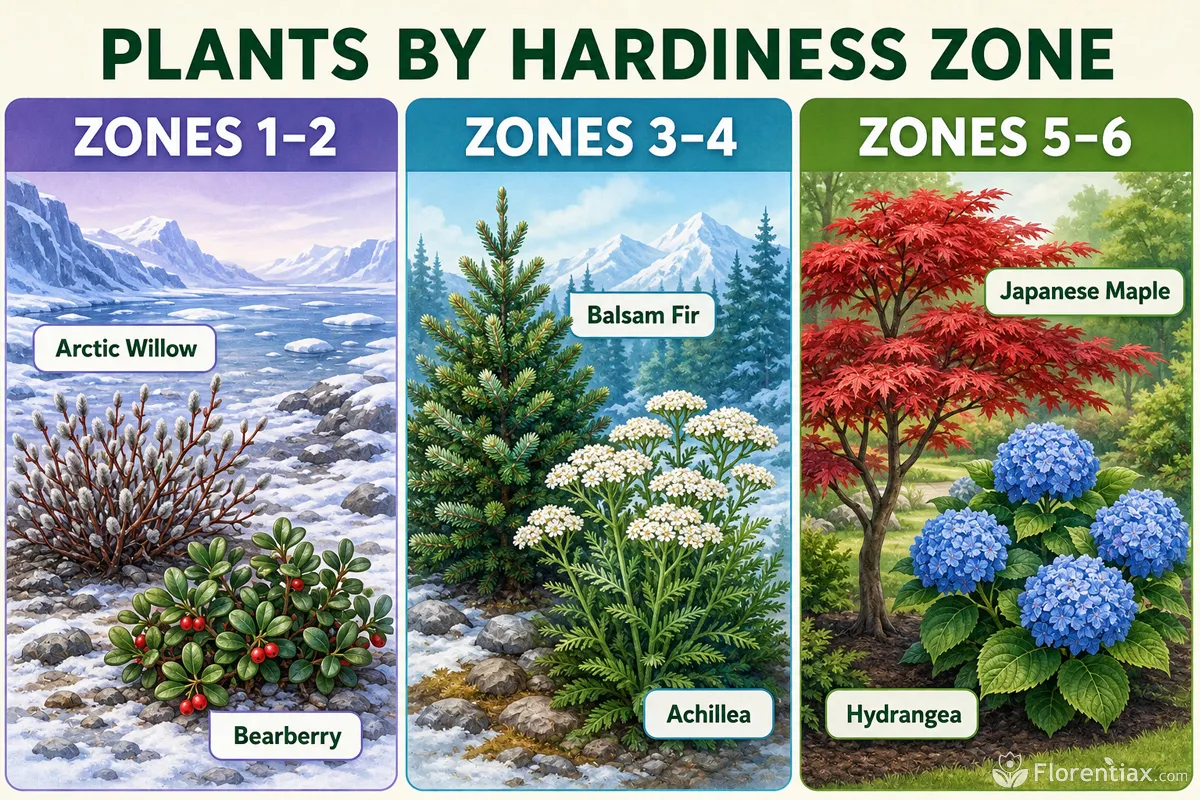
Plant selection is highly specialized in Zones 1 and 2. Use trees, shrubs and perennials with proven local performance and zone ratings that specifically include these conditions. Snow cover can protect low crowns and roots, but exposed branches must still tolerate severe cold and drying wind.
Many common nursery perennials and warm-climate shrubs are unsuitable for permanent outdoor planting. Even cold-associated genera should be checked at species and cultivar level rather than assumed to be hardy.
Zones 3–4: cold northern and inland gardens
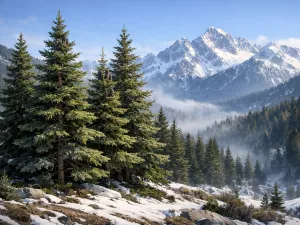
Cold-adapted conifers and dormant perennials offer useful choices. Some Abies firs are naturally suited to cool climates, although their tolerance of summer heat and soil conditions still varies by species.
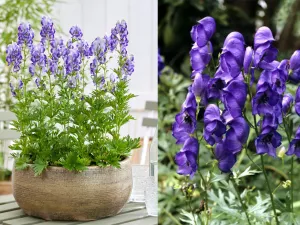
Hardy herbaceous plants such as Achillea can provide summer flowers after surviving a deeply frozen winter. Certain Aconitum species are also associated with cool conditions, but every cultivar should be checked and handled carefully because the plant is toxic.
Tender succulents, subtropical shrubs and plants listed only for Zone 7 or warmer should generally be treated as container plants or seasonal displays.
Zones 5–6: cool temperate gardens
These zones support a broad selection of deciduous trees, flowering shrubs, bulbs and herbaceous perennials. Many plants experience sufficient winter dormancy while avoiding the most severe cold of Zones 1–4.
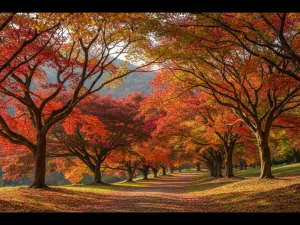
The genus Acer provides a useful example of why the species matters. Maples range from highly cold-tolerant trees to selections that need milder winters and sheltered conditions.
Plants whose minimum rating is Zone 6 may be less reliable in an exposed Zone 6a garden than in a protected Zone 6b location. Wind protection, drainage and autumn plant condition become especially important at the cold edge of the range.
Zones 7–8: moderate winter conditions
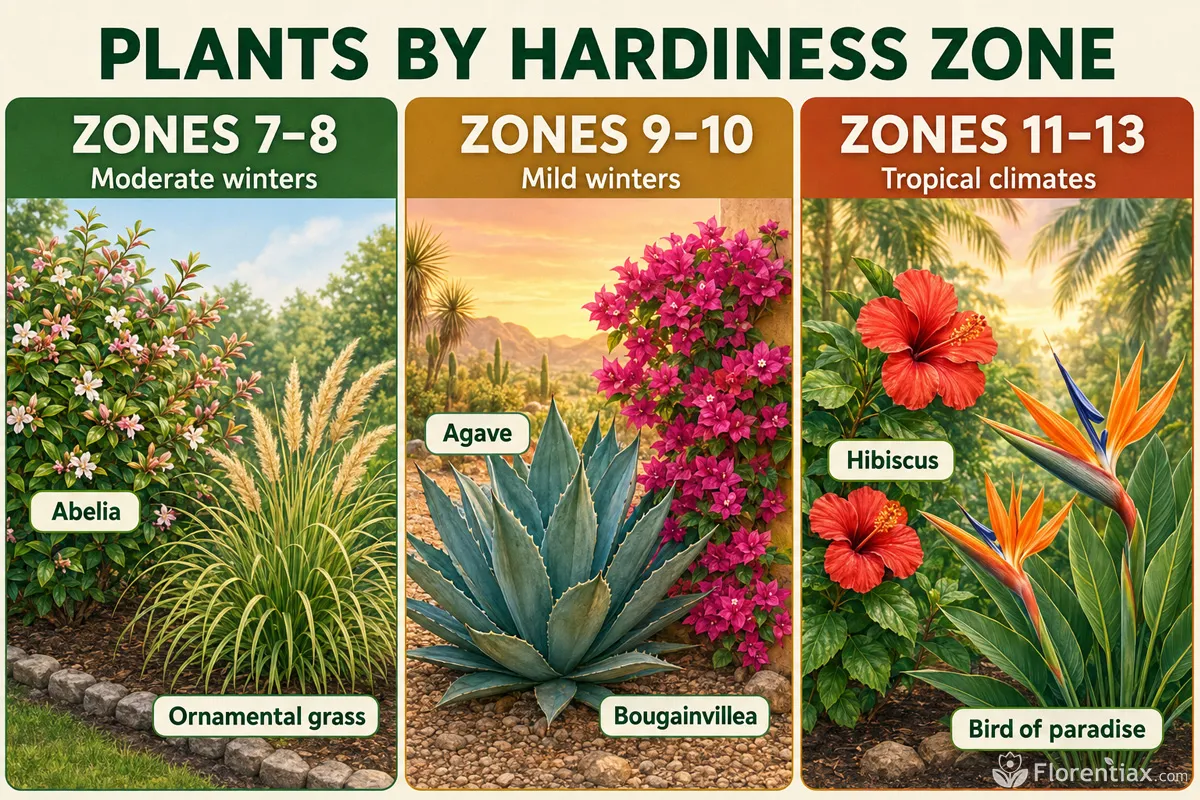
Zones 7 and 8 provide a wide transition between cold-climate and warm-climate planting. Many temperate shrubs, ornamental grasses, perennials and selected warm-region plants can be grown, but a single severe cold event can still damage plants near their northern limit.
Abelia is an example of a flowering shrub whose suitability depends on the cultivar, local winter conditions and planting position. A sheltered specimen may retain more stems through winter than the same cultivar in an exposed site.
In Zone 7, plants rated only for Zone 8 and warmer are borderline choices. In Zone 8, cold-loving plants may survive winter but struggle where summers are prolonged, hot and humid.
Zones 9–10: mild winters and greater heat pressure
Many warm-climate shrubs, succulents and tender perennials can remain outside through winter in Zones 9 and 10. The planting decision shifts from extreme cold toward summer heat, drought, humidity and water management.
Agave includes species for mild, dry climates as well as unexpectedly cold-tolerant selections. Good drainage is essential because winter moisture can damage a plant even when the air temperature remains within its listed zone.
Cold-climate firs and perennials that require a long winter dormancy may be poor choices. A warm zone does not automatically provide better growing conditions for every plant.
Zones 11–13: tropical and subtropical conditions
These zones allow many tropical plants to grow outdoors as permanent landscape specimens. Frost is limited or absent in the warmest locations, but individual cold-sensitive plants can still be damaged during unusual weather.
Temperate species that require winter chilling may fail to flower, set fruit or enter normal dormancy. Tropical planting decisions are often influenced more by rainfall, humidity, wind, salt exposure, soil drainage and hurricane resistance than by winter cold alone.
| Location zones | Useful starting points | Plants requiring extra caution |
|---|---|---|
| 1–2 | Locally proven subarctic trees, shrubs and perennials | Most ordinary temperate and warm-climate nursery plants |
| 3–4 | Cold-adapted conifers and deeply dormant perennials | Subtropical shrubs, tender bulbs and succulents |
| 5–6 | Many deciduous trees, shrubs, bulbs and perennials | Plants whose minimum rating begins at Zone 7 |
| 7–8 | Temperate plants and selected warm-climate species | Borderline subtropicals and plants sensitive to summer heat |
| 9–10 | Warm-climate shrubs, succulents and tender perennials | Cold-loving plants requiring cool summers or winter chilling |
| 11–13 | Tropical and subtropical landscape plants | Temperate plants with strong dormancy or chilling requirements |
How garden microclimates affect hardiness
A ZIP-code result describes the general hardiness classification for an area. Conditions within an individual property can be slightly warmer or colder because of elevation, buildings, pavement, wind, vegetation and the movement of cold air.
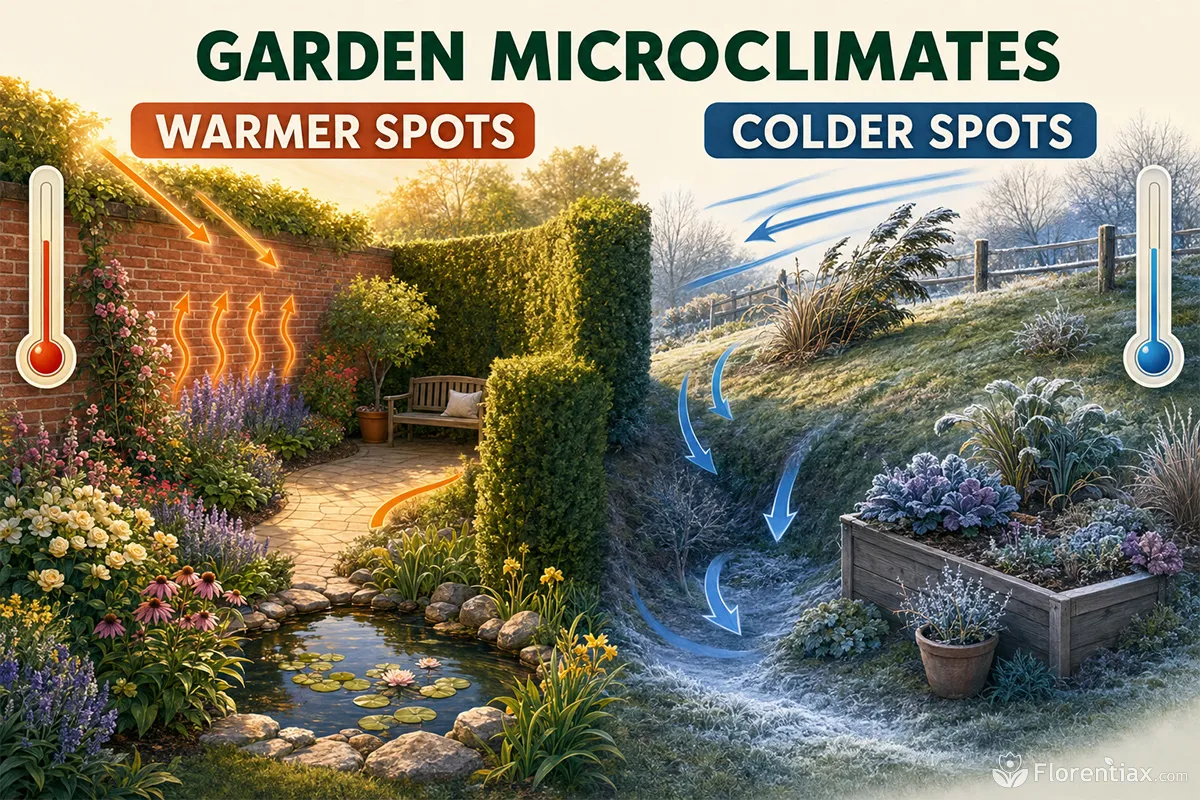
Locations that may be warmer
- A sheltered bed beside a south-facing masonry wall.
- An urban garden surrounded by buildings and paved surfaces.
- A slope above a low area where cold air collects.
- A location near a large body of water that moderates winter temperature.
- A courtyard protected from prevailing winter wind.
Locations that may be colder
- A low point where dense cold air settles overnight.
- An open property exposed to persistent winter wind.
- A north-facing slope receiving little winter sun.
- A high-elevation site within a generally warmer ZIP code.
- A container or raised planter whose root system is exposed on several sides.
The 2023 USDA map has finer resolution than earlier editions, but it cannot represent every wall, hollow, slope or protected corner. A garden may contain several small microclimates even though the calculator returns one zone.
Keep a simple winter record for borderline plants. Note the lowest temperature, wind exposure, snow cover and spring condition. Several seasons of observations will show whether a bed behaves like the general zone or has a warmer or colder microclimate.
What a hardiness zone cannot tell you
The USDA zone is valuable, but it measures only one part of the growing environment. Two gardens in the same zone may have different rainfall, summer temperatures, soil and growing-season lengths.
| Factor | Why it matters | What to check |
|---|---|---|
| Summer heat | A cold-hardy plant may decline during hot days and warm nights | Heat tolerance, afternoon shade and regional performance |
| Frost dates | The zone does not indicate the length of the growing season | Local first and last frost dates |
| Soil drainage | Wet roots can reduce winter survival and cause decay | Drainage rate, soil structure and seasonal saturation |
| Soil moisture | Drought-stressed plants may enter winter in poor condition | Rainfall, irrigation and autumn moisture |
| Sunlight | Incorrect exposure weakens growth and can increase stress | Hours of direct sun and seasonal shade |
| Humidity | Humidity affects moisture loss, disease pressure and heat response | Regional humidity and airflow around the plant |
| Winter wind | Evergreen foliage can lose water while the ground is frozen | Exposure, windbreaks and autumn hydration |
| Snow cover | Snow can insulate crowns and shallow roots | Typical snow depth and reliability |
| Chilling requirement | Some plants need sufficient winter cold for normal growth or flowering | Species-specific chill hours or dormancy needs |
Before purchasing a permanent landscape plant, combine the USDA zone with its light, soil, moisture, heat and mature-size requirements. Local extension recommendations and established gardens in the same area can provide additional evidence of real-world performance.
Growing plants near their hardiness limit
A borderline plant is one whose minimum zone is the same as, or slightly warmer than, the garden zone. It may survive ordinary winters but remain vulnerable to an unusually cold event.
Choose the planting position carefully
Use a location protected from prevailing winter wind and avoid low points where cold air pools. A position near a wall can provide additional warmth, but reflected summer heat should also be considered.
Protect the root zone
Apply an appropriate mulch layer after the ground begins to cool. Mulch moderates rapid soil-temperature changes and can protect shallow roots and crowns. Keep it away from trunks and plant crowns rather than piling it against stems.
Allow the plant to harden before winter
Avoid late-season high-nitrogen fertilizing and heavy pruning that stimulates soft new growth. Maintain adequate soil moisture during a dry autumn, but do not leave the root zone waterlogged.
Use containers when permanent planting is too risky
A tender plant can be grown outdoors during the warm season and moved to a protected location before freezing weather. Remember that roots in above-ground containers experience greater temperature fluctuations than roots insulated by garden soil.
Keep realistic expectations
Winter protection can improve the chances of survival, but it does not permanently change the local climate or the genetic cold tolerance of a plant. For an important structural tree or expensive shrub, choosing a cultivar rated at least as cold as the location is usually safer than relying on annual protection.
For a plant that must survive for many years, I prefer a zone range that gives some cold margin. Experimenting at the edge of a zone can be worthwhile, but it is better suited to a protected bed or a plant that can be replaced without redesigning the entire landscape.
Why USDA hardiness zones change
The 2023 USDA map uses weather observations from 1991–2020, while the 2012 edition used an earlier 30-year period. The newer map also incorporates additional weather stations, improved elevation data and updated PRISM interpolation methods.
Many locations are shown approximately one-quarter zone warmer than on the 2012 map, but not every change is caused by the same factor. Some areas became cooler in the classification because of improved data or more detailed modelling.
A change from Zone 6b to 7a does not mean that every established plant should be removed or replaced. Plants already thriving in a garden provide useful evidence about that site. The new result should guide future plant selection while being considered alongside local experience.
Zone boundaries should also not be treated as permanent forecasts. The map summarizes a historical 30-year period and cannot guarantee the severity of any future winter.
Frequently asked questions
What is my USDA plant hardiness zone?
Enter the five-digit ZIP code for your planting location into the finder. The result will show the 2023 USDA zone and its corresponding average annual extreme minimum winter temperature range.
Can I enter a ZIP+4 code?
Yes. The finder accepts ZIP+4 formatting but uses the first five digits to determine the zone.
Why was my ZIP code not found?
Check that the first five digits are correct and belong to a U.S. ZIP-code area included in the database. Recently introduced, changed or special-purpose ZIP codes may not always produce a result.
Can one ZIP code contain more than one hardiness zone?
Yes. A large ZIP-code area can include elevation changes, urban heat effects, valleys, slopes or coastal influences. The ZIP result is a practical general classification; the official interactive map can provide more precise location-based detail.
Is the USDA zone the coldest temperature ever recorded?
No. It is based on the average annual extreme minimum winter temperature during the 1991–2020 period. An unusual winter can become colder than the displayed zone range.
Is a hardiness zone the same as a frost date?
No. The zone describes a winter cold statistic. Frost dates estimate when freezing conditions are likely to end in spring and begin in autumn.
Does a higher zone number mean better growing conditions?
No. A higher number means milder average winter extremes. It does not mean the location has better soil, more rainfall, less heat or a longer suitable growing season for every plant.
Can I grow a plant one zone warmer than my garden?
It may survive in a protected microclimate or during mild winters, but the risk of cold damage is higher. Consider winter protection, container growing or a hardier cultivar.
What if my location is warmer than the plant’s maximum zone?
The plant may face excessive summer heat, warm nights or insufficient winter chilling. Check regional recommendations rather than assuming that a warmer winter is always beneficial.
Do annual flowers have USDA hardiness zones?
Annuals may be given zone information when they behave as perennials in warm climates, but their use in colder regions is normally determined by frost dates and growing-season length.
Are container plants as hardy as plants in the ground?
Not necessarily. Container roots are more exposed to cold and rapid temperature changes. A plant that is hardy in the ground may require insulation or protected winter storage when grown in a pot.
Why did a plant die even though its zone was suitable?
Possible causes include poor drainage, drought, summer heat, incorrect light, transplant stress, disease, winter wind, a sudden cold snap or a cultivar with different limits. Zone compatibility addresses winter temperature only.