Fertilizer Mixing Calculator

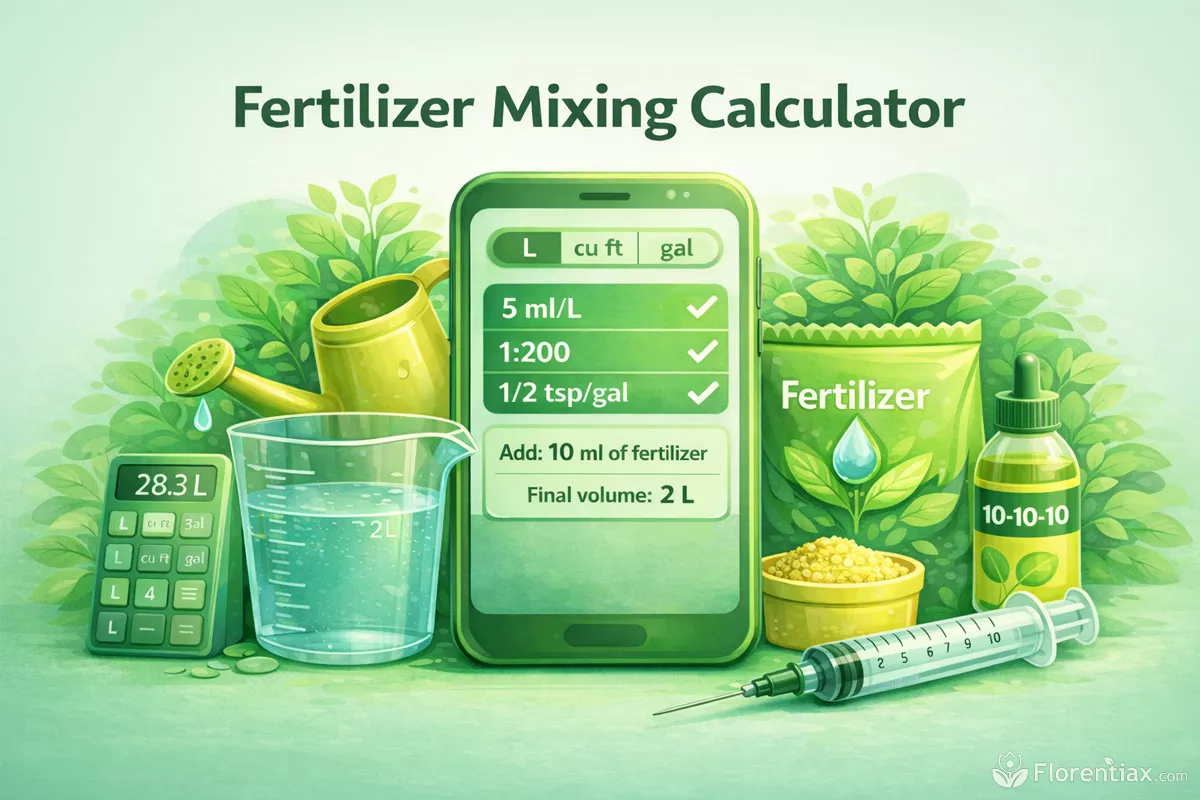 This fertilizer mixing calculator helps you calculate accurate fertilizer dilution and dosage for plants. Use it to determine how much fertilizer to add per liter or gallon, apply common 1:X ratios, and adjust strength for liquid or powder fertilizers. The calculator is designed for practical, everyday fertilizer mixing without unnecessary complexity.
This Fertilizer Mixing Calculator helps you calculate the exact amount of fertilizer concentrate for any target solution volume. It works for label dosing (ml/L, g/L, tsp/gal) and 1:X ratios, so you can mix consistently without guessing. You can also account for “extra” volume (waste, settling, leftover in the container) to avoid coming up short mid-watering.
What Is a Fertilizer Blending Calculator?
A fertilizer dilution calculator is a mixing tool that converts label directions into a precise amount of concentrate for the volume of water you plan to prepare. Most fertilizer labels are written as a dose per volume (for example, “5 ml per 1 L” or “1 tsp per 1 gal”), or as a dilution ratio (for example, “1:200”). If you mix a different volume than the label example, doing the math by hand often leads to rounding errors, unit confusion, or accidental overfeeding.
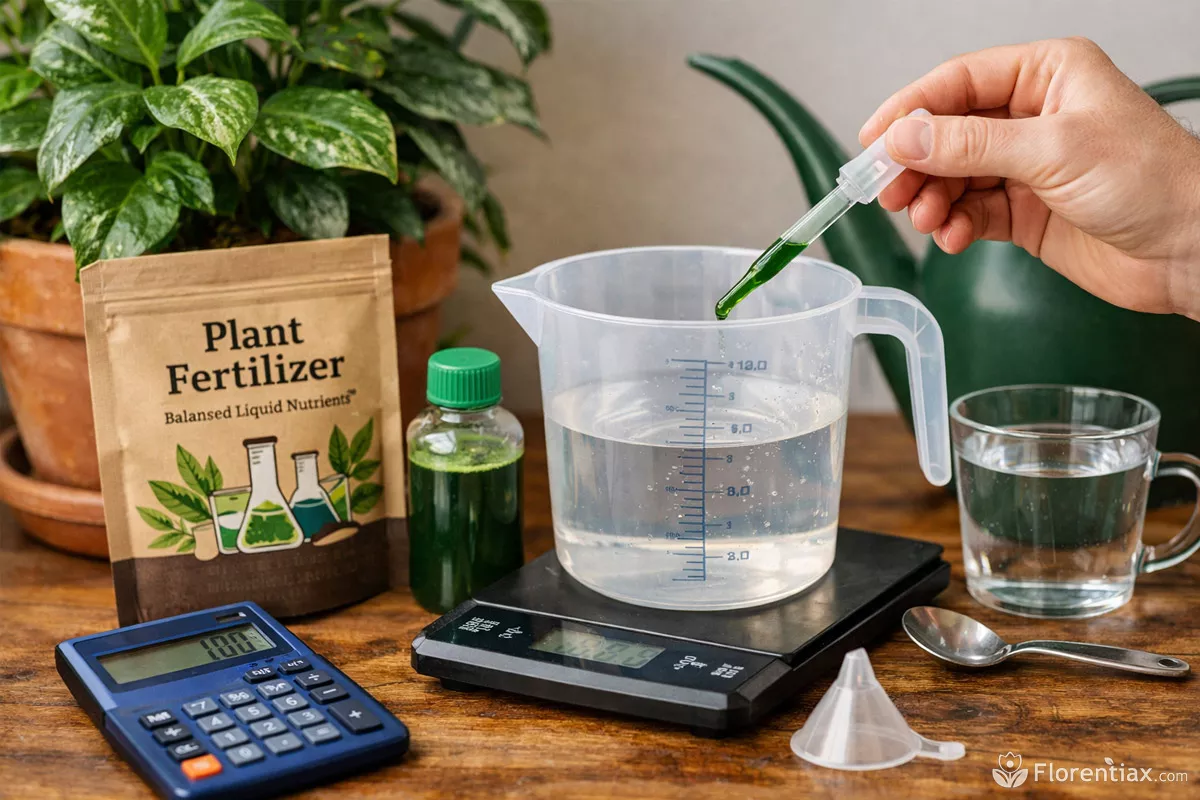
Using a calculator matters because fertilizer strength is concentration-based. A small mistake in measuring can noticeably change the final concentration, especially when you mix small batches for houseplants. Over-concentrated mixes can cause leaf burn and root stress, while under-dosed mixes may slow growth and lead to weak, pale foliage over time. Consistency is the real goal: when you mix the same strength each time, your plants experience stable nutrition, and you can actually evaluate whether your feeding schedule is working. Pairing this with a plant watering calculator helps keep both feeding strength and watering frequency aligned.
This type of calculator is also useful when you want to scale a recipe up or down. For example, you may need just 0.5 L for a few pots today, but 5 L when watering many plants. The calculation principle stays the same, but the numbers change quickly and it is easy to misplace a decimal. In practice, fertilizer planning often goes hand in hand with soil volume planning, which is why using a potting soil mix calculator alongside fertilizer calculations makes repotting and feeding more consistent and predictable.
In this tool, you can switch between Metric and US units and keep your input values aligned with what you can measure at home. That means you can mix in liters and milliliters, or in gallons and teaspoons, without rewriting the entire label math yourself.
How to Use the Fertilizer Calculator
Start by choosing the unit system that matches your measuring tools. If you use a kitchen measuring spoon set and a gallon jug, US units will feel natural. If you measure with a syringe, scale, or graduated bottle, Metric is usually faster and more accurate. After that, pick the mode based on how your fertilizer label describes mixing: dose-per-volume or 1:X ratio.
Next, enter the target solution volume you want to prepare. This is the final amount of mixed fertilizer solution you want in your container. If you often lose a bit of solution to container walls, settling, or leftover in a watering can, enable the extra percentage so you still end up with the amount you intended to use.
Accurate fertilizer dosing works best when combined with proper watering technique. Knowing how to water indoor plants correctly helps prevent excess moisture buildup, which can amplify fertilizer stress and increase the risk of root damage.
Finally, choose your strength. If you are following the label exactly, use Full strength. If you are feeding sensitive plants or you are not sure how they will respond, a reduced strength is safer and often recommended for indoor plants. The calculator applies your selected strength to the final concentrate amount so you do not have to re-calculate manually.
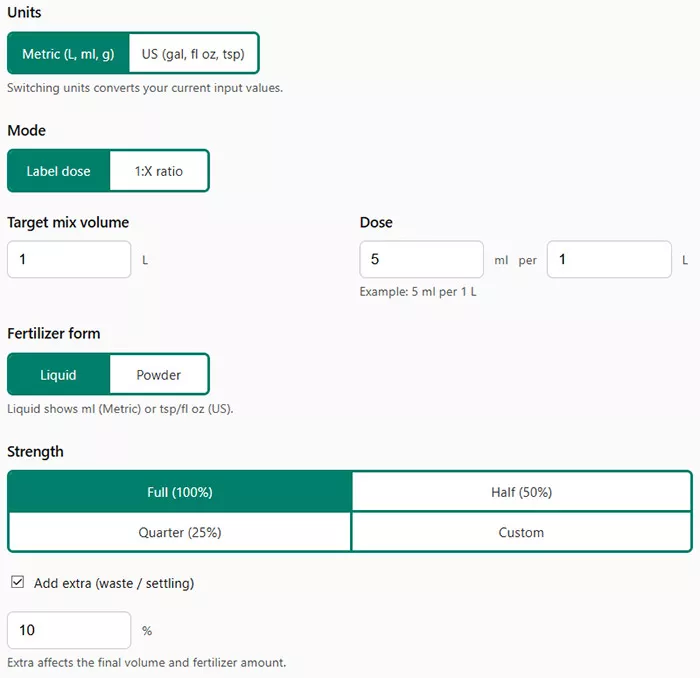
To make the workflow crystal clear, use this checklist:
- Select Units (Metric or US) so your measurements match your tools.
- Select Mode: Label dose for “X per Y,” or Ratio for “1:X.”
- Enter Target mix volume (the final amount you want to prepare).
- Enter the label dose (and its “per” volume) or enter the ratio X value.
- Select Fertilizer form (Liquid or Powder) so the calculator shows the right measuring unit.
- Select Strength (Full, Half, Quarter, or Custom if you want a specific percentage).
- Optional: Enable Extra and enter a percent if you want a little more final solution.
- Click Calculate and follow the mixing steps shown in the results.
If your label is in different units than the calculator’s current unit system, switch units first and then type the label exactly as written. This avoids “double converting” and keeps your dosing accurate. For best consistency, measure liquid concentrate with a syringe or graduated cylinder and measure powder with a small digital scale.
Fertilizer Dilution Explained
Fertilizer dilution describes how concentrated the final nutrient solution is after fertilizer and water are mixed together. In practical terms, dilution answers one simple question: how strong is the solution your plants will actually receive. Even when two people use the same fertilizer, different dilution choices can lead to very different results.
Most fertilizer labels express dilution in one of two ways: a dose per unit of water (for example, milliliters per liter or teaspoons per gallon) or as a ratio. Both methods describe the same idea, but they require different inputs. Understanding dilution helps you avoid common mistakes, such as preparing a solution that is too strong just because the water volume is smaller than the label example.
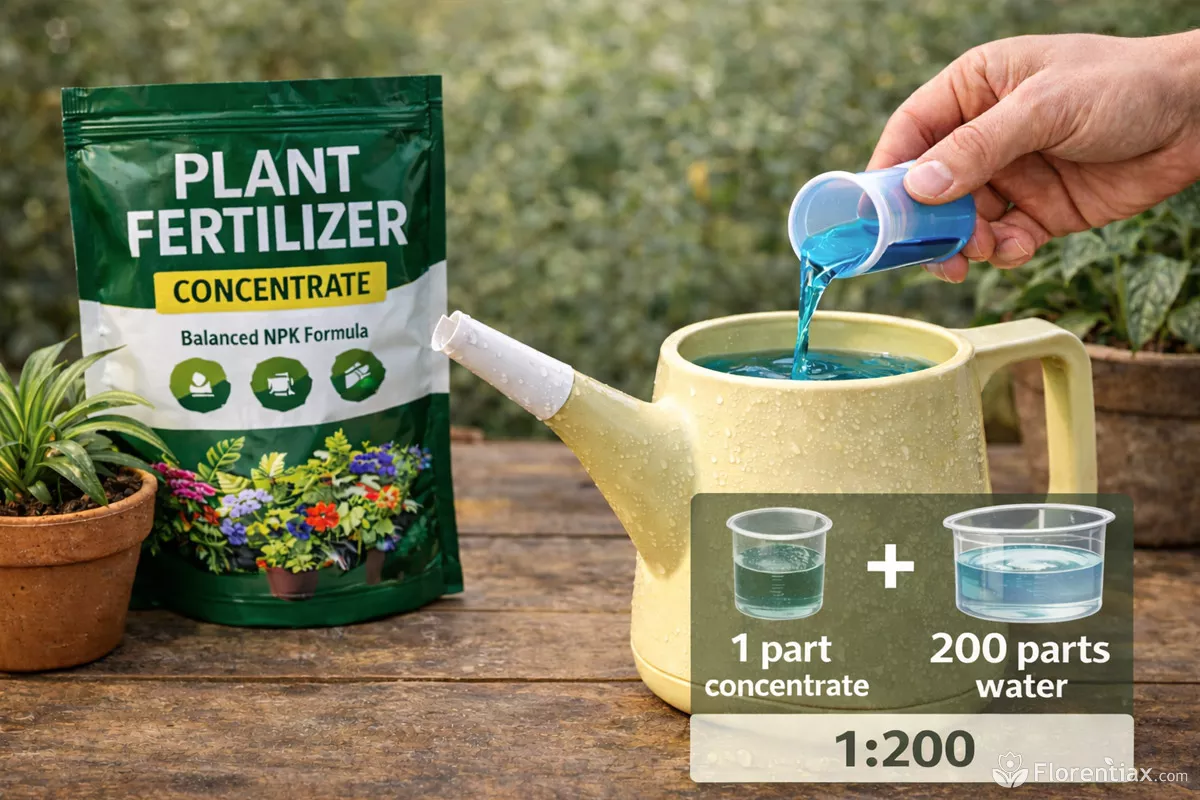
Dilution is especially important when blending fertilizer for houseplants, seedlings, or sensitive species. Small containers magnify errors because nutrient concentration directly influences how soil affects plant roots: adding just a little too much concentrate can noticeably increase the final strength. A calculator keeps dilution consistent so that each feeding matches the intended concentration.
| Label format | What it means | How to enter it in the calculator |
|---|---|---|
| 5 ml per 1 L | Fixed dose for each liter of water | Mode: Label dose, Dose = 5, Per = 1 L |
| 1 tsp per 1 gal | Fixed dose per gallon | Mode: Label dose, Units = US, Dose = 1 tsp, Per = 1 gal |
| 2 g per 1 L | Powder fertilizer by weight | Form = Powder, Dose = 2 g, Per = 1 L |
| 1:200 | One part concentrate to 200 parts water | Mode: Ratio, X = 200 |
When you follow label-style dilution, the calculator scales the dose automatically to your chosen volume. This makes it easy to prepare anything from a small spray bottle to a large watering can while keeping the same nutrient concentration.
Understanding Fertilizer Ratios (1:X)
Fertilizer ratios describe dilution using parts instead of fixed volumes. A ratio written as 1:X means one part fertilizer concentrate mixed with X parts water. The final solution therefore contains a total of X + 1 parts. This system is common for concentrated products and professional formulations.
Ratio-based mixing is flexible but easy to misunderstand. Many people assume that 1:200 means one part fertilizer in 200 parts total solution, which is incorrect. In reality, it means one part fertilizer plus 200 parts water. The calculator handles this automatically so you do not have to remember the math.
Ratios are often used when blending fertilizer in larger batches or when the exact measuring unit does not matter, only the proportion. For example, you can treat a “part” as a milliliter, a cup, or any other consistent unit. What matters is keeping the same proportion between concentrate and water.
| Ratio | Concentrate per 1 L | Concentrate per 1 gal |
|---|---|---|
| 1:50 | ≈ 19.6 ml | ≈ 2.6 fl oz |
| 1:100 | ≈ 9.9 ml | ≈ 1.3 fl oz |
| 1:200 | ≈ 5.0 ml | ≈ 0.7 fl oz |
| 1:500 | ≈ 2.0 ml | ≈ 0.26 fl oz |
Liquid vs Powder Fertilizers
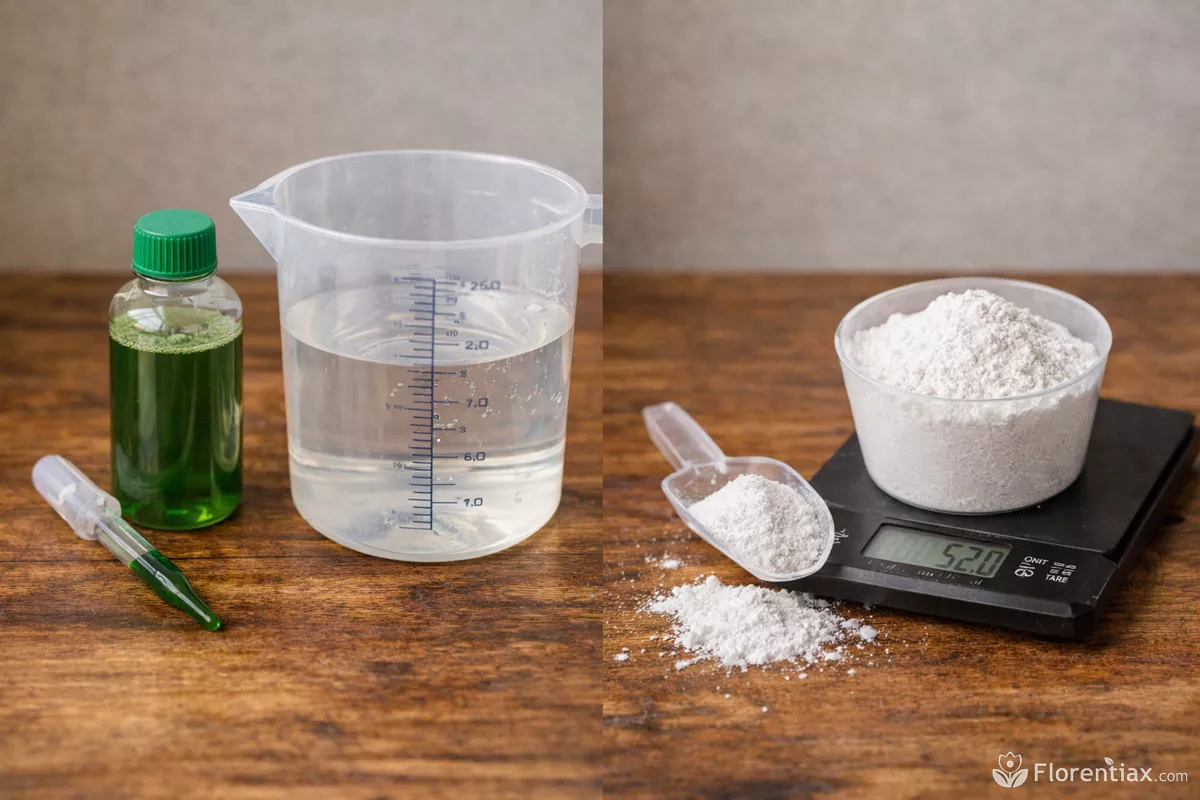
Fertilizers are commonly sold in two forms: liquid concentrates and dry powders. Both deliver nutrients effectively, but they behave differently during mixing and require slightly different handling. Choosing the correct form in the calculator ensures the dosage is interpreted correctly and prevents unit mistakes.
Liquid fertilizers are typically measured by volume and are easier to blend evenly with water. They are popular for routine feeding, especially for houseplants and container plants, because small adjustments are simple to make. Liquid products are often labeled in milliliters per liter or teaspoons per gallon.
Powder fertilizers are measured by weight and usually offer higher concentration and longer shelf life. They require more precision when mixing, since small errors in grams can noticeably change the final strength. Powder is common for bulk feeding, outdoor use, or when blending custom nutrient recipes.
| Feature | Liquid Fertilizer | Powder Fertilizer |
|---|---|---|
| Measurement | Volume (ml, tsp, fl oz) | Weight (g) |
| Mixing speed | Dissolves instantly | May need stirring or warm water |
| Best for | Indoor plants, frequent feeding | Bulk mixing, precise recipes |
| Calculator input | Dose per volume or ratio | Grams per volume or ratio |
When using the calculator, always match the fertilizer form to the product you are using. Selecting the wrong form can lead to incorrect units and inaccurate blending, especially when switching between metric and US systems.
Example Fertilizer Mixing Calculations
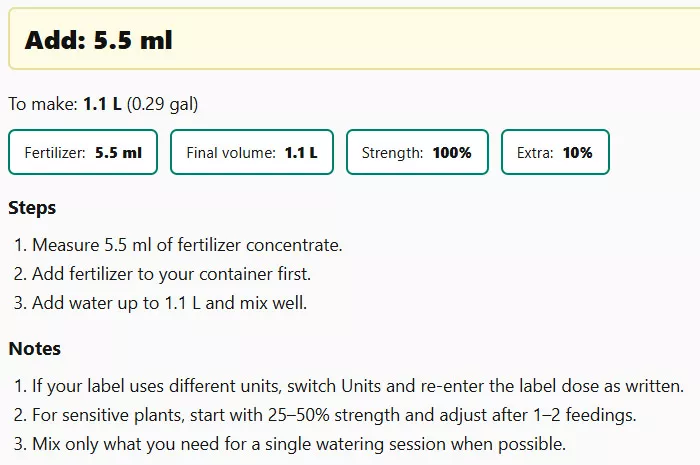
Seeing real examples makes fertilizer blending easier to understand. Below are common mixing scenarios that show how label instructions translate into exact amounts using the calculator. These examples apply equally to mixing, dilution, and blending for different container sizes.
Each example assumes clean measuring tools and fresh water. For sensitive plants or first-time use, it is always safer to start at half or quarter strength and observe plant response before increasing concentration.
| Scenario | Label instruction | Target volume | Fertilizer to add |
|---|---|---|---|
| Houseplant feeding | 5 ml per 1 L | 2 L | 10 ml liquid fertilizer |
| Seedling tray | 1:200 ratio | 1 L | ≈ 5 ml concentrate |
| Outdoor watering can | 1 tsp per 1 gal | 2 gal | 2 tsp liquid fertilizer |
| Powder fertilizer mix | 2 g per 1 L | 5 L | 10 g powder fertilizer |
These examples highlight how the calculator scales fertilizer amounts automatically. Whether you are blending a small indoor mix or preparing a larger batch outdoors, the same logic applies, helping you keep nutrient strength consistent across every feeding.
Frequently Asked Questions
This section answers the most common questions about fertilizer dilution, mixing, and safe use. These clarifications help you understand how the calculator works in real-world situations and how to avoid typical mistakes when blending fertilizer solutions.
1. What does a fertilizer calculator actually calculate?
The calculator determines the exact amount of fertilizer concentrate needed for a specific water volume. It converts label instructions, ratios, or blending rules into precise, measurable amounts so the final solution matches the intended strength.
2. Is fertilizer dilution the same as fertilizer mixing?
They are closely related but not identical. Dilution refers to how strong the final solution is, while mixing (or blending) describes the physical process of combining fertilizer with water. The calculator handles the dilution math so mixing becomes straightforward.
3. Can I use this calculator for both liquid and powder fertilizers?
Yes. The calculator supports liquid fertilizers measured by volume and powder fertilizers measured by weight. You simply select the fertilizer form so the units and calculations remain accurate.
4. What does a 1:X fertilizer ratio mean?
A 1:X ratio means one part fertilizer concentrate mixed with X parts water. The total solution contains X plus one parts. For example, 1:200 means one part fertilizer and 200 parts water, not 200 parts total.
5. Why does the calculator hide strength options in ratio mode?
Ratios already define the concentration mathematically. Adding percentage strength on top of a ratio can cause confusion or double adjustment, so the calculator locks the strength at 100 percent for clarity and safety.
6. What is the purpose of the strength presets (full, half, quarter)?
Strength presets reduce the original label dose proportionally. They are useful for sensitive plants, young plants, or maintenance feeding where full-strength fertilizer may be too strong.
7. When should I use the extra percentage option?
The extra option is helpful when you expect some solution loss due to spillage, absorption by soil, or container residue. It slightly increases the total volume so you still end up with the desired usable amount.
8. Is it safe to mix fertilizer stronger than the label recommendation?
In most cases, no. Stronger solutions increase the risk of root burn and nutrient toxicity. If higher feeding is required, it should be based on specific plant needs and experience, not guesswork.
9. Can I switch between metric and US units?
Yes. The calculator converts existing values when you change units, helping you move between liters and gallons or milliliters and teaspoons without recalculating manually.
10. Why do small volume mixes need extra accuracy?
Errors become more significant in small volumes. Adding even a small excess of concentrate to a one-liter or one-quart mix can noticeably increase fertilizer strength, which is why precise calculation matters. If you notice pale growth or chlorosis after feeding, it helps to review other yellow leaves on plants causes to separate nutrient issues from watering, light, or root problems.
11. Does this calculator replace fertilizer label instructions?
No. The calculator follows label-style dosing logic, but the product label should always be considered the primary reference. If instructions differ, the label instructions take priority.
12. How often should I recalculate fertilizer amounts?
You should recalculate whenever the water volume, fertilizer type, ratio, or desired strength changes. Different plants, seasons, and growth stages often require different feeding strategies.
In summary, a fertilizer calculator simplifies dilution, mixing, and blending by removing manual math and reducing error. Used correctly, it helps maintain consistent nutrient delivery, supports healthier plant growth, and minimizes the risk of overfeeding.