Abies — Evergreen Fir Tree With Cold-Climate Growing Needs

 This article explains Abies firs, from their botanical profile and native mountain range to their shape, needles, and mature form. It covers light needs, soil and watering balance, frost tolerance, maintenance, propagation, seasonal dormancy, and common pests, diseases, and stress signs.
- Fir tree overview and botanical profile
- Abies balsamea (Balsam fir)
- Types of fir trees (Abies) and key differences
- Native mountain habitats and natural range
- Shape, needles, and mature growth form
- Light exposure for healthy fir development
- Soil structure and watering balance for Abies
- Temperature tolerance and frost resilience
- Routine maintenance for strong evergreen growth
- Propagation from seed and young saplings
- Seasonal needle growth and dormancy cycle
- Common pests, diseases, and stress symptoms in fir trees
For a reliable evergreen fir that stays attractive through long winters, Abies is a strong choice. These cold-climate conifers do best where summers are mild and soil remains evenly moist yet well drained. They may decline in heat, drought, or compacted ground. Learning their preferred site and basic care early helps prevent common planting mistakes and supports steady, healthy growth.
Fir tree overview and botanical profile
Abies (true firs) are evergreen conifers best known for their tidy, conical form, soft-looking needles, and strong preference for cool, moist conditions. They’re a common sight in mountains and northern forests, where summers are mild and winters are reliably cold. In landscapes, they’re often chosen for year-round structure, screening, and that classic “holiday tree” silhouette.
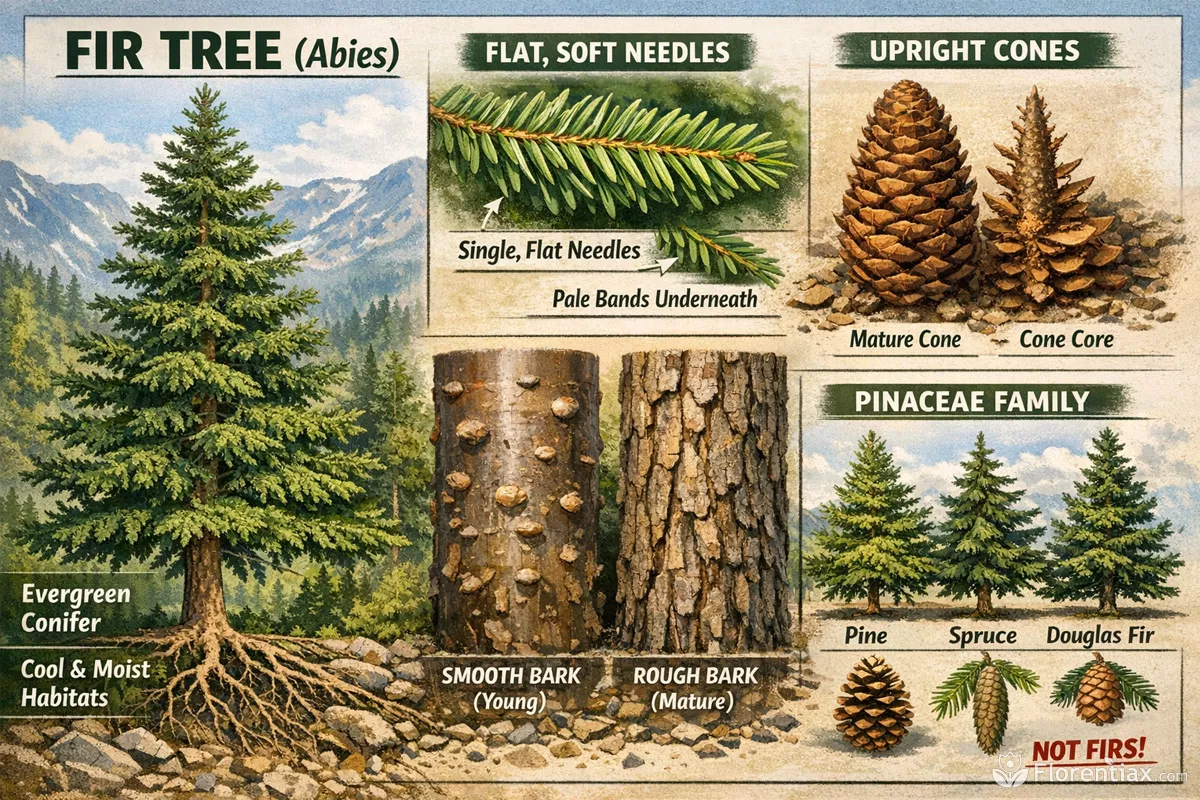
Botanically, firs sit in the pine family (Pinaceae) and are distinct from look-alikes such as spruces, pines, and Douglas-fir. The easiest way to recognize a true fir is to check the needles and cones: needles are typically flat and attached singly, and the cones stand upright on the branches rather than hanging down.
- Genus: Abies (true firs)
- Plant type: Evergreen coniferous tree
- Native range: Mainly the Northern Hemisphere, especially cool-temperate and montane regions
- Typical habit: Narrow to broad pyramidal crown; strong central leader when young
- Needles: Usually flat, soft to the touch, often with pale bands (stomata) beneath; arranged singly rather than in bundles
- Cones: Upright on branches; they often break apart at maturity, leaving a central spike-like core
- Bark: Smooth and resin-blistered when young on many species, becoming furrowed or scaly with age
- Roots: Commonly shallow to moderately deep depending on soil; dislike hot, dry, compacted sites
| Feature | What it looks like on a true fir (Abies) | Why it matters for ID |
|---|---|---|
| Needle attachment | Single needles attached with a small, round “suction-cup” base; twig feels relatively smooth after needles drop | Helps separate firs from spruces, which leave rough pegs on the twig |
| Needle shape | Usually flat (not square), often flexible; tips may be blunt or slightly notched | Flat needles are a quick clue when comparing to many spruces |
| Cone position | Cones stand upright like candles | Upright cones are a hallmark of Abies in the landscape |
| Cone behavior at maturity | Cones tend to disintegrate on the branch, shedding scales and seeds | You may rarely find whole cones on the ground under a mature specimen |
| Fragrance/resin | Resin can be aromatic; some species have noticeable balsam scent | Useful supporting trait when needles are crushed (not definitive alone) |
Growth rate and mature size vary widely by species and site, but most Abies develop best where summers stay on the cool side and soil holds moisture without becoming waterlogged. In warmer regions, the same traits that make them elegant—dense foliage and shallow, moisture-sensitive roots—can turn into stress points, so matching the species to your climate is the key first step.
Abies balsamea (Balsam fir): key traits and where it grows
Abies balsamea, commonly called balsam fir, is one of the best-known North American true firs and a classic “holiday tree” species. It is valued for its narrow, tidy pyramidal crown, soft flattened needles, and a strong resinous fragrance. In cool, moist climates it stays dense and glossy for years, but it can decline quickly in persistent heat, drought, or compacted soils.
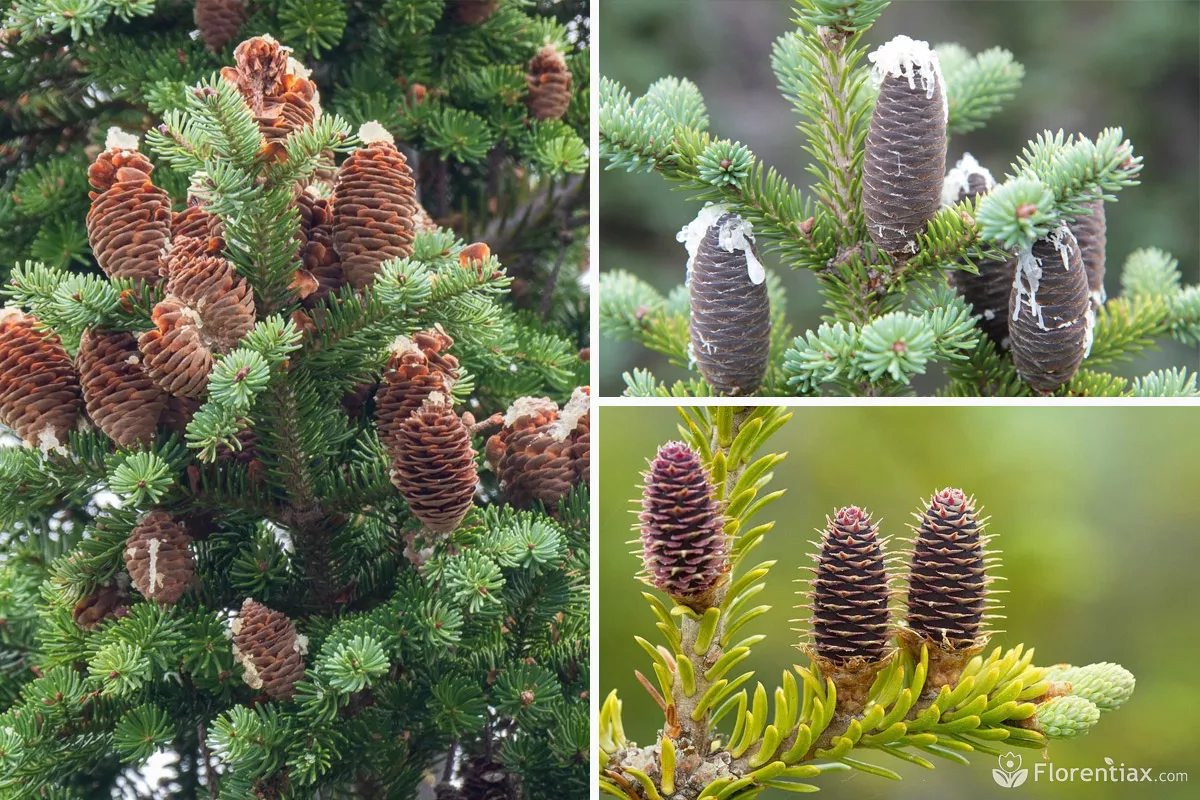
This species is especially recognizable by its upright cones that develop on upper branches. Cones often start purple to dark violet, then turn brown as they mature. Like other true firs, the cones typically break apart on the tree, so you may notice cone scales under the canopy rather than whole cones on the ground.
- Needles: Short, flat, and soft; typically dark green above with pale bands beneath; aromatic when crushed.
- Buds and resin: Buds are often sticky and resin-rich, which explains the “balsam” name.
- Cones: Stand upright like candles; young cones can be purple; they disintegrate at maturity.
- Bark: Smooth and gray when young, often with resin blisters; becomes rougher with age.
- Landscape value: Strong choice for screens in cold climates; widely grown as a Christmas tree.
Native range and habitat: Balsam fir is native to northeastern North America, including much of eastern and central Canada and the northern United States. In the wild it commonly grows in boreal and cool-temperate forests, thriving where summers are mild, humidity is moderate to high, and soil stays consistently moist. It is often found in mixed conifer stands, on cool slopes, and in areas influenced by snowmelt.
Care note: Treat it like a mountain/boreal tree — keep roots cool, maintain even moisture, and ensure good drainage. Full sun is best in cool climates, while light afternoon shade helps in warmer zones. Avoid heat-reflective spots near pavement, and keep a wide mulch ring to stabilize moisture and soil temperature.
Types of fir trees (Abies) and key differences
The genus Abies includes dozens of true fir species, and they can look similar at first glance. The quickest way to tell them apart is to compare needle length and color, cone appearance, fragrance, and climate preference. Below are some of the most common and widely planted firs, with short identification clues.
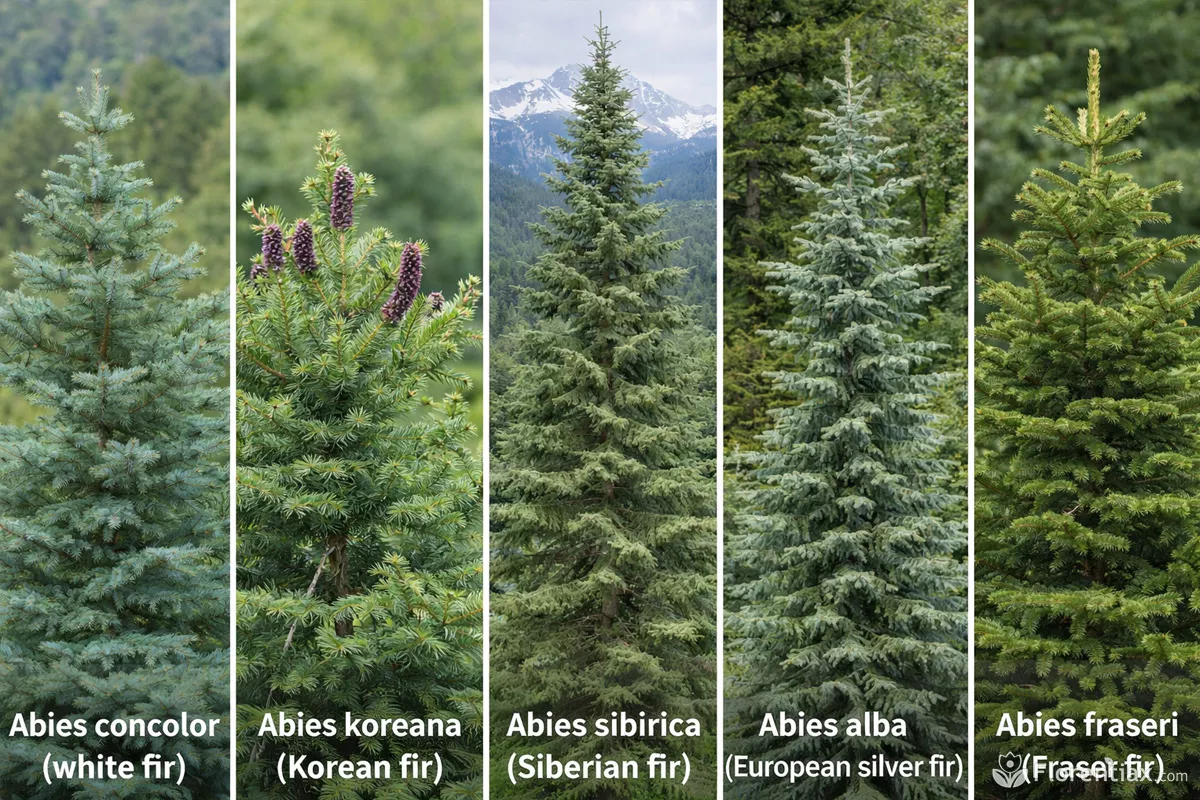
- Abies balsamea (balsam fir) — strong balsam scent, resinous buds, young cones often purple; best in cool, moist climates (NE North America).
- Abies nordmanniana (Nordmann fir) — very dense, symmetrical crown, glossy dark needles; excellent as an ornamental and Christmas tree (Caucasus region).
- Abies concolor (white fir) — longer blue-green needles, softer look, better heat and drought tolerance than most firs (western North America).
- Abies koreana (Korean fir) — compact growth, short needles, showy purple upright cones even on young trees; popular in gardens (Korea).
- Abies sibirica (Siberian fir) — narrow crown, very cold-hardy, strongly aromatic foliage; suited to harsh winters (Siberia and northern Asia).
- Abies alba (European silver fir) — large forest tree, smooth gray bark when young, long-lived; prefers cool mountain climates (central and southern Europe).
- Abies fraseri (Fraser fir) — short needles with silvery underside, strong upward-curving needles, good needle retention; widely used as Christmas tree (Appalachians).
If your goal is the best landscape performance, match the species to your summer temperatures and soil moisture. In warm regions, Abies concolor is often the most forgiving, while in cold, humid climates Abies balsamea and Abies fraseri stay dense and healthy with consistent moisture and good drainage.
Native mountain habitats and natural range

Fir trees in the genus Abies are built for cool summers, long winters, and steady moisture. In the wild, they most often occupy higher elevations where temperatures stay moderate, snowpack insulates roots, and mountain air reduces heat stress. That origin story explains why many firs struggle in lowland sites with hot nights, dry winds, or compacted soils.
Across the Northern Hemisphere, true firs form forests on slopes and in high valleys, commonly mixing with spruce, pine, hemlock, cedar, and mountain hardwoods depending on the region. Their distribution is broad, but their best growth tends to cluster in places with reliable precipitation and well-drained, acidic to slightly acidic soils.
- Elevation and climate: Many species are montane to subalpine, thriving where summers are short and cool and winter cold is consistent rather than erratic.
- Moisture patterns: Natural stands often rely on snowmelt and frequent fog or orographic rainfall; droughty ridges and rain-shadow basins are less typical.
- Soils and drainage: Firs favor deep, porous soils that stay evenly moist yet drain well. Waterlogged ground can invite root problems, while thin, rocky soils can limit establishment.
- Exposure: Seedlings commonly start in sheltered microsites (north-facing slopes, leeward sides of rocks/logs) where sun and wind are less intense.
- Disturbance and regeneration: Many Abies regenerate under partial shade after small canopy gaps, though some species also recolonize after larger disturbances when moisture is adequate.
| Region | Where true firs commonly occur | Typical conditions they’re adapted to |
|---|---|---|
| Western North America | Coastal ranges, Cascades, Sierra Nevada, Rockies | Snowy winters; cool, often dry summers moderated by elevation; frequent mountain precipitation gradients |
| Eastern North America | Northeastern forests and high Appalachians | Cold winters; humid growing seasons; acidic forest soils with consistent moisture |
| Europe and the Mediterranean mountains | Alps, Carpathians, Balkans, Pyrenees, Apennines | Cool upland climates; winter snow; summer heat tempered by altitude, with drought sensitivity in warmer zones |
| East Asia | Himalayas, western China, Korea, Japan, Russian Far East | Monsoon-influenced moisture in many areas; cold winters; cloud/fog belts that reduce summer stress |
If you’re trying to match a fir to your yard, think like a mountain: cooler nights, protection from drying wind, and soil that holds moisture without staying soggy. When those pieces line up, Abies tends to look dense, glossy, and calm; when they don’t, the tree often shows it through thin growth, needle browning, or poor recovery after heat waves.
Shape, needles, and mature growth form
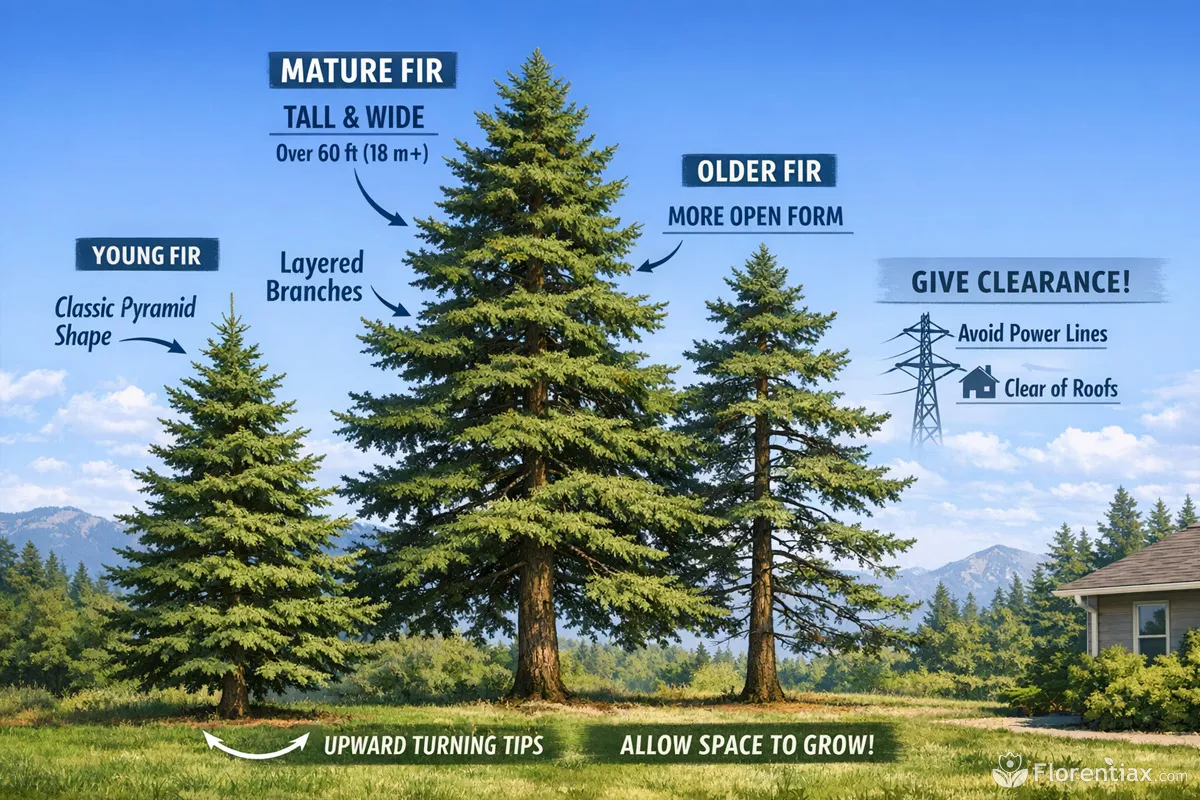
Firs (Abies) tend to read as “classic Christmas tree” conifers: a strong central trunk, evenly spaced tiers of branches, and a clean, symmetrical outline when they have enough light and room. In the landscape, that tidy look is most reliable in youth; older specimens can broaden, open up, or lose lower limbs as shade increases or snow load and wind take their toll.
- Overall silhouette: Usually narrow to broadly pyramidal, with a clear leader (top stem) and whorled branching. Many species keep a formal outline for decades, while others become more columnar or irregular with age.
- Branching habit: Branches often sweep slightly upward at the tips, creating layered “shelves.” Lower branches may persist in open sites but commonly thin out in crowded plantings or deep shade.
- Mature size and spacing: Expect a substantial footprint. Even “moderate” firs can become tall and wide over time, so give them clearance from roofs, power lines, and narrow side yards.
Needles are one of the easiest ways to recognize a true fir. They are typically soft to the touch, attached singly (not in bundles), and many species show a neat, combed look along the twig. Flip a spray over and the underside often reveals pale bands that make the foliage look silvery in wind.
- Needle attachment: Needles connect to the twig with a small, suction-cup-like base, leaving a smooth twig when removed (unlike spruces, which leave rough pegs).
- Needle arrangement: Often two-ranked (flattened sprays) on shaded branches; more radial and brushy on sun-exposed shoots.
- Color and texture: Ranges from deep green to blue-green or gray-green; many have a glossy upper surface and lighter undersides.
- Fragrance: When crushed, needles and buds are usually resinous and pleasantly aromatic, though intensity varies by species.
As they mature, Abies develop a sturdier, more architectural presence. Bark typically starts smooth and gray, then becomes more furrowed or plated with age. Cones are another hallmark: they stand upright on the branches and tend to break apart on the tree, so you’re more likely to find cone scales on the ground than a whole cone.
| Feature | What you’ll notice on Abies | Why it matters in the garden |
|---|---|---|
| Leader and crown | Strong central leader; pointed crown in youth | Protect the top from breakage; a damaged leader can make the tree look uneven |
| Lower branches | Can persist in open sun; may thin in shade | Plan for the eventual “skirt” width or for clearance if lower limbs are removed |
| Needle underside | Often shows pale stomatal bands | Gives a two-tone effect; helps with ID and adds visual movement in wind |
| Cones | Upright cones that disintegrate on the tree | Less cone litter as whole cones, but expect scattered scales beneath mature trees |
If you want the most balanced form, prioritize even light exposure and avoid tight spacing. Firs that are shaded on one side often lean or thin on the darker side, and heavy, wet snow can splay branches outward. Gentle corrective pruning is best limited to removing dead or broken wood; cutting back into older, leafless sections rarely produces dense regrowth on a fir.
Light exposure for healthy fir development
Give firs steady, bright conditions and they’ll reward you with dense needles and even branching. Most Abies species grow best with full sun to light shade, but the “right” amount depends on your summer heat, wind, and how reflective your site is (snow, pale walls, pavement).
If you’re planning a full-sun planting area around the tree, pick companions that won’t suffer in bright exposure — see plants that grow in full sun.
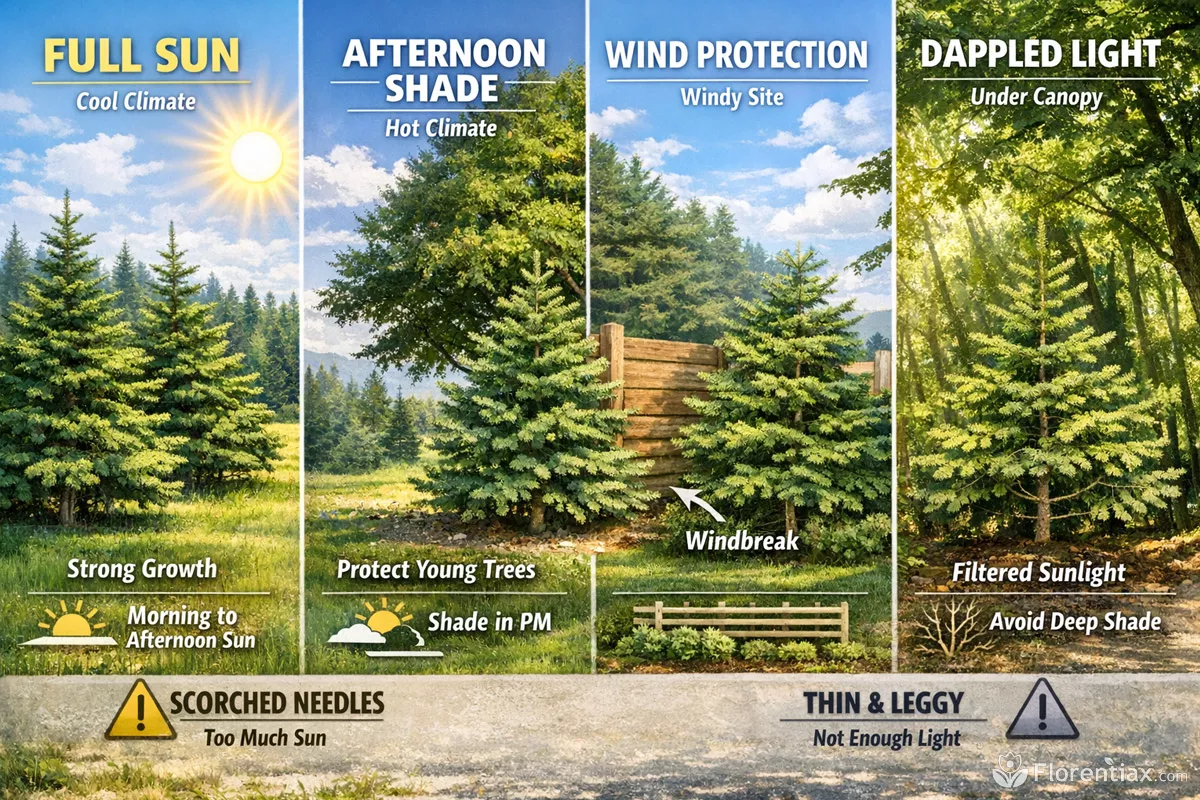
- Cool-summer climates: Aim for full sun for the tightest growth and strongest bud set. Morning through late afternoon sun is usually ideal.
- Warm or high-UV sites: Provide afternoon shade, especially for young trees. Heat plus intense sun can dry needles faster than roots can replace moisture.
- Wind-exposed locations: Sun combined with winter wind increases needle desiccation. A spot with sun but some wind buffering (fence line, mixed border, or natural windbreak) helps.
- Under light canopy: Dappled light can work, but deep shade often leads to thin crowns, longer internodes, and sparse lower branches.
Use the tree’s behavior as your guide. If the leader is stretching with wide gaps between whorls, or the lower limbs are shedding early, it’s usually not getting enough sun. If needles look scorched on the south or west side, or new growth is short and stressed during hot spells, it’s often getting too much harsh afternoon exposure for that site.
| What you observe | Likely light issue | What to adjust |
|---|---|---|
| Open, “see-through” crown; sparse lower branches | Too much shade | Move to brighter exposure or thin nearby shade sources; avoid planting tight to buildings or dense hedges |
| Long, floppy shoots; wide spacing between branch whorls | Insufficient direct sun | Increase morning-to-midday sun; prioritize an unobstructed eastern or southern sky |
| Browned needle tips on sun-facing side after hot weather | Excessive afternoon sun/heat load | Add late-day shade (near taller shrubs/trees), mulch to cool roots, and keep soil evenly moist |
| Winter bronzing and needle drop on windward side | Sun + wind desiccation | Choose a less exposed spot; use a windbreak and maintain hydration going into freeze-up |
When planting, think ahead: firs often start tolerating a bit more sun as their roots establish, but they rarely “grow out of” deep shade. If you’re unsure, favor a location with strong morning light and some protection from late-day heat and winter wind—especially in continental climates where cold, bright days can be as stressful as summer sun.
Soil structure and watering balance for Abies
Fir roots do best when the ground stays evenly moist but never stagnant. Most Abies struggle in sites that swing between soggy soil and drought, so the goal is a soil profile that drains reliably while still holding enough water to buffer hot, windy days.
To keep the root zone in that “slightly moist, never waterlogged” range, use a simple watering rhythm — see watering indoor plants for balanced soil moisture (the moisture principles are the same, even for outdoor trees).
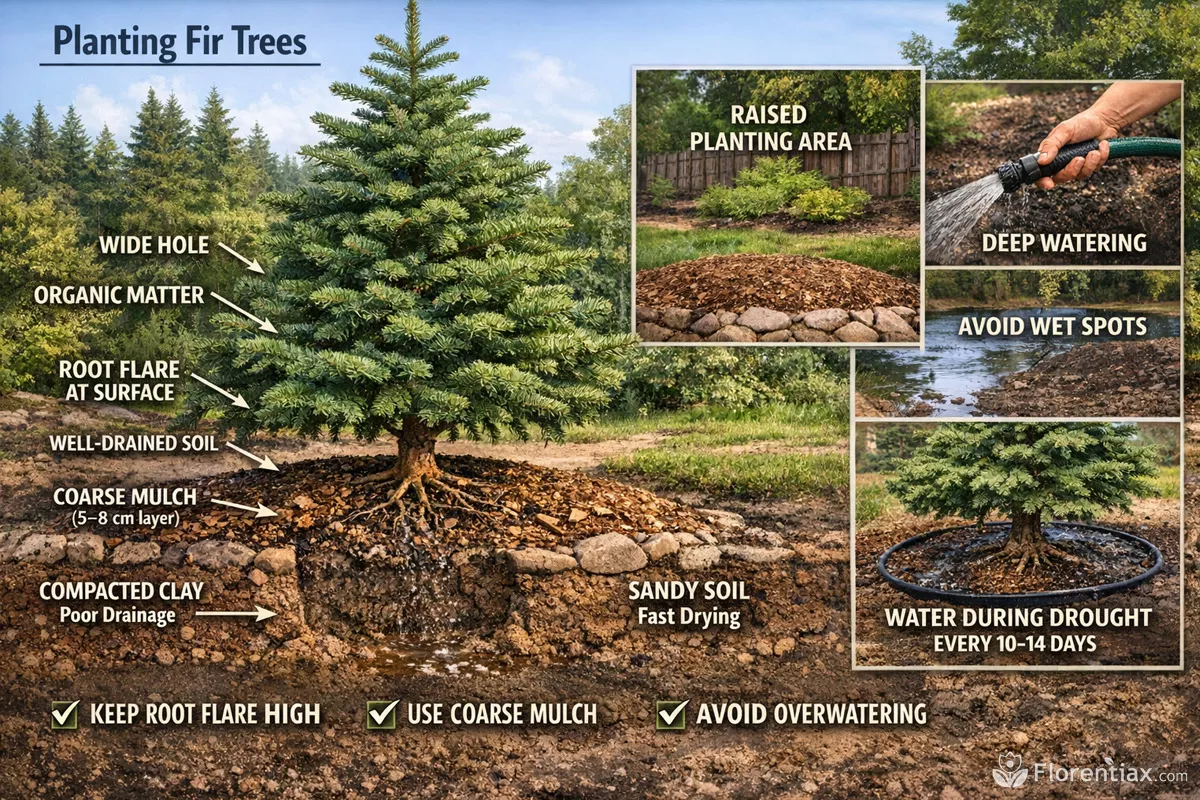
Start with structure: Abies generally prefer a loose, oxygen-rich root zone with plenty of organic matter. Compacted clay can suffocate fine feeder roots, while very sandy soils can dry too quickly in summer and leave trees stressed going into winter.
- Drainage first: If water sits on the surface after rain, improve the site before planting. A slightly raised planting area, wider planting hole, and organic matter worked into the surrounding soil (not just the hole) can help roots explore beyond a “pot” of amended soil.
- Organic matter helps balance moisture: Leaf mold, composted bark, or well-finished compost improves crumb structure and water-holding without turning the soil into a sponge.
- Keep the root flare high: Plant so the root flare is visible at the surface. Burying it encourages rot and makes watering problems worse.
- Mulch, don’t mound: A 5–8 cm layer of coarse mulch moderates temperature and slows evaporation. Keep it a few centimeters away from the trunk to avoid constant moisture against the bark.
| Soil / site condition | What Abies tends to do | Practical adjustment |
|---|---|---|
| Heavy clay, slow drainage | Yellowing needles, sparse growth, root decline from low oxygen | Plant slightly high, widen the planting area, incorporate organic matter broadly, avoid frequent shallow watering |
| Sandy or gravelly soil | Quick drying, tip burn during heat or wind | Add organic matter, mulch consistently, water deeper and less often |
| Compacted soil (foot traffic, construction) | Stunted growth, poor establishment, drought sensitivity | Loosen soil over a wide area, protect the root zone from traffic, keep mulch in place |
| Low spot / seasonal waterlogging | Higher risk of root rot and sudden decline | Choose a different location or build a raised berm; avoid planting where snowmelt pools |
Watering is about depth and timing. Newly planted firs need consistent moisture while roots expand, but they still dislike “wet feet.” Water slowly so moisture reaches the full root zone, then let the upper few centimeters begin to dry before watering again.
- First growing season: Deep soak 1–2 times per week in dry weather, adjusting for rainfall and soil type. The aim is steady moisture, not daily splashes.
- Years 2–3: Water less often but more deeply to encourage deeper rooting, especially during summer heat and in windy sites.
- Established trees: Irrigate during extended droughts. A long soak every 10–14 days is often better than frequent light watering.
- Late-season moisture matters: In cold climates, going into winter with dry soil can increase needle browning from winter desiccation. Water during autumn dry spells until the ground begins to freeze.
Two common mistakes are overwatering in cool weather and watering too close to the trunk. If the soil feels wet and cool several centimeters down days after irrigation, back off. If the surface is dry but the deeper soil is moist, that’s usually fine—mulch will help smooth out those swings.
Temperature tolerance and frost resilience
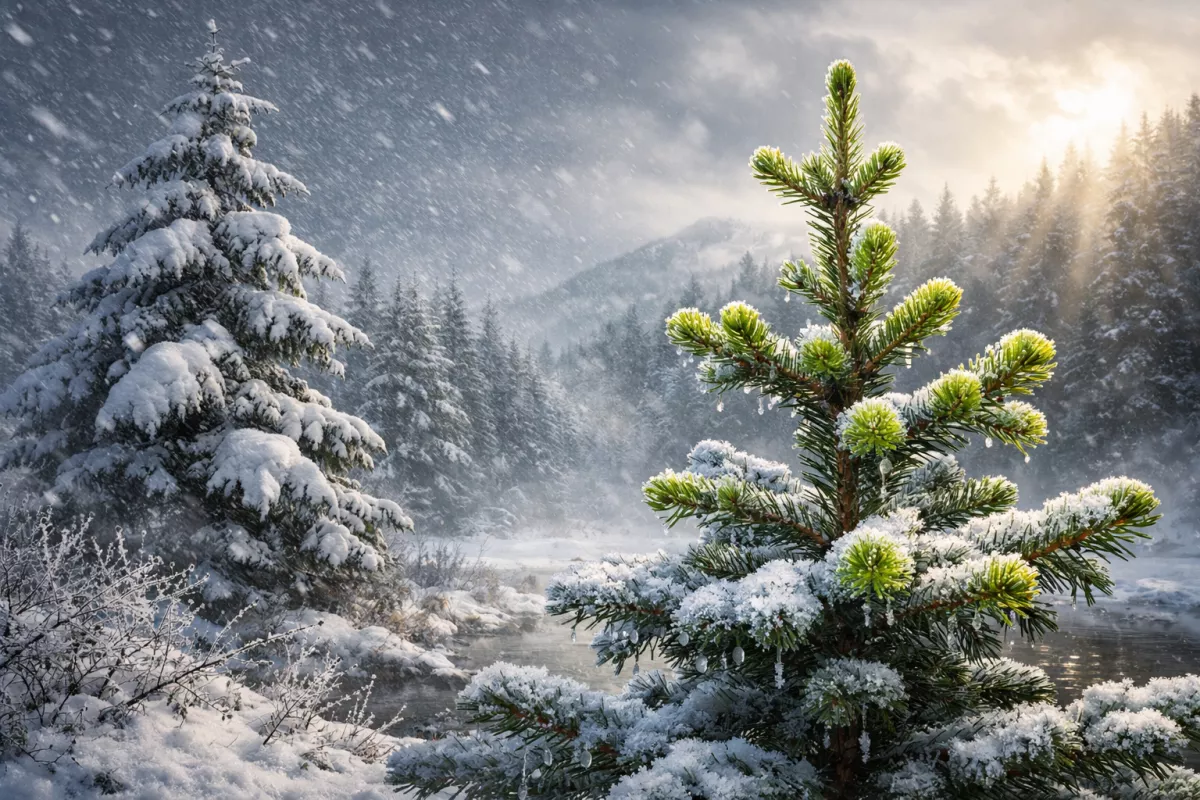
Firs (Abies) are built for long, cold winters, but their limits depend on species, provenance, and how quickly temperatures swing. Most handle sustained subfreezing weather well once established; the bigger risks are rapid freeze-thaw cycles, dry winter wind, and late spring cold snaps that hit tender new growth.
Cold hardiness isn’t just about the lowest number on a thermometer. A tree that has gradually “hardened off” in autumn can tolerate much lower temperatures than one pushed into soft growth by late-season fertilizing, heavy pruning, or an unusually warm fall. Likewise, a fir planted in a protected microclimate may avoid needle scorch and bud damage that the same species would suffer in an exposed site.
| Cold-weather situation | What can happen to Abies | Practical ways to reduce damage |
|---|---|---|
| Early fall freeze before the tree is fully dormant | Tip burn on new shoots; buds may be less prepared for deep cold later | Stop nitrogen fertilizing in late summer; avoid late pruning; keep soil evenly moist going into fall |
| Midwinter extreme cold with dry wind | Needle desiccation and “winter burn,” especially on sun- and wind-exposed sides | Plant with windbreaks; mulch the root zone; water during winter thaws if soil is dry and unfrozen |
| Freeze-thaw cycles (warm days, hard freezes at night) | Bark stress and cracking; roots can heave in poorly mulched soils; fluctuating dormancy can weaken buds | Maintain a consistent mulch layer; avoid dark hard surfaces near the trunk that amplify warming; don’t expose roots by cultivating late in the season |
| Late spring frost after budbreak | New candles and fresh needles blacken or curl; growth may be set back for the season | Choose later-flushing species or provenances for frost pockets; avoid low spots where cold air pools; don’t stimulate early growth with early heavy feeding |
| Heavy wet snow or ice loading | Branch bending or breakage; leaders can deform, affecting shape | Gently brush off snow soon after storms; use a soft tie to support a damaged leader; avoid shaking frozen branches |
- Young trees are more vulnerable. Recently planted Abies often suffer more from wind drying and root-zone freezing because their roots haven’t spread widely yet.
- Soil moisture matters as much as air temperature. Evergreens lose water through needles on sunny winter days; if the ground is frozen and dry, they can’t replace it.
- Site selection is a quiet advantage. North or east exposures warm more slowly in late winter, which can reduce premature bud activity and lessen sunscald.
- Recovery is usually possible. If only the newest growth is nipped by frost, the tree may push secondary buds later; prune dead tips only after you can clearly see what is alive.
If you regularly see browned needles on the windward side by late winter, treat it as a signal to adjust protection rather than a sign the fir “can’t take cold.” A thicker mulch, better wind shelter, and watering during mild spells often make the difference between cosmetic damage and a stressed tree going into spring.
Routine maintenance for strong evergreen growth
Keep firs (Abies) vigorous by focusing on steady moisture, cool roots, and light-touch pruning. These trees are built for cold climates, so most problems come from heat stress, compacted soil, or inconsistent watering rather than a lack of “feeding.” A simple seasonal routine prevents needle drop, sparse growth, and pest flare-ups.
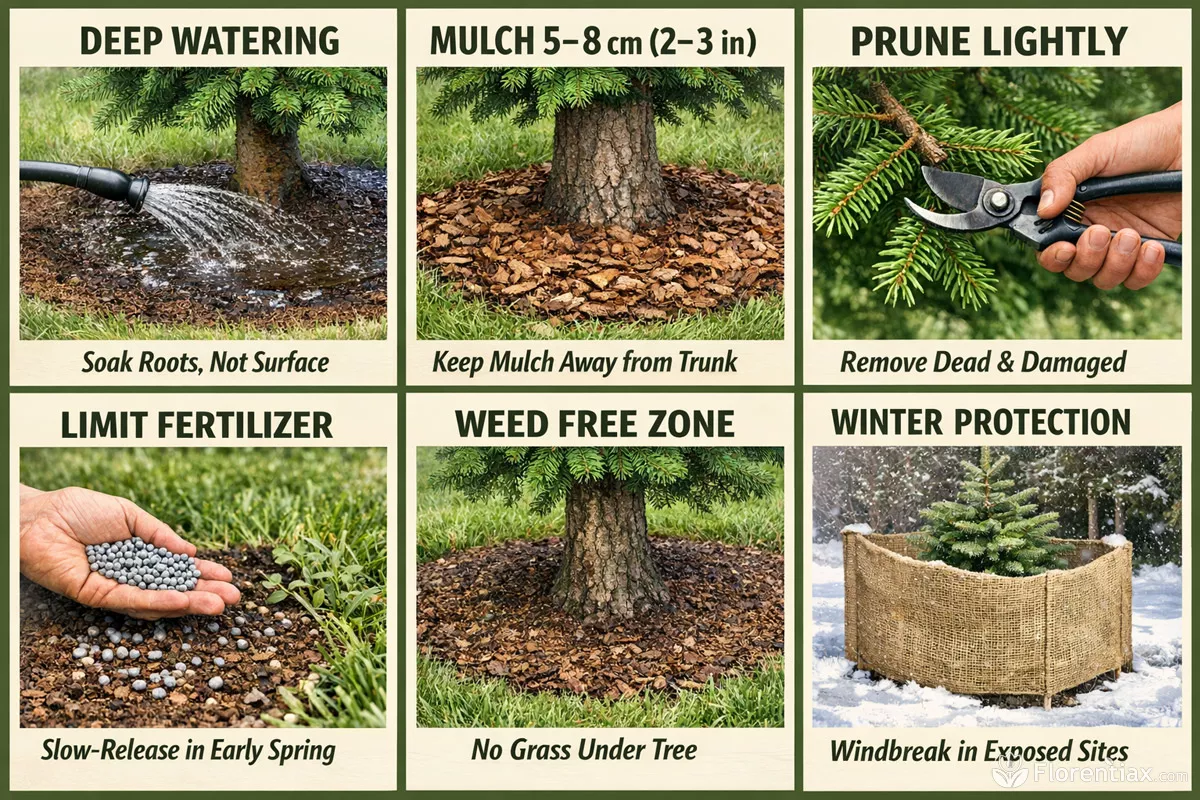
- Watering: Deep, infrequent soakings encourage deeper roots. During the first 2–3 years after planting, water whenever the top few inches of soil are drying out, especially in warm spells. Once established, irrigate during extended dry periods and in late summer if rainfall is scarce. Avoid daily sprinkling, which keeps the surface wet and can promote root issues.
- Mulch and root-zone care: Maintain a 5–8 cm (2–3 in) layer of wood chips or shredded bark over the root area to keep soil cool and evenly moist. Keep mulch pulled back a few centimeters from the trunk to prevent bark staying damp. Don’t cultivate deeply under the canopy; fir roots are often shallow and easily damaged.
- Fertilizing: Feed only if growth is weak or a soil test indicates a need. If you do fertilize, apply a slow-release, balanced product in early spring as buds begin to swell. Skip high-nitrogen pushes that create soft growth prone to winter injury, and never fertilize late in the season when the tree should be hardening off.
- Pruning: Minimal pruning is best. Remove dead, broken, or rubbing branches any time, but do most shaping in late winter while the tree is dormant. Avoid cutting into bare old wood; firs don’t reliably resprout from leafless sections. If a leader is damaged, select a strong upright side shoot and gently stake it to re-form a single top.
- Weed and grass competition: Keep a weed-free ring under the canopy. Turf right up to the trunk competes for water and warms the soil, which can stress Abies in milder climates.
- Winter and wind protection: In exposed sites, wind can desiccate needles when the ground is frozen. A windbreak (even temporary burlap screening) can help young trees. Water well before the soil freezes if autumn is dry.
| Season | What to do | What to avoid |
|---|---|---|
| Late winter to early spring | Inspect for winter damage; prune dead or crossing limbs; apply slow-release fertilizer only if needed; refresh mulch. | Heavy pruning into old wood; fertilizing without a reason. |
| Spring to early summer | Monitor new “candle” growth; water deeply during dry spells; check for aphids/adelgids on tender shoots. | Frequent shallow watering; compacting soil around the root zone. |
| Mid to late summer | Prioritize consistent moisture and cool soil; watch for spider mites in hot, dusty conditions; keep weeds down. | High-nitrogen feeding; letting mulch thin out and soil bake. |
| Autumn | Water before freeze-up if rainfall is low; remove fallen debris from the trunk area; plan any site adjustments for drainage. | Late-season fertilizing; pruning that stimulates fresh growth. |
When needles yellow or drop from the inside of the canopy, check the basics first: soil moisture swings, poor drainage, and heat reflected from pavement are common triggers. If you need a quick symptom checklist, see why plant leaves turn yellow. Correcting site conditions usually does more for long-term evergreen density than adding extra fertilizer or frequent trimming.
Propagation from seed and young saplings
Starting firs at home is doable, but it’s slow and a bit particular. Seeds often need a cold, moist rest to “wake up,” and young plants dislike heat, drought, and rough root handling. If you want predictable results, buy small container-grown trees; if you want variety (and patience), start from seed.
Growing Abies from seed
- Collect or source fresh seed. Cones are usually gathered when mature and allowed to dry so seeds release. Fresh seed generally germinates better than older stock.
- Cold-stratify to break dormancy. Many Abies species need a period of moist chilling. Mix seed with barely damp sterile medium (like sand or vermiculite), seal in a bag, and refrigerate.
- Sow shallowly in a well-drained medium. Use a clean seed-starting mix; cover lightly. Keep evenly moist, not wet.
- Provide cool, bright conditions. Aim for bright light and cool temperatures; avoid hot windowsills and drying vents.
- Protect seedlings from damping-off. Good airflow, clean trays, and careful watering matter more than fertilizer at this stage.
- Pot up gently once established. Move seedlings to deeper pots when they have a sturdy root system. Disturb the roots as little as possible.
| Stage | What to do | What to watch for |
|---|---|---|
| Stratification (chilling) | Keep seed cold and slightly moist in the fridge for several weeks to a few months (species-dependent). | Mold from excess moisture; drying out stops the process. |
| Sowing & germination | Sow shallow, keep medium evenly moist, give bright light and cool temps. | Damping-off, crusted soil surface, overheating. |
| Seedling year 1 | Grow on in deep containers; water consistently; avoid heavy feeding. | Root stress, sudden drying, sun scorch in hot spells. |
| Hardening off | Gradually introduce outdoor conditions before planting out. | Windburn, late frosts, rapid swings from shade to full sun. |
| Planting out (year 2+) | Transplant in cool weather; mulch lightly; keep roots cool and moist. | Transplant shock, browsing, drought during the first summer. |
Planting young saplings (the easier route)
- Choose the right stock. Container-grown saplings usually establish more reliably than bare-root firs, which can resent root disturbance.
- Time it for cool conditions. Early spring or early fall planting reduces stress and helps roots grow before heat or deep freezes.
- Prep a wide hole, not a deep one. Set the root flare at the same level it was in the pot; backfill with native soil and water in thoroughly.
- Water for the first 1–2 seasons. Keep the root zone evenly moist, especially in dry, windy weather. Letting the soil swing from soggy to bone-dry is a common cause of failure.
- Mulch to keep roots cool. A thin mulch layer helps conserve moisture, but keep it off the trunk to prevent rot.
- Skip heavy pruning early on. Abies form their shape naturally; remove only dead or broken branches until the tree is established.
If you’re in a mild climate, the biggest challenge is heat stress: pick the coolest part of the yard, protect young trees from reflected heat, and prioritize consistent moisture. In colder regions, winter sun and wind can dry needles, so a sheltered spot and good soil moisture going into freeze-up make a noticeable difference.
Seasonal needle growth and dormancy cycle
Fir trees run on a predictable annual rhythm: a short burst of new growth when conditions are cool and moist, followed by a long period of slowdown that protects tissues from heat stress and winter damage. Understanding that rhythm helps you time watering, pruning, and fertilizing so you don’t accidentally push tender growth right before a hard freeze.
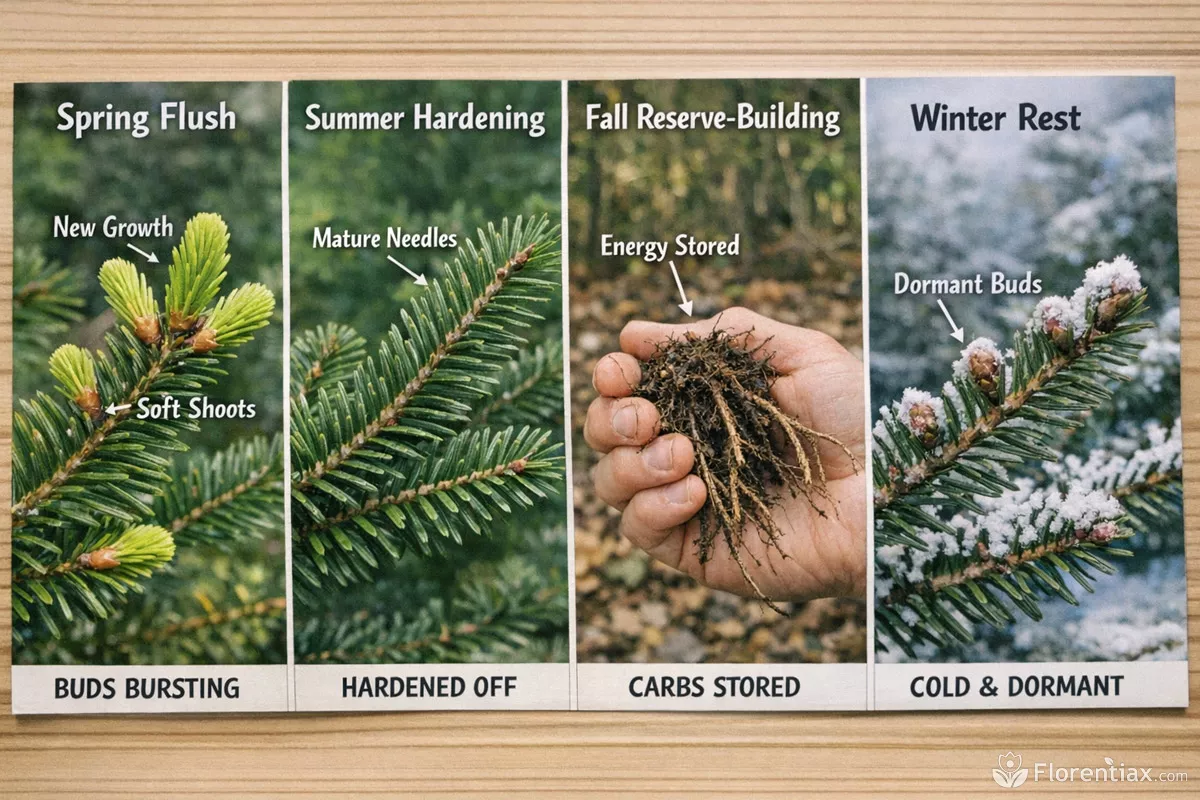
Most Abies produce new shoots from their buds in spring. The soft, pale-green “candles” elongate, needles expand and harden off, and then the tree shifts from making length to building reserves. In many climates, the bulk of needle and shoot extension is finished by early to mid-summer, even though the tree stays green year-round.
- Spring flush: Buds break, shoots extend, and fresh needles emerge. This is when late frosts can scorch the newest tips.
- Early summer hardening: Needles darken, cuticles thicken, and twigs lignify. The tree becomes more tolerant of sun and wind as tissues mature.
- Late summer to fall reserve-building: Growth slows; carbohydrates are stored in roots and stems. Drought at this stage can reduce winter hardiness.
- Winter rest: Metabolism drops and buds stay set for the next season. The tree relies on cold tolerance rather than active growth.
Day length is a major cue for dormancy, but temperature and moisture decide how smoothly the transition happens. Warm spells in late winter can briefly wake tissues, yet buds usually stay closed until enough chilling and spring warmth accumulate. That’s why firs can look “awake” on a mild day but still be vulnerable if a sharp cold snap follows.
Needle retention and shedding are also seasonal, just less obvious than in deciduous trees. Older inner needles often yellow and drop after a few years, especially in late summer or fall, while the newest needles remain. A light interior needle drop can be normal; heavy browning on outer tips, or rapid loss across the canopy, points to stress such as root issues, drought, or sudden temperature swings.
| Time of year | What you’ll see | What the tree is doing | Care that fits the phase |
|---|---|---|---|
| Late winter to early spring | Buds swell; little visible growth | Preparing to break dormancy; roots may start moving water in mild spells | Water only if soil is dry and unfrozen; avoid heavy pruning that exposes inner branches to sunscald |
| Spring | Candles extend; needles are soft and light green | Fast shoot and needle expansion | Keep soil evenly moist; protect from late frost if possible; fertilize lightly only if the tree is established and not stressed |
| Early to mid-summer | Needles darken; shoots firm up | Hardening off; shifting energy to roots and storage | Deep, infrequent watering during dry spells; mulch to moderate soil temperature |
| Late summer to fall | Minimal new growth; possible inner needle drop | Building carbohydrate reserves; setting buds for next year | Avoid high-nitrogen feeding; maintain moisture until the ground cools; stop pruning that would trigger late growth |
| Winter | No growth; needles remain but can bronze in wind | Full dormancy; dehydration risk from sun and wind | Water during winter thaws if soil is dry; use wind protection in exposed sites; prevent salt spray and foot traffic over roots |
If you’re trying to diagnose problems, match symptoms to the calendar. Tender tip burn right after budbreak often traces back to late frost, while widespread browning in late winter is frequently winter desiccation, especially on windy sites with frozen soil. When in doubt, check buds: firm, plump buds usually mean the tree is still on track for the next growth flush.
Common pests, diseases, and stress symptoms in fir trees
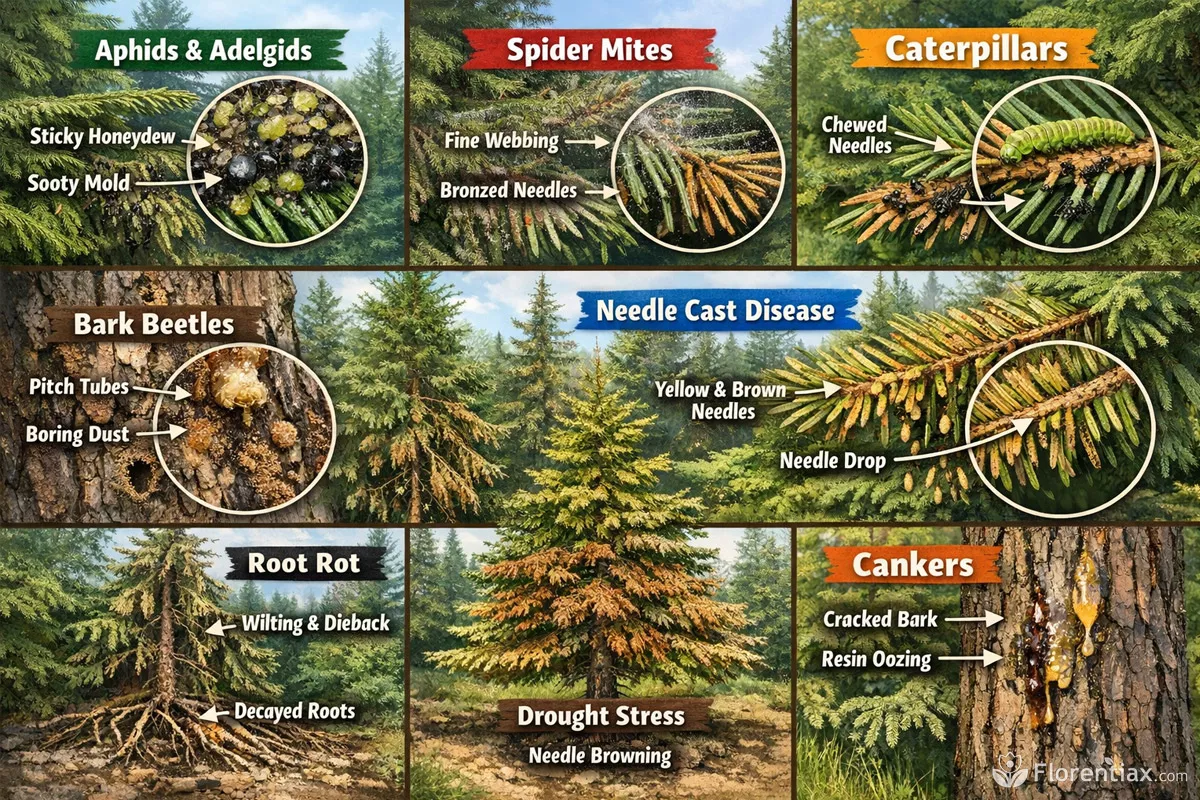
Fir trees usually show trouble first in the needles and the newest growth. If you notice thinning crowns, uneven color, or dieback on branch tips, look closely for insects, cankers, or root issues before assuming it is “just winter burn.” Many problems overlap, so it helps to match the symptom pattern with site conditions such as drainage, exposure, and recent drought.
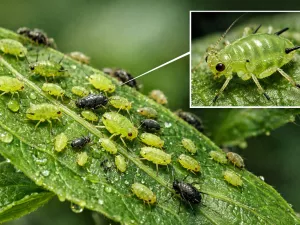
If you find clusters of soft-bodied insects on fresh shoots, start with the basics and treat early — see how to get rid of aphids for practical, plant-safe steps.
| Issue | What you’ll notice | Most likely trigger | What to do first |
|---|---|---|---|
| Aphids and adelgids | Sticky honeydew, sooty mold, curled or stunted new shoots, clusters of tiny insects on tender growth | Warm spells, lush nitrogen-heavy growth, crowded branches with low airflow | Rinse colonies off with a strong spray of water; prune out heavily infested tips; avoid excess fertilizer |
| Spider mites | Fine webbing, needles that look dusty or bronzed, stippling that starts on inner needles | Hot, dry weather; drought stress; sheltered sites with little rain wash | Increase irrigation consistency; hose foliage to knock mites down; reduce reflected heat from nearby hardscape |
| Spruce budworm and other caterpillars | Chewed buds and new needles, ragged shoot tips, frass (tiny pellets) on branches | Outbreak years; stressed trees are hit harder | Prune and destroy infested tips when practical; monitor new growth in spring so damage is caught early |
| Bark beetles | Pitch tubes or resin beads on bark, boring dust in crevices, rapid browning of the crown, woodpecker activity | Drought, heat, or root damage that weakens defenses | Improve watering during dry periods; remove severely infested trees promptly to reduce spread; avoid wounding trunks |
| Needle cast diseases | Needles yellow then brown and drop prematurely; symptoms often start on lower/inner branches | Prolonged wetness on needles, dense plantings, shaded sites with slow drying | Rake and discard fallen needles; thin surrounding vegetation for airflow; water at the soil line rather than overhead |
| Cytospora and other cankers | Sunken or cracked bark, resin flow, localized branch dieback that progresses over time | Stress from drought, transplant shock, or repeated defoliation | Prune out affected branches back to healthy wood; sanitize tools between cuts; focus on reducing stress rather than “quick fixes” |
| Root rot (Phytophthora and similar) | Overall decline, sparse needles, poor new growth, needles dull green to gray-green; roots may be dark and soft | Poor drainage, waterlogged soils, planting too deep | Check drainage; correct grade and keep the root flare visible; reduce irrigation frequency while improving deep soil aeration |
| Rust diseases | Yellow spots or bands on needles, occasional orange spore masses depending on the rust type | Wet spring weather; nearby alternate host plants for certain rusts | Remove heavily affected shoots; improve airflow; keep needles dry when watering |
| Winter burn and desiccation | Needle browning on exposed sides, especially after windy cold snaps; damage is often worst at branch tips | Frozen soil plus sun and wind pulling moisture from needles | Water well before the ground freezes; use wind protection in very exposed sites; avoid late-season pruning that pushes tender growth |
| Salt and road-spray injury | Scorched needle tips and margins, browning on the side facing roads or walkways | De-icing salts and salty slush splash | Flush soil with fresh water in early spring if feasible; add a barrier or increase setback distance; use salt-tolerant ground covers near pavement |
| Nutrient stress (often iron or magnesium) | Chlorosis (pale needles), slow growth; sometimes greener veins with paler tissue | High pH soils, compacted ground, root disturbance | Test soil pH before adding amendments; mulch with acidic organic matter; address compaction and root-zone damage |
- Pattern helps you diagnose. Even browning on the windward side points to desiccation; scattered branch dieback often suggests cankers or root problems; rapid whole-tree fade in summer raises concern for bark beetles or severe root failure.
- Check the root zone early. Fir trees dislike soggy soil, and drainage issues can mimic many pest and disease symptoms. A mulch ring and a visible root flare reduce chronic stress.
- Prune thoughtfully. Remove dead or diseased branches back to healthy tissue, and avoid heavy pruning during heat or drought, when the tree has less energy to seal wounds.
- Watering beats most “treatments.” Consistent deep watering during dry spells improves resin production and overall resilience, which can limit insect pressure and slow disease progression.