Plant Watering Calculator – Find the Right Schedule

 The Plant Watering Calculator helps answer one of the most common plant care questions: how often should I water my plant. Instead of guessing or following a fixed weekly rule, this watering schedule calculator estimates a safe interval based on pot size, light, temperature, humidity, soil type, season, and growth stage.
Knowing how often to water your plant is one of the most common and most confusing questions in plant care. The right answer depends on real conditions such as pot size, temperature, light, humidity, soil type, and season. This Plant Watering Calculator helps you estimate a safe watering interval and reduce the risk of overwatering or underwatering.
How Often Should I Water My Plant?
Quick answer: Most indoor plants need watering every 5–10 days, but the exact frequency depends on pot size, light, temperature, humidity, and soil type. Always confirm by checking soil dryness before watering.
There is no single “correct” schedule for every home. Watering frequency depends on how fast your potting mix dries in your conditions: pot size, light level, temperature, humidity, soil mix, season, and whether the plant is actively growing. If you want to estimate how much mix your container actually holds, use a soil volume tool. For a deeper explanation of balanced soil moisture and proper watering indoor plants, see our detailed guide.
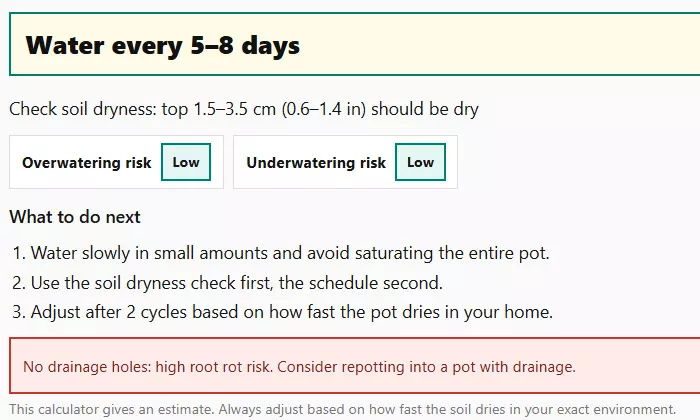
This calculator gives you a safe interval range (for example, “Water every 6–8 days”) and pairs it with a soil dryness check (how deep the top layer should be dry before watering). Use the range as guidance, but let the soil dryness check make the final decision.
How to think about the result:
- The interval range helps you avoid watering too often “just in case”.
- The soil dryness depth confirms whether the plant actually needs water today.
- Risk badges highlight conditions that commonly cause root rot (overwatering) or stress (underwatering).
| What you see in results | What it means | What to do next |
|---|---|---|
| Water every X–Y days | A practical interval range based on your inputs | Use it as a starting point, then confirm with the soil dryness check |
| Check soil dryness: top A–B cm (… in) | The top layer should be dry to this depth before watering | Test with a finger/wooden stick; if still damp, wait even if the “days” are up |
| Overwatering risk: Low/Medium/High | Your setup tends to keep soil wet too long (common root-rot risk) | Extend intervals, improve drainage, avoid heavy soil, water only when the soil check confirms dryness |
| Underwatering risk: Low/Medium/High | Your setup dries fast (heat, bright light, airflow, fast soil) | Check soil more often than the schedule; consider a slightly more moisture-balanced mix |
Important: the calculator is an estimate. After 2 watering cycles, adjust the interval based on how fast the soil dries in your exact spot (window, AC airflow, heater, fan, etc.).
How to Use the Calculator
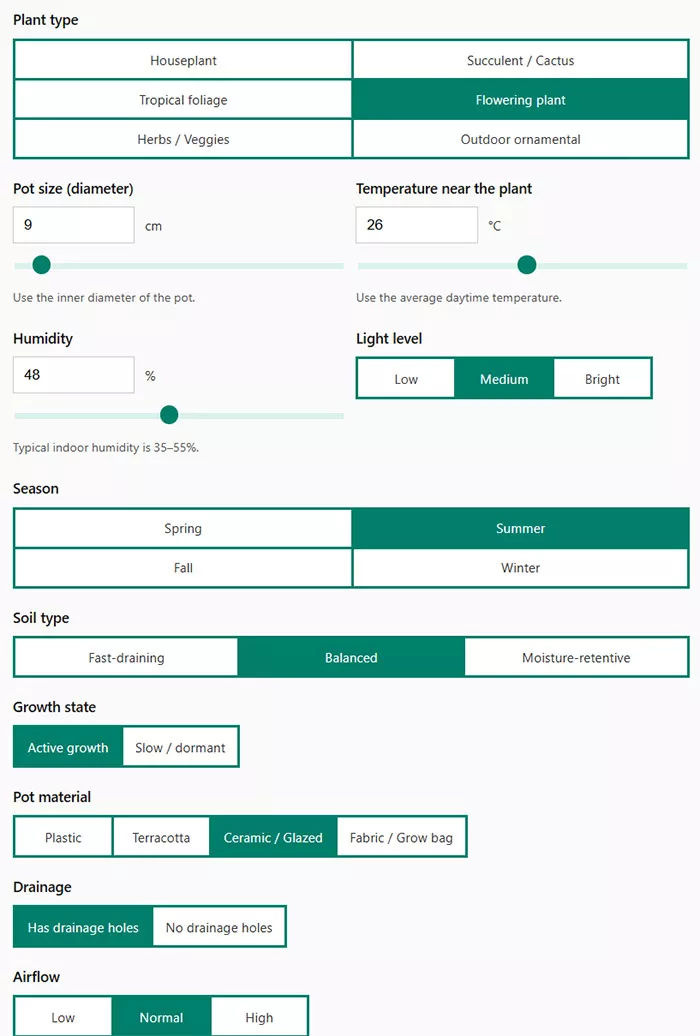
Fill in your conditions, then click Calculate. You can change any input and recalculate as often as needed.
- Select Units — Metric (cm, °C) or US (in, °F). You can switch anytime; the values are converted.
- Choose Plant type — Houseplant, Succulent/Cactus, Tropical foliage, Flowering plant, Herbs/Veggies, or Outdoor ornamental.
- Set Pot size (diameter) — use the inner diameter if possible for a more accurate estimate.
- Set Temperature near the plant — use average daytime temperature in that exact location.
- Adjust Humidity — typical indoor humidity is often 35–55%, but your home may differ.
- Select Light level — Low, Medium, or Bright (bright window sun usually dries pots faster).
- Select Season — Spring, Summer, Fall, Winter.
- Select Soil type — Fast-draining, Balanced, or Moisture-retentive.
- Select Growth state — Active growth or Slow/dormant.
- Choose Pot material — Plastic, Terracotta, Ceramic/Glazed, or Fabric/Grow bag.
- Set Drainage — Has drainage holes or No drainage holes.
- Set Airflow — Low, Normal, or High (fans/AC can dry soil faster).
- Click Calculate to see the watering interval range, soil dryness guidance, risk badges, and next steps.
- Use Reset if you want to return to default values and start over.
Best practice: treat the “days” result as a reminder window, but always confirm by checking soil dryness before watering. If your plant consistently dries faster or slower than expected, tweak inputs (especially soil type, airflow, light, and temperature) and recalibrate.
How the Calculator Works
The Plant Watering Calculator does not use a fixed weekly rule. Instead, it combines a base watering interval with environmental adjustments to reflect real growing conditions.
Step 1 – Base interval. Each plant type has a seasonal baseline depending on whether it is actively growing or dormant.
Step 2 – Environmental adjustments. The base interval is increased or reduced depending on pot size, temperature, humidity, light level, soil type, pot material, airflow, and drainage.
Step 3 – Risk analysis. The calculator evaluates overwatering and underwatering risk based on combinations that commonly cause problems (for example: low light + cool temperature + moisture-retentive soil).
| Calculation Stage | What Happens | Why It Matters |
|---|---|---|
| Base interval | Plant type + season + growth stage define starting days | Different plants use water differently across seasons |
| Pot size adjustment | Larger pots extend interval, smaller pots shorten it | Soil volume affects drying speed |
| Climate adjustment | Temperature and humidity modify drying rate | Heat speeds evaporation; cool air slows water use |
| Light & airflow | Bright light and high airflow reduce interval | Increased transpiration dries soil faster |
| Soil & material | Fast soil shortens interval; retentive soil extends it | Soil structure controls water retention |
| Drainage check | No drainage increases interval and overwatering risk | Standing moisture increases root rot risk |
The final result is shown as a range (for example, 6–8 days) instead of one exact number. This allows flexibility because real drying speed changes slightly from week to week.
What Affects Watering Frequency?
Watering frequency changes when one or more environmental factors shift. Even small differences in light or airflow can significantly alter how fast soil dries.
| Factor | Effect on Watering | Practical Tip |
|---|---|---|
| High temperature (30°C+ / 86°F+) | Shorter interval | Check soil more often during heat waves |
| Low temperature (below 18°C / 64°F) | Longer interval | Avoid watering on schedule; confirm dryness first |
| Bright direct light | Shorter interval | Monitor pots near south-facing windows |
| Low light | Longer interval | Reduce watering to prevent root rot |
| Fast-draining soil | Shorter interval | Consider slightly more balanced mix if drying too fast |
| Moisture-retentive soil | Longer interval | Ensure proper drainage and avoid compacting soil |
| Terracotta or fabric pots | Shorter interval | Expect faster evaporation through pot walls |
| No drainage holes | Higher overwatering risk | Water slowly and in small amounts |
Because these factors interact, watering frequency is never based on just one variable. The calculator evaluates the full combination to give a safer estimate.
Example Calculations
These examples show how the answer to “how often should I water my plant” changes depending on real environmental conditions.
Below are realistic scenarios showing how different conditions change watering frequency. These examples illustrate why a fixed “once a week” rule rarely works.
| Scenario | Conditions | Typical Result | Adjustment Advice |
|---|---|---|---|
| Summer Houseplant | 14 cm pot, 24°C, 45% humidity, medium light, balanced soil | Water every 5–7 days | Check top 2–4 cm dryness before watering |
| Winter Succulent | 12 cm pot, 19°C, winter, dormant growth | Water every 18–26 days | Extend intervals; avoid watering cold soil |
| Herbs in Hot Bright Spot | 18 cm pot, 32°C, bright light, fast-draining soil | Water every 3–5 days | Monitor daily during heat waves |
| Low-Light Plant in Large Pot | 22 cm pot, 20°C, low light, retentive soil | Water every 10–14 days | High overwatering risk; confirm dryness deeply |
Notice how light, soil type, and temperature significantly change the interval even when the plant type stays the same.
Common Watering Mistakes to Avoid
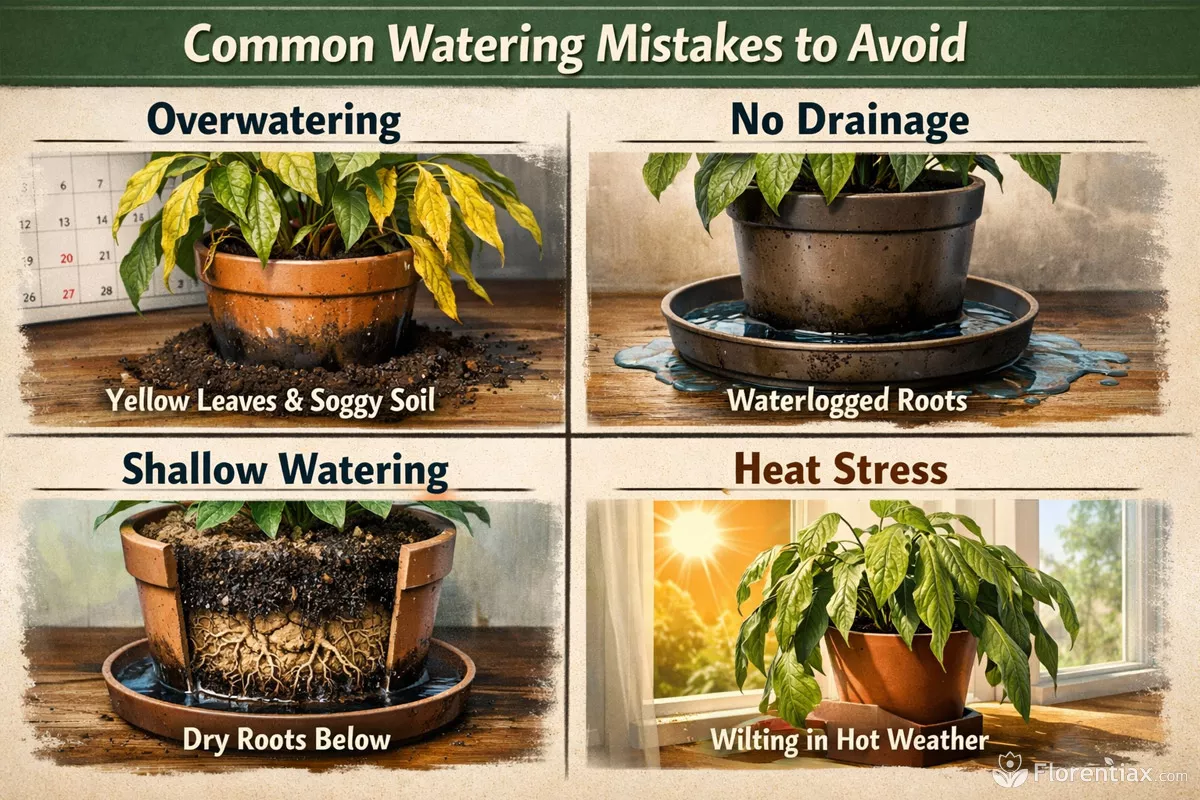
Most plant problems are caused by incorrect watering habits rather than lack of fertilizer or light. Avoid these common mistakes:
- Watering strictly by calendar without checking soil dryness.
- Adding small amounts of water too frequently.
- Ignoring drainage holes and saucer overflow.
- Using heavy soil in low-light conditions.
- Increasing watering in winter without active growth.
| Mistake | Common Symptom | Why It Happens | How to Fix It |
|---|---|---|---|
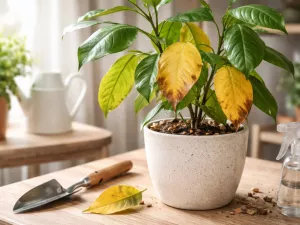
| Watering on schedule only | Yellow Leaves on Plants, soft stems | Soil stays wet too long | Use soil dryness check before watering |
| No drainage holes | Root rot smell, slow growth | Water accumulates at bottom | Repot into container with drainage |
| Too little water too often | Dry root ball inside pot | Water never reaches lower roots | Water thoroughly until runoff |
| Overwatering in winter | Mushy stems, fungal issues | Plant uses less water when dormant | Extend intervals during cold months |
| Ignoring heat waves | Wilting despite schedule | Rapid evaporation | Check soil more frequently in hot weather |
The calculator helps prevent these mistakes by combining environmental factors instead of relying on guesswork.
Frequently Asked Questions
Below are the most common questions people ask about watering frequency, overwatering, soil drying speed, and how to correctly use the Plant Watering Calculator. These answers explain not only what to do, but why it works.
1. How often should I water my plant?
There is no universal schedule. The correct frequency depends on how fast the soil dries in your environment. Temperature, light, pot size, humidity, and soil type all change the drying rate.
Instead of following a fixed rule like “once a week,” use the calculator to get an estimated range. Then confirm with a soil dryness check before watering.
- If the top layer is still damp, wait.
- If it is dry to the recommended depth, water thoroughly.
2. Why does the calculator show a range instead of one number?
Drying speed changes slightly from week to week. Even small shifts in weather, heating, air conditioning, or sunlight exposure can affect soil moisture.
A range (for example, 6–8 days) gives flexibility and reduces the risk of watering too early or too late.
3. What matters more: the number of days or soil dryness?
Soil dryness always matters more. The interval is a guideline. The soil test confirms whether watering is needed today.
Insert your finger or a wooden stick into the soil:
- If it comes out clean and dry at the recommended depth — water.
- If it feels cool or damp — wait longer.
4. How do I know if I am overwatering?
Overwatering symptoms often appear slowly. Common signs include yellowing leaves, soft stems, fungus gnats, and a sour smell from the soil.
Overwatering usually happens because:
- The soil stays wet too long.
- The pot has no drainage holes.
- Light levels are too low for the amount of water given.
Extending intervals, improving drainage, and adjusting your mix with a potting soil calculator usually solves the issue.
5. How do I know if I am underwatering?
Underwatered plants often wilt, develop dry crispy leaf edges, or stop growing.
However, wilting alone does not always mean dryness — roots may also be damaged by overwatering. Always check soil moisture before increasing watering frequency.
6. Should I water more in summer and less in winter?
In most cases, yes. During summer, higher temperatures and stronger light increase evaporation and plant transpiration.
In winter:
- Growth slows down.
- Water use decreases.
- Soil dries much more slowly.
This is why the calculator adjusts intervals based on season and growth stage.
7. Does pot size really change watering frequency?
Yes. Larger pots hold more soil and therefore more moisture. They dry slower than small pots.
A plant in a small container may need water twice as often as the same plant in a large pot under identical conditions.
8. What if my pot has no drainage holes?
This increases the risk of root rot because excess water cannot escape.
If you cannot change the pot:
- Water in small amounts.
- Avoid fully saturating the soil.
- Monitor dryness carefully.
Whenever possible, repot into a container with drainage holes.
9. How accurate is the Plant Watering Calculator?
The calculator provides a realistic estimate based on environmental variables. However, every home environment is unique.
After two watering cycles, observe how quickly your soil dries and adjust accordingly. Think of the calculator as a calibration tool, not a rigid rule.
10. Why does my plant still struggle even if I follow the schedule?
Watering frequency is only one factor in plant health. Light intensity, root health, soil quality, and airflow also affect growth.
If problems continue:
- Check root condition.
- Evaluate light levels.
- Make sure soil is not compacted.
11. Can I use this calculator for outdoor plants?
Yes. Select “Outdoor ornamental” and adjust airflow, light, and temperature to match outdoor conditions.
Keep in mind that outdoor drying rates can change rapidly during wind, rain, or heat waves.
12. What is the biggest watering mistake beginners make?
The most common mistake is watering on a fixed schedule without checking soil moisture. Plants do not follow calendars — they respond to environmental conditions.
The combination of interval range plus soil dryness test is the safest approach for long-term plant health.