Acacia — Fast-Growing Tree Adapted to Dry Growing Conditions

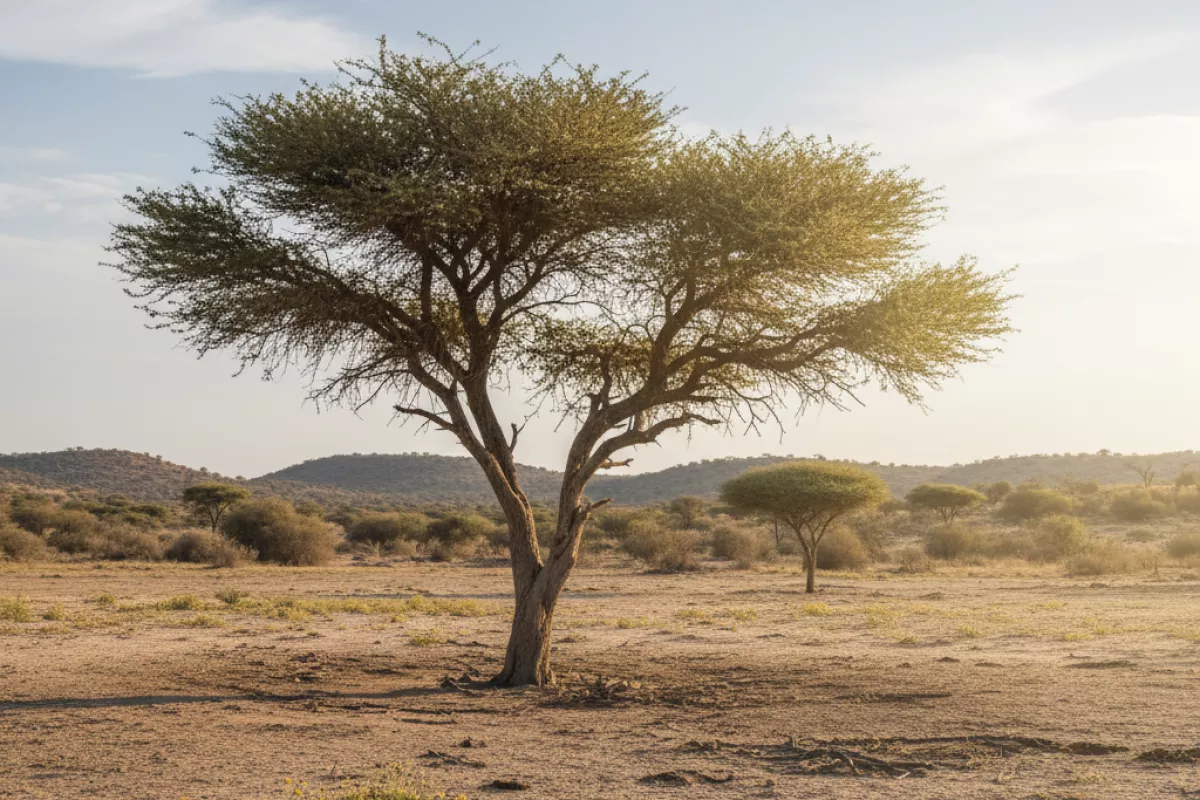 Covers Acacia tree species traits, native dry habitats and distribution, plus growth structure and foliage. Explains light needs for fast growth, soil drainage and watering, heat tolerance and climate adaptability, pruning for strong branches, propagation, seasonal growth and flowering, and signs of pests, disease, or drought stress.
- Acacia tree overview and species traits
- Native dry habitats and distribution zones
- Growth structure and foliage characteristics
- Light exposure for rapid Acacia development
- Soil drainage and watering strategy for Acacia
- Heat tolerance and Acacia climate adaptability
- Maintenance for strong branch structure
- Propagation methods for trees
- Seasonal growth and flowering cycle
- Pests, diseases, and Acacia drought stress signs
Need a fast-growing tree for a dry, tough site? Acacia is a strong choice. Once established, it handles limited water and suits hot gardens, sandy soils, and low-maintenance landscapes. This guide covers first-year care, including watering and mulching, simple pruning to shape growth, and the best places to plant for reliable performance.
Acacia tree overview and species traits
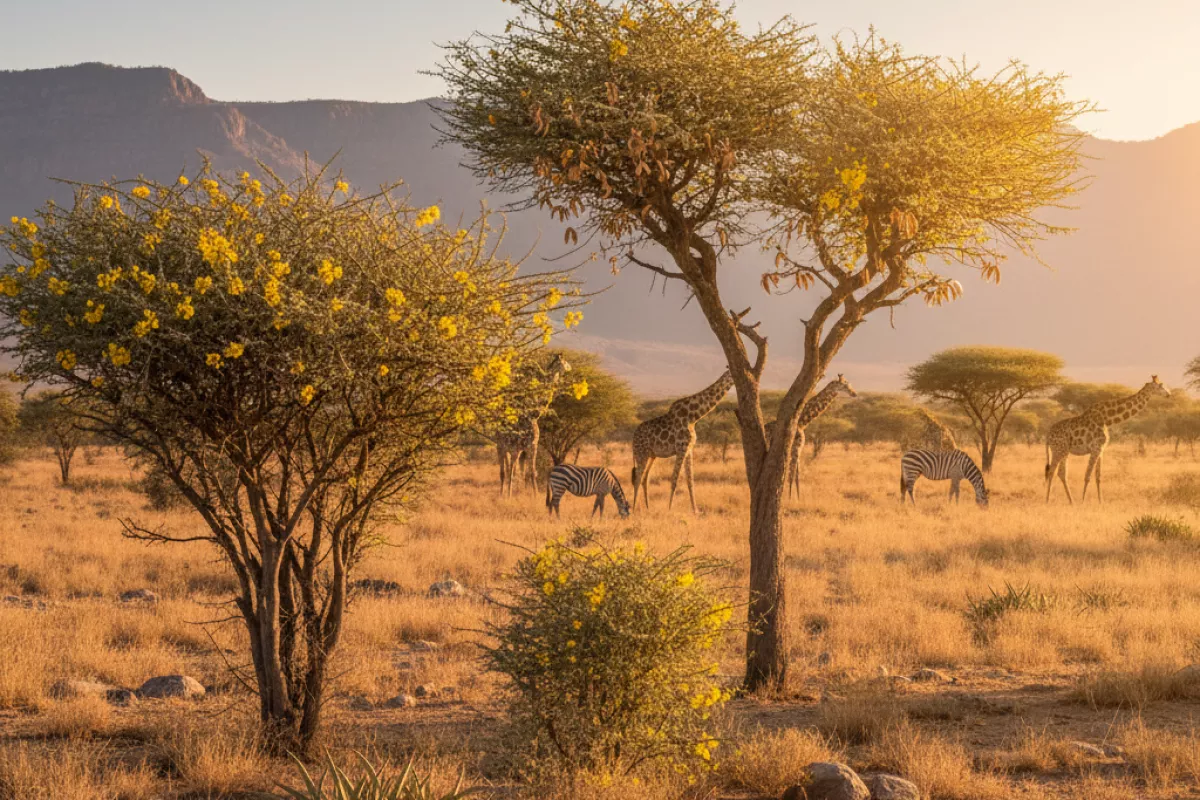
These trees and shrubs belong to the legume family and are best known for handling heat, bright sun, and long dry spells better than many ornamentals. Depending on the species, they grow as multi-stemmed shrubs or single-trunk trees with a light, airy canopy that casts dappled shade rather than deep darkness.
One reason they cope so well in arid and semi-arid climates is how they manage water and nutrients. Many types have small leaflets or flattened leaf-like stems (phyllodes) that reduce moisture loss, and their roots often form partnerships with soil microbes that help them access nitrogen. In practice, that can mean decent growth on lean soils where other trees stall.
- Growth habit: Often fast to establish, with forms ranging from compact shrubs to medium-sized trees; canopy shape can be rounded, umbrella-like, or irregular depending on pruning and site exposure.
- Foliage strategy: Fine, feathery bipinnate leaves in some species; leathery phyllodes in others, which typically tolerate wind and drought better.
- Flowers: Usually showy in a subtle way—puffball clusters or slender spikes, commonly yellow or cream; bloom time varies widely by species and climate.
- Thorns and defense: Some have thorns or prickles that deter browsing; others are unarmed and easier to site near paths.
- Roots: Typically deep and wide-spreading once established; this helps with drought survival but can compete with shallow-rooted plants nearby.
- Soil tolerance: Many handle sandy or rocky ground and moderate salinity; most still prefer good drainage and can struggle in waterlogged clay.
- Wildlife value: Nectar and pollen support insects; seeds and shelter can benefit birds and small animals, especially in dry landscapes.
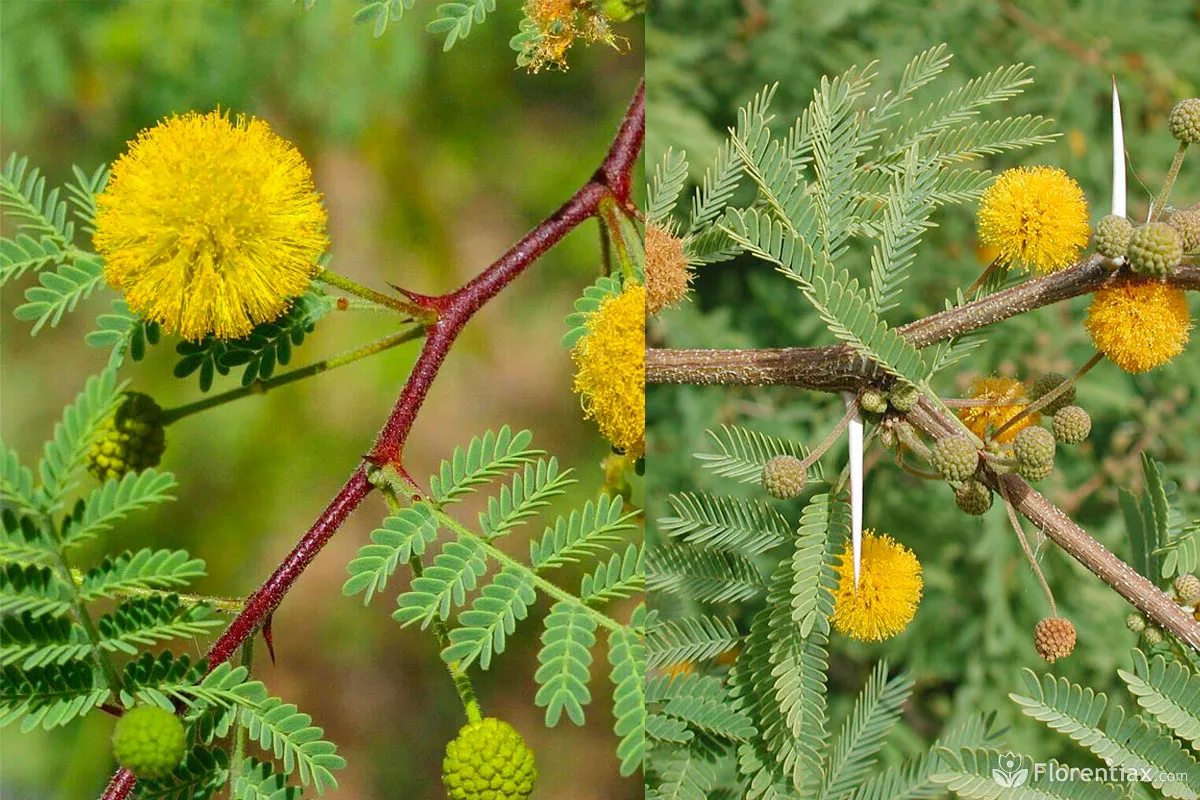
Acacia farnesiana (Sweet Acacia)
| Trait | What you’ll notice in the landscape |
|---|---|
| Drought response | Slows growth and may shed some foliage during extended dry periods, then rebounds after rain or irrigation. |
| Heat and sun tolerance | Performs well in exposed sites with intense summer sun; leaf form often helps limit water loss. |
| Cold sensitivity | Many are damaged by hard freezes; choose species matched to local minimums and protect young plants during cold snaps. |
| Longevity and structure | Some are relatively short-lived but quick-growing; regular pruning can improve branch structure and reduce storm breakage. |
Species selection matters because “acacia” covers a wide range of plants with different strengths. Some are better for windbreaks, some for ornamental bloom, and others for tough, low-water sites. Before planting, it’s worth checking mature size and whether the species is known to self-seed aggressively in your region.
Native dry habitats and distribution zones
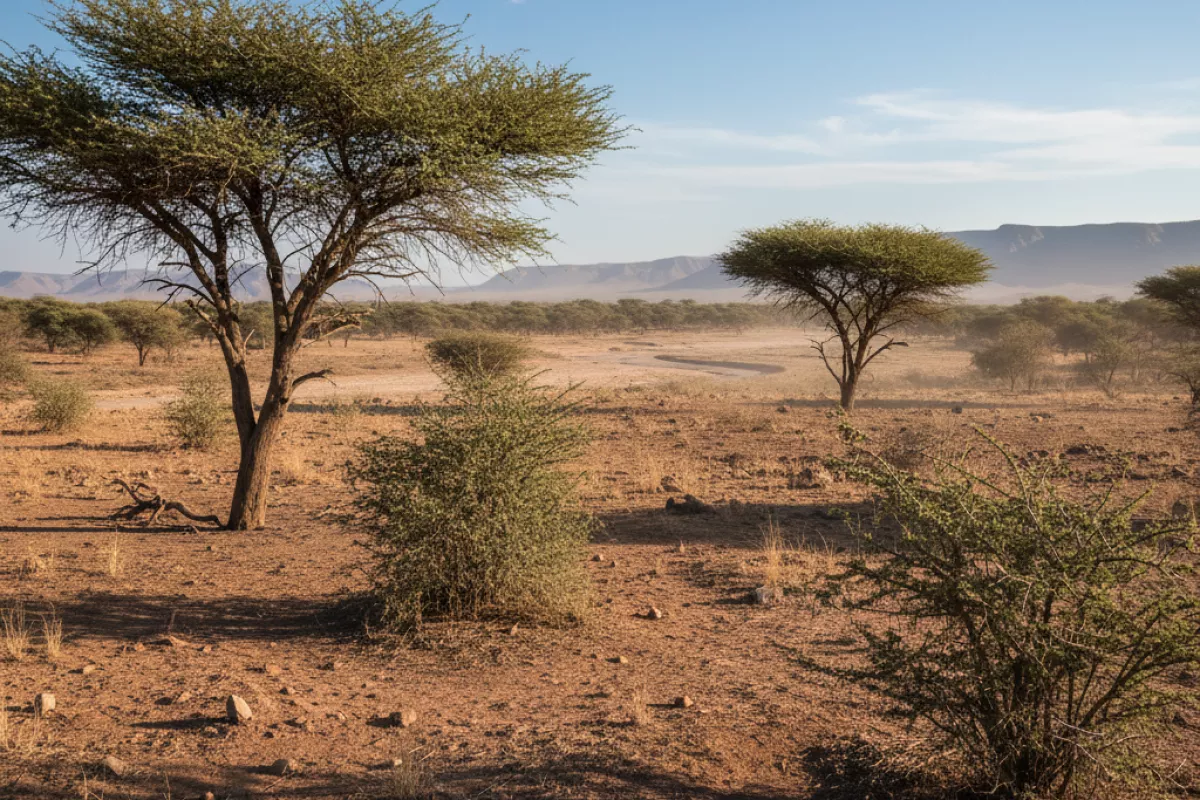
Acacias are most at home where water is unreliable: open woodlands, scrub, and semi-desert edges with long dry seasons and short, intense wet periods. Many species evolved under high sun, strong winds, and nutrient-poor soils, which helps explain their reputation for coping with drought, heat, and intermittent grazing or browsing.
Across their natural range, these trees and shrubs commonly occupy landscapes shaped by disturbance. Fire, seasonal flooding in dry riverbeds, and soil movement on slopes can all create the bare ground and light levels that favor quick establishment. Depending on the species, you’ll find them from coastal sand plains to inland plateaus, often in places where annual rainfall is low to moderate and arrives in a few concentrated months.
- Australia: The global center of diversity. Wattle species dominate arid and semi-arid interiors, Mediterranean-climate southwest regions, and dry savannas, thriving on sandy or lateritic soils and in open eucalypt woodlands.
- Africa: Common in savannas and thornveld from the Sahel down through eastern and southern regions, especially on well-drained plains and along seasonal waterways where roots can tap deeper moisture.
- Middle East and South Asia: Scattered in dry steppe, rocky hillsides, and desert margins, where heat and irregular rainfall select for small leaves or phyllodes and efficient water use.
- Americas: A number of species occur naturally in warm, seasonally dry zones, including parts of Mexico, the southwestern United States, and South America’s dry forests and scrublands.
- Islands and coastal drylands: Some acacias are adapted to salty winds, sandy substrates, and episodic storms, establishing in sheltered swales and behind dune systems.
Soil type matters as much as climate. Many acacias perform well on coarse, fast-draining ground where water percolates quickly, and several tolerate mildly saline or alkaline conditions. Their ability to partner with nitrogen-fixing microbes lets them persist on lean sites, gradually improving soil fertility and supporting other plants in the surrounding community.
Elevation ranges are broad, but dry, sun-exposed positions are a recurring theme. In practical terms, if a site has a pronounced dry season, full sun, and soils that don’t stay waterlogged after rain, it resembles the conditions where many acacia species originated. Similar site requirements are seen in plants like succulent for hot dry climates, where drainage and sun exposure matter more than rich soil.
Growth structure and foliage characteristics

Many acacias put their energy into quick canopy development and a tough framework that can handle heat, wind, and irregular rainfall. Depending on the species, you’ll see everything from low, multi-stem shrubs to single-trunk trees with a broad, spreading crown. In open, dry sites they often develop a wider canopy and denser branching, while in tighter plantings they may grow more upright as they compete for light.
The branching pattern is typically fine-textured, with lots of small twigs that create dappled shade rather than a heavy, dark canopy. That light shade can be helpful in arid landscapes because it reduces soil surface temperatures without completely blocking understory plants. Many species also have thorns or spines, which can deter browsing and reduce moisture loss from repeated leaf damage.
- Form and habit: Commonly rounded to umbrella-like crowns; some species stay shrubby and multi-stemmed, others form a clear trunk with a higher canopy.
- Bark and stems: Young stems are often smooth and greenish; older bark may become fissured or flaky, helping protect the cambium during hot, dry periods.
- Root architecture: A mix of deep anchoring roots and wide, shallow feeders is common, letting the plant tap deeper moisture while quickly absorbing light rains.
- Wind response: Flexible branchlets and small leaf surfaces reduce drag, so the canopy is less likely to tear in strong gusts.
Foliage is where acacia really shows its dry-climate strategy. Many species have true compound leaves when young, then shift to phyllodes (flattened leaf stalks that function like leaves). Phyllodes generally present less surface area and have thicker tissues than delicate leaflets, which helps limit water loss. In species that keep compound leaves, the leaflets are often small and can fold or angle away from harsh midday sun.
| Foliage feature | What it looks like | Why it helps in dry conditions |
|---|---|---|
| Compound leaves (bipinnate) | Many tiny leaflets arranged on fine stems | Small leaflets shed heat quickly and can reduce transpiration compared with broad leaves |
| Phyllodes | Flat, leaf-like blades (modified petioles) replacing leaflets | Thicker, tougher tissue and fewer pores exposed, improving water-use efficiency |
| Waxy or leathery surface | Slight sheen; firmer “leather” feel | Cuticle slows moisture loss and protects from sun and drying winds |
| Seasonal leaf drop or thinning | Partial defoliation during drought or extreme heat | Reduces water demand when soil moisture is limited |
| Spines/thorns (in some species) | Sharp projections on stems or at nodes | Limits browsing pressure, preventing repeated defoliation that would increase stress |
New growth often flushes after rain or irrigation, then hardens off quickly. If you’re pruning, it helps to work with that natural rhythm: shaping after a growth flush can encourage a sturdy framework, while heavy cutting during drought can push the plant to spend water on regrowth when it can least afford it.
Light exposure for rapid Acacia development
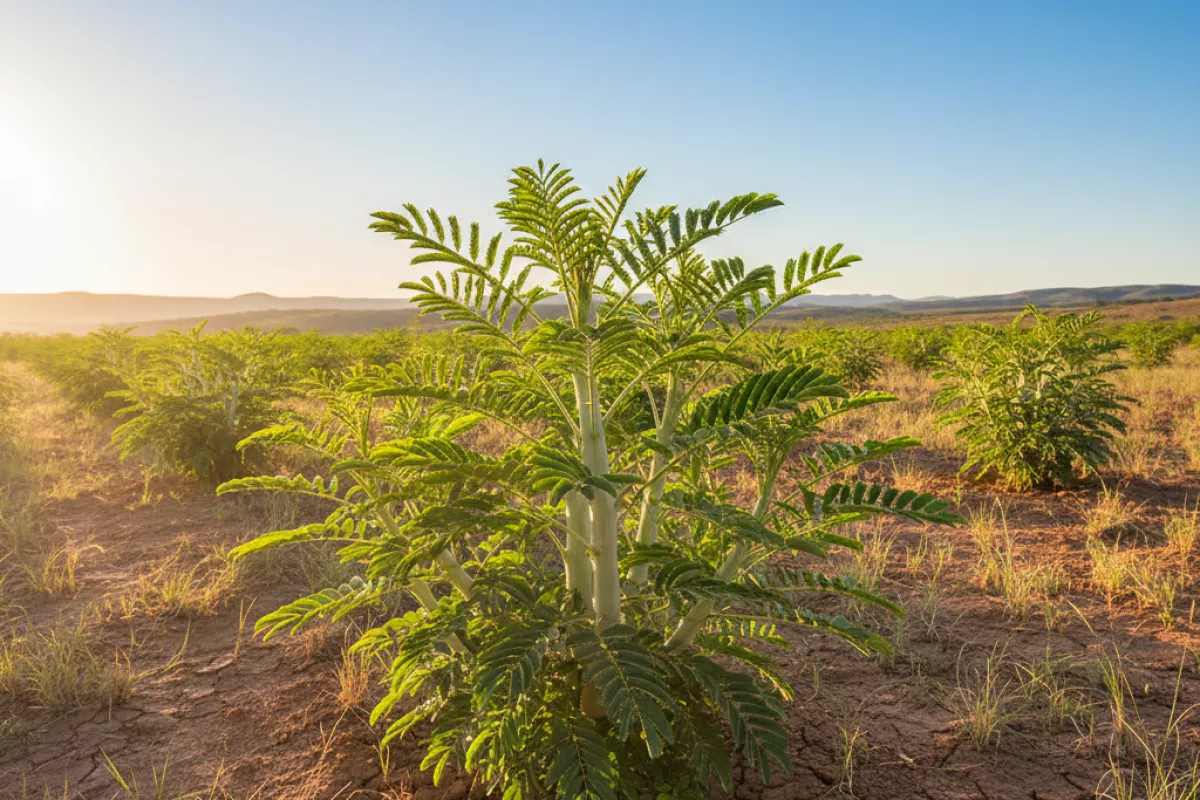
Fast early growth in Acacia is mostly a light game: more usable sunlight generally means more leaf area, thicker stems, and quicker root expansion. Most species perform best in full sun, especially once established, while young plants can stall if they’re shaded for much of the day.
If you’re planting for speed, prioritize an open site with long daily sun hours and minimal competition from buildings or dense canopies. In dry climates, it can be tempting to tuck seedlings into shade to reduce water stress, but too little sun often trades short-term comfort for slower development and weaker structure. The same balance shows up in ornamental shrubs adapted to warm regions, such as those discussed in abutilon care, where strong light supports flowering while good watering discipline prevents stress.
- Target exposure: Aim for 6–8+ hours of direct sun per day. Less than about 4 hours can lead to leggy growth and sparse branching.
- Seedlings vs. established trees: New transplants may benefit from brief protection during extreme heat, but keep it light and temporary so they still receive strong morning and mid-day sun.
- Best daily pattern: Morning sun is valuable because it drives photosynthesis early while temperatures are lower; harsh late-afternoon sun can be the stress point in very hot regions.
- Spacing matters: Crowding reduces light to lower branches and slows overall biomass gain. Give enough room that neighboring crowns won’t overlap quickly, especially in the first 2–3 years.
- Watch for “stretching”: Thin, elongated stems and wide gaps between leaf nodes usually mean the plant is reaching for light. Move containers or thin nearby vegetation to correct it.
| Situation | What you’ll likely see | Adjustment that helps |
|---|---|---|
| Open, full-sun site | Compact branching, faster trunk thickening, steadier height gain | Maintain weed-free ring so the canopy isn’t competing for light and water |
| Partial shade (half-day sun) | Slower growth, longer internodes, lighter foliage density | Prune or remove overhead shade sources; reposition container plants to brighter exposure |
| Deep shade (under canopy or north side of structures) | Very slow development, weak stems, poor form | Relocate planting site; Acacia generally won’t “grow out of” persistent low light |
| Extreme heat with intense afternoon sun | Leaf scorch, midday droop, slowed growth despite bright conditions | Use temporary shade cloth and focus on deep watering; remove protection once roots expand |
For container-grown Acacia, rotate pots every 7–14 days so one side doesn’t become dominant, and keep reflective surfaces in mind. A bright wall can boost light, while a narrow courtyard can create long shade windows that quietly slow growth.
Finally, remember that light and water interact. In strong sun, the tree can grow quickly, but only if moisture is available at the root zone. If you’re limiting irrigation, it’s often better to keep full sun and reduce competing vegetation than to rely on heavy shade that suppresses photosynthesis.
Soil drainage and watering strategy for Acacia
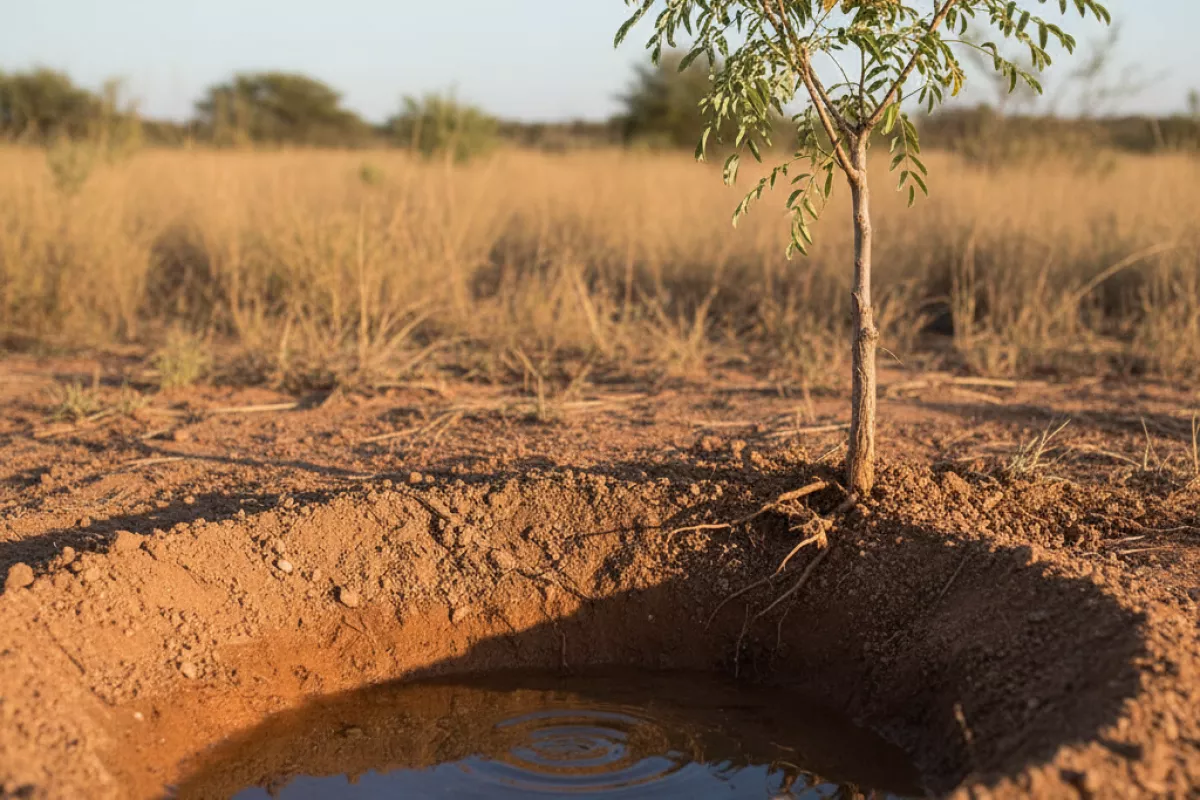
Healthy growth depends more on how quickly excess water leaves the root zone than on rich soil. Most acacias handle lean ground well, but they react poorly to waterlogged conditions because roots lose oxygen and rot can set in fast. If symptoms are unclear, a root rot risk calculator for plants can help distinguish between drought stress and damage caused by saturated roots. Plan for sharp drainage first, then water deeply but infrequently so roots chase moisture downward instead of staying near the surface.
Before planting, do a simple drainage check: dig a hole about 30 cm (12 in) deep, fill it with water, let it drain once, then refill. If the second fill drains within 2–4 hours, drainage is usually fine; if it still holds water after 6–8 hours, the site is too slow-draining for most species without improvement.
- Choose the right spot: Slightly elevated ground or a gentle slope sheds water better than a low pocket where runoff collects.
- Match soil texture to watering: Sandy soils drain fast and need less volume per watering but slightly more frequent intervals; clay holds water longer and needs longer gaps between soakings.
- Avoid “bathtub planting”: In heavy clay, a smooth-sided hole can trap water. Roughen the sides and bottom so roots can penetrate and water can move.
- Use mounding where needed: If your soil stays wet, plant on a mound 15–30 cm (6–12 in) high to lift the crown above saturated layers.
- Mulch, but keep it off the trunk: A 5–8 cm (2–3 in) layer moderates evaporation; leave a 5–10 cm (2–4 in) gap around the stem to reduce rot risk.
Watering is simplest when you treat establishment and mature care differently. For the first growing season, keep the root ball evenly moist but never soggy. After that, most acacias prefer a soak-and-dry rhythm: apply water slowly until it penetrates 20–30 cm (8–12 in), then wait until the top 5–8 cm (2–3 in) is dry before watering again.
| Situation | What to do | Why it helps |
|---|---|---|
| Newly planted (first 4–12 weeks) | Water 1–2 times per week, adjusting for heat and soil; soak to 20–30 cm (8–12 in) | Supports new feeder roots without keeping the crown wet |
| Established in-ground (after first season) | Deep water every 2–4 weeks in dry weather; skip if rain has soaked the soil 2.5–5 cm (1–2 in) | Encourages drought-tolerant rooting and reduces disease pressure |
| Heat wave above 35°C (95°F) | Add an extra deep soak if leaves droop by morning; water early, not at night | Prevents stress while avoiding prolonged overnight moisture around roots |
| Heavy clay or poor drainage | Use a mound 15–30 cm (6–12 in) high; water less often and check moisture before irrigating | Limits waterlogging and lowers the risk of root rot |
| Container-grown plants | Use a fast-draining mix; water when the top 2–3 cm (1 in) is dry; ensure free drainage from the pot | Containers dry unevenly and can suffocate roots if water sits in the base |
Watch the tree rather than the calendar. Pale leaves and slow growth can come from either drought or saturated roots, so check moisture 10–15 cm (4–6 in) down before adding water. If the soil is cool and wet at that depth, hold off; if it’s dry and crumbly, a slow deep irrigation is usually the right move.
Heat tolerance and Acacia climate adaptability
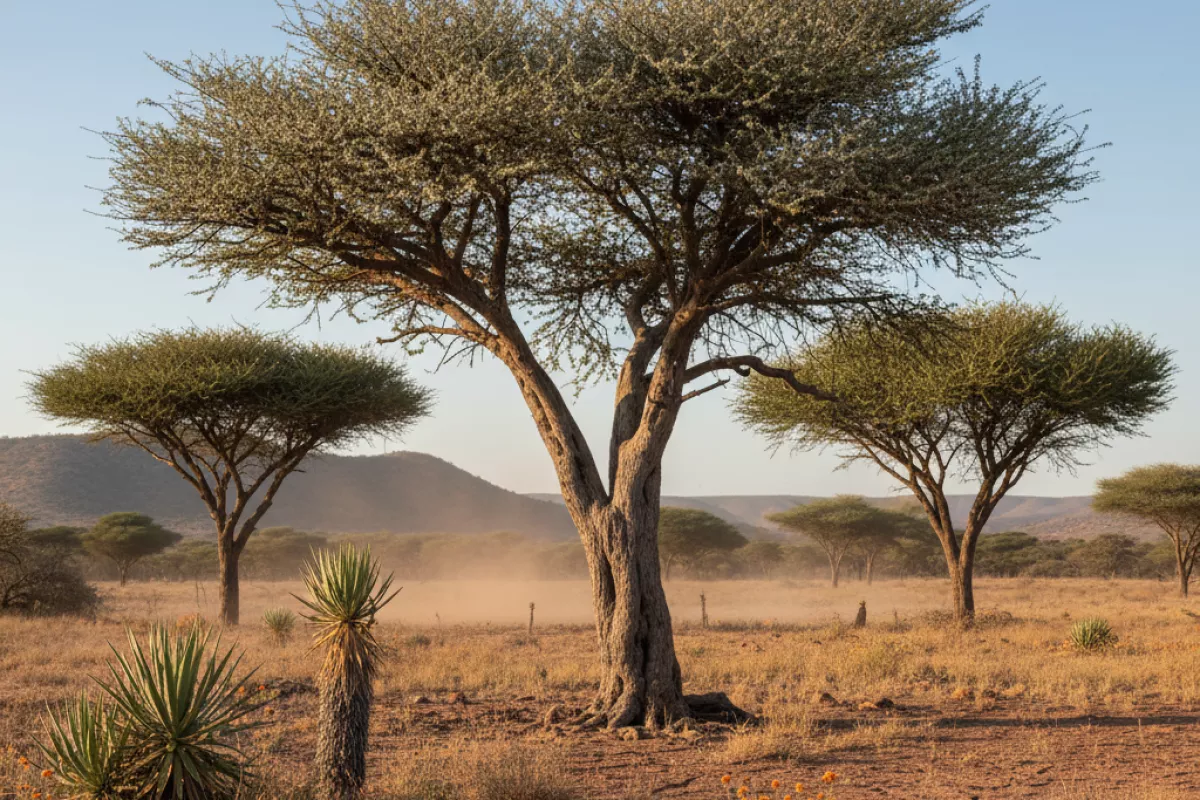
Many Acacia species cope with hot, dry weather by limiting water loss and keeping growth going when other trees stall. Small leaflets (or flattened leaf-stems called phyllodes in some types), waxy surfaces, and the ability to partly close stomata during the hottest hours all reduce midday stress. Deep, wide-spreading roots help them tap moisture stored below the surface after brief rains.
Heat resilience varies by species and local provenance, but it’s common for established trees to handle summer highs around 35–45°C (95–113°F) when soil moisture is available at depth. Young plants are less forgiving: the first 1–2 summers are usually the make-or-break period, especially in exposed sites with reflected heat from paving or walls.
- Sun and exposure: Full sun is typically ideal, but newly planted saplings benefit from temporary shade cloth during extreme heat waves above 40°C (104°F).
- Humidity and wind: Hot, dry winds increase transpiration; windbreaks can reduce leaf scorch and twig dieback during prolonged hot spells.
- Soil type: Sandy or gravelly soils drain fast and warm quickly, which suits many acacias, but they may need deeper, less frequent watering while roots establish.
- Cold snaps after heat: Rapid swings can stress new growth; avoid heavy pruning right before forecast drops below 0°C (32°F) after warm weather.
| Climate factor | What Acacia tends to do | Practical takeaway for growers |
|---|---|---|
| Extreme daytime heat (e.g., 40°C / 104°F) | Slows growth, reduces leaf water loss; may shed some foliage to conserve moisture | Prioritize deep watering early morning; mulch 5–8 cm (2–3 in) to buffer soil temperature |
| Low rainfall with brief storms | Uses quick pulses of moisture; roots explore laterally and downward | Water deeply but infrequently to encourage rooting; avoid constant light sprinkling |
| Poor, low-nitrogen soils | Fixes nitrogen via root nodules, maintaining greener growth than many trees | Go easy on high-nitrogen fertilizer; focus on soil structure and drainage instead |
| High UV and reflected heat near hardscape | Higher risk of leaf scorch and bark stress, especially on young trunks | Use trunk guards or temporary shading; keep mulch off the trunk by 5 cm (2 in) |
| Cool winters (species-dependent, near -5°C / 23°F) | Some species tolerate light frost; others suffer tip damage or dieback | Select locally proven varieties; protect first-year plants with frost cloth below 0°C (32°F) |
To get the best climate fit, match the species to your local pattern: not just average temperatures, but how long heat persists, whether nights stay warm, and how dry the wind gets. In arid regions, a thick organic mulch and a watering schedule that mimics occasional heavy rain often produces sturdier, more drought-ready trees than frequent shallow irrigation.
Maintenance for strong branch structure
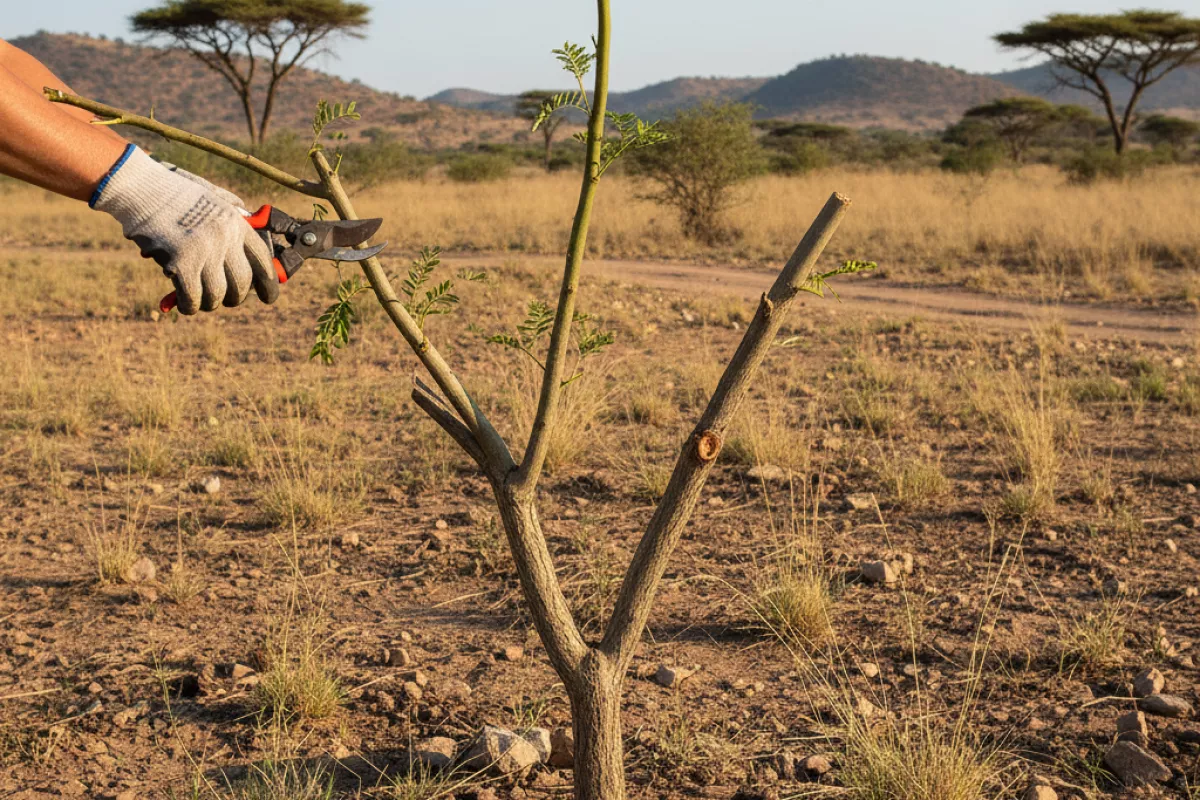
Build a stable canopy early, because many acacias grow fast and can develop narrow crotch angles, long lever-like limbs, and multiple competing leaders. A little training while the tree is young reduces breakage later, especially in dry climates where growth can come in quick flushes after rain or irrigation.
- Start training in year 1–3. Choose one main leader (or a clearly defined multi-stem form if that’s the goal) and remove or shorten competing upright shoots before they thicken.
- Favor wide branch angles. Keep scaffold branches that leave the trunk at roughly 45–60°; narrow V-shaped unions are more likely to split as the canopy gains weight.
- Reduce end-weight on long limbs. Use reduction cuts to shorten overextended branches back to a lateral that’s at least one-third the diameter of the cut stem. This keeps the natural look while lowering leverage.
- Thin lightly, don’t “lion-tail.” Removing too much interior growth shifts weight to the tips and increases wind stress. Aim for small, selective thinning rather than stripping the inner canopy.
- Keep cuts small and well-placed. It’s better to remove a 2 cm (0.8 in) stem now than a 10 cm (4 in) limb later. Cut just outside the branch collar; avoid flush cuts that slow closure.
- Watch for co-dominant stems. If two leaders are the same size, subordinate one early by shortening it, or remove it if it’s poorly attached. This is one of the biggest predictors of future splitting.
- Time pruning to reduce stress. In very hot areas, avoid heavy work during heat waves. Light structural pruning is often best in the cooler part of the year; in frost-prone sites, avoid stimulating tender new growth right before cold snaps.
- Manage irrigation to prevent weak, fast growth. Deep, infrequent watering encourages steadier wood development. For example, soak the root zone to about 30–45 cm (12–18 in) rather than frequent shallow watering that promotes soft, elongated shoots.
- Stake only when necessary. If staking is needed, use flexible ties and remove supports within 6–12 months. A trunk that can’t move develops less taper and may be more failure-prone.
| Issue to look for | Why it matters | What to do |
|---|---|---|
| Two equal leaders (co-dominant stems) | Weak union; higher chance of splitting as diameter increases | Subordinate one leader with reduction cuts, or remove the poorer attachment while stems are small |
| Narrow V-shaped crotches | Often forms included bark, reducing strength | Prefer wider-angled branches; shorten or remove tight unions early |
| Overextended lateral limbs | Tip-heavy branches act like levers in wind | Reduce length back to a strong lateral; avoid stripping interior foliage |
| Dense outer canopy with bare interior (“lion-tailed”) | Weight shifts outward; more breakage in storms | Restore balance with selective thinning and reduction, keeping interior foliage where possible |
Recheck structure after major growth spurts. A quick annual look for new competing leaders and overlong laterals is usually enough to keep an acacia’s framework resilient without turning pruning into a constant chore.
Propagation methods for trees
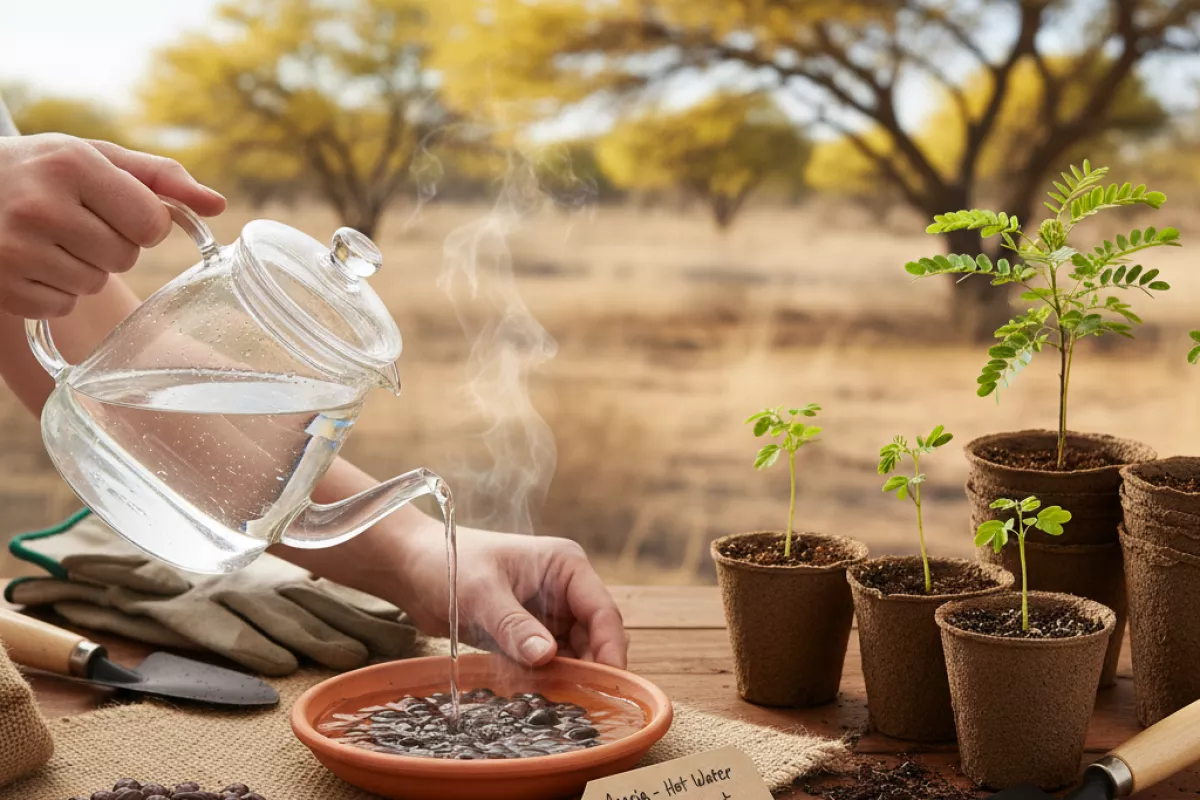
Acacias are usually raised from seed because it’s reliable, inexpensive, and scales well for windbreaks, shade trees, and restoration plantings. Some species can also be started from cuttings, but success varies a lot by species and timing, so it’s generally a secondary option unless you’re trying to clone a specific plant.
- Seed (most common)
Many acacia seeds have a hard coat that delays germination. To speed things up, use a pre-treatment: pour hot (not boiling) water over the seeds, let them soak as the water cools for 12–24 hours, then sow. Another approach is gentle scarification (lightly nicking the seed coat) so moisture can enter. Sow shallowly, about 0.5–1 cm (0.2–0.4 in) deep, in a free-draining mix. - Cuttings (selective, for cloning)
Semi-hardwood cuttings taken from healthy, non-flowering shoots often root better than very soft tips. Keep cuttings warm and humid but not wet, and use a gritty medium to prevent rot. Rooting hormone can help, especially when conditions are cooler than about 20°C (68°F). Expect uneven results; if only a few plants are needed, it can still be worthwhile. - Transplanting seedlings (handle early)
Acacias tend to form a strong taproot, which makes older seedlings resent disturbance. Transplant when they’re small—ideally when they have a few true leaves and before roots circle the pot. Use deeper containers (tree tubes) to reduce root deformation and to support early drought tolerance in dry sites.
| Method | Best use | Key steps | Common pitfalls |
|---|---|---|---|
| Seed | Most plantings; genetic diversity | Pre-treat hard seed coat; sow 0.5–1 cm (0.2–0.4 in) deep; keep evenly moist | Skipping pre-treatment; waterlogged mix causing damping-off |
| Cuttings | Cloning a desirable tree | Take semi-hardwood; use airy medium; maintain humidity; keep around 20–25°C (68–77°F) | Rot from excess moisture; low strike rate in some species |
| Early transplant | Nursery-grown seedlings for dry sites | Move while young; use deep pots; avoid root circling | Transplant shock when rootbound; damaged taproot slowing establishment |
| Direct sowing in place | Large areas with minimal infrastructure | Pre-treat seed; sow after reliable rain; protect from grazing | Losses to drought, ants, birds, or browsing without protection |
For dry growing conditions, timing matters as much as technique. Whether you’re sowing in trays or directly in the ground, aim to start plants when there’s a predictable moisture window, so roots can push down before heat and drought intensify. If you’re in a hot climate, light shade during the first few weeks can reduce stress without making seedlings soft.
One more practical note: some acacias can self-seed aggressively in suitable climates. If you’re planting near natural areas, collect pods before they split and avoid dumping unused seed mix where it can wash into creeks or disturbed ground.
Seasonal growth and flowering cycle
Most acacias follow the rhythm of rainfall rather than the calendar. When moisture arrives and temperatures are mild, they push new shoots and expand their canopy; when conditions dry out, they slow down, harden off new growth, and conserve water. This stop-start pattern is one reason they cope well in arid and semi-arid landscapes.
Growth timing varies by species and region, but the same basic cues show up again and again: soil moisture, day length, and temperature. In climates with winter rains, many types put on their main flush in late winter to spring; in summer-rain regions, the strongest growth often comes after the first reliable storms.
- After rain: buds break, soft new foliage appears (including phyllodes on many species), and roots explore newly moist soil.
- Dry spells: elongation slows, leaves may become smaller or tougher, and the tree prioritizes survival over size.
- Heat or cold extremes: growth pauses; young tips are the most sensitive, especially during sudden hot winds or frosts.
Flowering is also tied to seasonality, but it’s less predictable than leaf growth because it depends on how much energy the tree stored in the previous months. Many acacias set buds well before you see color, then open flowers when conditions favor pollinators and seed set. In some species, a short dry period followed by rain can help trigger a more noticeable bloom.
| Seasonal phase | What you’ll notice | What the tree is doing | Practical care notes |
|---|---|---|---|
| Post-rain growth flush | Fresh shoots, brighter foliage, faster canopy fill | Investing in new leaves and fine roots while water is available | Deep watering is most useful here if rains are light; soak to roughly 30–45 cm (12–18 in) depth, then let the surface dry between irrigations |
| Bud formation (often weeks to months before bloom) | Small, firm buds at shoot tips or along stems | Allocating stored carbohydrates to reproduction | Avoid heavy pruning now; it can remove developing buds and reduce flowering |
| Flowering window | Puffball or spike-like blooms; increased insect activity | Maximizing pollination and beginning seed development | Keep stress low: don’t over-fertilize; if watering, do it deeply and infrequently to prevent shallow rooting |
| Seed set and hardening off | Pods forming and drying; new growth becomes woody | Finishing reproduction and preparing for drought or cold | Light shaping is safer after flowering; reduce irrigation as pods mature to discourage weak, sappy growth |
| Dormant or low-activity period | Little visible growth; some leaf drop in very dry conditions | Conserving water and maintaining core tissues | Water only if prolonged drought threatens young trees; for established plants, occasional deep soaking is better than frequent small amounts |
If you’re trying to predict bloom, watch the weather pattern more than the month name. A consistent wet period followed by stable temperatures (for example, around 15–25°C (59–77°F) depending on species) often lines up with the strongest display, while erratic rain can spread flowering out in smaller waves.
One last detail: young acacias typically grow faster and flower less until their roots and canopy are established. Once they’re settled, they tend to alternate between years of heavier flowering and years where they focus more on vegetative growth, especially after a tough dry season.
Pests, diseases, and Acacia drought stress signs
Most problems on acacias show up first in the canopy: leaf color shifts, sticky residue, fine webbing on leaves, or dieback at the tips. Because these trees are built for lean conditions, the biggest risk is usually a combination of stress (heat, poor drainage, root disturbance) plus an opportunistic pest or fungus.
| Issue | What you’ll notice | Most common trigger | What to do first |
|---|---|---|---|
| Scale insects / mealybugs | Sticky honeydew, sooty black coating, small bumps on stems, yellowing leaves | Plant stress, dusty sites, crowded branches | Prune heavily infested twigs; wash with a strong water spray; encourage airflow |
| Aphids | Clusters on new growth, curled tips, honeydew, ants “farming” the shoots | Flushes of soft growth after heavy feeding or overwatering | Rinse off; avoid high-nitrogen fertilizer; remove badly distorted shoots |
| Spider mites | Fine webbing, stippled pale leaves, bronzing in hot weather | Hot, dry, dusty conditions; water stress | Hose down foliage (especially undersides); reduce dust; keep mulch off the trunk |
| Borers (wood-boring beetles) | Sawdust-like frass, small exit holes, branch dieback, cracking bark | Drought stress, sunscald, wounds, poor vigor | Remove and destroy affected branches; protect trunk from injury; improve watering routine |
| Root rot (Phytophthora and similar) | Sudden wilt, dull gray-green foliage, leaf drop, dark/soft roots, poor recovery after watering | Waterlogged soil, heavy clay, frequent irrigation | Stop frequent watering; improve drainage; replant on a mound if needed |
| Leaf spots / blights | Brown or black spots, yellow halos, premature leaf fall | Overhead watering, poor airflow, prolonged humidity | Remove fallen leaves; prune for airflow; water at soil level |
| Cankers (stem lesions) | Sunken or oozing patches on branches, dieback beyond the lesion | Mechanical damage, frost injury, chronic stress | Prune back to healthy wood; disinfect tools between cuts; avoid trunk wounds |
To separate drought stress from “too much water,” look at both the leaves and the soil. Dry stress often causes smaller new leaves, leaf folding, and tip scorch, while saturated roots cause a limp, gray-green look that doesn’t perk up in the evening. In contrast, clusters of aphids on new growth point to pest pressure rather than irrigation problems.
- Early drought stress: midday droop that improves at night, slightly dull foliage, slower growth, and leaflets closing more than usual.
- Moderate stress: crispy leaf edges, premature leaf drop, twig tip dieback, and increased mite activity during heat waves above 32°C (90°F).
- Severe stress: cracking bark, larger dead branches, sparse canopy, and borer signs (frass or exit holes) following prolonged dryness.
- Overwatering look-alikes: yellowing with soft leaves, musty soil smell, and poor response even after a deep soak of 10–20 L (2.6–5.3 gal) for young trees.
Practical prevention is mostly about keeping roots healthy. Water deeply but infrequently, letting the top 5–8 cm (2–3 in) dry between irrigations, and avoid “little sips” every day. Use a 5–8 cm (2–3 in) mulch layer to buffer heat, but keep it 5 cm (2 in) away from the trunk to reduce rot and pest shelter.
If you do need to prune, time it for mild weather and remove only what’s necessary to restore structure and airflow. Always cut back to healthy tissue, and avoid heavy pruning during extreme heat above 35°C (95°F), when the tree is already conserving moisture and wounds close more slowly.