How to Water Indoor Plants Without Overwatering

 Explains how indoor overwatering happens when soil stays wet, what changes water needs at home, and how to check moisture before watering. Covers watering for oxygen, pot size and drainage, light/temp/humidity effects, tips by plant type, signs of over vs under, fast fixes to prevent rot, and flexible routines.
- How overwatering actually happens indoors
- What changes a plant’s water needs at home
- How to check soil moisture before watering
- The correct way to water so roots get oxygen
- Pot size, drainage, and why soil stays wet too long
- How light, temperature, and humidity affect watering
- Watering by plant type: succulents, leafy plants, orchids
- Signs of overwatering vs underwatering
- How to fix overwatering fast and prevent root rot
- Simple watering routines that stay flexible
Watering houseplants without drowning them means adding moisture only when the pot truly needs it. Overwatering kills faster than missing a day, and it usually happens when you guess instead of checking. Learn to read the soil, pot weight, and plant cues so you can water with confidence, keep roots healthy, and avoid the slow damage caused by constantly soggy mix.
How overwatering actually happens indoors
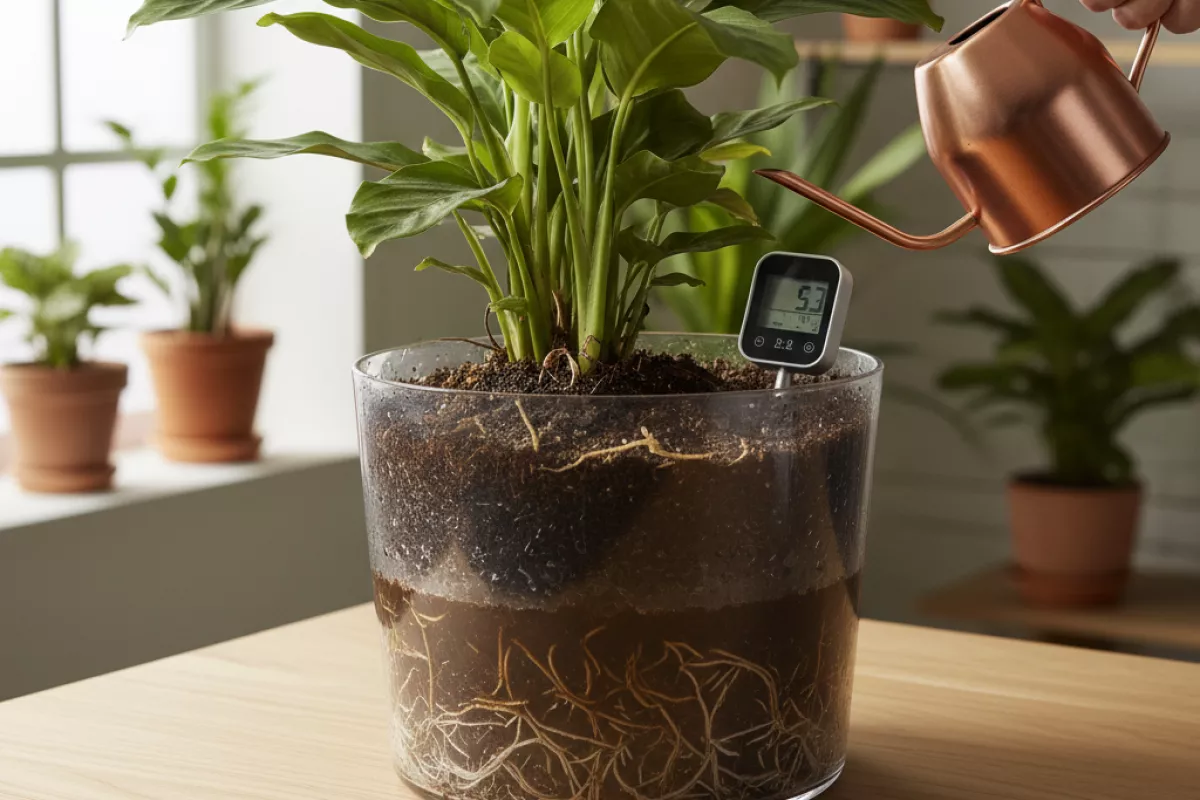
Indoors, plants usually get into trouble not from a single big watering, but from repeated watering before the pot has had time to dry. With weaker light, steadier temperatures, and limited airflow, soil can stay damp for days longer than you expect. That creates low-oxygen conditions around the roots, which is what “too much water” really means in practice.
Another common trap is judging by the surface. The top 1–2 cm (0.4–0.8 in) can look dry while the lower half of the pot is still wet, especially in deeper containers. If you water again based on that dry-looking crust, moisture builds up where roots actually sit.
- Watering on a schedule: “Every Sunday” ignores changes in season, room temperature, and growth rate. In winter, many houseplants use far less water, so the same routine can turn into constant saturation.
- Oversized pots: A small root system in a large container can’t use the stored moisture quickly. The extra soil acts like a reservoir, staying wet long after the plant is done drinking.
- Pots without drainage (or blocked drainage): Decorative cachepots, saucers, and liners can trap runoff. If the inner pot sits in 1 cm (0.4 in) of water for hours, the bottom layer never gets a chance to re-oxygenate.
- Soil that holds too much water: Fine, compact mixes (or old potting soil that has broken down) reduce air pockets. Even “careful” watering can lead to soggy conditions because the mix drains slowly. If you are repotting, plan a faster-draining recipe with a soil mix calculator.
- Low light and low airflow: A plant in a dim corner or far from a window transpires less, and the pot dries slowly. Still air also reduces evaporation from the soil surface.
- Cold windowsills and chilly rooms: Cooler soil slows root activity and evaporation. A potting mix at 18°C (64°F) can stay wet much longer than the same mix at 24°C (75°F).
- Misting and “top-ups” that add up: Small, frequent splashes keep the upper layer constantly damp, encouraging fungus gnats and shallow roots while deeper soil remains wet.
| Indoor situation | What it leads to | Why it’s easy to miss |
|---|---|---|
| Dry-looking surface, wet lower pot | Roots sit in low-oxygen soil; yellowing leaves, droop despite wet mix | You only see the top layer, especially in deep pots |
| Cachepot or saucer holds runoff | Bottom stays waterlogged; root rot starts from the base | Water is hidden under the inner pot |
| Dense or degraded potting mix | Slow drainage; musty smell; fungus gnats | Soil can look “normal” while air spaces are gone |
| Seasonal drop in light | Plant uses less water; wet-dry cycle stretches out | Your routine feels consistent, but the plant’s demand isn’t |
| Pot too large for the root ball | Moisture lingers; roots don’t colonize the wet soil quickly | The plant may look fine for weeks before decline shows |
The key takeaway is that indoor overwatering is usually a timing problem, not a volume problem. If the pot can’t drain well or can’t dry at a reasonable pace for your home’s light and airflow, even “small” waterings can keep roots wet all the time.
What changes a plant’s water needs at home
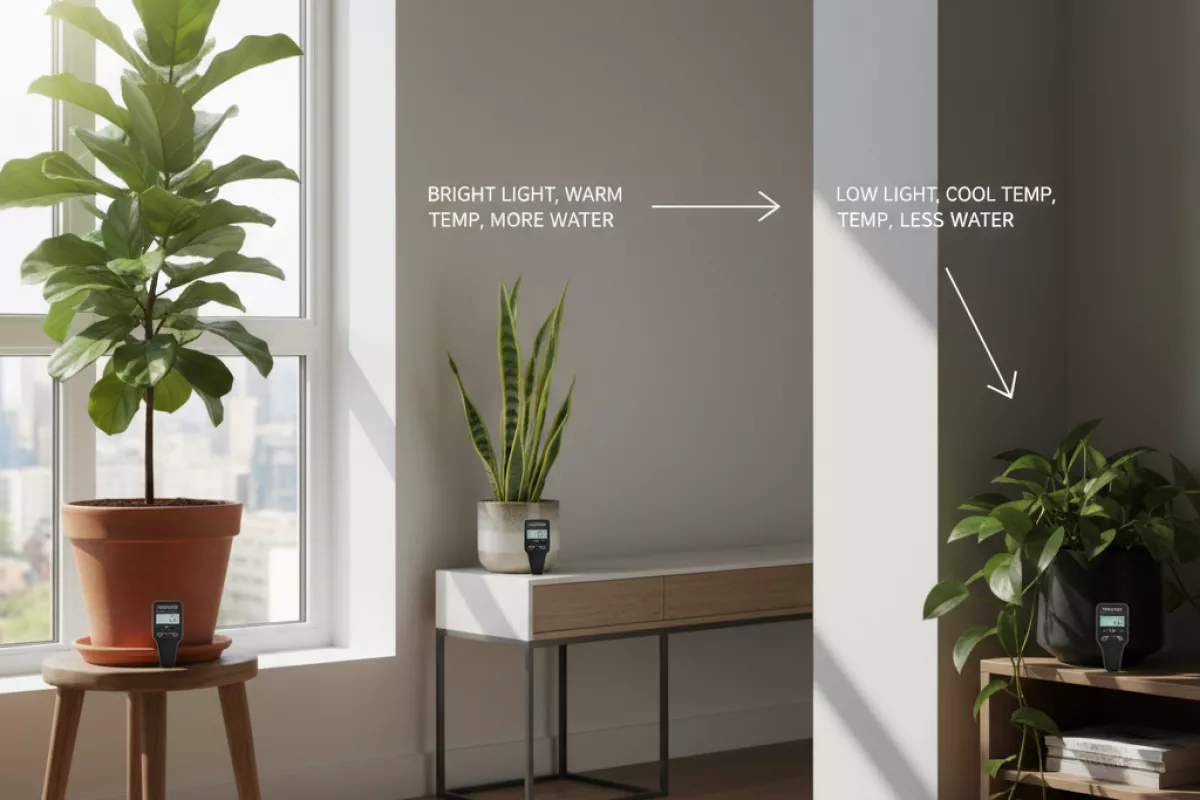
Indoor watering isn’t really about sticking to a schedule—it’s about how fast the potting mix dries in your rooms. The same plant can go from “thirsty every few days” to “fine for two weeks” just because the light, temperature, airflow, or pot setup changed.
- Light intensity and day length: Brighter light drives faster growth and higher transpiration, so the soil dries sooner. A plant 30 cm (12 in) from a bright window usually needs water more often than one 2 m (6.5 ft) back in the room.
- Temperature swings: Warm rooms speed evaporation and plant metabolism; cooler rooms slow both. A move from 18°C (64°F) to 24°C (75°F) can noticeably shorten the time between waterings.
- Humidity: Dry air pulls moisture from leaves and soil; humid air slows drying. In winter heating, indoor humidity can drop below 30% (common in many homes), which often increases how quickly pots dry.
- Airflow: Fans, vents, and drafty windows increase evaporation from the soil surface. A plant under an HVAC vent may need a different routine than one in a still corner.
- Pot size and material: Small pots hold less water and dry faster. Terracotta is porous and “breathes,” so it typically dries quicker than plastic or glazed ceramic.
- Drainage and saucers: A pot with a drainage hole lets excess water escape; a cachepot (nursery pot inside a decorative pot) can trap runoff and keep roots wet. Leaving water in a saucer for hours can turn “watering” into “soaking.”
- Potting mix and compaction: Chunky mixes (bark, perlite) drain and dry faster; peat-heavy mixes can stay wet longer. Over time, soil can compact and hold water unevenly, creating a wet core even when the top feels dry.
- Root-to-soil ratio: A rootbound plant can dry quickly because roots fill the pot and drink more, while an overpotted plant (too much soil for the root mass) stays wet longer and is easier to overwater.
- Plant type and leaf traits: Succulents and thick-leaved plants store water and prefer drying out; thin-leaved tropicals often want more consistent moisture. Hairy leaves, waxy leaves, and leaf size all affect water loss.
- Growth stage and season: Active growth (often spring/summer) increases water use; dormancy slows it. Even indoors, shorter winter days can reduce demand, so the same “weekly” habit may become too much.
- Recent repotting or pruning: After repotting, roots may be stressed and uptake can be slower; after heavy pruning, fewer leaves means less transpiration. Both can temporarily reduce how often the plant needs a drink.
| Change at home | What it usually does | How to adjust without overwatering |
|---|---|---|
| Moved closer to a bright window | Soil dries faster; growth speeds up | Check moisture 1–2 days earlier than usual; water only when the root zone is partly dry (plant-dependent) |
| Winter heating turned on (drier air) | Leaves lose more water; topsoil dries quicker | Don’t water just because the surface is dry; feel 5 cm (2 in) down or use a skewer test |
| Switched from plastic to terracotta | Pot breathes; mix dries sooner | Expect shorter intervals; water thoroughly, then let it dry more predictably between waterings |
| Upsized to a much larger pot | More soil stays wet longer; higher rot risk | Water less often; confirm deeper moisture before watering again, not just the top layer |
| Placed near a vent or fan | Evaporation increases; uneven drying | Rotate the pot weekly; monitor the side facing airflow and avoid “topping up” too frequently |
| Potting mix broke down/compacted | Water lingers around roots; poor aeration | Let it dry more between waterings and consider refreshing the mix when growth resumes |
If you take only one takeaway: treat watering as a response to conditions, not the calendar. When something changes in your home—light, heat, pot, or soil—assume the plant’s drink schedule changed too, and confirm with a quick moisture check before you pour. If you want to quantify the light variable, use a light calculator.
How to check soil moisture before watering
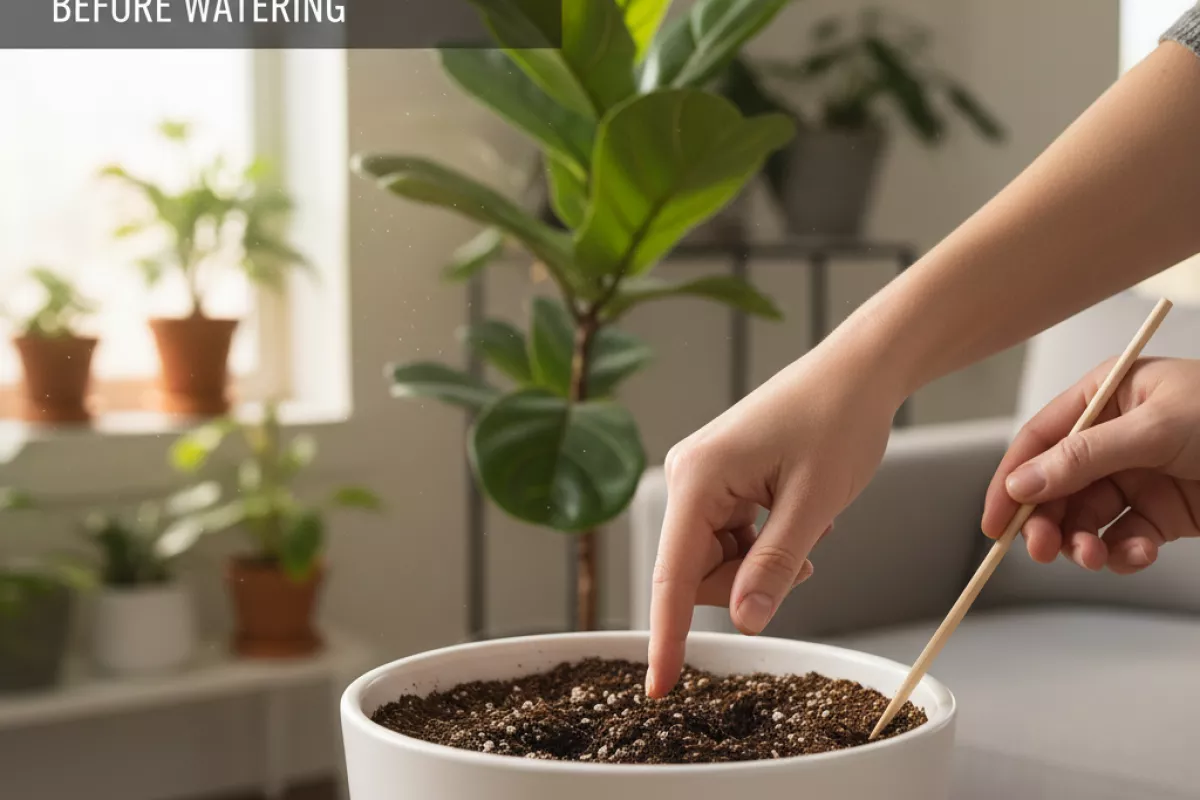
Watering decisions are easiest when you rely on the soil, not the calendar. The goal is to figure out whether the root zone still has usable moisture, or if it’s genuinely drying out and ready for a drink — then use a flexible watering schedule as a range, not a rule.
- Finger test (fast, no tools): Push a clean finger into the potting mix about 2–5 cm (1–2 in). If it feels cool and damp, wait. If it feels dry at that depth, it’s usually safe to water. For small pots, even 2 cm (1 in) can be enough; for larger containers, aim closer to 5 cm (2 in).
- Chopstick or skewer test (great for deeper pots): Insert a wooden chopstick 8–10 cm (3–4 in), leave it for 10–20 seconds, then pull it out. Dark, damp soil stuck to it means there’s still moisture below; a mostly clean, dry stick suggests the center is drying.
- Lift-the-pot method (surprisingly reliable): After a thorough watering, lift the pot to learn its “heavy” feel. Check again a few days later. When it feels noticeably lighter, the mix has dried down. This is especially helpful for hanging baskets and plastic nursery pots.
- Look for soil cues, not just surface crust: A dry top layer can be misleading. Check for shrinking soil pulling away from the pot edge, or a uniformly pale mix several centimeters down. If only the surface is dry but below is still cool, hold off.
- Moisture meter (useful, but verify): Insert the probe near the root zone, avoiding the pot wall. Treat the reading as a second opinion and occasionally confirm with the finger or skewer test—salts and dense mixes can throw meters off.
| Method | Best for | What “wait” looks like | What “water” looks like |
|---|---|---|---|
| Finger test (2–5 cm / 1–2 in) | Most houseplants in small-to-medium pots | Cool, damp mix at depth | Dry, crumbly mix at depth |
| Chopstick/skewer (8–10 cm / 3–4 in) | Deep pots, dense foliage, hard-to-see soil | Soil clings dark and moist | Stick comes out mostly clean and dry |
| Lift the pot | Plastic pots, hanging baskets, quick checks | Pot still feels heavy | Pot feels much lighter than after watering |
| Moisture meter probe | Large collections, big containers, consistency | Reading stays in “moist” range near roots | Reading drops to “dry” near roots |
If you’re unsure, err on the dry side for most common indoor plants. The main exception is moisture-lovers (like many ferns), where you’ll want the mix to stay evenly damp rather than swinging from wet to bone-dry.
One more tip: check moisture in more than one spot. Soil often dries unevenly—near the pot edge it can be drier, while the center stays wet—so a quick second check can prevent accidental overwatering.
The correct way to water so roots get oxygen
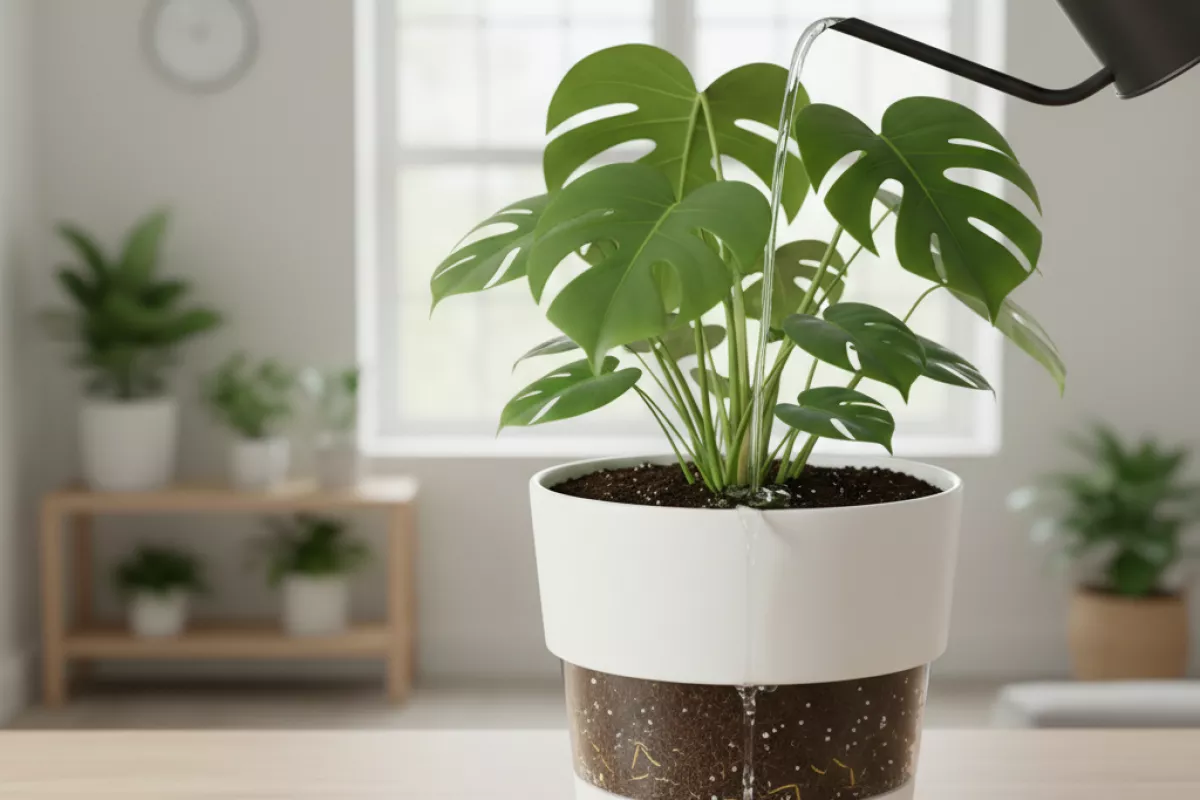
Healthy roots need a steady cycle of moisture and fresh air in the pot — that balance is the foundation of root health. Overwatering isn’t just “too much water” at once—it’s keeping the mix wet for too long, which pushes oxygen out of the spaces roots normally breathe through. The goal is to water thoroughly, then let the pot drain and the mix partially dry so air can move back in.
- Start with a pot that can drain.
If there’s no drainage hole, oxygen problems are almost guaranteed because water can’t leave the root zone. Use a nursery pot with holes inside a decorative cachepot, and empty any collected water after watering.
- Water deeply, not in sips.
Slowly pour until water runs out of the bottom, then keep going for a few seconds to fully wet the mix. This flushes salts and ensures all roots get moisture. As a rough guide, many indoor plants take about 1/4–1/3 of the pot’s volume in water (for example, 250–350 ml per 1 L pot volume (8–12 fl oz per 1 qt)), but always stop once you get steady drainage.
- Let it drain completely.
Wait 5–10 minutes, then discard runoff from the saucer or cachepot. Leaving the pot sitting in water keeps the lower mix saturated and starves roots of air.
- Time the next watering by dryness, not the calendar.
Check the top 2–5 cm (1–2 in) of mix with your finger, or lift the pot to feel its weight. Water again when the plant’s preferred “dry zone” is reached (some like slightly moist; others want a bigger dry-down). This dry-down is what pulls oxygen back into the root area.
- Keep the mix airy so water can leave and air can return.
If water takes longer than about 30–60 seconds to start draining, or the pot stays heavy for many days, the mix may be compacted. Gently poke a few holes with a chopstick, or repot into a chunkier blend (often adding bark, perlite, or pumice) so the root zone doesn’t stay waterlogged.
| What you notice | What it usually means for oxygen | What to do next time |
|---|---|---|
| Water pools on top and drains slowly | Compacted mix; air spaces are blocked | Water more slowly; loosen the surface; consider repotting into a more open mix |
| Saucer has water hours later | Bottom stays saturated; roots can’t breathe | Empty runoff after 5–10 minutes; raise the pot on feet or a rack inside the saucer |
| Pot feels heavy for 7+ days | Dry-down is too slow; oxygen returns too late | Increase light/airflow, reduce pot size at repot, or switch to a faster-draining mix |
| Top looks dry but lower mix is soggy | Perched water at the bottom; poor drainage pattern | Ensure drainage holes are clear; avoid adding rocks; use a well-structured potting mix |
If you’re unsure, err on the side of a fuller soak followed by a proper drain, rather than frequent small pours. Small amounts often wet only the upper layer, leaving deeper roots in stale, low-oxygen conditions while the top keeps getting re-wet.
Pot size, drainage, and why soil stays wet too long
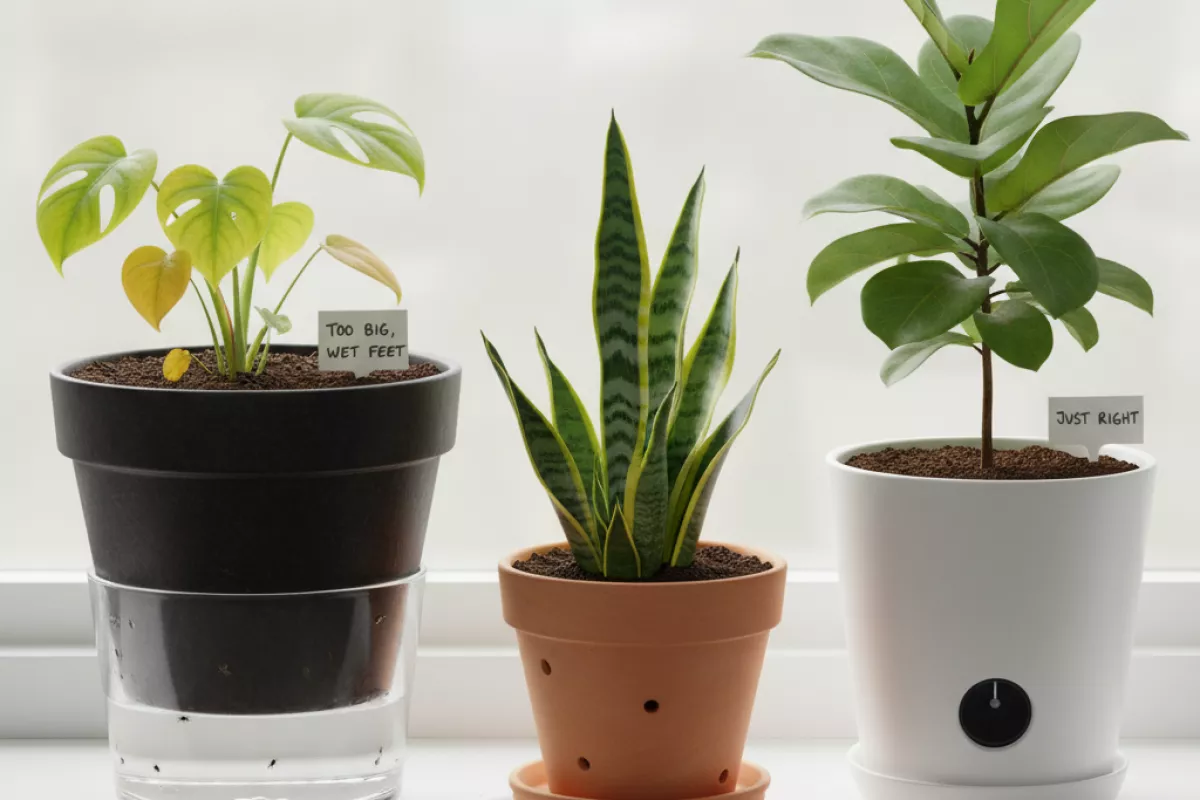
When a plant’s mix takes forever to dry, the cause is usually the container setup, not your watering can. A pot that’s too large, has poor drainage, or sits in a water-catching cachepot can keep roots in low-oxygen conditions for days. That’s when “I only watered once” still turns into yellow leaves, fungus gnats, and root rot.
- Oversized pots dry slowly. A small root system can’t use the water stored in a big volume of mix, so the center stays damp long after the top looks dry. Use a pot size calculator to avoid overpotting.
- No drainage hole means no escape route. Without a hole, excess water pools at the bottom and the lower roots suffocate. If you must use a decorative pot without holes, keep the plant in a plastic nursery pot with holes and lift it out to water and drain fully.
- Saucers and cachepots can “rewet” the soil. If the pot sits in runoff, the mix wicks water back up. Empty the saucer within about 10–15 minutes after watering (or once dripping stops) so the plant isn’t soaking from below.
- Drainage layers don’t fix a heavy mix. Pebbles or gravel at the bottom rarely improve drainage; they often create a perched water layer where moisture lingers above the rocks. Better results come from a well-aerated potting mix and a container with a real exit hole.
- Compacted soil holds water longer than you think. Old potting mix breaks down into fine particles that trap moisture and reduce airflow. If water takes a long time to run through, or the surface crusts, it may be time to refresh the mix or repot.
| What you notice | Likely container/drainage cause | What to change |
|---|---|---|
| Top dries fast but the pot feels heavy for days | Pot is too large or mix is dense and staying wet in the center | Downsize or repot into a lighter mix; step up only 2–5 cm (1–2 in) at a time |
| Water sits on the surface or drains very slowly | Compacted/old soil, blocked drainage hole, or roots circling tightly | Clear the hole, loosen the root ball, refresh potting mix, or repot |
| Leaves yellowing and soil smells sour | Standing water at the bottom, often from no hole or a constantly full saucer | Use a pot with drainage; empty saucers after 10–15 minutes; avoid letting it sit in runoff |
| Fungus gnats keep returning | Mix staying consistently moist due to poor airflow/drainage | Let the top 2–5 cm (1–2 in) dry between waterings; improve drainage and aeration |
A quick check that helps: after watering, the pot should feel noticeably lighter within a reasonable window for that plant and season. If it stays heavy for a week (or more) in normal indoor conditions, treat it as a pot-and-drainage problem first—then adjust your watering schedule second.
How light, temperature, and humidity affect watering
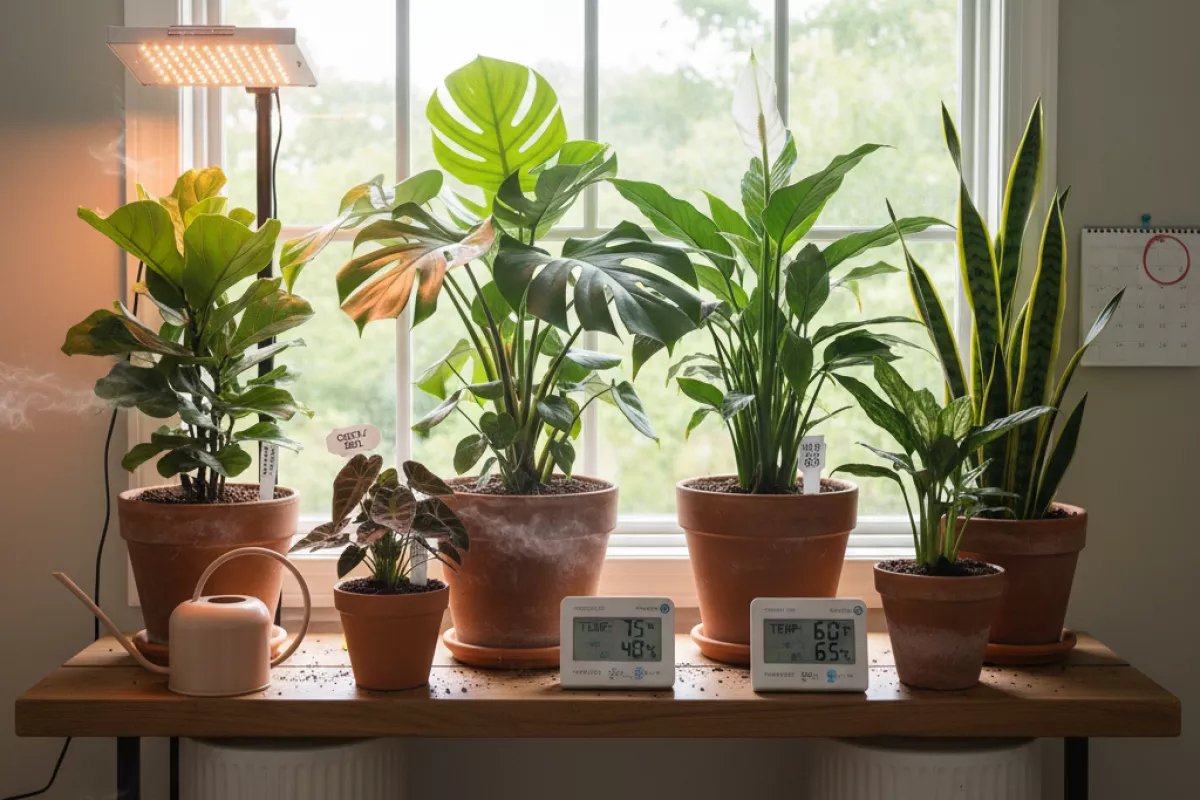
Water use isn’t fixed—it changes with the room conditions. A plant in bright light, warm air, and moving airflow can dry out surprisingly fast, while the same plant in dim light or cool, still air may stay wet long enough to invite root rot. Before you follow a calendar, adjust your watering based on what’s happening around the leaves and in the pot.
| Condition change | What it does to drying speed | How to adjust watering (practical cue) |
|---|---|---|
| More light (closer to a sunny window or under a grow light) | Faster; more photosynthesis and transpiration | Check soil sooner; water only when the top 2–5 cm (1–2 in) is dry for most houseplants |
| Less light (short winter days, shaded corner) | Slower; plant uses less water | Extend the time between waterings; wait for deeper dryness (often 5–7 cm / 2–3 in) depending on plant and pot size |
| Higher temperature (near heater, warm room) | Faster evaporation and leaf water loss | Don’t automatically add water daily; instead, feel the mix and water thoroughly only when it’s actually drying |
| Lower temperature (cool room, cold window at night) | Slower; roots take up less water | Reduce frequency; avoid leaving soil wet for long stretches, especially below about 18°C (65°F) |
| Low humidity (dry indoor air, winter heating) | Faster leaf moisture loss; soil may crust on top | Confirm dryness below the surface before watering; consider humidity support (tray, grouping, humidifier) rather than extra watering |
| High humidity (bathroom, crowded plant shelf) | Slower drying; less transpiration | Water less often and watch for fungus gnats; let the upper layer dry more between waterings |
| More airflow (fan, open window, HVAC vent) | Often faster; increases evaporation | Re-check moisture a day or two earlier than usual; rotate plants so one side doesn’t dry out unevenly |
| Still air (no movement) | Often slower; moisture lingers | Be conservative; prioritize drainage and avoid “topping up” small amounts that keep soil constantly damp |
- Use the pot as a clue: Lightweight pot usually means the root zone is drying; a heavy pot often means there’s still plenty of moisture.
- Watch for mixed signals: In dry air, leaves can droop even when soil is wet. Check the soil before watering so you don’t treat humidity stress like thirst.
- Expect seasonal shifts: When indoor temps drop from around 24°C (75°F) to 19°C (66°F) and light decreases, many plants need less frequent watering even if they look the same.
Watering by plant type: succulents, leafy plants, orchids
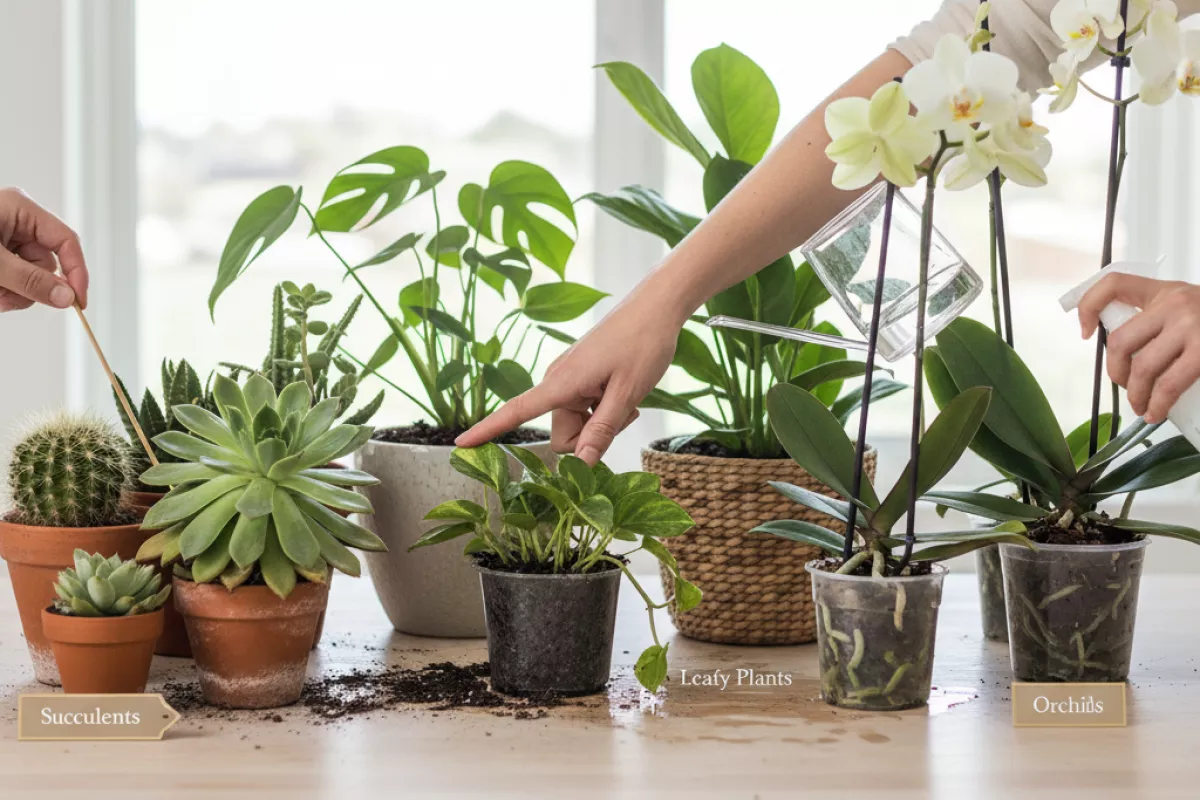
Different indoor plants store and use water in very different ways, so the safest routine is to match your method to the plant’s roots and leaves. Instead of watering on a calendar, use a quick check (finger test, pot weight, or a skewer) and then water thoroughly only when that plant type is ready.
| Plant type | When to water | How to water (low-overwatering approach) | Common overwatering warning signs |
|---|---|---|---|
| Succulents & cacti | When the potting mix is dry all the way through and the pot feels very light | Use the “soak and dry” method: water until it runs out of the drainage holes, then let it dry completely before the next watering. Empty the saucer after 5–10 minutes. | Soft, translucent leaves; sudden leaf drop; blackened stem base; soil staying damp for days |
| Leafy tropicals (pothos, philodendron, monstera, peace lily) | When the top 2–5 cm (1–2 in) is dry; deeper soil should still feel slightly cool, not wet | Water evenly around the pot until you get a little runoff. If the plant is in bright light, it may need more frequent watering; in low light, stretch the interval and re-check before adding more. | Yellowing lower leaves; mushy stems; fungus gnats; a sour smell from the pot |
| Orchids (common phalaenopsis) | When the bark is nearly dry and roots look silvery; the pot feels light | Water in the morning. Run water through the pot for 10–20 seconds, then let it drain completely. Keep water out of the crown (the center where leaves meet). Never leave the pot sitting in water. | Wrinkled leaves with wet media (root rot); brown/black mushy roots; persistent condensation inside the pot |
| Quick “is it dry?” check | Match the check to the pot size and mix | Small pots: finger test to 2–3 cm (1 in). Larger pots: wooden skewer to mid-depth; if it comes out damp or with soil stuck to it, wait. For orchids: look at root color and bark dryness. | Watering “just in case” even though the mix still feels cool or the pot is heavy |
Two small tweaks prevent most accidental overwatering across all three groups: use a pot with drainage and empty the cachepot/saucer after watering. If you’re unsure, it’s usually safer to wait 24 hours than to top up again—especially for succulents and orchids.
Signs of overwatering vs underwatering
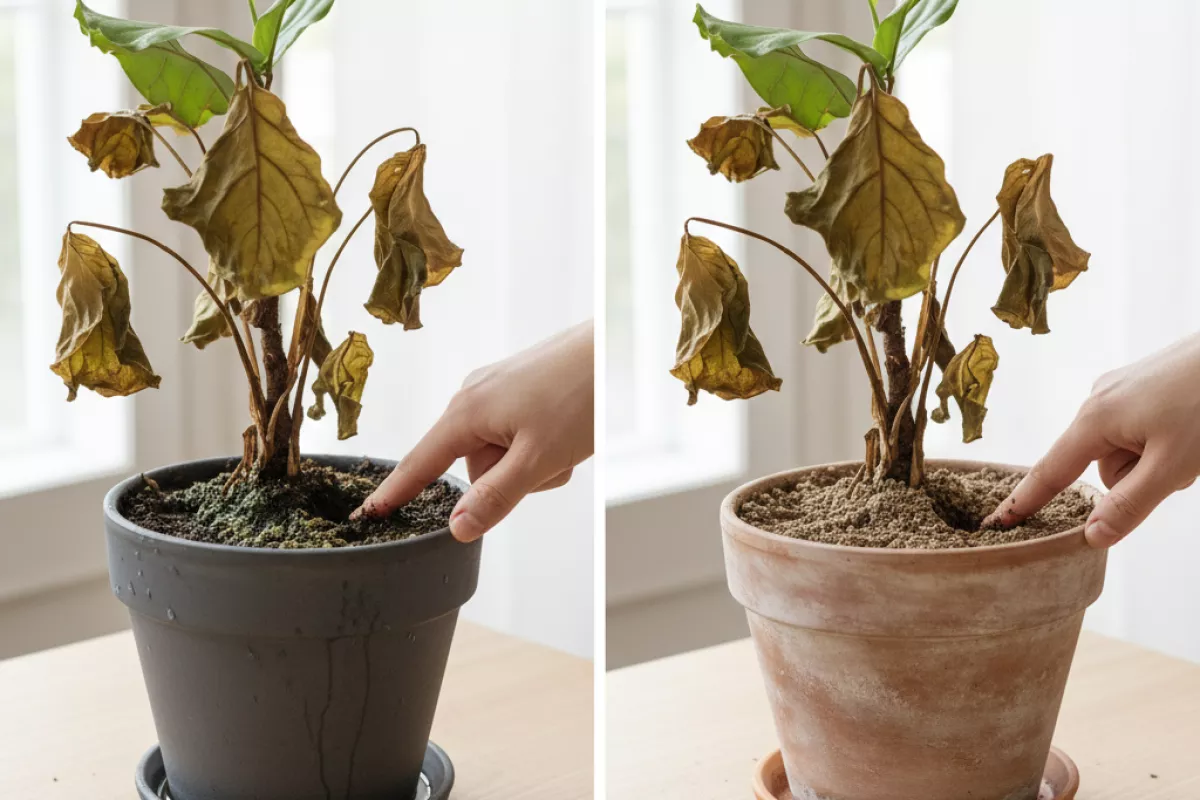
Most watering mistakes look similar at first glance: droopy leaves, slow growth, and a plant that just seems “off.” The quickest way to tell what’s happening is to check both the foliage and the potting mix. A plant can wilt from dry soil, but it can also wilt because roots are sitting in water and can’t take up oxygen.
| What you notice | More often points to overwatering | More often points to underwatering |
|---|---|---|
| Soil feel 5 cm (2 in) down | Still wet, cool, or muddy days after watering | Dry, dusty, or pulling away from the pot edges |
| Leaf texture and color | Yellowing leaves that feel soft; sometimes translucent patches | Crispy edges, dull color, leaves feel thin or papery |
| Wilting pattern | Droop even though the soil is wet; stems may feel limp | Droop with dry soil; perks up within a few hours after a thorough drink |
| Leaf drop | Older leaves drop first; may fall while still yellow/soft | Leaves may drop after turning brown and brittle |
| Smell and surface clues | Sour/musty odor, algae on soil, fungus gnats hanging around | Little to no smell; soil surface may look cracked and hard |
| Pot weight | Pot stays heavy for many days | Pot feels unusually light; dries very quickly |
| Roots (if you slide the plant out) | Brown/black, mushy roots; outer layer slips off when pinched | Dry, wiry roots; some may be shriveled but not mushy |
If you’re seeing mixed signals, trust the root zone. For example, yellow leaves plus a heavy pot usually means the mix is staying wet too long (often from poor drainage, a pot that’s too large, or watering on a schedule). Crispy tips plus bone-dry soil usually means the plant is simply not getting enough water, or the mix has become hydrophobic and needs a slow, thorough soak.
- One fast tie-breaker: check moisture at depth, not just the surface. If the top 2 cm (0.8 in) is dry but it’s wet below, wait.
- Watch the newest growth: new leaves that emerge small, thin, or misshapen can happen when roots are stressed from staying soggy; dry stress more often shows as browning and shedding.
- Consider the timeline: overwatering symptoms often build gradually; underwatering often shows up suddenly after a missed watering or a hot, bright spell.
How to fix overwatering fast and prevent root rot
Act quickly when soil stays wet for days, leaves turn yellow and limp, or you notice a sour, swampy smell. The goal is to get oxygen back to the roots, remove any rot, and reset your routine so the plant can recover instead of declining.
- Stop watering immediately. Don’t “balance it out” with more water or fertilizer. Let the plant use what’s already in the pot.
- Increase airflow and light (gently). Move it to brighter indirect light and add air movement (a fan across the room is enough). Avoid hot sun that can scorch stressed leaves.
- Check drainage and empty the saucer/cachepot. If the pot is sitting in runoff, pour it out. If it’s a decorative cover pot, lift the nursery pot out so it can drain and breathe.
- Wick out excess moisture if the mix is soggy. Tip the pot slightly and press paper towels against the drainage holes, or set the pot on a thick layer of dry towels for 30–60 minutes. This won’t fix rot, but it can buy time.
- Assess the roots if symptoms are progressing. Slide the plant out. Healthy roots are firm and pale; rotting roots are brown/black, mushy, and may smell bad.
- Trim rot and reset the root ball. With clean scissors, cut away mushy roots back to firm tissue. If more than about 1/3 is gone, reduce some top growth (a few leaves or stems) so the remaining roots can keep up.
- Repot into fresh, airier mix. Replace saturated soil; don’t reuse it. Choose a pot with drainage holes and a mix that drains well (for many houseplants, adding perlite/pumice or bark improves oxygen). Keep the pot size close to the root mass; jumping up in size holds extra water.
- Hold off on watering after repotting. Wait until the top 2–5 cm (1–2 in) is dry, then water lightly. The exact depth depends on the plant and pot size, but the principle is the same: don’t keep newly trimmed roots constantly wet.
- Skip fertilizer until you see new growth. Feeding a stressed plant can burn damaged roots. Resume only after you see fresh leaves or firm new stems.
| What you notice | What it usually means | What to do next |
|---|---|---|
| Soil is wet 3–7 days after watering; pot feels heavy | Mix is holding too much water or drainage is blocked | Empty saucer, improve airflow, and plan a repot into a chunkier mix if it keeps happening |
| Yellowing leaves + limp stems, but soil is still damp | Roots aren’t taking up water due to low oxygen | Pause watering; move to brighter indirect light; check roots if decline continues |
| Sour smell; fungus gnats; algae on soil surface | Constant moisture and poor aeration | Let the top layer dry, remove the top 2–3 cm (1 in) of soil, and consider repotting |
| Roots are brown/black and mushy | Root rot has started | Trim damaged roots, discard old soil, disinfect the pot, and repot into fresh, well-draining mix |
| Plant wilts even though the soil is wet | Severe root damage; water can’t move through the plant | Unpot and inspect immediately; take cuttings as backup if the root system is mostly gone |
- Use the “dryness check,” not the calendar. Feel the mix 5 cm (2 in) down, or use a wooden skewer: if it comes out cool and dark, wait; if it’s mostly dry, water.
- Water thoroughly, then let it drain fully. A deep watering is fine as long as excess runs out and the pot isn’t left sitting in it.
- Match the pot to the plant. Oversized pots stay wet longer. After a rot episode, staying closer to the root ball helps the mix dry at a healthier pace.
- Adjust for seasons and indoor conditions. In cooler rooms around 18–20°C (64–68°F) or low light, plants drink less. In warmer, brighter spots around 24–27°C (75–81°F), they dry faster.
- Keep the top layer breathable. Avoid thick decorative moss or dense top-dressings that trap moisture unless you’re compensating with a very airy mix.
If you catch the issue early, many indoor plants bounce back within 2–4 weeks as new roots form. The key is giving roots air, not just withholding water—good drainage, a suitable potting mix, and a simple check-before-you-water habit prevent the same problem from returning.
Simple watering routines that stay flexible
Consistency helps, but rigid schedules are what usually lead to soggy soil. A better approach is to build a simple rhythm (check, decide, then water) and let the plant and the potting mix tell you when it’s time. That way you’re less likely to “top up” out of habit and more likely to water only when roots can actually use it.
- Pick two “check days,” not two “water days.” For example, look in on most plants every 3–4 days (72–96 hours) rather than watering weekly no matter what. On check days, decide based on soil moisture and plant cues.
- Use a quick moisture test you’ll actually do. For small pots, a finger test works: if the top 2–5 cm (1–2 in) are dry, it may be time. For larger pots, use a chopstick or skewer: insert it deep, wait 10 seconds, and pull it out; damp soil will darken the wood.
- Match the method to the plant’s “dry-down” preference. Many tropical foliage plants like to dry slightly between waterings; succulents and cacti prefer drying much more thoroughly. When in doubt, err on the dry side for a day and reassess.
- Water thoroughly, then stop. When you do water, aim for an even soak until a little drains out, then empty the saucer after 10–15 minutes. This prevents the pot from reabsorbing runoff and keeps the lower roots from sitting in water.
- Keep a tiny note, not a strict log. A simple “last watered” date on your phone is enough. If you notice you’re watering more often than every 5–7 days (120–168 hours) in average indoor conditions, double-check light, pot size, and drainage.
| Situation | What to do | Why it helps prevent overwatering |
|---|---|---|
| Top looks dry, but the pot feels heavy | Wait 1–2 days (24–48 hours) and test deeper with a skewer | Surface dryness can be misleading; deeper soil may still be wet |
| Leaves droop, but soil is damp | Hold off on watering; check for cold drafts and low light; loosen compacted soil surface gently | Droop can come from stress or low oxygen at the roots, not thirst |
| Plant is in bright window light for 6–8 hours (360–480 min) daily | Expect faster drying; keep check days the same but be ready to water more often | Light drives water use; you avoid “schedule shock” by adjusting only when needed |
| Winter heating is on and humidity drops | Check a bit more often; water only when the root zone is drying, not just the top | Air dries faster than soil; checking prevents unnecessary extra watering |
| New pot or fresh mix after repotting | Water once to settle, then let it dry more than usual before the next watering | Fresh mix holds water differently; roots need air as they recover |
If you want a simple rule to remember: check often, water less often. The habit is the inspection; the watering is the decision you earn after the soil test.