How to Get Rid of Aphids on Plants

 How to get rid of aphids quickly without harming your plants. This guide covers safe removal methods, including water sprays, insecticidal soap, neem oil, and natural predators. You’ll learn how to identify aphid infestations, treat them properly, and prevent future outbreaks on indoor and outdoor plants.
How to Identify Aphids
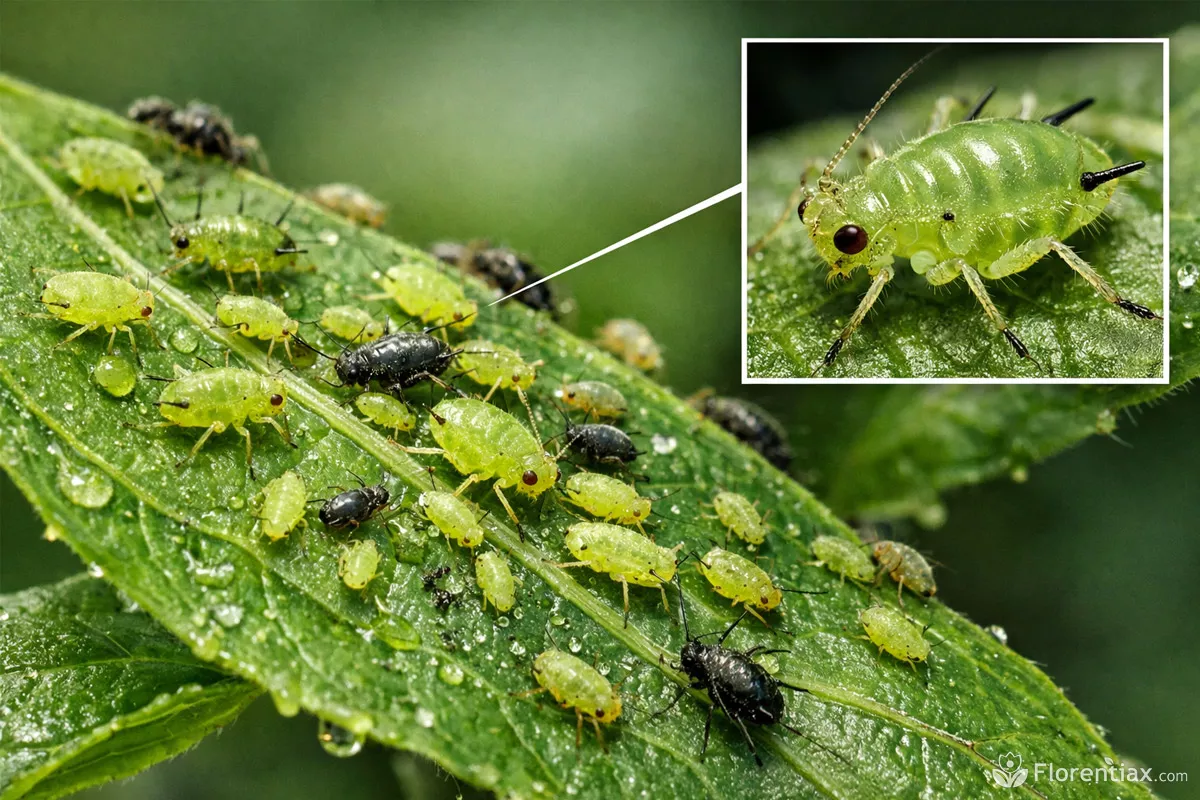
Aphids are small sap-sucking insects that feed on plant juices and multiply quickly. They usually gather on the softest, newest parts of the plant because those tissues are easiest to pierce and contain the most nutrient-rich sap.
Adult aphids are typically 1–4 mm (0.04–0.16 in) long. Many species are green, but they can also be black, yellow, white, gray, or reddish. Some have wings (especially when colonies are overcrowded), but most are wingless.
Where to look first
Check these areas in this exact order, because aphids prefer protected feeding spots:
- New growth tips — the soft top leaves and tender shoots.
- Undersides of leaves — especially along the midrib and veins.
- Flower buds — aphids commonly hide under sepals and around bud bases.
- Leaf nodes and stem joints — small colonies often start here.
- Lower stems near the soil line — less common, but possible on heavily infested plants.
Key signs that confirm an aphid problem
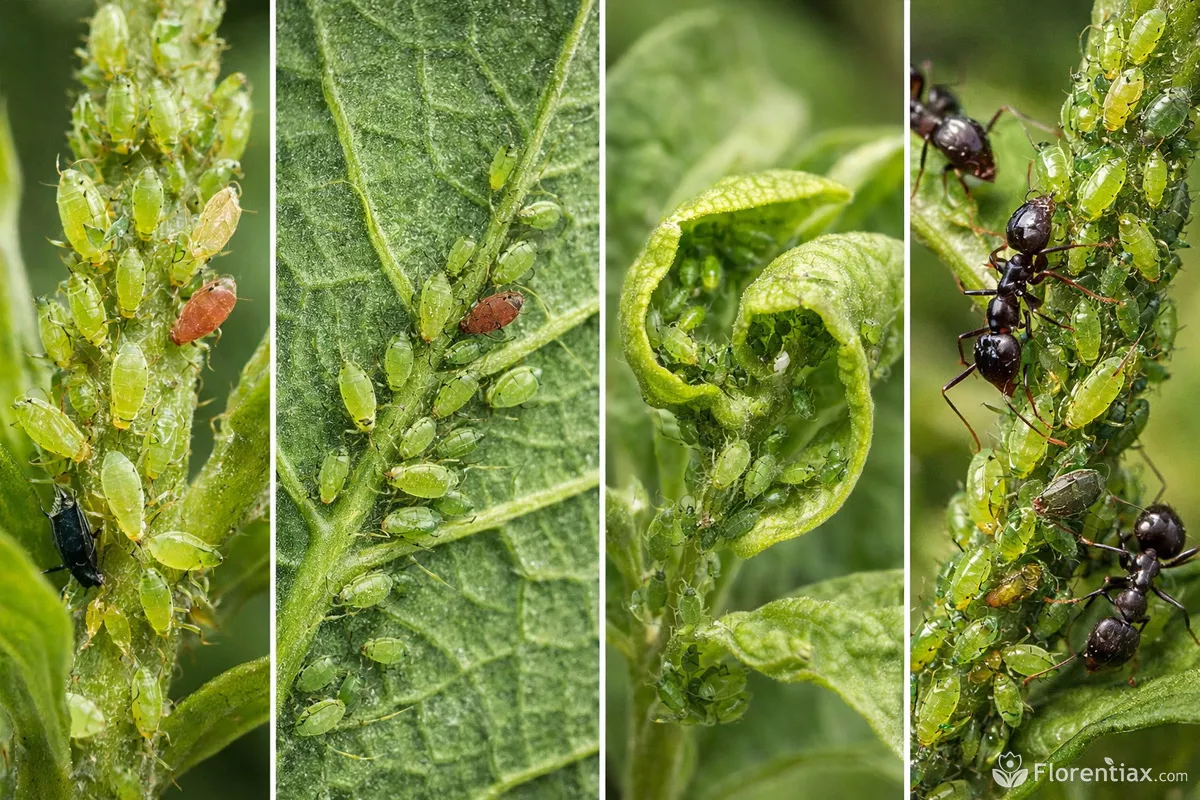
Aphids are often easier to detect by damage patterns than by the insects themselves:
- Sticky leaves or surfaces — aphids excrete sugary liquid called honeydew that coats leaves and nearby furniture or windowsills.
- Curled or distorted new leaves — feeding on soft growth causes twisting, cupping, and stunted leaf expansion.
- Deformed buds and flowers — buds may fail to open or flowers may look misshapen.
- Yellow speckling or pale patches — sap loss reduces chlorophyll and causes localized discoloration.
- Ant activity — ants “farm” aphids for honeydew and protect them from predators.
How to confirm aphids in 30 seconds
- Hold a white sheet of paper under a suspect shoot.
- Tap the stem firmly 2–3 times.
- If tiny green/black/yellow insects fall and begin moving, you have an active colony.
For indoor plants, also inspect nearby plants. Aphids spread by crawling, by winged adults, and by hitchhiking on hands and tools.
| What You See | What It Usually Means | Where to Check Next |
|---|---|---|
| Sticky leaves or shiny residue | Honeydew from aphids (or sometimes scale) | Undersides of leaves, stems, leaf nodes |
| Curled tips and distorted new growth | Active feeding on tender tissue | New shoots, buds, soft stems |
| Ants climbing the plant or pot | Ants protecting aphids for honeydew | Stems and leaf joints for colonies |
| Black soot-like coating on leaves | Sooty mold growing on honeydew | Look for aphids above the moldy area |
| Tiny insects clustered on tips or veins | Confirmed aphids (colony behavior) | Inspect nearby plants for spread |
Aphids or something else
Aphids are often confused with other pests. A quick rule:
- Aphids — soft-bodied, cluster in groups, produce sticky honeydew.
- Spider mites — fine webbing and tiny speckling, usually no sticky honeydew.
- Thrips — silvery streaks and black dots (waste), insects are slender and fast-moving.
- Scale — hard bumps that do not move, sticky honeydew is common.
If you see sticky residue plus clusters of soft insects on new growth, it is almost always aphids.
Why Aphids Appear on Plants
Aphids appear when plants offer an easy food source and low resistance. They are attracted to soft, nitrogen-rich growth and spread rapidly when conditions are warm, dry, and stable.
The main reasons aphids infest plants
- Too much nitrogen fertilizer — high nitrogen creates soft, juicy growth that aphids prefer. This is why outbreaks often happen 7–14 days after feeding.
- Weak or stressed plants — inconsistent watering, poor light, root restriction, or repotting stress reduces plant defenses and makes feeding easier.
- Warm indoor temperatures — many aphid species reproduce faster between 20–27°C (68–81°F).
- Low airflow — crowded plants and stagnant air allow colonies to build without disruption.
- New plants brought indoors — aphids commonly enter homes on nursery plants, especially those with buds or fresh growth.
How fast aphids multiply
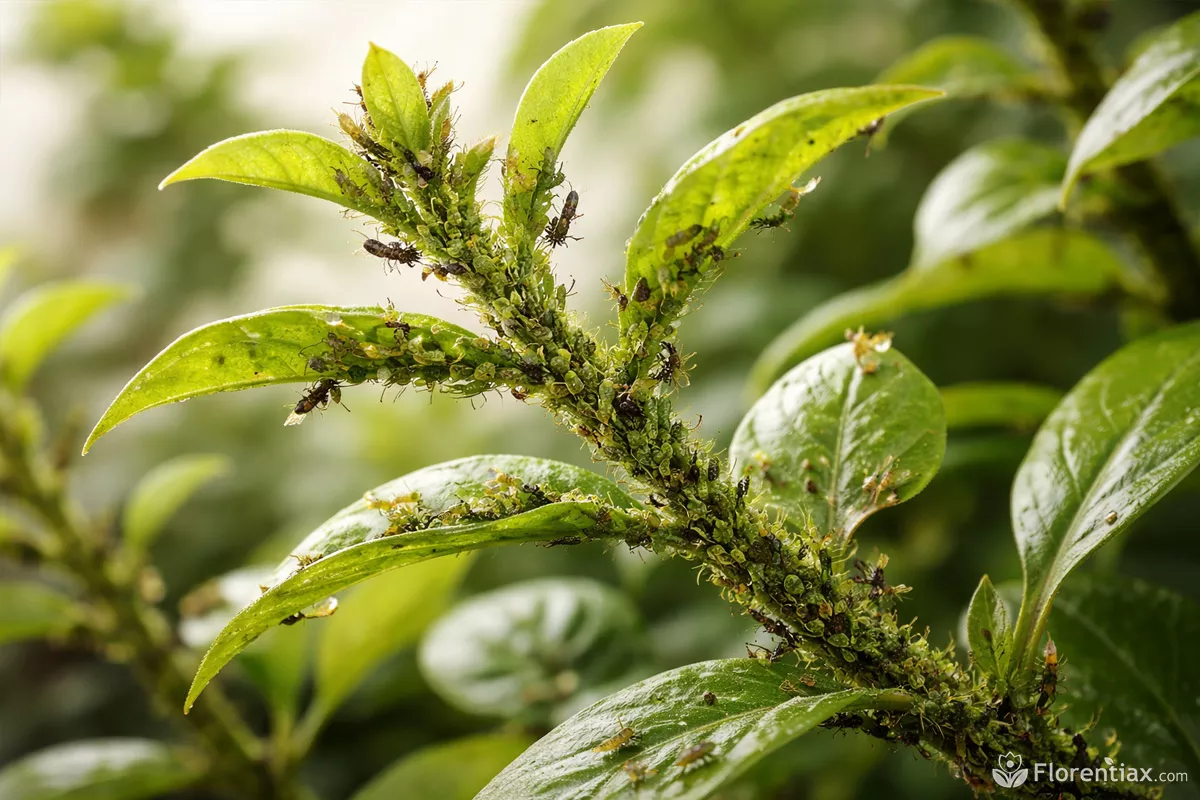
Aphids reproduce extremely fast. In many species, females can produce live young without mating. Under good conditions, a small colony can become a serious infestation within 1–2 weeks. Winged adults may appear when colonies are overcrowded, allowing aphids to spread to nearby plants.
Indoor vs outdoor triggers
- Indoors: Aphids often explode due to stable warmth, weak light in winter, and lack of natural predators. Even one hidden colony on a new plant can spread to a shelf of houseplants.
- Outdoors: Aphids commonly appear in spring when plants push tender new growth. Dry weather and heavy fertilizing can make outbreaks worse.
Why ants make aphid problems harder
Ants protect aphids because they feed on honeydew. They will actively chase away ladybugs and other beneficial insects. If you see ants moving up and down stems, treat the aphids and also reduce ant access (for example, by removing nearby debris and using physical barriers on pots if needed).
Once you understand why aphids appear, you can treat the infestation more effectively and reduce the chance of repeated outbreaks.
How to Get Rid of Aphids Safely
Effective aphid control depends on infestation size. A few insects on one plant require a different approach than a heavy colony covering multiple stems. Always start with the least aggressive method and escalate only if necessary.
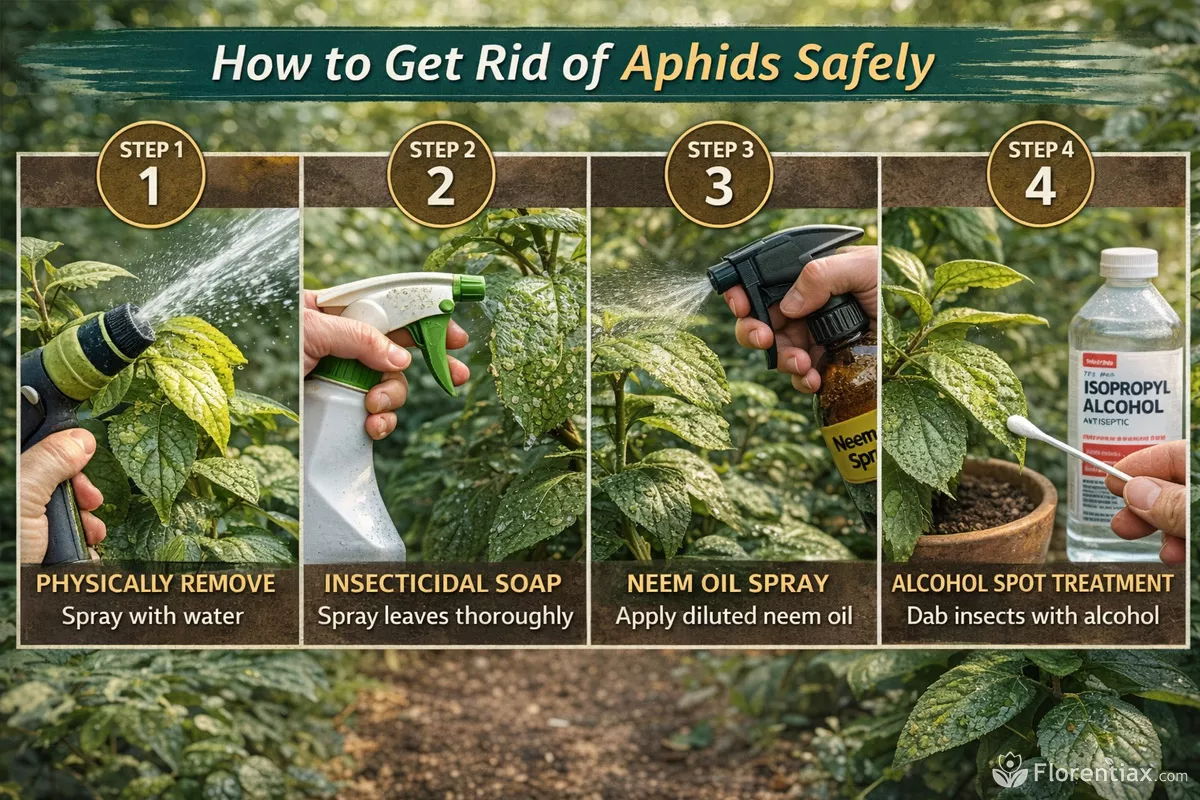
Step 1: Physically Remove Aphids
For light infestations, mechanical removal works well.
- Rinse plants under a steady stream of lukewarm water.
- Focus on leaf undersides and growth tips.
- Repeat every 2–3 days for one week.
Water pressure should be firm but not damaging. This method is especially effective for outdoor plants and sturdy indoor foliage species.
Step 2: Use Insecticidal Soap
Insecticidal soap breaks down aphids’ outer cell membranes, causing dehydration. It works only on contact, so full coverage is critical.
- Spray thoroughly on both sides of leaves.
- Apply in the evening or out of direct sun.
- Repeat every 5–7 days if needed.
Step 3: Neem Oil Treatment
Neem oil disrupts aphid feeding and reproduction. It works more slowly than soap but provides longer residual protection.
- Dilute according to label instructions.
- Apply every 7–10 days.
- Avoid use in strong sunlight to prevent leaf burn.
Step 4: Spot Treatment With Alcohol
For small clusters, use a cotton swab dipped in 70% isopropyl alcohol. Dab directly on aphids. Always test a small leaf area first.
| Method | How It Works | Best For | Speed of Results | Risk Level |
|---|---|---|---|---|
| Water Spray | Physically dislodges aphids | Light infestations | Immediate reduction | Very Low |
| Insecticidal Soap | Breaks cell membranes on contact | Indoor plants, moderate colonies | 1–3 days | Low |
| Neem Oil | Disrupts feeding and reproduction | Recurring infestations | 3–7 days | Low–Moderate |
| Alcohol Spot Treatment | Dehydrates insects instantly | Small visible clusters | Immediate | Low (if tested first) |
| Systemic Insecticide | Absorbed by plant tissues | Severe outdoor outbreaks | 7–14 days | Higher (use carefully) |
Important: Repeat treatments are often necessary because eggs and hidden nymphs may survive the first application. Inspect plants every 3–4 days for at least two weeks.
Natural and Organic Aphid Control
If you prefer non-chemical solutions or are treating edible plants, natural control methods can reduce aphid populations effectively when applied consistently.
Introduce Beneficial Insects
Ladybugs and lacewing larvae are natural aphid predators. One lacewing larva can consume dozens of aphids per day. This method works best outdoors or in greenhouses.
Encourage Airflow and Plant Spacing
Crowded plants create ideal environments for aphids. Increasing airflow reduces colony buildup and makes plants less attractive to pests.
Control Nitrogen Levels
Avoid over-fertilizing. Rapid, soft growth caused by excess nitrogen is highly attractive to aphids. Use balanced fertilizers and follow label instructions.
Regular Monitoring
Inspect new growth weekly during active seasons. Early detection prevents heavy infestations.
Natural control works best as a prevention strategy combined with physical removal when colonies first appear.
How to Prevent Aphids From Returning
Eliminating aphids once is not enough. Without preventive measures, colonies often return within 2–4 weeks, especially during active growing seasons. Prevention focuses on reducing plant stress and removing the conditions that attract aphids.
Build Stronger, More Resistant Plants
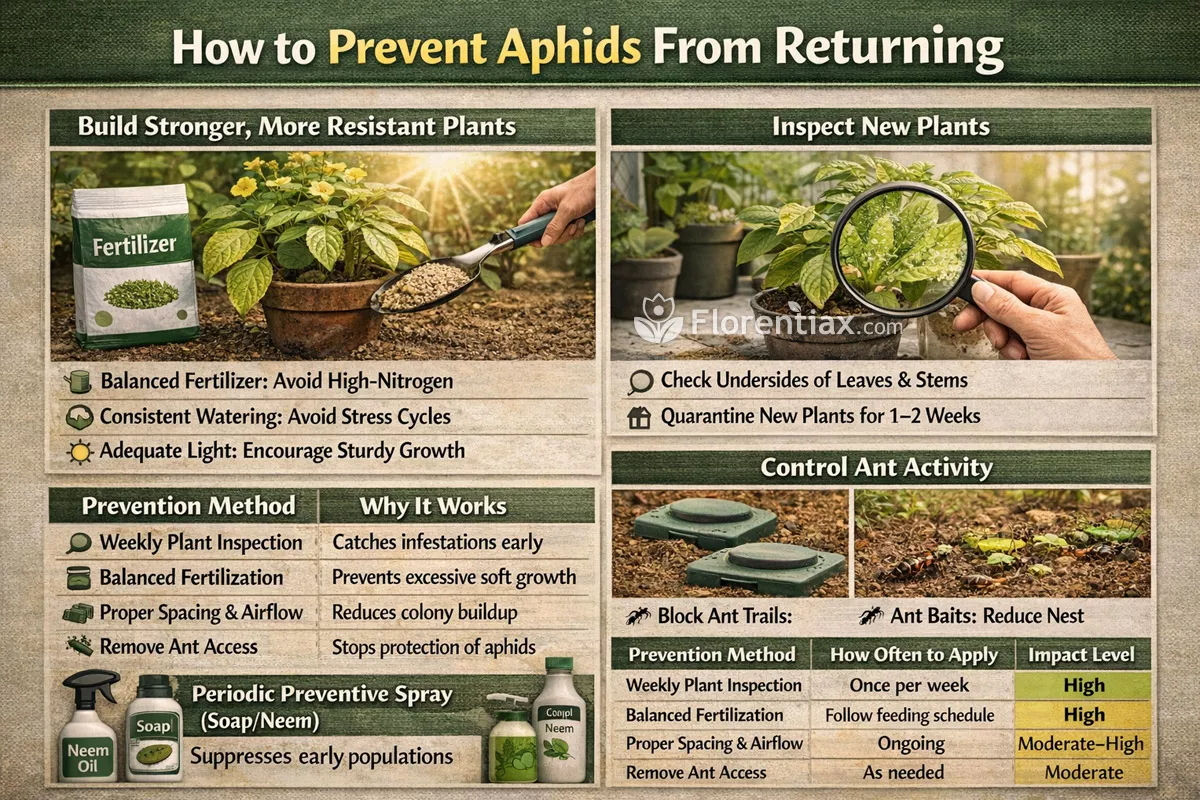
Healthy plants are less attractive to pests and recover faster from minor infestations. The goal is stable growth, not rapid, overly soft new shoots.
- Use balanced fertilizer instead of high-nitrogen formulas.
- Maintain consistent watering without stress cycles.
- Provide adequate light for compact, sturdy growth.
Inspect New Plants Before Bringing Indoors
Many aphid outbreaks begin with one infested nursery plant. Always inspect undersides of leaves, stems, and buds before introducing new plants to your collection.
Control Ant Activity
If ants are present, aphid colonies are often nearby. Ants protect aphids from predators in exchange for honeydew. Reducing ant access can significantly reduce reinfestation risk.
| Prevention Method | Why It Works | How Often to Apply | Impact Level |
|---|---|---|---|
| Weekly Plant Inspection | Catches infestations early | Once per week | High |
| Balanced Fertilization | Prevents excessive soft growth | Follow feeding schedule | High |
| Proper Spacing & Airflow | Reduces colony buildup | Ongoing | Moderate–High |
| Remove Ant Access | Stops protection of aphids | As needed | Moderate |
| Periodic Preventive Spray (Soap/Neem) | Suppresses early populations | Every 2–3 weeks in peak season | Moderate |
Seasonal Monitoring
Aphids are most active in spring and early summer when plants produce tender growth. During this period, inspect plants more frequently and respond immediately to the first signs of infestation.
Key principle: Early detection and mild intervention prevent the need for aggressive treatments later. Consistency is more effective than intensity.
Common Questions About Getting Rid of Aphids
Aphids spread fast, and misinformation spreads even faster. Below are the most common questions people ask about aphid control — with clear, practical answers based on what actually works.
1. Do aphids go away on their own?
Sometimes small outdoor colonies disappear due to predators or weather changes. Indoors, however, aphids rarely go away without intervention. Stable temperatures and lack of natural enemies allow them to reproduce continuously. If you see active clusters, treat them.
2. Does spraying water completely solve the problem?
Water spray can significantly reduce light infestations, especially outdoors. However, it does not kill eggs and may miss hidden nymphs. For moderate or recurring infestations, combine water spray with insecticidal soap for better control.
3. Is dish soap safe for plants?
Not always. Regular dish soap may contain degreasers and additives that damage leaves. If using a soap solution:
- Use a mild, unscented liquid soap.
- Test on one leaf first.
- Rinse after a few hours.
Commercial insecticidal soap is safer and more reliable.
4. Does neem oil kill aphids instantly?
No. Neem oil disrupts feeding and reproduction rather than acting as an immediate killer. Results usually appear within 3–7 days. It works best when applied consistently and thoroughly.
5. Will vinegar kill aphids?
Vinegar can kill aphids on contact, but it also damages plant tissue. It is not recommended for general treatment. The risk of leaf burn outweighs the benefits.
6. Can aphids harm humans or pets?
Aphids do not bite humans or pets. They are plant-specific feeders. The main issue is plant damage, not personal safety.
7. Why do aphids keep coming back?
Common reasons include:
- Overfertilizing with high nitrogen
- Incomplete treatment (eggs or hidden nymphs survived)
- Ants protecting colonies
- Untreated nearby plants
Reinfestation usually means one of these factors was not addressed.
8. Do coffee grounds repel aphids?
There is no strong evidence that coffee grounds effectively repel aphids. While they may improve soil structure in some cases, they are not a reliable pest control method.
9. Are systemic insecticides necessary?
For severe outdoor infestations, systemic insecticides can be effective. However, they should be used carefully and avoided on edible plants unless clearly labeled as safe. For most indoor infestations, non-systemic methods are sufficient.
10. How long does it take to fully eliminate aphids?
With consistent treatment, light infestations can be controlled in 7–10 days. Moderate outbreaks may require 2–3 weeks of monitoring and repeated applications. Weekly inspections for at least one month are recommended to prevent recurrence.
Final advice: Early detection and consistent follow-up matter more than aggressive treatment. The faster you respond, the easier aphids are to eliminate.