Insecticidal Soap for Scale Insects: How to Use It

 Here we how insecticidal soap works on scale insects, which stages are easiest to kill, how to pick the right soap, prep the plant, and spray leaves, stems, and hidden spots correctly. It also explains when to repeat treatment, how to spot soap damage, mistakes that reduce results, and what to try if it does not work.
- How insecticidal soap affects scale insects
- Which scale insect stages are most vulnerable
- Choosing a suitable insecticidal soap
- How to prepare the plant before treatment
- How to apply insecticidal soap correctly
- Where to spray leaves, stems and hidden areas
- How often to repeat the application
- Plant sensitivity and signs of soap damage
- Common mistakes that reduce effectiveness
- What to do if insecticidal soap does not work
If scale insects are spreading on your plants, insecticidal soap can be an easy, lower-toxicity way to manage them before turning to stronger products. It works best when sprayed directly and thoroughly on the pests, especially on stems and leaf undersides where they hide. Repeat treatments are often needed because one application may miss some insects. Test sensitive plants first, since certain varieties can show leaf burn or spotting after treatment.
How insecticidal soap affects scale insects
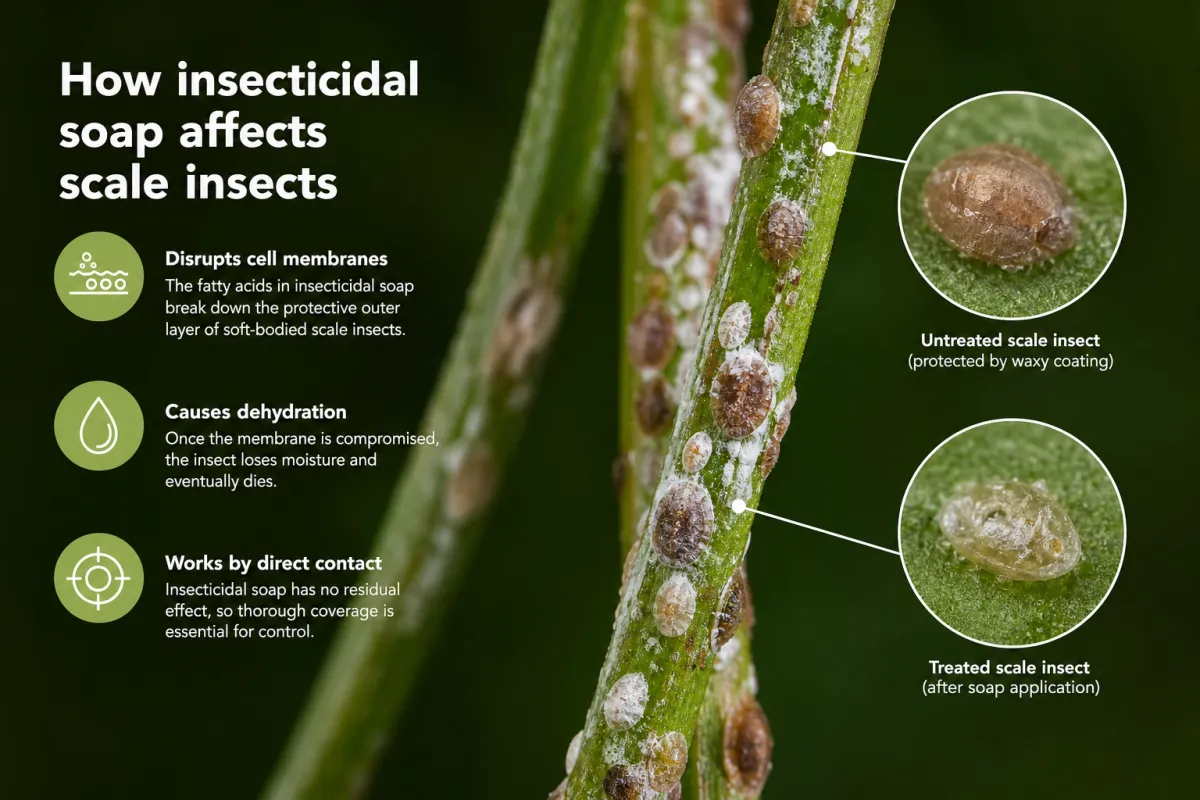
Insecticidal soap works by direct contact, not by lingering in the plant for days or weeks. The fatty acid salts in the spray disrupt the outer cell membranes of soft-bodied pests and interfere with their protective coating, causing them to dehydrate and die. That is why it can help with certain phases of scale insects, but it is not equally effective on every type and stage.
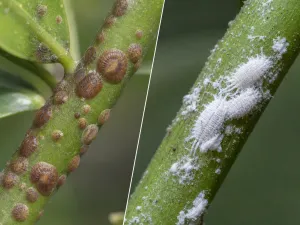
Scale pests can be frustrating because many species develop a waxy or shell-like covering that shields them from sprays. Once that covering hardens, soap has much less impact unless it reaches a vulnerable area such as newly hatched crawlers or exposed body tissue. Good coverage matters more than strong concentration. A weakly coated crawler thoroughly wetted with soap is easier to kill than an adult scale lightly misted several times.
Contact action rather than residue
This kind of treatment only affects insects the spray touches. It does not continue killing pests after the surface dries. If a colony is hidden under leaves, packed into stem joints, or protected in bark crevices, those individuals may survive even though nearby ones die.
- It must coat the pest directly to work.
- Dry residues do not provide dependable control.
- Eggs are usually unaffected, so later hatchings are common.
- Heavy infestations often need physical removal as well as spraying.
Why soap can succeed where water alone does not
Plain water may rinse away dust or loose honeydew, but it does not reliably break down the insect’s outer protective layer. Soap lowers surface tension, spreads more evenly over the pest, and damages tissues more effectively. On smoother houseplant foliage, this spreading action is often enough to improve control significantly, especially for young scale and other soft-bodied pests like indoor aphids.
Editor’s note: When growers say soap “did nothing,” the cause is often incomplete coverage rather than a bad product. On dense plants, I usually find live scale tucked along the midrib, under petioles, or where stems meet the main cane.
Which scale insect stages are most vulnerable
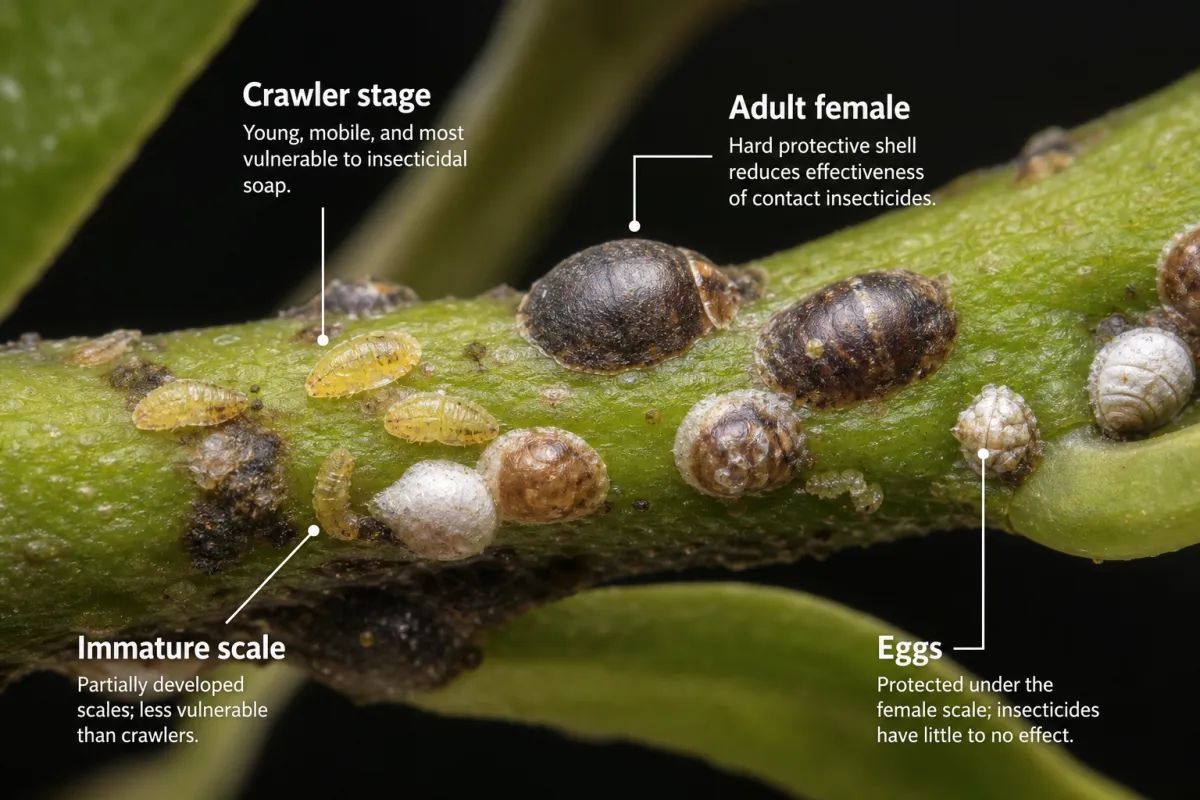
Not all scale insects are equally exposed to treatment. The moving juvenile stage, commonly called the crawler stage, is the easiest target because it has not yet developed the thicker protective shell or wax layer seen on older insects. Timing matters more with scale than with many common foliage pests.
If you spray only after the infestation is mature, you may kill a portion of the population but still leave enough adults and eggs behind for the colony to rebound. Learning which stage you are looking at saves time and reduces repeat damage to the plant.
Crawlers are the prime target
Crawlers are tiny, often yellowish, orange, or pale brown, and may look like moving specks. They settle quickly, so this vulnerable window can be short. On indoor plants you may notice them near fresh growth, leaf undersides, or close to older scale clusters.
- They are soft-bodied and poorly protected.
- They move to new feeding sites, making spread more likely.
- Soap can reach them more effectively than mature scales.
- Repeated treatment is especially useful during active hatching.
Adults are harder to control
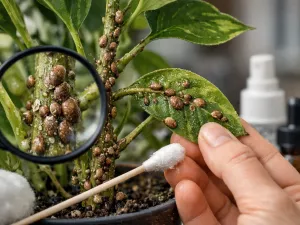
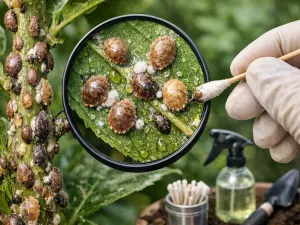
Mature armored scale and many older soft scale individuals resist contact sprays better because of their covering. Soap may weaken exposed soft scale, but heavily protected adults often need to be rubbed off by hand first. A cotton swab, soft toothbrush, or fingernail through a paper towel can remove many visible insects without damaging stems.
| Scale stage | Soap effectiveness | What improves results |
|---|---|---|
| Eggs | Low | Repeat after hatching begins, usually in 5 to 10 days depending on temperature and species |
| Crawlers | High | Spray thoroughly and repeat on schedule to catch later hatchings |
| Young settled scales | Moderate | Combine direct coverage with hand removal where practical |
| Mature armored scale | Low to moderate | Physically remove first, then spray surrounding areas for hidden juveniles |
Warm indoor conditions, around 21 to 27°C (70 to 81°F), can speed life cycles, so new crawlers may appear sooner than expected. Outdoors, timing depends more on species and weather, and colonies described as outdoor scale may hatch in distinct waves rather than continuously.
Choosing a suitable insecticidal soap
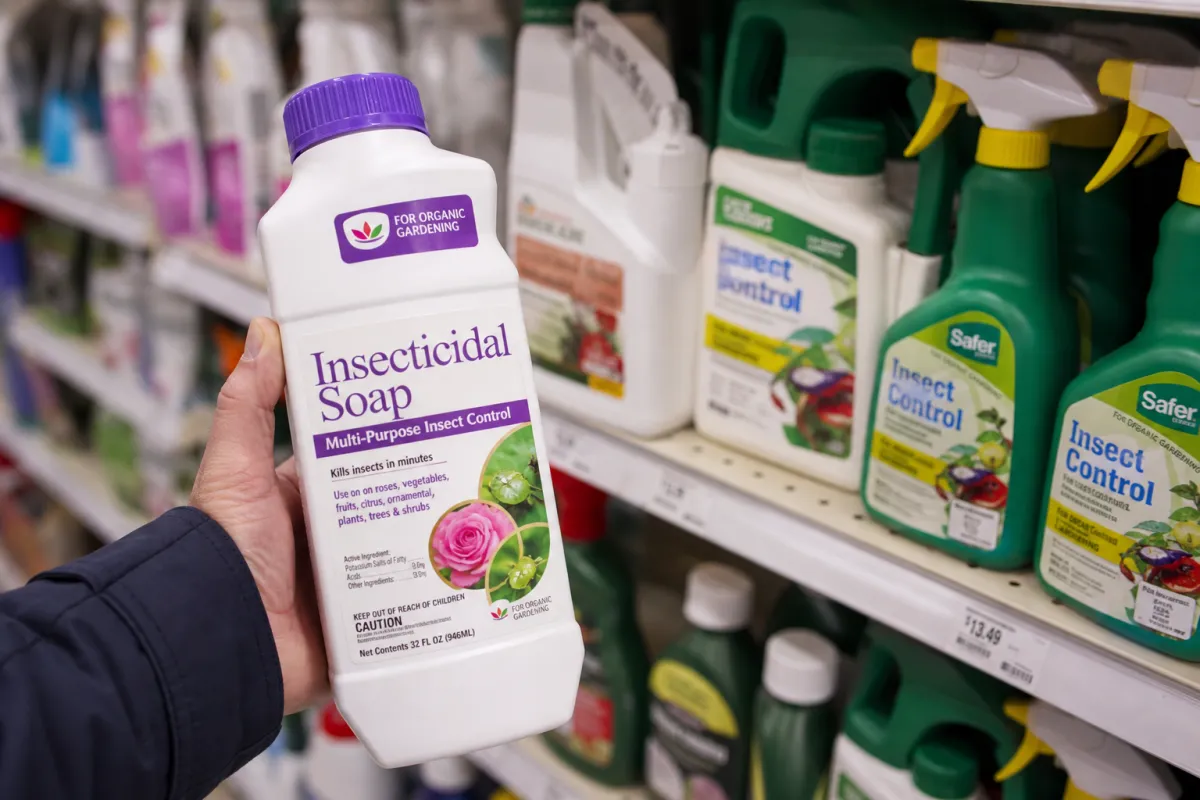
The safest choice is a ready-made or clearly labeled concentrate designed for use on plants. Products sold as true insecticidal soap are formulated around potassium salts of fatty acids and are tested for plant use. Improvised household soap mixtures are much less predictable and are more likely to burn leaves.
Read the label closely before you spray. Some products are intended for ornamental plants, some for edibles, and some can be used on both. The best option is one that clearly states it can be used on the plants you are treating and gives mixing directions for scale or other soft-bodied insects.
What to look for on the label
Gardeners often focus on the front of the bottle, but the important details are usually on the back panel. Those instructions tell you whether the product is a concentrate, what rate to mix, and whether a rinse is recommended for delicate plants.
- Look for a product labeled specifically as insecticidal soap.
- Check whether it is safe for houseplants, herbs, vegetables, citrus, or ornamentals, depending on your plant.
- Confirm the dilution rate, such as 25 ml per 1 L or about 0.8 fl oz per 34 fl oz of water, if it is a concentrate.
- Use clean, soft or room-temperature water if the label suggests it, since very hard water can reduce mixing quality.
What to avoid
Dish detergents, degreasers, and scented household soaps can strip leaf surfaces too aggressively. Additives such as bleach alternatives, antibacterial agents, or grease-cutting chemicals increase the risk of spotting and tissue burn. Even mild-looking “natural” soaps are not automatically safe on foliage.
If scale has become established on thick-leaved plants, woody stems, or heavily waxed foliage, soap may need support from another approach. Some gardeners alternate with neem oil, but not on the same day unless the product label specifically permits it. Layering treatments too closely can stress the plant more than the pest.
How to prepare the plant before treatment
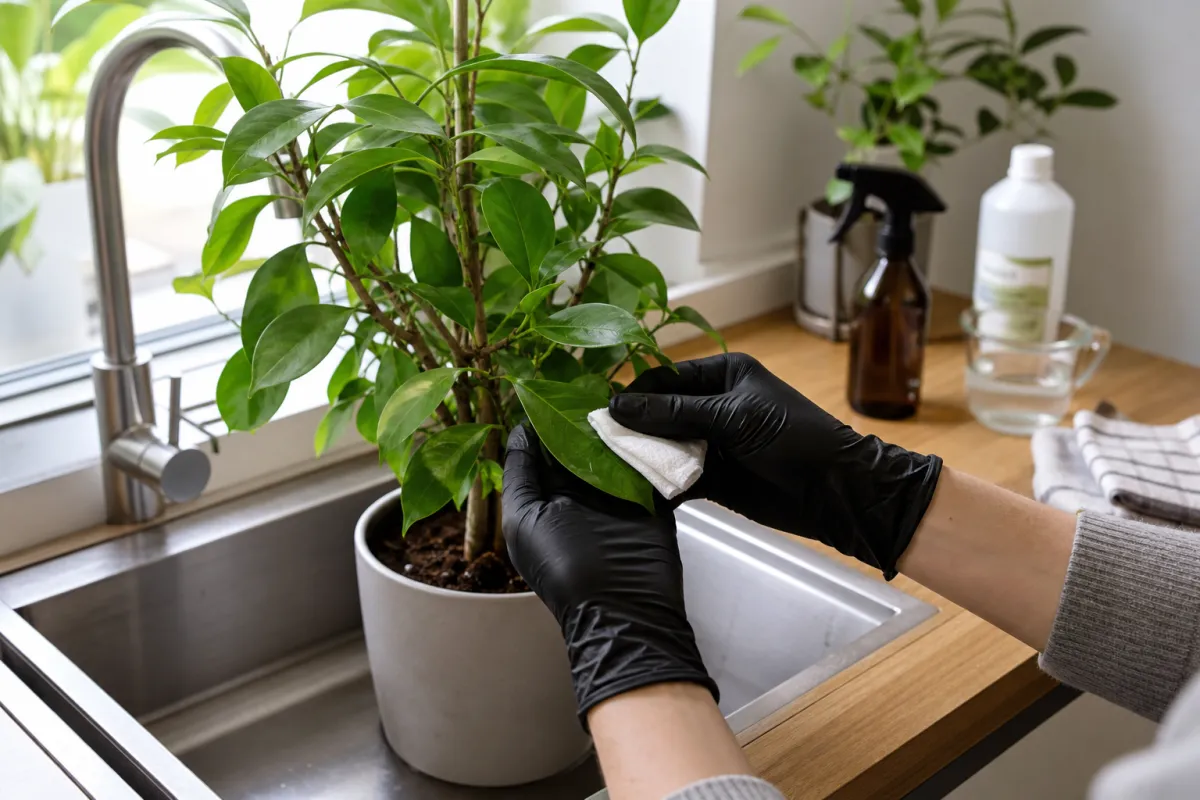
Preparation does more than make spraying easier. It reduces dust, improves coverage, and helps you see where the infestation is concentrated. A quick cleanup also lowers the chance that dead leaves and sticky honeydew will hide surviving pests after treatment.
Before you begin, move the plant to a bright but shaded place with good airflow. Avoid direct midday sun during preparation and spraying, especially if the plant has thin or tender leaves. Indoor plants benefit from being placed in a sink, shower, bathtub, or on a waterproof floor where runoff can be managed easily.
Initial inspection and cleanup
Take a close look at stems, leaf undersides, petioles, and the crown of the plant. Scale often gathers where leaves join stems or along the main vein. If the plant is badly infested, prune off the worst material first. This can make the remaining treatment far more effective.
- Remove fallen leaves, old sheaths, and obvious plant debris from the pot surface.
- Wipe away heavy honeydew and sooty mold with a damp cloth so you can see live pests clearly.
- Cut off severely infested twigs or leaves if the plant can spare them.
- Isolate the plant from nearby specimens, especially if you are dealing with indoor scale on clustered houseplants.
Watering and plant condition
A drought-stressed plant is more likely to show leaf burn after spraying. Water the root zone a few hours before treatment if the potting mix is dry 2 to 3 cm (1 to 1.2 in) below the surface. The goal is not soggy soil, but a normally hydrated plant that can tolerate treatment better.
Plants already struggling from root rot, severe nutrient deficiency, or strong heat stress should be stabilized first if possible. Soap is gentle compared with many insecticides, but stressed tissue still reacts more easily.
How-to tip: On large-leaved plants, I rinse the foliage with plain lukewarm water first and let it drip for 10 to 15 minutes. This removes dust that can block contact and makes scale bumps stand out more clearly.
How to apply insecticidal soap correctly
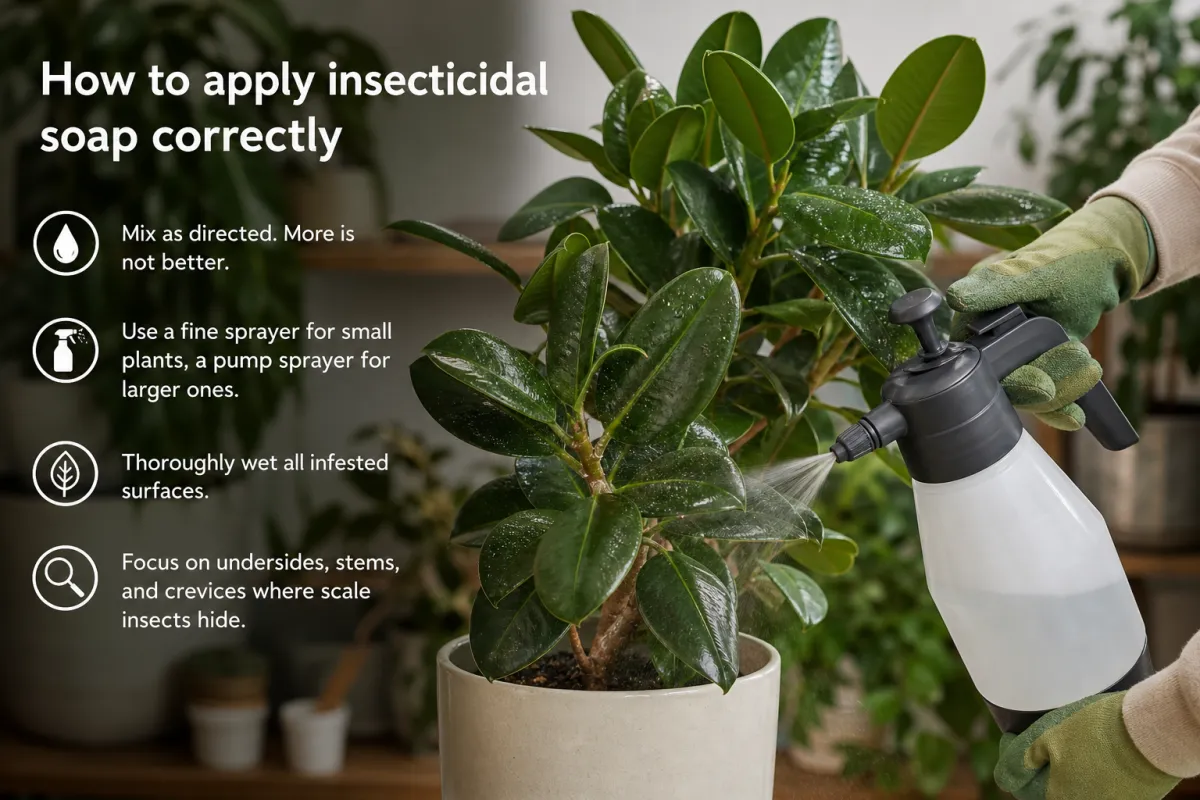
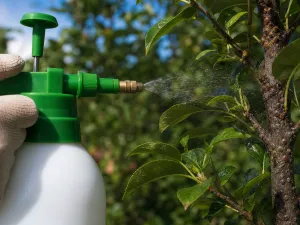
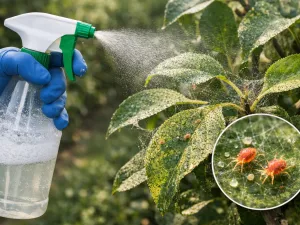
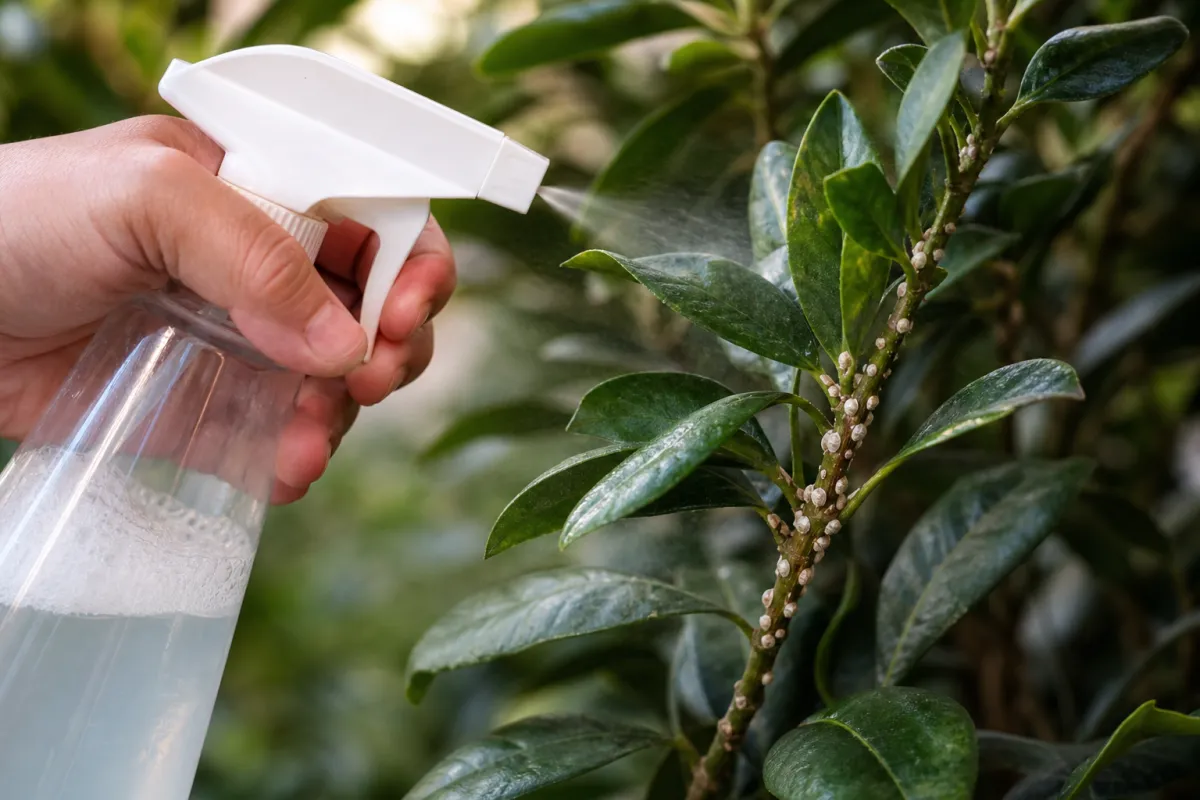
Application technique is where most of the real control happens. The objective is not to mist the plant lightly, but to wet infested surfaces enough that the soap reaches the insects. A fine hand sprayer works well for small plants, while a pump sprayer gives better reach and steadier pressure on larger specimens.
Always mix the product exactly as directed if you are using a concentrate. More is not better. High concentrations increase the risk of leaf damage without solving the coverage problem that usually causes failure.
Best time and conditions for spraying
Spray when temperatures are moderate and the plant is out of strong sun. For most indoor and outdoor ornamentals, that means early morning or late afternoon, ideally below 29°C (85°F). Avoid treatment when foliage is hot to the touch, when the plant is thirsty, or when freezing temperatures are expected within the next several hours.
- Choose a calm period outdoors so spray reaches the plant rather than drifting away.
- Indoors, open a window or use a fan nearby after spraying to help leaves dry steadily.
- Do not spray under grow lights at very close range until foliage has dried.
Application method step by step
A deliberate sequence helps avoid missed areas. Start from the most infested parts and work outward. Rotate the plant as you spray so every side is reached.
- Shake or stir the mixture if the label recommends it.
- Test one or two leaves first and wait 24 hours if the plant is known to be delicate.
- Spray until the target surfaces are evenly coated, with light runoff rather than heavy dripping.
- Pause to inspect hidden joints and spray them separately if needed.
- Leave the plant out of direct sun until the foliage is dry.
On waxy leaves, droplets may bead up rather than spread. In that case, make slower passes and spray from more than one angle so the insects are actually wetted.
Where to spray leaves, stems and hidden areas
Many failed treatments come down to spraying only what is easy to see. Scale insects settle where they are protected, and those sites vary by plant type. Broad-leaved houseplants hide them along the midrib and petiole. Woody shrubs often harbor them in bark cracks and branch forks. Succulents and tropicals may conceal them under overlapping leaves or dry leaf bases.
Instead of treating the plant like a flat surface, think in terms of pest shelters. Every protected crease or seam is a potential refuge that needs attention.
Priority zones on most plants
These are the places most likely to hold living insects, crawlers, or fresh settling sites. If your time is limited, do not skip them.
- Leaf undersides, especially along the central vein.
- Where the leaf stem joins the main stem.
- New growth tips and soft stems.
- Branch forks, nodes, and bark fissures.
- The crown or center of rosette-forming plants.
- Under old leaf sheaths and dried bracts.
How much runoff is enough
You want thorough wetting, not a torrent. Light runoff is useful because it shows the surface has been fully coated, but excessive dripping wastes product and can pool in crowns or leaf axils. On plants prone to crown rot, tip the pot slightly and wick away standing liquid with a paper towel.
Do not forget the pot rim, plant stake, or nearby saucer if crawlers may have wandered there. While soap is mainly for direct contact on the plant, cleaning the surrounding area can remove stragglers and sticky residue that would otherwise attract ants or hide activity.
Editor’s note: If a plant has dense leaf axils, use one hand to gently open the foliage while spraying with the other. I often find the worst colonies deep in the center where a quick surface spray never reaches.
How often to repeat the application
Repeat applications are usually necessary because eggs survive and hidden insects may avoid the first spray. The right interval depends on the product label, the plant, and how active the infestation is, but for many situations a repeat every 5 to 7 days is a practical starting point. In cooler conditions or on slower-developing infestations, a 7 to 10 day interval may be enough.
The goal is to break the life cycle by catching newly hatched crawlers before they settle and harden. One perfect treatment can still miss the next hatch. Several properly timed treatments usually outperform one aggressive spray.
Typical repeat schedule
Use the label as the final authority, but this pattern is often effective for moderate infestations on ornamentals.
| Infestation level | Suggested interval | Practical duration |
|---|---|---|
| Light, recently noticed | Every 7 days | 2 to 3 rounds, then monitor weekly |
| Moderate, visible on several areas | Every 5 to 7 days | 3 to 4 rounds with inspection between sprays |
| Heavy, mature colony with honeydew | Every 5 days if label allows | Combine with pruning and manual removal for 3 to 5 rounds |
When to stop repeating
Do not continue indefinitely on a strict calendar if the plant is clear and no new crawlers appear. Instead, inspect weekly for two to three weeks. Check stems and leaf undersides with a magnifier if needed. Fresh honeydew, ant activity, and tiny moving specks are better reasons to continue than old empty shells stuck to the plant.
If new scales keep appearing after several well-executed rounds, look for untreated reservoirs nearby. Adjacent plants, outdoor host branches touching the plant, or neglected greenhouse corners can reintroduce pests quickly.
Plant sensitivity and signs of soap damage
Most common foliage plants tolerate correctly used insecticidal soap fairly well, but sensitivity varies a lot. Ferns, some palms, certain succulents, African violets, and blue- or gray-leaved plants with a waxy bloom can react poorly. Tender new growth is usually more sensitive than mature foliage, and plants under heat or drought stress are much easier to injure.
Soap damage can resemble sunscald or fertilizer burn, so it helps to know the timing. If spotting or browning appears within 24 to 48 hours of treatment, the spray itself may be the cause.
Common symptoms of soap injury
The first signs may be subtle. Look closely at the sprayed leaves rather than the whole plant at once.
- Water-soaked patches that later turn brown or tan.
- Crisped leaf edges or tip burn.
- Bronzing, bleaching, or dull patches on glossy foliage.
- Distorted or puckered new leaves.
- Premature yellowing and leaf drop on very sensitive plants.
How to reduce the risk
Testing a small area first is the simplest safeguard. Spray one leaf or a small section, wait a full day, and check for damage before treating the whole plant. If the plant has fuzzy leaves, delicate cuticles, or a powdery bloom, use extra caution because these surfaces are easier to mark.
Rinsing after the contact period can help on sensitive plants if the label permits it. Many growers allow 10 to 20 minutes of contact, then gently rinse with plain water. This is especially useful indoors where residues can stay longer on foliage that dries slowly.
How-to tip: Blue succulents and plants with a silvery coating often lose that natural finish after spraying, even if they do not burn. Test a hidden leaf first if appearance matters as much as pest control.
Common mistakes that reduce effectiveness
Insecticidal soap has a reputation for inconsistency mainly because it is easy to use incorrectly. Most disappointing results come from timing, coverage, or concentration errors rather than from the product itself. Recognizing the usual mistakes saves both the plant and your time.
Coverage and timing errors
A quick surface mist rarely reaches the insects that matter. Scale colonies are often layered, sheltered, and spread over multiple parts of the plant. Missing just a few active pockets can allow the infestation to rebuild.
- Spraying only the upper leaf surface and ignoring undersides.
- Treating visible adults but not the nearby crawler zones.
- Applying once and assuming the problem is solved.
- Spraying in strong sun or high heat, which can increase leaf damage.
Product and mixing errors
Homemade mixtures are a common source of trouble. They may be too harsh, too weak, or simply the wrong chemistry for plant foliage. Another issue is poor measuring. A concentrate mixed “by eye” can swing far enough to either fail against pests or injure the plant.
- Do not substitute dish detergent for plant-safe soap.
- Measure carefully, for example 10 ml in 500 ml or about 0.34 fl oz in 17 fl oz, if the label gives that ratio.
- Use clean equipment so old herbicide or fertilizer residues do not contaminate the spray.
- Do not combine multiple sprays unless the labels clearly allow it.
Another hidden mistake is ignoring overall plant care. A weak plant in poor light, packed soil, or constantly soggy compost is slower to recover and more attractive to recurring pests. Good light, appropriate watering, and occasional pruning of crowded growth improve treatment success because they make the environment less favorable for buildup.
What to do if insecticidal soap does not work
If soap treatments are not reducing the infestation, the first step is to diagnose why. Failure usually points to one of four issues: the pest was misidentified, the scales were mostly mature and protected, the spray did not reach hidden areas, or the schedule was not repeated long enough to catch new hatchings.
Before switching products, inspect closely. Empty shells can remain stuck to leaves long after the insect inside has died. Gently scrape one with a fingernail or toothpick. If it is dry and hollow, the treatment may have worked better than it appears. If it is moist or still firmly attached with body tissue inside, live scale remain.
Next steps for stubborn infestations
When a plant still carries active scale after several careful rounds, use a more integrated approach rather than simply spraying more often.
- Manually remove visible adults with a cloth, swab, or soft brush.
- Prune heavily infested stems if the plant can regrow them.
- Improve spacing, airflow, and light so leaves dry well and inspection is easier.
- Check nearby plants and treat or isolate them if needed.
- Consider a different labeled control if the species is heavily armored and resistant to contact treatment.
When another method may be better
Some infestations are simply beyond what soap can handle alone. Large woody plants, thick bark, severe armored scale outbreaks, and plants with inaccessible crowns often need stronger or longer-lasting control. On valuable specimens, it may be worth combining physical cleanup with horticultural oil, a systemic product where legal and appropriate, or professional advice.
Do not keep spraying a plant that is clearly reacting badly just because live scale remain. At that point, recovery care matters: stable watering, bright indirect light or suitable outdoor shade, removal of badly damaged tissue, and patient follow-up. A healthier plant can tolerate later treatment better and is less likely to collapse under the combined stress of pests and repeated spraying.
Editor’s note: If a plant is covered from top to bottom and already declining, replacement can be the sensible choice. That is especially true for fast-growing common houseplants when repeated treatment would risk nearby plants without a good chance of full control.