How Soil Works for Plant Roots and Healthy Growth

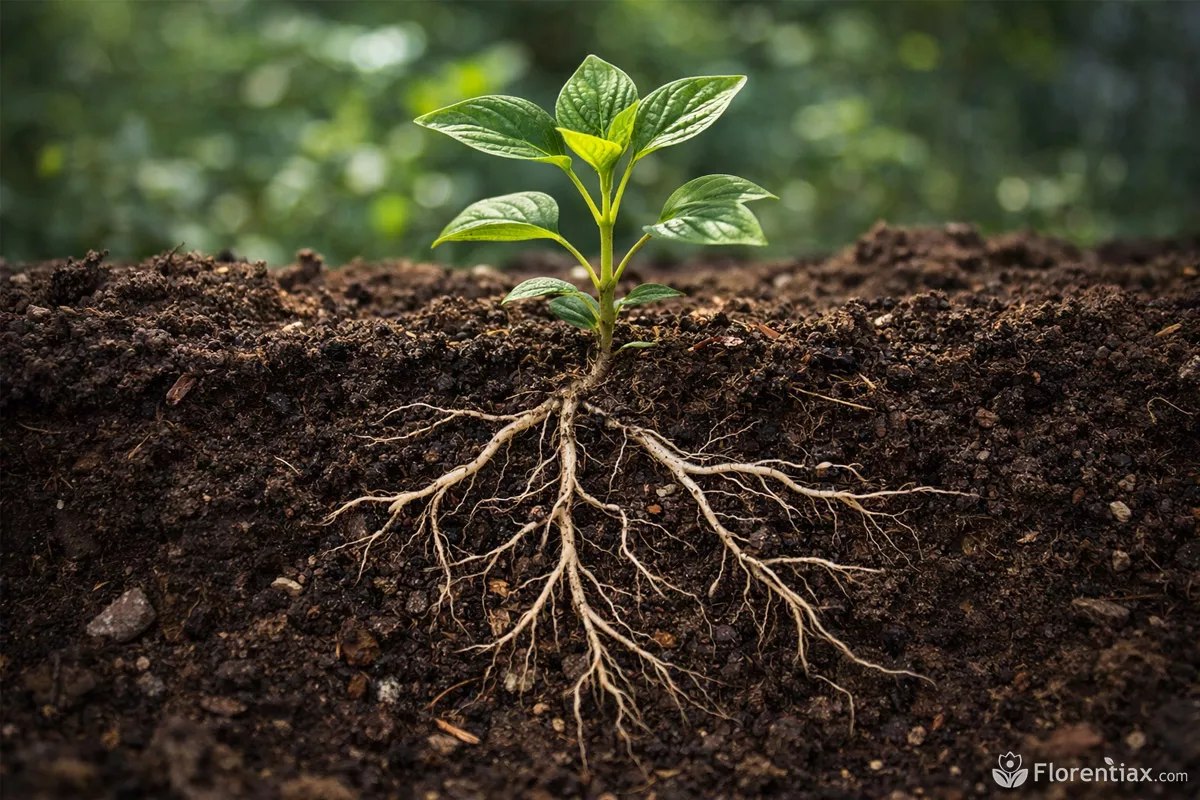 This article explains how soil functions as a living system that supports plant roots. You will learn how roots interact with soil particles, water, air pockets, and nutrients, and why soil structure is critical for oxygen flow and moisture balance. The guide helps you understand how soil conditions influence root strength, nutrient uptake, and overall plant health in real growing environments.
Soil is the foundation of every healthy plant, but its role goes far beyond holding roots in place. Understanding how soil works for plant roots helps explain why plants thrive or struggle even when watering and light seem correct.
The role of soil in root support
Soil is not just “something plants sit in”. It is the root environment that controls four essentials at the same time: anchoring, oxygen, water, and nutrients. If any one of these is out of balance, roots stop functioning normally even if you water and fertilize correctly.
Roots need soil that stays stable enough to hold the plant upright, but loose enough to let fine feeder roots explore new space. They also need air-filled pores because roots breathe. When pores stay filled with water for too long, oxygen drops and roots begin to fail.
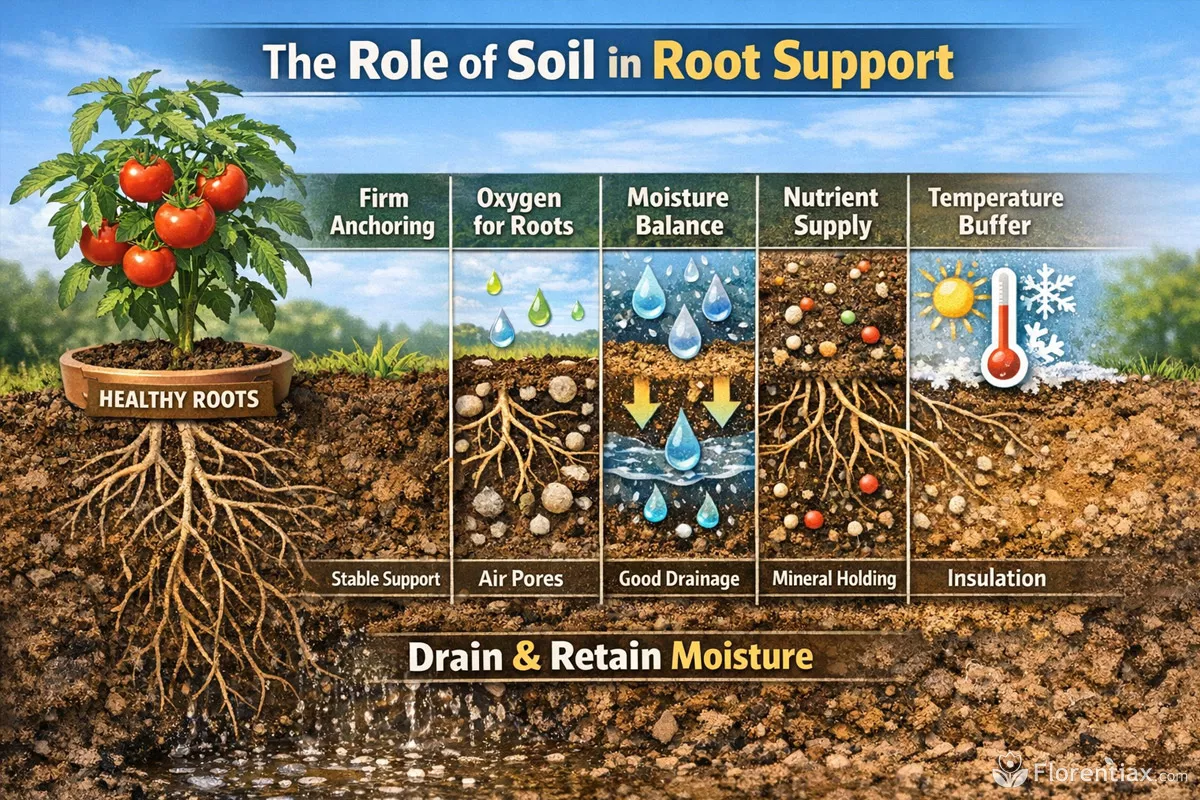
Another basic job of soil is buffering. Good soil slows down sudden changes in moisture, temperature, and nutrient concentration. This buffering is why the same plant can look healthy in one mix and struggle in another, even with identical care.
| What roots need | What soil must provide | What goes wrong when soil fails |
|---|---|---|
| Firm anchoring | Enough structure to hold roots in place | Plant leans, wobbles, breaks fine roots during growth |
| Oxygen for root cells | Air pockets that refill after watering | Wilting in wet soil, root rot, slow recovery after watering |
| Moisture access | Even moisture without staying soggy | Dry pockets, uneven watering response, crispy leaf tips |
| Nutrient exchange | Ability to hold and release minerals gradually | Deficiency symptoms despite fertilizing, stalled growth |
| Safe root temperature | Some insulation and stable conditions | Stress during heat or cold, weak new growth |
In practical terms, soil works when it can do two things at once: drain excess water quickly and still keep a usable reserve of moisture inside the root zone. That balance is what separates healthy roots from постоянной борьбы с переливом или пересушкой.
How soil structure affects root growth
Soil structure is the way particles and organic matter form clumps and create spaces between them. These spaces are not “empty” — they are the channels that hold water right after watering and then refill with air as water drains. Roots grow best when they can move through these channels easily.
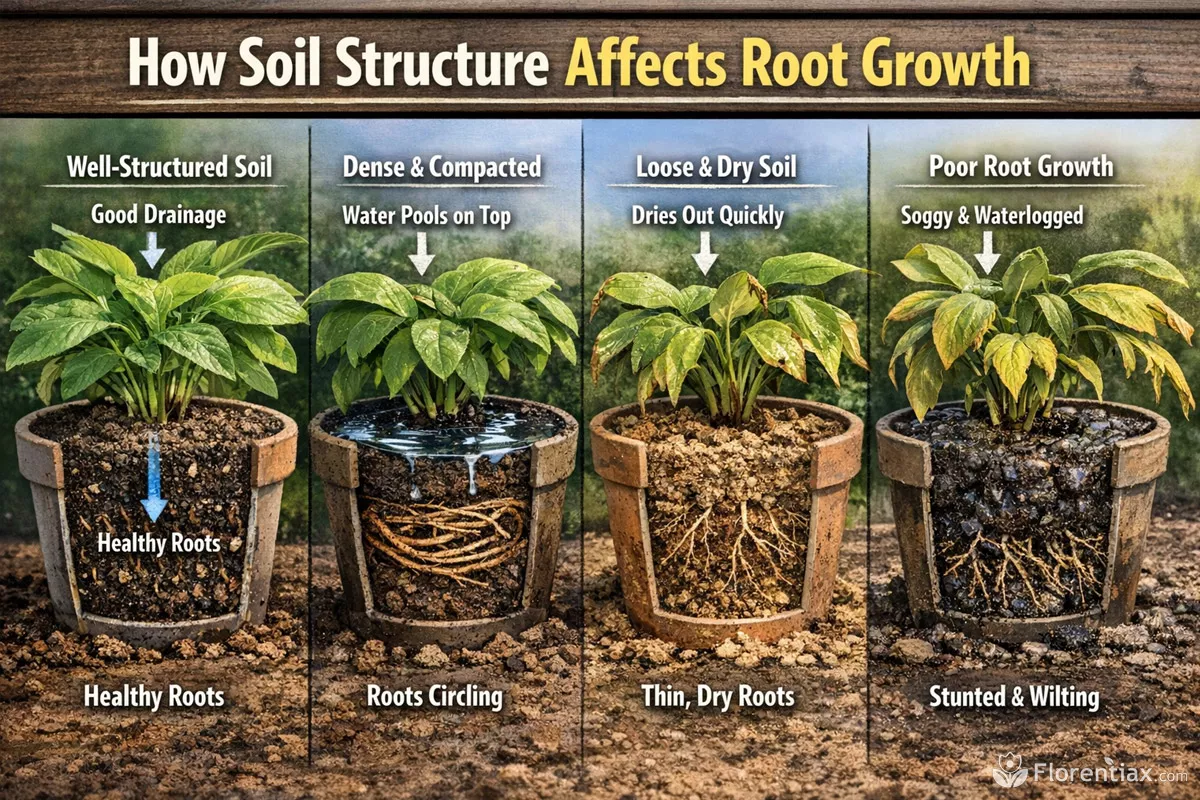
When soil is too dense, water either pools on top or stays trapped inside. Roots respond by growing shallow, circling the pot, or stopping. When soil is too loose and dry, roots cannot maintain steady contact with moisture and the plant becomes sensitive to missed watering.
A simple rule: roots expand where conditions are stable. If moisture and oxygen are inconsistent, roots stay small and the plant relies on fewer working root tips, which limits growth and resilience.
| Soil structure | How it feels in a pot | Water behavior | Root behavior | Visible plant signs |
|---|---|---|---|---|
| Airy and well-structured | Crumbly, springy, not sticky | Water absorbs fast, drains in seconds, soil stays evenly damp | Fine roots spread and branch throughout the pot | Steady growth, fewer yellow leaves, strong new shoots |
| Dense but workable | Holds shape when squeezed, slightly heavy | Absorbs slower, drains slowly, stays wet longer in the center | Roots concentrate near edges or upper layer | Slower growth, occasional droop, mild yellowing after watering |
| Compacted | Hard, tight, forms a solid mass | Water pools on top or runs down the sides, center stays soggy | Roots circle, stall, or rot; few feeder roots survive | Wilting in wet soil, persistent yellowing, bad smell from soil |
| Too loose and fast-drying | Very light, falls apart, dries quickly | Drains instantly, dries unevenly, little moisture reserve | Roots stay thin, plant depends on frequent watering | Crispy tips, fast droop between waterings, stunted growth |
To evaluate structure without tools, use a quick check after watering: if water sits on the surface for a long time, structure is too dense; if water runs straight through and the pot feels dry the next day, the mix is too loose for most houseplants.
Water and air balance in soil
Healthy roots need water and oxygen at the same time. Soil works properly only when it can hold water temporarily and then release excess water to refill air spaces. This balance happens after every watering cycle and is one of the most misunderstood parts of plant care.
Right after watering, soil pores fill with water. As gravity pulls water downward, larger pores empty first and refill with air, while smaller pores keep moisture available to roots. Problems begin when this process does not complete and pores stay waterlogged for too long.
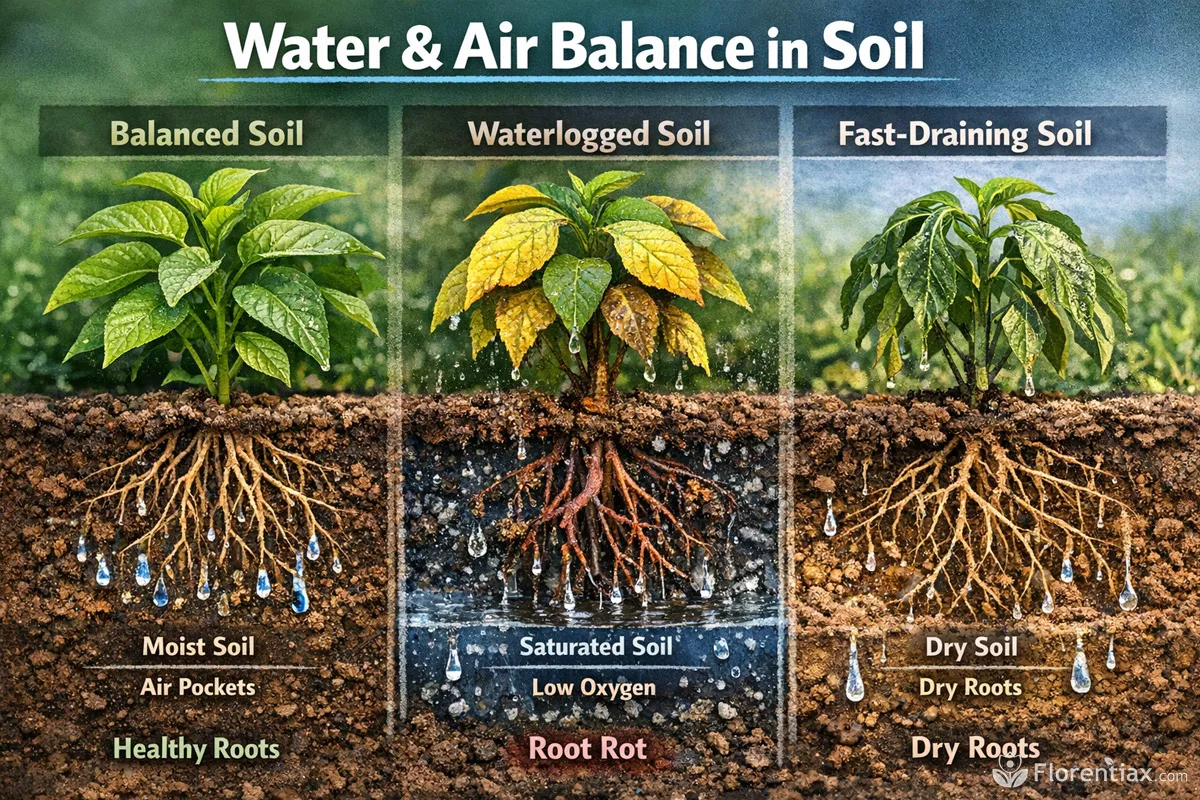
Soil that holds too much water blocks oxygen, while soil that drains too fast cannot maintain steady moisture contact with roots. In both cases, roots lose efficiency even if watering frequency seems correct, often leading to signs of overwatering and root rot that are misdiagnosed as simple watering mistakes.
| Soil condition | Water behavior after watering | Air availability | Root response | Common outcome |
|---|---|---|---|---|
| Balanced soil | Evenly moist, excess drains within minutes | Air returns quickly to root zone | Roots stay active and branch normally | Stable growth and predictable watering rhythm |
| Water-retentive soil | Stays wet for days | Very limited oxygen | Roots suffocate and rot | Wilting despite wet soil, yellow leaves |
| Fast-draining soil | Drains instantly, dries unevenly | High oxygen but low moisture contact | Roots dry out between waterings | Frequent drooping, crispy leaf edges |
If you want to adjust watering based on how your soil actually behaves, use a watering schedule based on soil conditions instead of fixed calendar intervals.
Good soil does not eliminate drying — it controls it. The goal is a predictable dry-down cycle where roots experience moisture first, then oxygen, before the next watering.
Why roots need oxygen in soil
Roots respire just like leaves, but underground. Oxygen is required for root cells to convert sugars into energy. Without oxygen, roots cannot absorb water or nutrients efficiently, even if both are present in the soil.
When soil stays saturated, oxygen levels drop rapidly. Within 24–72 hours, fine feeder roots begin to die first. These roots are responsible for most water and nutrient uptake, so their loss quickly affects the entire plant.
Lack of oxygen also slows root regeneration. Once damaged, roots in poorly aerated soil recover slowly or not at all, leading to chronic decline rather than sudden collapse, often showing up as yellow leaves caused by root stress even when light and nutrients appear sufficient.
- Roots need oxygen to power nutrient absorption
- Oxygen enters soil through air-filled pores
- Compaction and overwatering block oxygen flow
- Fine roots are affected before thick structural roots
This is why improving soil aeration often fixes problems that look like nutrient deficiency or watering mistakes. In many cases, the issue is not what you add to the soil, but how much air the soil allows roots to access.
How roots absorb nutrients from soil
Roots do not absorb nutrients directly from solid soil particles. Nutrients must first dissolve in water and form a thin solution around the root surface. This is why water availability and soil contact matter just as much as fertilizer choice.
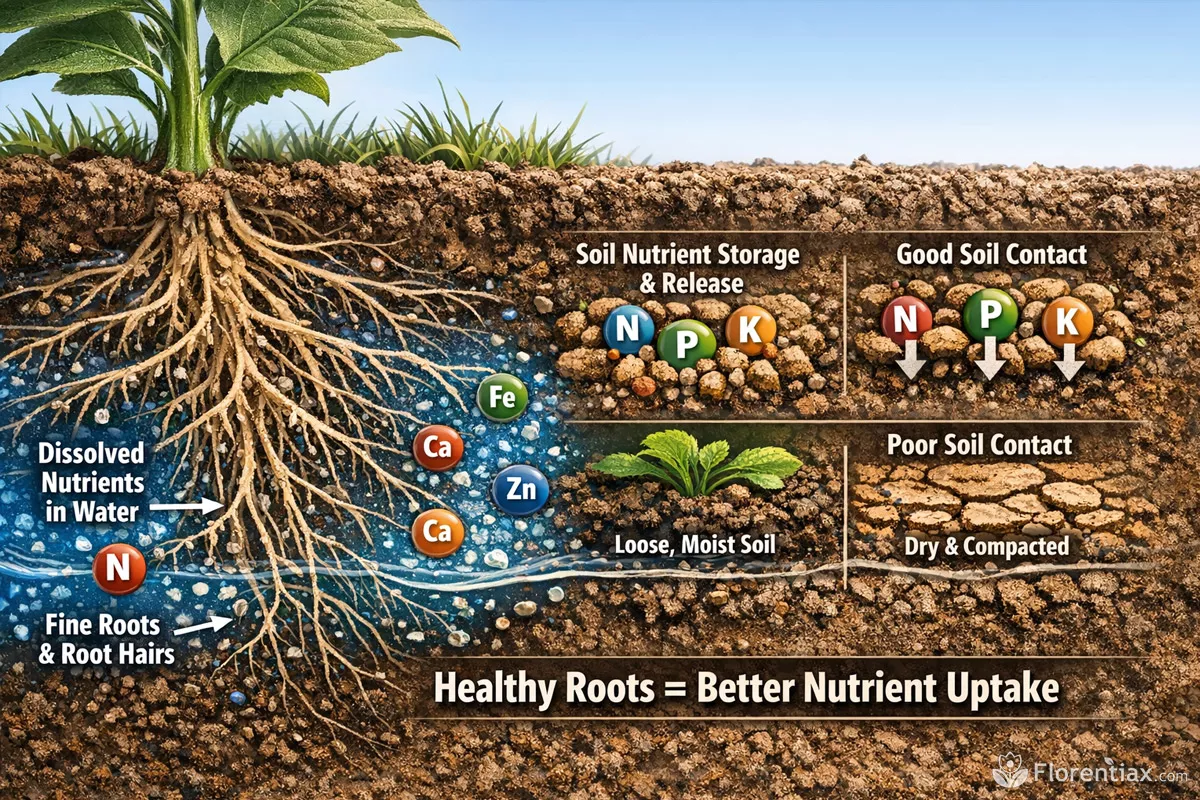
Fine feeder roots and root hairs do most of the work. They increase the contact area between roots and the soil solution, allowing plants to take in nitrogen, potassium, phosphorus, and trace elements in small, controlled amounts.
Soil plays a key role as a buffer. Instead of releasing nutrients all at once, good soil holds them on particle surfaces and organic matter, then releases them gradually. This prevents spikes that can burn roots and reduces nutrient loss during watering.
- Nutrients must be dissolved in water to be absorbed
- Fine roots and root hairs handle most uptake
- Soil acts as a storage and release system
- Poor soil contact reduces nutrient efficiency
If soil dries unevenly or becomes compacted, nutrient uptake drops even when fertilizer is present. This is why feeding alone cannot fix poor soil conditions.
Soil particles and root contact
Roots absorb water and nutrients only where they physically touch soil particles or the thin moisture layer around them. Large air gaps or hardened soil surfaces reduce this contact and limit root efficiency.
Different particle sizes play different roles. Fine particles hold water and nutrients, while larger particles create air channels. A healthy mix combines both, ensuring roots stay in constant contact without being smothered.
When soil shrinks, pulls away from the pot, or forms hard clumps, roots lose contact zones. This causes sudden wilting after watering or dry pockets that roots cannot reach.
- Fine particles maintain moisture contact
- Coarse particles preserve airflow
- Balanced particle size keeps roots active
- Loss of contact leads to uneven absorption
Good soil maintains close but breathable contact with roots throughout the pot, allowing consistent absorption instead of forcing roots to survive in isolated pockets.
How different soils affect roots
Different soil types create very different environments for roots, even when watering habits stay the same. The main difference lies in how long water stays in the root zone, how quickly air returns, and how evenly roots can spread.
When repotting or planting, it also helps to calculate how much potting soil you need so the root zone stays consistent and is not disrupted by uneven soil depth.
Roots adapt their growth pattern to soil conditions. In dense soils, they stay shallow or circle the pot. In very loose soils, they grow thin and depend heavily on frequent watering. The healthiest root systems form in soils that balance moisture retention with steady aeration.
Understanding soil type helps explain why some plants struggle after repotting, even when placed into a “fresh” mix. The issue is often not nutrients, but how the new soil changes root behavior.
| Soil type | Water retention | Airflow | Typical root behavior | Best suited for |
|---|---|---|---|---|
| Loam-based mix | Moderate | Good | Even root spread, strong feeder roots | Most houseplants |
| Peat-heavy mix | High | Low when wet | Shallow roots, risk of rot | Moisture-loving plants |
| Sandy mix | Low | High | Fast root growth, low moisture reserve | Drought-tolerant plants |
| Bark-based mix | Low to moderate | Very high | Thick roots, rapid oxygen access | Epiphytic plants, orchids |
| Clay-heavy soil | Very high | Very low | Restricted roots, poor branching | Rarely suitable for pots |
Choosing soil based on plant type and watering habits allows roots to grow naturally instead of constantly compensating for poor conditions.
What makes soil healthy for roots
Healthy soil is not defined by a single ingredient. It is defined by how consistently it supports roots over time. Good soil maintains structure, resists compaction, and continues to drain and aerate even after repeated watering.
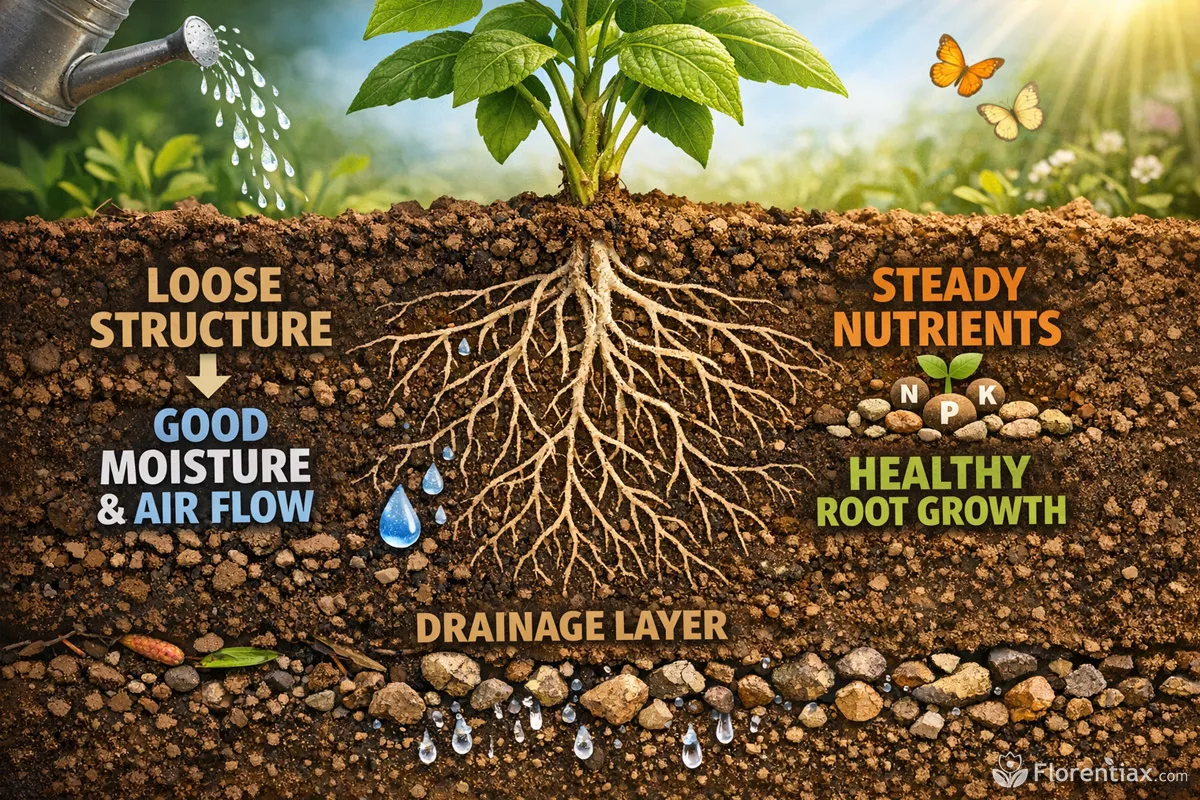
For roots, healthy soil provides predictable cycles: moisture after watering, oxygen as it dries, and steady access to nutrients without sharp fluctuations. When these cycles stay stable, roots remain active and regenerate quickly. As soil structure breaks down over time, roots become crowded and stressed, which is why understanding when you should repot plants is critical for maintaining long-term soil and root health.
Soil health is also dynamic. Over time, organic matter breaks down, particles settle, and drainage changes. This is why even good soil eventually needs refreshing or replacement.
- Stable structure that resists compaction
- Balanced water retention and drainage
- Consistent airflow to the root zone
- Ability to hold and release nutrients gradually
When soil supports roots properly, most plant care becomes simpler. Watering becomes predictable, fertilizing works as expected, and plants recover faster from stress.