Watering Indoor Plants for Balanced Soil Moisture

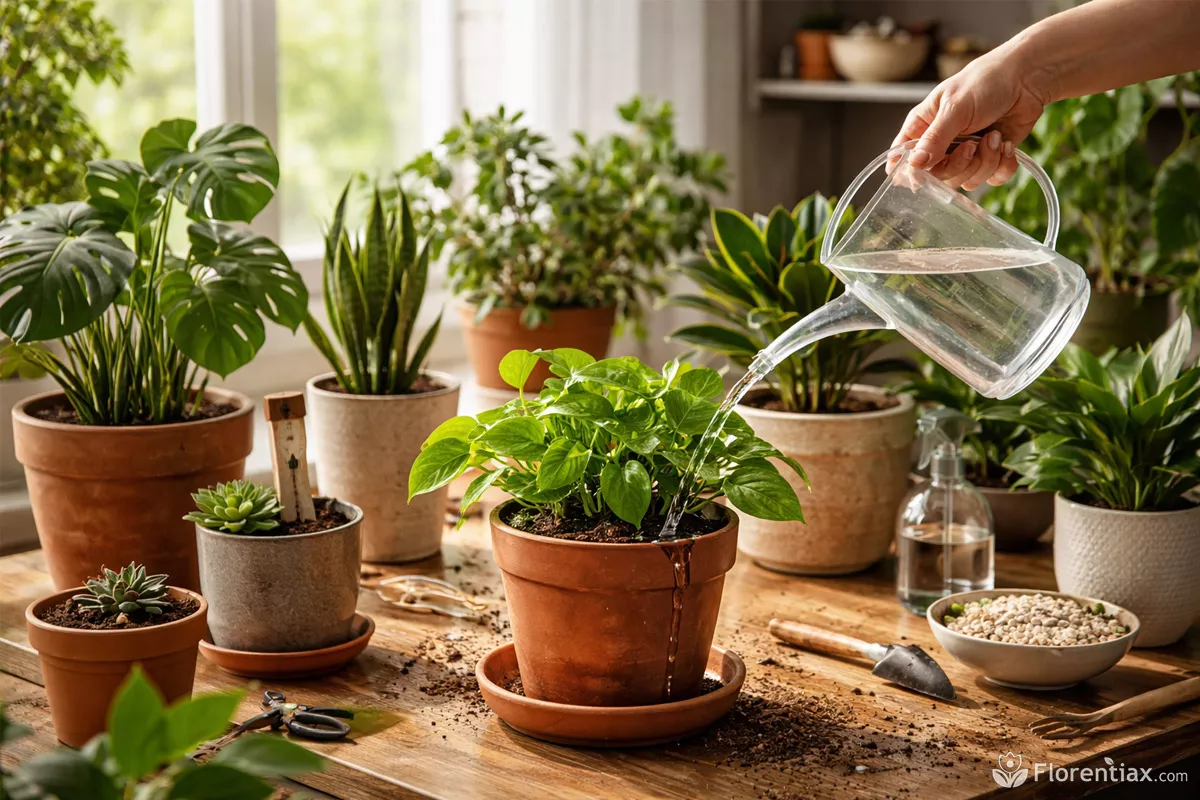 This article explains how to maintain balanced soil moisture when watering indoor plants. You’ll learn how often to water, how to check soil dryness correctly, and how to adjust watering based on plant type, season, and indoor conditions. It also covers common mistakes like overwatering and poor drainage that lead to root rot and weak growth.
Why Balanced Soil Moisture Matters for Indoor Plants
Balanced soil moisture means the root zone stays slightly moist but never constantly wet. In practical terms, this means the soil should dry partially between waterings but not turn into a hard, dusty mass. The majority of indoor plant problems are caused not by pests, but by chronic overwatering.
Roots need both water and oxygen. When soil pores are permanently filled with water, oxygen levels drop. Within 24–72 hours of waterlogged conditions, fine feeder roots begin to die. Once that happens, nutrient uptake slows, leaves turn yellow, and fungal pathogens develop. Persistent chlorosis is often one of the first visible signs of root stress — learn more about yellow leaves on plants causes and fixes to properly diagnose and correct the problem before permanent damage occurs.
On the other hand, letting soil dry too deeply damages the fine root hairs responsible for absorbing moisture. Recovery after severe underwatering can take weeks.
What balanced moisture actually looks like
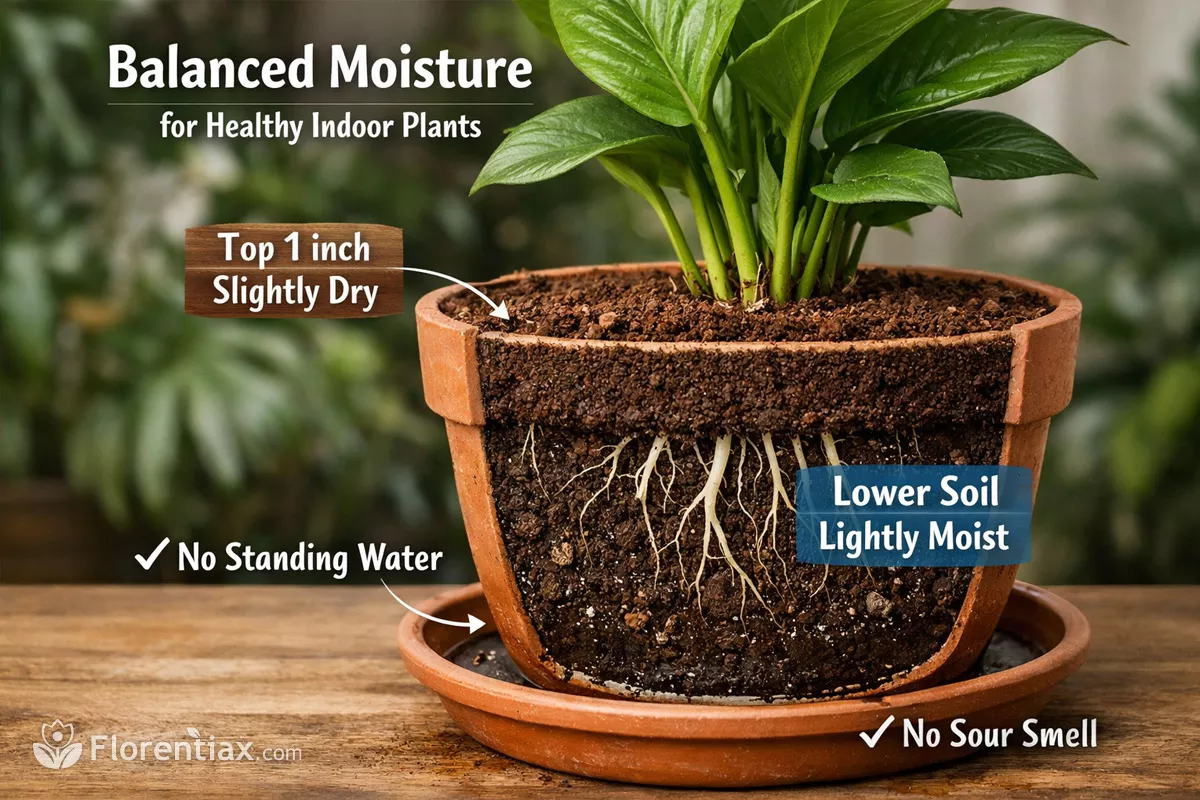
For most tropical indoor plants:
- Top 2–3 cm (1 inch) of soil — slightly dry
- Lower root zone — lightly moist, not muddy
- No standing water in saucer
- No sour smell from soil
For succulents and cacti:
- Soil dries completely between waterings
- Pot feels noticeably lighter before next watering
Moisture imbalance usually happens because of three technical reasons:
- Pot too large for root system
- Soil mix retains too much water
- Watering based on schedule instead of soil check
If pot size is the issue, use our repotting pot size guide to choose a safe next pot diameter and reduce overwatering risk.
Balanced watering is not about frequency. It is about monitoring the root zone condition.
How Often to Water Indoor Plants
There is no universal “once per week” rule. Watering frequency depends on measurable factors: pot size, soil composition, light intensity, humidity, and plant type.
Instead of asking “How many times per week?”, ask:
- How fast does this pot dry?
- How deep is the root system?
- Is the plant actively growing?
Key variables that change watering frequency
| Factor | Technical Detail | Effect on Watering Frequency | Adjustment Advice |
|---|---|---|---|
| Pot Size | Small pots dry 2–3× faster than large pots | Smaller pots need more frequent checks | Check soil every 2–3 days in warm months |
| Soil Mix | Peat-heavy soil holds water longer | Slower drying, higher overwatering risk | Add perlite or bark for better drainage |
| Light Level | Bright indirect light increases evaporation | Higher light = faster drying | Use an indoor plant light calculator to estimate lux and PPFD, then adjust moisture checks accordingly |
| Season | Winter growth slows significantly | Watering may reduce by 30–50% | Always re-check soil before watering in winter |
| Humidity | Dry air increases surface evaporation | Top layer dries faster than root zone | Check deeper soil, not only surface |
| Plant Type | Tropical vs succulent water storage | Different moisture tolerance | Research species-specific needs |
Practical watering rule
For most indoor foliage plants:
- Water when top 2–3 cm (1–1.2 in) are dry
- Water thoroughly until excess drains out
- Discard excess water after 10–15 minutes
- Do not water again until soil partially dries
For a quick, practical estimate based on pot size and conditions, use our plant watering calculator.
Typical indoor intervals in average home conditions (20–23°C, moderate light):
- Small pots (10–12 cm / 4–5 in) — every 4–6 days
- Medium pots (15–20 cm / 6–8 in) — every 7–10 days
- Large floor plants — every 10–14 days
- Succulents — every 2–3 weeks
These numbers are reference ranges, not fixed schedules. Soil condition always overrides the calendar.
The safest long-term strategy is simple: check first, water second. Balanced soil moisture is maintained by observation, not routine.
How to Check Soil Moisture Properly
Surface dryness does not mean the root zone is dry. The top layer can dry within 24 hours, while deeper soil remains wet for several days. Watering based only on the surface is one of the main causes of root rot.
Practical methods to measure soil moisture
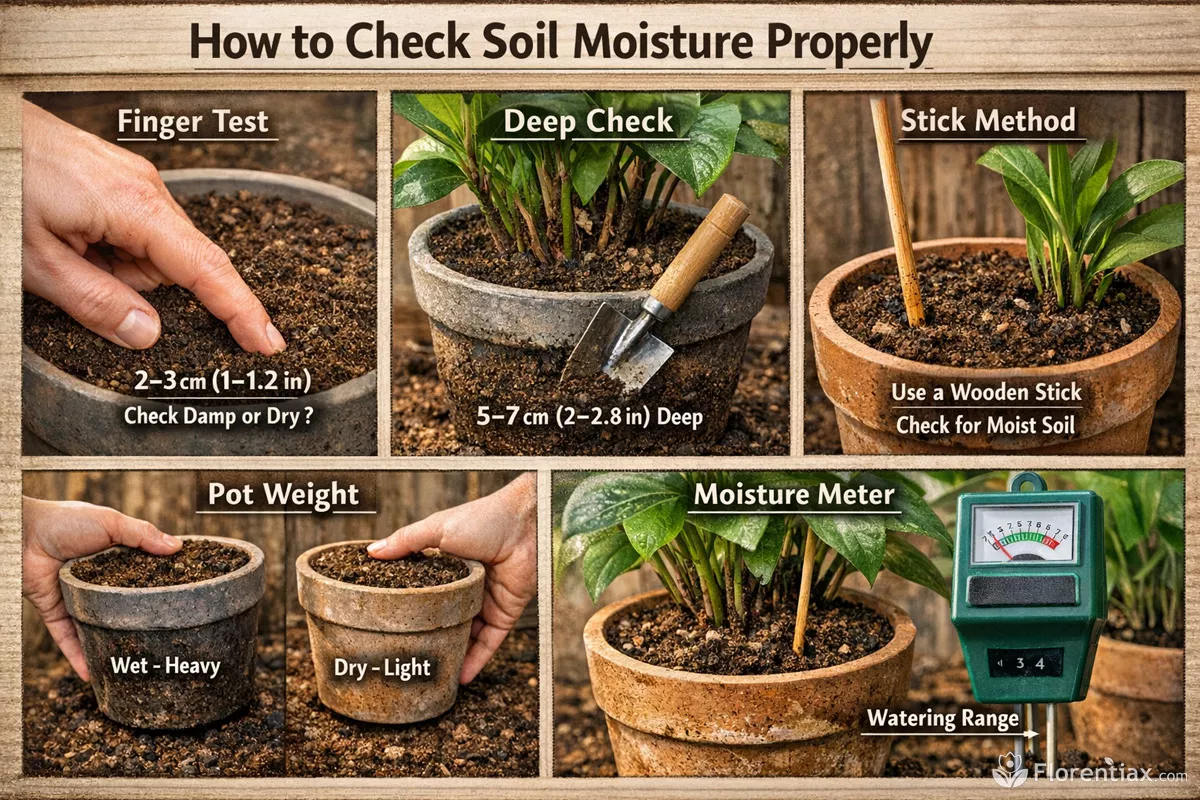
- Finger test — Insert your finger 2–3 cm (1–1.2 in) into the soil. If it feels cool and damp at that depth, do not water. If it feels dry, watering is usually appropriate for tropical plants.
- Deep check for larger pots — For containers deeper than 25 cm (10 in), check at least 5–7 cm (2–2.8 in) below the surface. Large pots dry unevenly, and the lower root zone can stay wet much longer.
- Wooden stick method — Insert a wooden skewer or chopstick deep into the soil and leave it for 5–10 minutes. If it comes out dark, moist, or with soil sticking to it, the inner root zone is still wet.
- Pot weight comparison — Lift the pot immediately after watering and again when dry. A fully watered pot can weigh 20–40% more than when dry, depending on soil composition.
- Moisture meter — Insert the probe halfway into the root zone. On most 1–10 scales, a reading of 3–4 indicates watering time for tropical foliage plants, while succulents should reach 1–2 before watering.
How deep should you check based on pot size?
Moisture must be checked relative to container depth:
- Pots under 15 cm (6 in) — check 2–3 cm (1–1.2 in) deep.
- Pots 15–25 cm (6–10 in) — check 3–5 cm (1.2–2 in) deep.
- Pots over 25 cm (10 in) — check 5–7 cm (2–2.8 in) deep.
Important: If soil feels wet but leaves wilt, roots may already be damaged. Never respond to wilting by automatically adding more water without confirming root health.
Signs of Overwatering and Root Rot
Overwatering does not kill plants immediately. It creates oxygen-deficient conditions in the root zone. Within 48–72 hours of continuous saturation, root respiration slows. After several days, fine feeder roots begin to decay.
Early overwatering indicators
- Lower leaves turning pale yellow
- Soil staying wet for more than 5–7 days
- Small flying insects (fungus gnats) around the soil
- Slow growth despite regular feeding
Advanced root rot symptoms
- Persistent wilting even though soil is moist
- Soft, dark, mushy roots when inspected
- Sour or rotten smell from the pot
- Stem base becoming soft near soil line
Why oxygen matters in the root zone
Healthy soil contains 20–30% air space when properly drained. When those air pockets fill completely with water, oxygen exchange stops. Root cells suffocate, and anaerobic bacteria multiply. This is why “watering less” is not always enough once rot has started.
In severe cases, the plant must be removed from the pot, affected roots trimmed, and replanted in fresh, well-draining soil containing materials such as perlite, bark, or coarse sand.
Signs of Underwatering in Indoor Plants
Underwatering develops more slowly than overwatering but still causes structural stress. When soil remains dry for extended periods, fine root hairs die first. These microscopic roots are responsible for absorbing most of the water and nutrients.
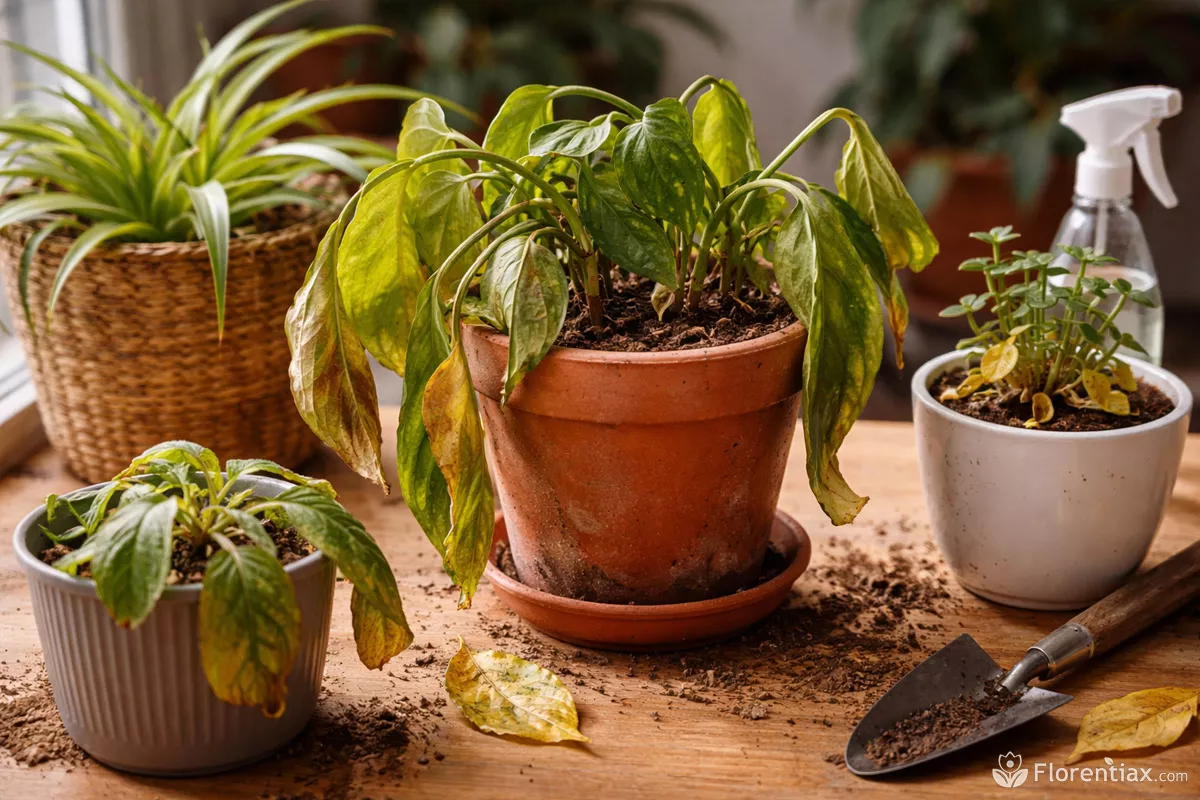
Unlike overwatering, underwatering damage is usually reversible if corrected early.
Early signs of underwatering
- Leaves lose firmness and begin to droop
- Leaf edges turn dry or crispy
- Soil pulls away from the edges of the pot
- Pot feels noticeably lighter than usual
Advanced dehydration symptoms
- Yellowing followed by leaf drop
- Slow or stalled new growth
- Dry soil throughout full depth of container
- Root ball shrinking inside the pot
If soil becomes completely hydrophobic (water runs straight through without absorbing), place the pot in a container of room-temperature water for 20–30 minutes until bubbles stop rising. This allows the root ball to rehydrate evenly.
For most indoor foliage plants, do not allow soil to dry deeper than 5–7 cm (2–2.8 in) in medium-sized pots before watering again. Succulents are the exception and require full drying between waterings.
Best Watering Methods for Indoor Plants
The way you water directly affects root health. Even if frequency is correct, poor technique can leave parts of the root system dry while other areas remain waterlogged.
Top Watering (Standard Method)
Pour water slowly and evenly over the entire soil surface until excess drains from the bottom holes. This ensures full saturation of the root zone from top to bottom.
- Distribute water evenly across the whole surface
- Continue until water flows freely from drainage holes
- Let the pot drain for 10–15 minutes
- Remove excess water from the saucer
This method works best for most tropical foliage plants and flowering indoor species.
Bottom Watering
Place the pot in a tray filled with 2–4 cm (0.8–1.5 in) of water. Allow it to absorb moisture for 15–30 minutes. Water moves upward through capillary action, evenly hydrating the lower root zone.
Bottom watering reduces fungus gnat activity and prevents splashing soil onto leaves. However, it should occasionally be combined with top watering to flush out accumulated mineral salts.
Measured Watering Based on Pot Volume
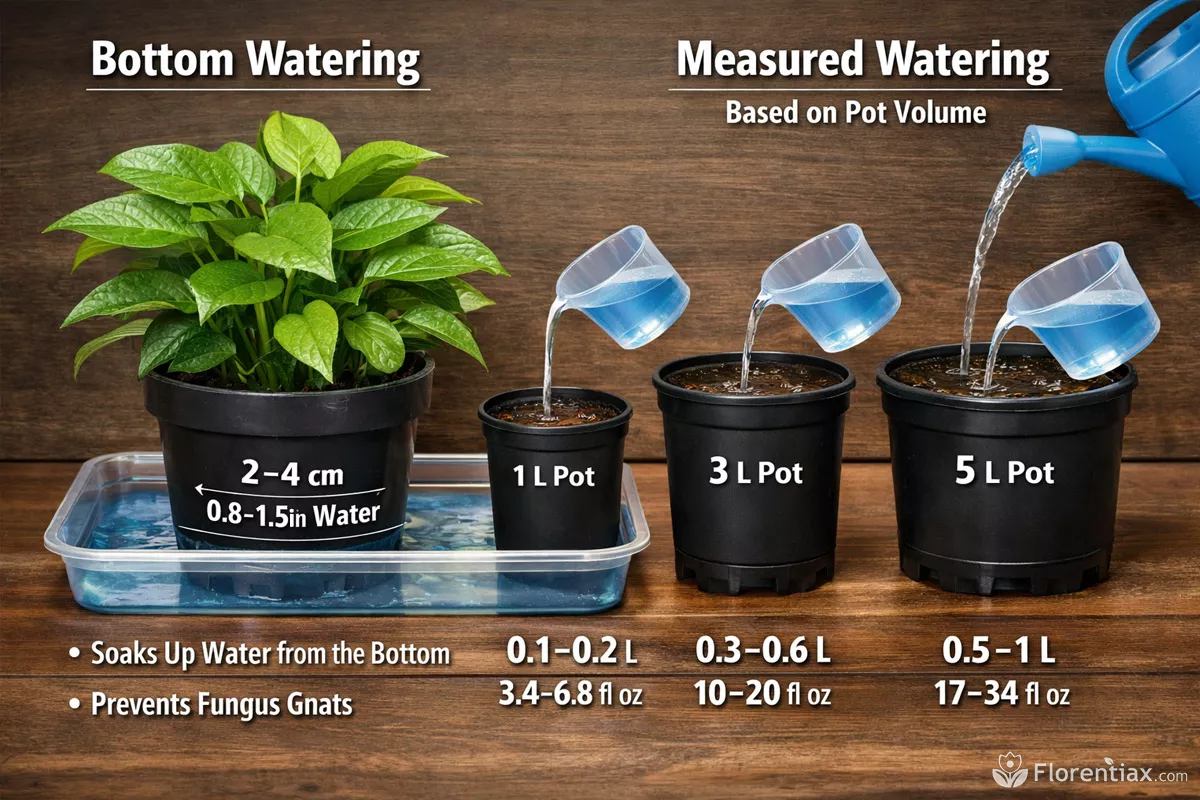
A practical guideline is to apply water equal to 10–20% of the pot’s total volume. Below are reference ranges:
- 1 liter pot (33.8 fl oz) — apply 0.1–0.2 liters (3.4–6.8 fl oz)
- 3 liter pot (101 fl oz) — apply 0.3–0.6 liters (10–20 fl oz)
- 5 liter pot (169 fl oz) — apply 0.5–1 liter (17–34 fl oz)
These numbers are guidelines only. Fast-draining mixes may require slightly more frequent watering with smaller volumes, while dense soils require stricter monitoring to avoid saturation.
Critical rule: Never leave standing water in decorative outer pots. Roots exposed to constant moisture lose oxygen access within 48–72 hours, increasing the risk of rot.
Soil and Drainage Setup
Balanced soil moisture is impossible without proper soil structure and drainage. Even perfect watering habits will fail if the potting mix holds excessive water or the container lacks drainage holes.
Why drainage holes are non-negotiable
Every indoor plant pot must have at least one drainage hole. Without it, excess water accumulates at the bottom, saturating the lower 3–7 cm (1.2–2.8 in) of the root zone. This creates anaerobic conditions and significantly increases the risk of root rot.
If using decorative outer pots without holes, always keep the plant inside a nursery container and remove it for watering.
What a well-draining soil mix should contain
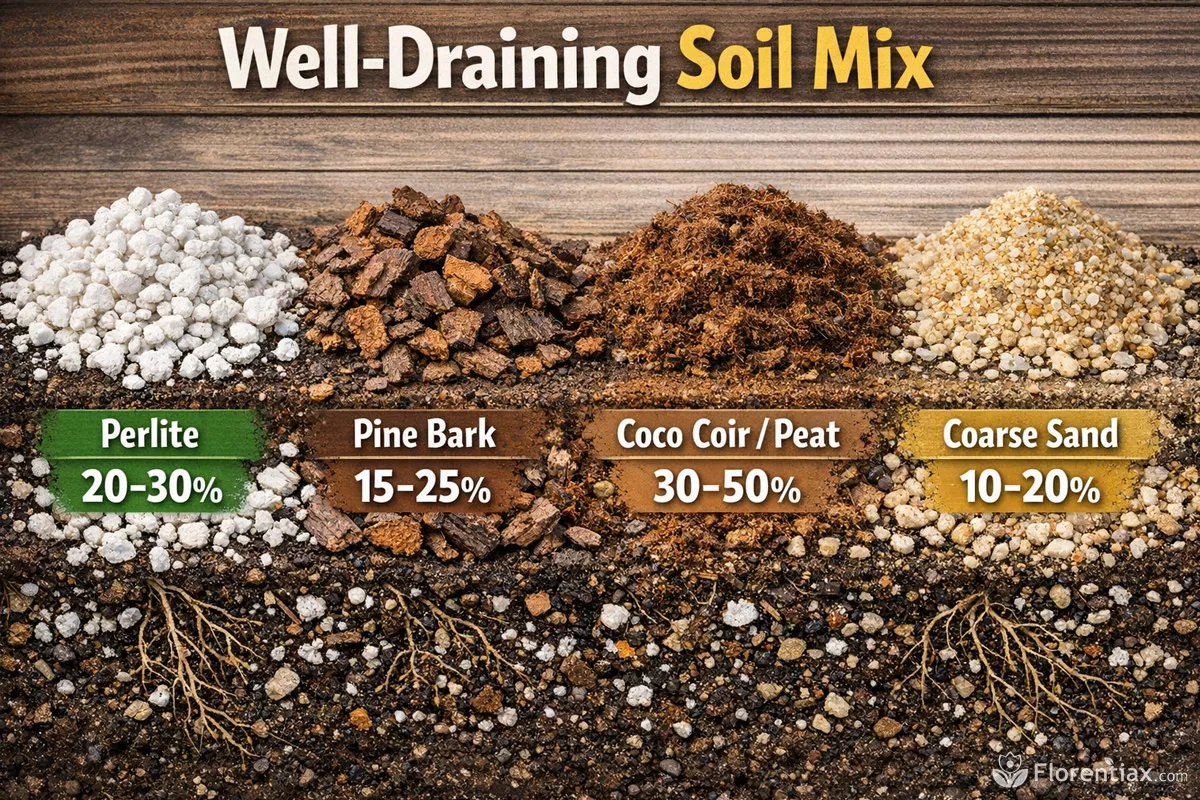
A proper indoor mix should allow water to move through the soil while still retaining moderate moisture. Ideal structure contains 20–40% aeration components.
| Component | Purpose | Recommended Percentage | When to Use More |
|---|---|---|---|
| Perlite | Improves aeration and drainage | 20–30% | For plants prone to root rot |
| Pine Bark | Creates air pockets | 15–25% | For large tropical plants |
| Coco Coir / Peat | Moisture retention | 30–50% | For moisture-loving species |
| Coarse Sand | Improves water flow | 10–20% | For succulents and cacti |
Dense peat-heavy soil without aeration additives can stay wet for 7–10 days in moderate indoor conditions (20–23°C / 68–73°F). A well-balanced mix may dry evenly in 4–6 days under the same conditions.
Seasonal Watering Adjustments
Indoor watering needs change throughout the year, even inside climate-controlled homes. Light intensity, daylight duration, and growth rate shift seasonally.
Spring and Summer (Active Growth)
During active growth, plants consume more water. In bright rooms with temperatures of 22–26°C (72–79°F), soil may dry 30–50% faster than in winter.
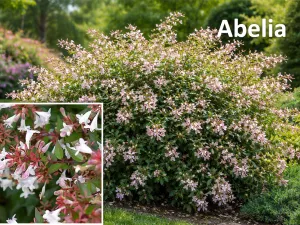
Flowering ornamental shrubs require stable but well-drained soil moisture during active growth. For example, species like Abelia shrub perform best when the soil remains evenly moist but never waterlogged.
- Check soil every 3–5 days for medium pots (15–20 cm / 6–8 in)
- Increase watering volume slightly if growth accelerates
- Monitor drainage closely in high heat
Autumn Transition
As daylight decreases, evaporation slows. Gradually extend intervals between watering by 2–4 days depending on plant size.
Winter (Dormant or Slow Growth)
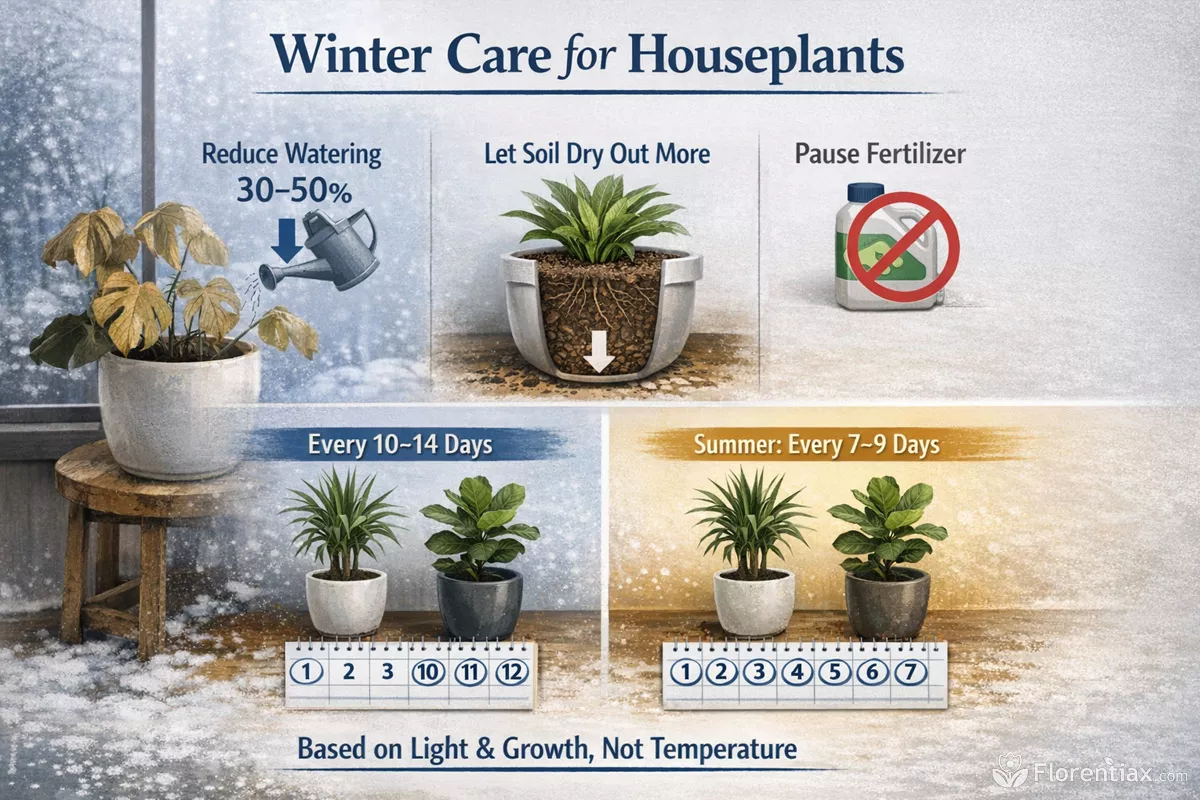
In winter, growth slows dramatically due to reduced light. Even at stable indoor temperatures of 20–22°C (68–72°F), plants use less water.
- Reduce watering frequency by approximately 30–50%
- Allow slightly deeper drying before watering
- Avoid fertilizing if growth has paused
Large floor plants in 25–30 cm (10–12 in) pots may require watering only every 10–14 days in winter, compared to every 7–9 days in summer.
Common Watering Mistakes
Most indoor plant watering problems come from repeatable habits, not bad luck. Below are the top 10 mistakes that cause overwatering, underwatering, and unstable soil moisture — with clear fixes you can apply immediately.
1. Watering on a fixed schedule instead of checking soil
This is the most common cause of overwatering. Indoor conditions change weekly — light, temperature, humidity, and plant growth rate all shift. A “every Sunday” routine ignores what the soil is actually doing. Correct approach: check moisture first, then water. For most foliage plants, wait until the top 2–3 cm (1–1.2 in) are dry, and confirm deeper layers are not wet in larger pots.
2. Judging moisture by the surface only
The top layer can feel dry within 24 hours while the lower root zone stays wet for 5–10 days, especially in pots over 20 cm (8 in). This leads to repeated watering into already-wet soil. Correct approach: use a deeper check — 3–5 cm (1.2–2 in) for medium pots, and 5–7 cm (2–2.8 in) for large pots. A wooden skewer test is simple and reliable.
3. Using pots without drainage holes
Without drainage, excess water accumulates at the bottom and creates a permanent wet zone. Roots sitting in that zone lose oxygen within 48–72 hours. Correct approach: always use a pot with drainage holes. If you want a decorative cachepot, keep the plant in a plastic nursery pot and remove it for watering, then let it drain fully before placing it back.
4. Leaving water in the saucer or outer pot
Standing water keeps the lower soil saturated and encourages root rot and fungus gnats. Even “a little water” left repeatedly creates chronic wetness. Correct approach: after watering, let the pot drain for 10–15 minutes, then empty the saucer completely. Never allow the pot base to sit in water for hours.
5. Watering lightly and frequently instead of thoroughly
Small sips only wet the top layer, which encourages shallow roots and leaves the lower root zone dry. Then the plant wilts, and people overcorrect by watering more often. Correct approach: water thoroughly until drainage occurs, then wait until the soil partially dries before watering again. This builds deeper, healthier roots.
6. Using the wrong soil mix for indoor containers
Garden soil or dense peat-heavy mixes compact in pots, hold water too long, and reduce oxygen. Even correct watering becomes dangerous because the soil cannot breathe. Correct approach: use a well-draining potting mix with 20–40% aeration material (perlite, bark, coarse components). If soil stays wet longer than 7 days at 20–23°C (68–73°F), it is usually too dense for many houseplants.
7. Oversizing the pot “to give roots room”
A pot that is too large holds a big volume of wet soil that roots cannot use quickly. The unused soil stays wet and becomes a rot zone. Correct approach: repot gradually. Choose a new pot only 2–5 cm (0.8–2 in) wider than the current root ball. This keeps drying time predictable and reduces overwatering risk.
8. Watering when the plant looks sad, without diagnosing the cause
Wilting can happen from both underwatering and overwatering. If roots are damaged by rot, the plant may wilt even when soil is wet. Adding more water makes it worse. Correct approach: always check soil before watering. If soil is moist but the plant droops, investigate drainage, smell the soil, and consider root inspection instead of watering.
9. Not adjusting watering for seasons and light changes
In winter, growth slows because light intensity drops. Water use can decrease by 30–50% even if indoor temperature stays stable. Continuing summer watering frequency is a classic way to trigger root rot. Correct approach: reduce frequency in winter, especially in low-light rooms. Re-check soil more carefully and allow slightly deeper drying for most foliage plants.
10. Ignoring water quality and salt buildup
Hard water and frequent fertilizing can cause salt accumulation in soil, leading to brown leaf tips and stressed roots. Bottom watering only can worsen this because salts are not flushed out. Correct approach: occasionally top-water until water drains freely to flush the soil. If you see white crust on soil or pot edges, flush with clean water and reduce fertilizer strength. Use filtered or dechlorinated water if your tap water is very hard.