Hot and Dry Conditions Causing Spider Mites

 This article explains why spider mites thrive in hot, dry conditions, how warmth speeds reproduction, and why low humidity and indoor spaces make outbreaks worse. It also covers warning signs, seasonal risk, and simple humidity or temperature changes to help prevent infestations.
During warm, dry weather, spider mite infestations can develop quickly and often go unnoticed until leaves begin to show damage. These tiny pests thrive in low humidity, especially when plants are already stressed and less vigorous. To reduce the risk, gardeners should watch plants closely, water consistently, maintain adequate air moisture when possible, and inspect leaves regularly so problems can be caught early and kept under control.
Why spider mites thrive in hot and dry conditions

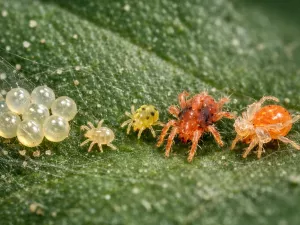
Spider mites are not insects but tiny sap-feeding relatives of spiders, and they become especially troublesome when weather turns warm, air turns dry, and plants are under mild stress. Those conditions favor the pest while reducing many of the natural checks that normally keep populations low. A plant that is already coping with heat, inconsistent watering, or intense sun often has less resilience, so mites can feed and multiply before the damage is obvious.
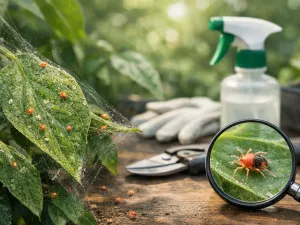
Hot, dry spells also change the plant surface itself. Leaves lose moisture faster, stomata may close more often, and tender growth can become more vulnerable. Spider mites prefer the undersides of leaves where they are sheltered, and when the environment stays dry, their fine webbing lasts longer and helps protect colonies from disturbance.
Why stressed plants become easier targets
Plant stress does not create mites, but it makes infestations more likely to take hold. Heat stress, dry potting mix, reflected light from walls or patios, and root crowding can all reduce a plant’s ability to outgrow feeding damage. Once mites begin piercing leaf tissue, the plant loses chlorophyll in tiny spots, and the weakened foliage becomes even less efficient.
- Water imbalance: Plants allowed to swing between very dry and very wet conditions often produce weaker growth that is easier for mites to exploit.
- Leaf tenderness: New growth pushed by heat can be soft and attractive to feeding colonies.
- Reduced recovery: A stressed plant replaces damaged leaves more slowly, so visible symptoms build up faster.
Why natural suppression drops in dry weather
Outdoor gardens often benefit from predatory mites, lacewings, and other beneficials. During prolonged hot and dry periods, those helpers may be less active or less abundant, especially if the garden is dusty or has been treated with broad-spectrum sprays. Dust itself is a surprisingly important factor because it coats leaves, stresses plants, and creates a friendlier surface for mites.
When all of these factors line up, outbreaks can seem sudden. In reality, the population has usually been building quietly for days or weeks, then reaches a point where stippling, fading, and webbing become visible all at once.
Editor’s note: Plants near paved surfaces, south-facing walls, or gravel mulch often run hotter than the general garden temperature suggests. If one area repeatedly gets mite problems, check the microclimate rather than blaming the plant alone.
How temperature accelerates reproduction

Temperature is one of the biggest reasons spider mites explode so quickly. As conditions warm, their life cycle shortens dramatically. Eggs hatch faster, immature stages develop more quickly, and adults begin laying sooner. That means a small, barely noticeable colony can turn into a widespread infestation in a very short time, especially when daytime temperatures remain consistently high.
For many common plant-infesting species, warm conditions in the range of 24°C to 32°C (75°F to 90°F) are especially favorable. Reproduction slows when temperatures are cooler, but in hot weather the overlap of eggs, nymphs, and adults creates continuous pressure on the plant. This is why waiting “a few more days” to inspect or respond often leads to a much larger problem.
Faster generations mean faster damage
Each female can produce many eggs over a short lifespan, so the speed of generation turnover matters more than the size of the original colony. If a plant is kept in a warm room, greenhouse, or sheltered patio corner, several generations can overlap before the gardener notices the first pale speckling on leaves.
| Temperature range | Typical effect on mite activity | What growers usually notice |
|---|---|---|
| Below 18°C (64°F) | Development slows and reproduction is reduced | Infestations build gradually and may remain localized |
| 18°C to 24°C (64°F to 75°F) | Steady feeding and regular reproduction | Early stippling appears if plants are not checked often |
| 24°C to 32°C (75°F to 90°F) | Rapid life cycle and strong population growth | Damage spreads quickly across multiple leaves |
| Above 32°C (90°F) | Activity can remain high if the host plant is still viable | Plants may decline from both heat stress and heavy feeding |
Why warm nights matter too
Gardeners often focus on daytime heat, but warm nights are just as important. If temperatures stay elevated after sunset, mites do not get the cooling slowdown that might otherwise interrupt development. Indoor plants are especially exposed to this pattern because many homes remain near 21°C to 27°C (70°F to 81°F) around the clock.
This is one reason infestations can persist even when a plant is moved away from direct afternoon sun. If the room remains warm and dry, the colony may continue reproducing at a strong pace unless the environment and the plant care routine are both adjusted.
Role of low humidity in infestations

Low humidity does not just make the air feel dry to us; it changes how leaves function and how hospitable the plant surface becomes for pests. Spider mites generally do better when the surrounding air is dry because their feeding damage compounds the plant’s moisture stress. Leaves lose water more readily, edges may crisp, and cells recover more slowly after being punctured.
Dry air also helps webbing remain effective. Fine silk strands are easier to maintain in low-humidity conditions, giving colonies more shelter on leaf undersides and between stems. On many houseplants, that webbing appears only after the infestation is already well established, so the earlier clue is usually a dull, dusty-looking stipple rather than obvious silk.
How dry air affects the plant
Plants adapted to tropical or woodland conditions often struggle when relative humidity falls very low, especially below about 40 percent. In that state, they may transpire faster than roots can comfortably replace moisture, particularly if the pot is small or the root ball has become compacted. Mites exploit that weakness.
- Thinner margin for error: A missed watering in dry air causes more stress than the same delay in moderate humidity.
- Leaf surface strain: Tissue becomes less supple, so stippling and bronzing show more quickly.
- Slower recovery: Damaged leaves remain unattractive longer, even after the pests are reduced.
Humidity is helpful, but not a cure by itself
Raising humidity can make conditions less favorable, but it should not be treated as a standalone solution. A pebble tray, room humidifier, or grouping plants together may reduce stress on the plant, yet those measures will not remove eggs or active colonies already established on the foliage. Practical control still depends on inspection, rinsing, pruning badly damaged leaves, and correcting the care conditions that allowed the outbreak.
It is also worth noting that occasional misting is often overestimated. A brief spray may raise local humidity for only a short period, sometimes minutes rather than hours. More consistent methods, such as maintaining a room around 45 to 60 percent relative humidity, are usually more meaningful for plant comfort.
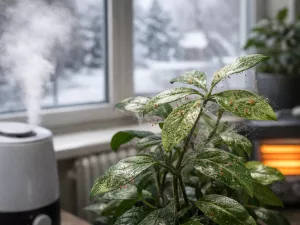
Practical tip: If you use a humidifier, place it so air moisture reaches the plant canopy without soaking leaves all day. Constantly wet foliage can create a different set of problems, especially in cool rooms with poor airflow.
Why indoor environments are ideal for mites

Indoor spaces often provide the exact mix spider mites prefer: steady warmth, low humidity, limited rainfall, and very few natural predators. Unlike outdoor plants, houseplants are not exposed to regular wind, heavy dew, or rain that can physically disrupt colonies. Once mites arrive indoors on a new plant, cut flowers, clothing, or even through an open window near infested outdoor growth, they can settle into a stable environment with little interruption.
Heating systems make this worse in cooler seasons. Central heat, radiators, and vents dry the air while keeping temperatures comfortable for people and favorable for mites. At the same time, many plants receive less light in winter, so growth slows and damaged leaves are replaced more slowly. The result is a plant that is easier to weaken and harder to restore.
Common indoor conditions that encourage outbreaks
Not every room carries the same risk. Plants placed near heaters, bright windows, or electronics often sit in microclimates that are warmer and drier than the rest of the home. Crowded shelves can also make inspection difficult, allowing a small colony to spread before anyone notices.
- Warm air from vents: Repeated blasts of dry air stress leaves and speed moisture loss from the potting mix.
- Bright but dry windows: Sun through glass can raise leaf temperature significantly, especially in the afternoon.
- Infrequent washing: Dusty leaves are more prone to stress and harder to inspect closely.
- Lack of quarantine: New plants introduced directly into a collection can spread mites quickly.
Why some houseplants seem to get them repeatedly
Certain plants are frequent targets because they combine attractive foliage with indoor stress sensitivity. Palms, ivy, crotons, calatheas, alocasias, and many thin-leaved tropicals often show problems first. Repeated infestations usually point to a persistent environmental issue rather than bad luck.
If the same plant keeps getting mites, review the basics: is the soil drying too hard between waterings, is the pot root-bound, is direct sun overheating the leaves, and is feeding balanced rather than excessive? Soft, weak growth from overfertilizing can be as unhelpful as drought stress. Healthy, evenly grown plants are not immune, but they are less likely to collapse under feeding pressure.
Signs conditions are promoting outbreaks

Before a severe infestation becomes obvious, the environment usually gives clues. Plants may start showing subtle stress signals that suggest the setting is favorable for mites: dry leaf edges, fading color, dusty surfaces, and a potting mix that dries much faster than expected. If several plants in the same area begin looking dull at once, it is wise to inspect closely rather than assuming they simply need fertilizer.
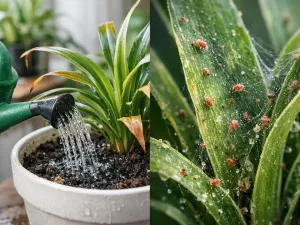
The earliest visible feeding symptom is often fine pale stippling, especially on the upper leaf surface. Turn the leaf over and you may see tiny moving dots, shed skins, or a faint grainy look along the veins. By the time webbing appears between petioles or across leaf tips, the colony is usually advanced.
Environmental clues worth taking seriously
These signs do not prove mites by themselves, but they strongly suggest conditions are helping them if they are present.
- Air feels consistently dry: Indoor humidity remains low, especially near heating or cooling vents.
- Leaves heat up fast: Plants near glass or reflective surfaces feel warm by midday.
- Soil dries unusually quickly: Pots need water far more often during hot spells or in heated rooms.
- Dust collects on foliage: A dusty leaf surface often goes hand in hand with stress and poor inspection habits.
- Damage starts on the most exposed plants: Specimens in bright, warm, dry spots show symptoms first.
How to distinguish mite-friendly stress from other problems
Nutrient issues, underwatering, and sun scorch can all resemble early mite damage, but there are differences. Mite stippling tends to look finely speckled and widespread, while fertilizer problems often show more uniform yellowing and scorch tends to create larger bleached patches. A simple check with a white sheet of paper can help: tap a suspect leaf over the paper and look for tiny moving specks.
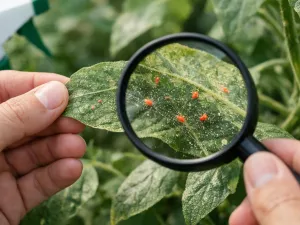
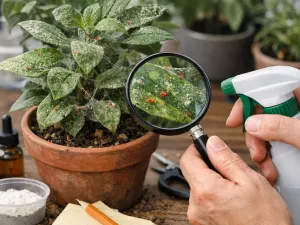
If you inspect with a hand lens, pay attention to the underside of leaves near the midrib and along fine webbing. Also check plants nearby. Spider mites rarely stay on one plant if conditions are favorable across the whole growing area.
Quick recommendation: Keep a small magnifier in your plant care kit. Catching mites when damage is still limited is far easier than trying to rescue a heavily webbed plant later.
How to adjust environment to reduce risk
The most effective way to lower risk is to make the plant less stressed and the setting less favorable to rapid mite buildup. That does not mean creating a damp, stagnant environment. It means aiming for balanced moisture, moderate humidity, cleaner leaves, and temperatures that do not stay excessively high around the plant canopy.
Start with the basics: water thoroughly when needed, let excess drain, and avoid both chronic drought and constantly soggy soil. A plant that repeatedly wilts in a hot room is much more likely to attract trouble than one kept evenly hydrated. If the potting mix has become compacted and dries unevenly, repotting into a fresh, airy medium can make a major difference.
Environmental changes that help most
Small adjustments often work better than dramatic ones. The goal is to reduce the stress points that let mites gain momentum.
- Move vulnerable plants away from heat sources. Keep foliage clear of radiators, heater vents, and hot window glass. Even shifting a pot by 30 cm to 60 cm (12 in to 24 in) can reduce leaf temperature.
- Raise humidity steadily, not briefly. Use a humidifier or group plants so the surrounding air stays more stable, ideally around 45 to 60 percent for many tropical houseplants.
- Rinse foliage regularly. A gentle shower or sink rinse helps remove dust and can physically reduce early mite numbers. Use lukewarm water around 20°C to 25°C (68°F to 77°F).
- Improve watering consistency. Check soil by feel rather than on a fixed calendar. Many plants do best when the top 2.5 cm to 5 cm (1 in to 2 in) dries slightly before watering again.
- Thin or prune badly damaged growth. Removing heavily infested leaves improves airflow and reduces the population reservoir.
Care practices that support recovery
Once mites have fed on a plant, recovery depends on good culture as much as pest reduction. Avoid heavy feeding right away, especially with high-nitrogen fertilizer, because forcing soft new growth on a stressed plant can create more vulnerability. Instead, return the plant to stable light, moisture, and temperature, then resume feeding at a moderate rate once active growth is visible.
For outdoor containers, consider relocating plants during severe heat spells. Morning sun with afternoon shade is often easier on susceptible species than full exposure all day. Mulching the pot surface lightly and using a container large enough to buffer root-zone temperature can also reduce stress.
Preventing seasonal infestations
Seasonal prevention works best when it begins before the usual trouble period. For many gardeners, that means late spring through summer outdoors and the start of the heating season indoors. Instead of waiting for visible webbing, build a routine that catches the first signs of stress and keeps plants vigorous enough to resist heavy damage.
Prevention is really a combination of timing, observation, and consistent care. Plants that enter a hot season already root-bound, dusty, or irregularly watered are much more likely to develop problems. A little preparation makes outbreaks less dramatic and easier to manage.
Build a seasonal check routine
Regular inspection matters more than occasional deep cleaning. A brief weekly check is often enough to catch the early stage.
- Inspect leaf undersides weekly: Focus on plants in warm, bright, dry positions and on species with a history of infestations.
- Wash foliage during high-risk periods: Rinsing every 7 to 14 days in summer or during indoor heating season can interrupt early colonies.
- Quarantine new plants: Keep new arrivals separate for at least 2 weeks before placing them with the rest of the collection.
- Refresh potting mix when needed: Old, hydrophobic soil can lead to repeated drought stress even when you water regularly.
- Clean growing areas: Remove fallen leaves, wipe windowsills, and reduce dust that accumulates around plants.
Match prevention to the season
Different times of year create different risks. Summer heat outdoors often combines strong sun, wind, and fast-drying containers. Indoors, winter heating creates a separate danger zone with warm dry air and less natural humidity. Tailoring your routine to the season is more effective than using the same approach all year.
| Season or situation | Main risk factor | Best preventive focus |
|---|---|---|
| Late spring to summer outdoors | Heat, drought, reflected sun, dusty conditions | Steady watering, leaf rinsing, shade adjustment, close monitoring of containers |
| Hot greenhouses or sunrooms | Constant warmth and dry air around foliage | Ventilation, humidity management, frequent inspection, removal of infested leaves |
| Autumn transition indoors | Pests hitchhiking in on moved plants | Quarantine, washing plants before bringing them inside, checking leaf undersides |
| Winter heating season | Low humidity and warm, stable indoor temperatures | Humidifier use, keeping plants away from vents, consistent watering, regular cleaning |
When prevention becomes part of routine plant care, spider mites are far less likely to reach crisis level. The key is not chasing every outbreak with the same treatment, but understanding that hot and dry conditions are the real invitation. Reduce those pressures, and plants are much better equipped to stay healthy through the season.