Soil Problems That Cause Yellow Leaves

 This article explains how depleted soil, low organic matter, and weak soil biology cause yellow leaves even when watering is fine. It covers signs of degraded soil, why nutrients become unavailable, and how organic amendments help rebuild long-term fertility.
- How depleted soil loses its ability to support healthy plant growth
- Why long-term nutrient exhaustion leads to yellowing leaves
- How lack of organic matter weakens soil fertility over time
- Impact of poor soil biology on nutrient availability
- Signs your soil is degraded even if plants are watered correctly
- How to restore soil health using organic amendments
- Building long-term soil fertility to prevent recurring yellow leaves
Yellow leaves often point to trouble below the surface, where poor soil conditions interfere with how roots absorb water, oxygen, and nutrients. Compacted soil, weak drainage, salt buildup, or an unsuitable pH can all lead to the same warning sign. Understanding the link between soil and yellowing helps gardeners address the real cause, improve root health, and avoid focusing only on the leaves while the underlying problem continues.
How depleted soil loses its ability to support healthy plant growth

Healthy leaves depend on more than water and sunlight. Soil acts as a reservoir for nutrients, air, moisture, and microbial life, and when that reservoir is worn out, plants begin to struggle in ways that often show up first as pale or yellow foliage. Depleted soil is not simply “old” soil. It is soil that has lost structure, fertility, and the ability to buffer stress.
Many gardeners notice yellow leaves and assume the plant needs more fertilizer right away. Sometimes that helps briefly, but poor soil often cannot hold or deliver nutrients efficiently. If the root zone is compacted, low in organic material, or repeatedly le-used without replenishment, roots have less access to oxygen and fewer pathways to absorb what the plant needs.
What depletion looks like below the surface
When soil is repeatedly planted, heavily watered, or exposed to weather without being improved, it changes physically and chemically. Fine particles can pack tightly together, drainage can become uneven, and nutrients can be washed out faster than they are replaced. In containers, this process happens even faster because the root zone is small and nutrients are used up quickly.
- Compaction: Roots struggle to spread, and oxygen levels drop around them.
- Nutrient loss: Nitrogen, potassium, magnesium, and trace elements become less available over time.
- Poor moisture balance: The soil may dry too fast or stay wet too long, both of which interfere with nutrient uptake.
- Weak buffering capacity: Soil with little organic matter cannot hold nutrients steadily between waterings.
Why plants respond with yellow leaves
Yellowing is often a signal that chlorophyll production is slowing down. That can happen when roots cannot access enough nitrogen, iron, magnesium, or sulfur, but it can also happen when those nutrients are technically present yet unavailable because the soil is exhausted. A plant in depleted ground may be watered on schedule and still look hungry because the root environment no longer supports active uptake.
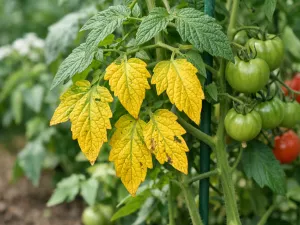
Older leaves often yellow first when mobile nutrients such as nitrogen or magnesium are in short supply. Newer leaves may yellow first when iron or other less mobile nutrients are tied up. The pattern matters, but the bigger issue is that declining soil function affects the whole plant over time.
If a plant greens up only briefly after feeding and then fades again within 2 to 3 weeks (14 to 21 days), look beyond fertilizer. That pattern often points to weak soil structure or poor root health rather than a simple one-time deficiency.
Why long-term nutrient exhaustion leads to yellowing leaves

Plants remove nutrients from the soil every time they produce stems, leaves, flowers, fruit, or roots. If those nutrients are not returned through compost, mulch, balanced feeding, or natural cycling, the soil gradually becomes less capable of supporting green growth. Yellow leaves are one of the clearest visual signs that the nutrient bank has been overdrawn.
Long-term exhaustion is different from a short feeding gap. A plant that missed one fertilizer application may slow down slightly. A plant growing in chronically undernourished soil often shows repeated chlorosis, weak stems, smaller leaves, and poor recovery after heat, pruning, or transplanting.
Which nutrients are most often involved
Not all deficiencies create the same yellowing pattern. Knowing which nutrients are commonly depleted helps explain why symptoms vary from plant to plant and season to season.
- Nitrogen: Older leaves turn pale green, then yellow, because the plant moves nitrogen to newer growth.
- Magnesium: Older leaves may develop yellow areas between veins while the veins stay greener.
- Iron: New growth can emerge yellow with green veins, especially in stressed or alkaline soils.
- Sulfur: Newer leaves may look uniformly pale when sulfur is lacking for long periods.
- Potassium: Leaf edges can yellow or scorch, often alongside weak flowering or fruiting.
Why repeated cropping speeds up the problem
Vegetable beds, annual flower borders, and heavily planted containers are especially vulnerable because they produce a lot of biomass in a short time. Fast growers remove nutrients rapidly, and frequent watering can leach soluble elements out of the root zone. If old roots, compost, or mulch are not added back, the soil becomes less fertile each season.
This is also why yellowing often appears after a strong flush of growth. The plant has used what was available, and the soil cannot keep up. In raised beds and pots, the decline may happen within one growing season. In open ground, it may take several years, but the result is similar: leaves lose color because the plant is rationing resources.
The following table shows common patterns that suggest nutrient exhaustion rather than simple underwatering.
| Leaf symptom | Likely nutrient issue | Where it appears first | What it suggests about the soil |
|---|---|---|---|
| Uniform yellowing | Nitrogen shortage | Older leaves | General fertility has been depleted over time |
| Yellowing between veins | Magnesium shortage | Older leaves | Soil reserves are low or uptake is impaired |
| Yellow new leaves with green veins | Iron unavailability | New growth | Soil may be exhausted, alkaline, or biologically inactive |
| Yellow edges and weak growth | Potassium shortage | Older to mid-aged leaves | Heavy cropping has removed more nutrients than were replaced |
How lack of organic matter weakens soil fertility over time

Organic matter is one of the main reasons good soil stays productive. It improves texture, helps hold moisture, stores nutrients in a form roots can access gradually, and feeds the organisms that keep the soil alive. When organic matter levels fall, fertility does not just dip slightly. The entire system becomes less stable.
Garden soil with too little decomposed plant material often feels lifeless. It may crust on top, crack when dry, or turn dense and sticky when wet. In containers, old potting mix can shrink away from the sides, become hydrophobic, and stop rewetting evenly. Those physical changes directly affect leaf color because roots cannot function well in a stressed root zone.
How organic matter supports nutrient retention
Without enough composted material, the soil has fewer surfaces to hold dissolved nutrients after watering or rain. Instead of staying near the roots, nutrients move downward or wash away. This is especially noticeable with nitrogen and potassium. Plants may be fed regularly, yet still show yellow leaves because the root zone cannot retain what was applied.
Organic matter also helps moderate swings in moisture. Soil that dries out too quickly interrupts nutrient flow, while waterlogged soil reduces oxygen and damages root tips. Both conditions can lead to chlorosis even when the nutrient content on paper seems adequate.
Practical signs of low organic content
You do not need a lab test to suspect that organic matter is low. The soil’s behavior often tells the story clearly.
- Water runs off the surface instead of soaking in steadily.
- The top layer forms a crust after rain or irrigation.
- Soil dries very fast in warm weather, sometimes within 1 day (24 hours).
- Roots stay shallow because the lower zone is dense or poorly aerated.
- Mulch disappears without replacement and no compost is added year after year.
A thin annual top-dressing of compost does more than feed plants. It gradually changes how the soil holds water and nutrients, which is often the missing piece when yellow leaves keep returning despite regular care.
Impact of poor soil biology on nutrient availability

Soil is not only a physical medium; it is a living ecosystem. Bacteria, fungi, protozoa, earthworms, and other organisms break down organic matter, cycle nutrients, and help roots access minerals that would otherwise remain locked away. When soil biology is weak, plants can show deficiency symptoms even in ground that has been fertilized.
This is one reason some gardens respond poorly to repeated feeding. If the microbial community is sparse or damaged, nutrient conversion slows down. Organic inputs decompose less efficiently, root exudates are not processed well, and the soil becomes less resilient after drought, overwatering, or chemical stress.
What harms soil life
Several common gardening habits reduce biological activity over time. One or two events may not cause lasting damage, but repeated disturbance can leave the soil less active and less able to support strong green growth.
- Constant bare soil: Without mulch or plant cover, temperature and moisture fluctuate too much for many organisms.
- Frequent deep digging: This breaks fungal networks and disrupts soil structure.
- Overuse of salts: Heavy synthetic feeding can create conditions that stress roots and microbes.
- Waterlogging: Saturated soil reduces oxygen and suppresses beneficial aerobic organisms.
- Long dry periods: Microbial activity drops sharply when the soil repeatedly dries out hard.
How biology affects leaf color
Microbes help release nitrogen from organic matter, improve phosphorus access, and support trace element uptake. Mycorrhizal fungi in particular extend the effective root system, helping plants reach water and nutrients beyond the immediate root hairs. If those relationships are missing, plants often look underfed sooner and recover more slowly from stress.
Poor soil biology also contributes to uneven growth. One part of a bed may support decent color while another produces pale leaves, even with the same watering routine. That inconsistency often reflects differences in organic matter, compaction, and microbial activity rather than a simple feeding schedule problem.
In potted plants, old sterile mix can become especially unhelpful. Once the mix has broken down and fine particles dominate, roots lose both air space and biological support. Yellowing then becomes a combined issue of poor aeration, weak nutrient cycling, and declining root vigor.
Signs your soil is degraded even if plants are watered correctly

Correct watering does not guarantee healthy roots. A plant can receive the right amount of moisture and still develop yellow leaves if the soil is compacted, nutrient-poor, or biologically inactive. This is why some gardeners become frustrated after improving irrigation but seeing little change in leaf color.
Degraded soil often reveals itself through patterns rather than one dramatic symptom. Growth slows, leaves pale, and plants become more sensitive to heat or routine pruning. Looking at the soil itself, not just the foliage, helps separate a watering issue from a deeper root-zone problem.
Clues in plant performance
Plants growing in worn-out soil tend to respond weakly even when basic care is otherwise sound. Watch for combinations of these signs rather than relying on one symptom alone.
- Persistent yellowing after watering adjustments with no clear improvement over 1 to 2 weeks (7 to 14 days).
- Stunted new growth despite suitable light and seasonal temperatures.
- Leaves that are smaller than normal or drop early from the lower stems.
- Shallow, sparse roots when you inspect the top 10 cm (4 in) of soil.
- Rapid wilting and slow recovery even though the soil is not completely dry.
Clues in the soil itself
The condition of the root zone often confirms what the leaves are suggesting. You can learn a lot by checking texture, smell, drainage, and how easily roots move through the soil.
- Hard surface crust: Water penetration and gas exchange are limited.
- Sticky when wet, brick-like when dry: Structure has broken down and compaction is likely.
- Sour or stagnant smell: Oxygen is low and roots may be stressed.
- Very few worms or visible life: Biological activity may be poor in open ground.
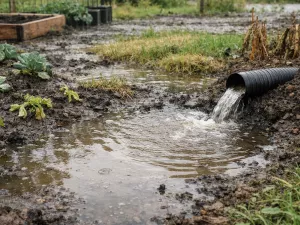
- Water pooling longer than 30 minutes after irrigation in a bed, or longer than a few minutes in a container, suggests drainage and structure problems.
Test the soil with a trowel, not just your eyes. If it is difficult to push into moist ground 10 to 15 cm (4 to 6 in) deep, roots are likely facing the same resistance.
How to restore soil health using organic amendments

Restoring soil health is usually more effective than chasing yellow leaves with repeated quick fixes. Organic amendments improve the root environment gradually and address several causes at once: low fertility, weak structure, poor moisture balance, and reduced microbial activity. The goal is not to make the soil rich overnight, but to rebuild function so plants can feed themselves more reliably.
The best amendment depends on whether you are working with a garden bed, raised bed, or container. In all cases, it helps to combine immediate support for the current plant with longer-term rebuilding of the root zone.
Best amendments for rebuilding worn soil
Different materials solve different problems. Using the right one in the right amount matters more than adding many products at once.
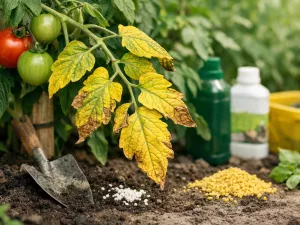
- Finished compost: Improves structure, adds mild fertility, and supports soil life. Spread 2.5 to 5 cm (1 to 2 in) over beds and gently work it into the top layer if appropriate.
- Leaf mold: Excellent for moisture retention and texture, especially in sandy or fast-drying soil.
- Well-rotted manure: Adds nutrients and organic matter, but it must be fully aged to avoid burning roots.
- Worm castings: Useful in containers or around stressed plants because they are gentle and microbially active.
- Mulch: Shredded bark, straw, or chopped leaves protect the surface and feed the soil slowly as they break down.
How to apply amendments without stressing plants
Established plants do not always need the soil heavily dug over. In many cases, top-dressing is safer and more effective. Spread compost around the root zone, keep it a few centimeters away from the stem or crown, and water it in well. Over time, worms, microbes, and irrigation move those materials downward naturally.
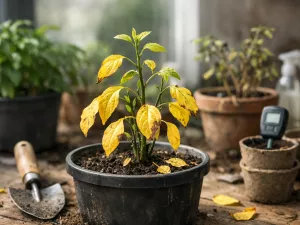
For containers, replace part or all of the old mix if it has collapsed or become difficult to rewet. If the plant is not ready for repotting, scrape away the top 3 to 5 cm (1 to 2 in) and replace it with fresh compost-rich mix. Then feed lightly rather than heavily until new growth improves.
A simple recovery approach
When yellow leaves are linked to poor soil, a steady approach works better than aggressive correction.
- Remove badly yellowed or dead foliage if it is no longer contributing to the plant.
- Top-dress with compost or worm castings based on plant size and root space.
- Mulch the surface to reduce moisture swings and protect soil life.
- Water deeply enough to moisten the root zone, then allow appropriate drying for the plant type.
- Use a gentle balanced feed only after the plant shows signs of renewed growth.
This method supports root recovery first. Once roots are functioning better, leaf color usually follows.
Building long-term soil fertility to prevent recurring yellow leaves
Preventing future yellowing is less about one product and more about maintaining a living, balanced root zone season after season. Soil fertility is easiest to protect when nutrients are replaced regularly, organic matter is kept in circulation, and the soil is not left exposed or compacted for long periods. This approach reduces stress, improves nutrient availability, and helps plants stay green through active growth.
Long-term fertility building also makes troubleshooting simpler. When soil structure and biology are in good shape, yellow leaves are more likely to reflect a specific issue such as watering error, light stress, or a temporary deficiency. In poor soil, every problem becomes harder to diagnose because the root environment is already unstable.
Habits that maintain healthy soil year after year
Consistent small actions usually outperform occasional heavy interventions. These practices help prevent the slow decline that leads to repeated chlorosis.
- Add compost annually: Even a 2.5 cm (1 in) layer each year can improve texture and nutrient holding capacity.
- Keep the surface mulched: A mulch layer of 5 to 7.5 cm (2 to 3 in) reduces erosion, temperature swings, and organic matter loss.
- Rotate heavy feeders: Avoid growing nutrient-demanding crops in the same spot every season without replenishment.
- Use cover crops where possible: In open beds, they protect the soil and add biomass between main plantings.
- Avoid unnecessary tilling: Preserving structure and fungal networks supports more stable nutrient cycling.
- Feed according to growth stage: Match fertilizer use to active growth rather than applying large doses by habit.
When to test and when to observe
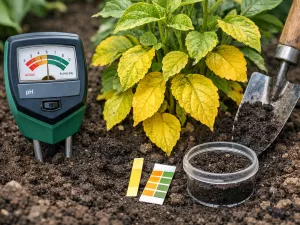
A soil test is valuable if yellowing is widespread, recurring, or affecting multiple plant types in the same area. It can reveal pH problems, major nutrient shortages, or salt buildup that visual assessment alone may miss. For beds with a history of poor performance, testing every 2 to 3 years can guide amendment choices more accurately.
Observation still matters. Watch how quickly the soil drains, how much mulch breaks down over a season, how roots look at transplant time, and whether leaf color improves after organic matter is added. Those practical signs tell you whether fertility is becoming more self-sustaining.
When the soil is consistently replenished, leaves stay greener, growth becomes more even, and plants recover faster from normal seasonal stress. That is the real sign of healthy fertility: not just fewer yellow leaves today, but fewer recurring problems across the whole growing cycle.