Yellow Leaves and Weak Root Development

 Here we how root size and strength affect leaf color, why weak roots fail to deliver enough water and nutrients, and the early signs of poor root development. It also explains how soil depth, structure, and common care mistakes limit root growth, plus safe ways to inspect roots and help them grow stronger and deeper.
- How root system size and strength affect leaf color
- Why weak roots fail to supply enough nutrients and water
- Early signs of poor root development in plants
- Soil depth and structure limiting root expansion
- Common mistakes that prevent roots from developing properly
- How to safely inspect and evaluate root health
- Methods to stimulate stronger and deeper root growth
Yellowing leaves paired with weak root growth often signal that the real issue is happening below the soil. For gardeners and plant owners, this is an important early warning that watering habits, poor drainage, compacted soil, or root injury may be preventing the plant from taking up what it needs. Catching this pattern early gives you a better chance to adjust care and restore healthy growth before the plant declines further.
How root system size and strength affect leaf color

Leaf color is often treated as a problem above the soil line, but it is usually a reflection of what the roots can or cannot do. A plant with a broad, active root system can pull in water steadily, absorb dissolved nutrients efficiently, and support healthy growth in both old and new leaves. When roots are sparse, damaged, or confined, the foliage often responds with pale green tones, yellowing, weak stems, and slower recovery after stress.
Roots are not just anchors. They act as the plant’s supply network, feeding the leaves with nitrogen, magnesium, iron, and moisture needed for chlorophyll production. If that network is undersized, the leaves may lose their strong green color even when the soil technically contains enough nutrition.
Why strong roots support greener foliage
A vigorous root system gives the plant more contact with the soil, which means more access to moisture pockets and nutrient-rich zones. This matters especially in containers, raised beds, and fast-draining soils, where resources are not evenly available from top to bottom.
- More root surface area allows better uptake of water and dissolved minerals.
- Deeper roots help the plant keep functioning during short dry spells, reducing stress-related yellowing.
- Healthy root tips are the most active parts for absorption, so fresh root growth often leads to improved leaf color.
- Balanced root-to-shoot growth helps the plant support its foliage without overextending itself.
How yellowing patterns can point to root limitations
The way leaves turn yellow can hint at whether the root system is underperforming. Older leaves often yellow first when the plant is short on mobile nutrients such as nitrogen. New leaves may pale when the roots are unable to take up iron or other micronutrients effectively, even if those nutrients are present in the soil.
Root stress can also make yellowing appear uneven. One side of a plant may fade first if roots are blocked by a pot wall, compacted patch, or waterlogged area. In severe cases, leaves may yellow and drop while the soil still seems damp, because damaged roots cannot use the moisture around them.
Editor’s note: When yellow leaves appear, avoid assuming fertilizer is the first fix. If the roots are weak, adding more feed can worsen salt stress instead of restoring green growth.
Plants that naturally grow fast, such as tomatoes, basil, pothos, and many annual flowers, show the connection between roots and foliage very clearly. If root growth stalls for even a short period, leaf color often dulls quickly. Slower-growing shrubs and houseplants may hide the issue longer, but the same principle applies: weak roots usually mean weaker leaves.
Why weak roots fail to supply enough nutrients and water

Weak roots do not fail for just one reason. Sometimes they are physically too small, sometimes they are damaged by rot or drought, and sometimes they are alive but inactive because the soil is too cold, compacted, or chemically imbalanced. In every case, the result is similar: the plant cannot move enough water and nutrients from the root zone into the stems and leaves.
Absorption depends on fine feeder roots and root hairs, which are delicate structures easily lost through overwatering, transplant shock, or rough handling. Once those fine roots are gone, the plant may still look upright for a while, but its ability to feed itself drops sharply.
Water uptake breaks down first
Water is the transport medium for most nutrients, so poor hydration at the root level quickly becomes a nutrition problem too. If roots are shallow or damaged, the plant cannot keep up with evaporation from the leaves. This creates internal stress, and the foliage may turn limp, pale, or yellow at the edges before browning.
Plants in small pots are especially vulnerable because the root zone heats and dries quickly. A root ball can become so dense that water runs down the sides instead of soaking in, leaving the center dry even after watering.
Nutrient access depends on active roots, not just fertilizer in soil
A bag of compost or a balanced feed does not help much if the roots cannot absorb it. Nutrients must be dissolved in water and taken up through living root tissue. Weak roots struggle with this process, and some deficiencies become visible even when feeding has been regular.
- Nitrogen shortages often show as general yellowing and reduced growth.
- Iron problems may appear as pale new leaves with greener veins, especially in alkaline or waterlogged soil.
- Magnesium shortages can cause yellowing between veins on older leaves.
- Potassium limitations may lead to yellowing or scorching around leaf edges.
Environmental stress can shut roots down
Roots need oxygen, warmth, and workable soil structure. In saturated ground, oxygen levels fall and roots cannot respire properly. In cold spring soil below about 10°C (50°F), many plants absorb nutrients much more slowly. In compacted beds, roots may survive but remain stunted and unable to branch into new areas.
This is why a plant can look hungry even in fertile soil. The issue is not always what is present in the ground, but whether the roots are in a condition to use it. Restoring root function often improves leaf color more reliably than repeated feeding.
Early signs of poor root development in plants

By the time a plant is badly yellowed, root trouble has usually been developing for a while. Catching the earlier signs makes recovery much easier. Poor root development tends to show up first as slow, inconsistent growth rather than dramatic collapse. The plant may survive, but it never seems to gain strength.
These early symptoms are often mistaken for minor watering errors or temporary nutrient issues. Looking at the whole growth pattern helps separate a root problem from a simple one-off stress event.
Visible growth clues above the soil
Plants with underdeveloped roots often produce smaller leaves, shorter stems, and fewer side shoots than expected for the season. New growth may emerge, then stall. Flowering plants may form buds but fail to open them well, or they may drop buds before blooming.
- Slow growth after transplanting that lasts longer than 2 to 3 weeks (14 to 21 days).
- Wilting soon after watering, suggesting the roots are not taking up moisture properly.
- Leaves yellowing from the bottom up while the plant remains undersized.
- Poor anchorage, with the plant wobbling because roots have not spread into the surrounding soil.
- Frequent stress in warm weather, even when temperatures are only moderately high, such as 27°C (81°F).
Signs in containers and seed trays
Young plants in pots often reveal root problems through watering behavior. If a pot stays soggy for many days, the root mass may be too small to use the moisture. If it dries out within hours, the roots may be circling densely and leaving little room for water retention.
Seedlings with weak root systems also tend to lean, stop producing larger true leaves, or remain pale despite adequate light. In plug trays, roots may be sparse at the edges when a healthy seedling should have formed a light but visible network.
Practical tip: Compare one struggling plant with a healthy one of the same type and age. Differences in leaf size, stem thickness, and how fast the pot dries can reveal root weakness before severe yellowing sets in.
Outdoor plants may show delayed spring leaf-out, poor summer resilience, or repeated stress after wind and heat. These are not always root problems, but they are strong clues when seen together. The key pattern is inconsistency: the plant never fully settles, even when basic care seems reasonable.
Soil depth and structure limiting root expansion

Roots need more than nutrients; they need physical space to move through. Even a fertile planting area can produce weak root systems if the soil is shallow, compacted, layered, or constantly wet. When roots cannot expand, the plant becomes dependent on a small volume of soil, which makes yellowing and drought stress much more likely.
Many gardeners focus on the top few centimeters of soil, but roots respond to what happens deeper down. A bed may look loose on the surface while hiding a dense layer below that stops root growth at 10 to 15 cm (4 to 6 in).
Shallow soil creates a small root zone
In raised beds placed over hard ground, in urban plots with rubble underneath, or in containers that are too small, roots quickly reach a barrier. Once that happens, the plant has limited access to water reserves and nutrients. Leaf color often fades during warm weather because the restricted root zone dries and depletes quickly.
This is especially noticeable with vegetables and flowering annuals that need sustained growth. A tomato in only 20 cm (8 in) of soil may survive, but it will usually struggle to maintain rich green foliage and steady fruit development compared with one given 40 to 45 cm (16 to 18 in) or more.
Compaction and poor structure reduce oxygen and movement
Compacted soil squeezes out air spaces and makes it harder for roots to penetrate. Clay-heavy ground can be productive when managed well, but if it is walked on wet or repeatedly tilled at the wrong time, it forms dense layers that roots avoid. Sandy soils create the opposite problem: roots can move through them, but moisture and nutrients may drain away too quickly unless organic matter is added.
The best root environment has a balance of pore spaces for air, enough fine particles to hold moisture, and enough structure to allow roots to branch. When any of these are missing, root growth slows and the leaves often show it.
| Soil condition | Effect on roots | Likely leaf response |
|---|---|---|
| Shallow soil over hard ground | Roots spread sideways instead of deeply | Fast wilting and pale growth in heat |
| Compacted clay | Limited oxygen and poor penetration | Yellowing, stunting, and slow recovery after rain |
| Very sandy soil | Low water and nutrient retention | Faded leaves and frequent nutrient deficiency symptoms |
| Waterlogged ground | Root rot risk and low oxygen | Yellow leaves despite wet soil |
Improving structure usually works better than trying to compensate with extra fertilizer. Organic matter, reduced foot traffic, proper bed preparation, and choosing a container with enough depth all give roots the conditions they need to support healthy foliage for longer.
Common mistakes that prevent roots from developing properly

Root problems are often created by care routines that seem helpful on the surface. Plants can survive these mistakes for a while, but over time the root system stays shallow, sparse, or damaged. The result is a plant that looks hungry, thirsty, or weak no matter how often it is watered or fed.
Most of these errors are avoidable once you understand how roots respond to moisture, air, temperature, and space.
Watering habits that weaken roots
Frequent light watering encourages roots to remain near the surface, where conditions change quickly. That makes the plant more vulnerable to heat and drying winds. On the other hand, keeping the soil constantly saturated deprives roots of oxygen and can lead to rot.
- Shallow daily watering trains roots to stay in the top layer instead of exploring deeper soil.
- Watering on a fixed schedule without checking the soil can keep roots too wet.
- Letting pots dry hard repeatedly kills fine feeder roots and slows recovery.
Container and planting errors
Pot size matters more than many growers expect. A container that is too small restricts root spread, while one that is far too large for a tiny plant can stay wet for too long. Planting depth also matters. Crowning a plant too deeply can keep the stem base damp, while setting it too high exposes roots near the surface.
Another common issue is leaving nursery root circling untouched at transplanting. If thick roots continue wrapping around the root ball, they may never branch properly into the surrounding soil. This limits water uptake later, even if the plant initially appears to settle in.
Feeding, soil, and handling mistakes
Overfertilizing can burn roots, especially in containers where salts accumulate quickly. Harsh liquid feeds applied to dry soil are particularly risky. Excessive cultivation around established plants can also break feeder roots near the surface, reducing uptake just when active growth is underway.
- Too much fertilizer can damage root tips and worsen yellowing.
- Dense, poorly drained mixes keep roots air-starved.
- Repeated root disturbance from frequent repotting or digging slows establishment.
- Cold wet soil early in the season delays root activity and nutrient uptake.
Editor’s note: If a plant is struggling, simplify care before adding products. Correct watering depth, drainage, and pot size often do more for root health than stimulants or extra feed.
A useful rule is to support root growth first and top growth second. Lush leaves produced by heavy feeding can actually increase stress if the roots are not strong enough to support them.
How to safely inspect and evaluate root health

Checking roots directly is one of the best ways to confirm whether yellow leaves are linked to poor root development. The key is to inspect without causing unnecessary damage. Container plants are easiest to assess, but even garden plants can be evaluated carefully by looking at the soil, stem base, and a small sample area near the root zone.
A healthy root system usually looks firm, well branched, and appropriately spread for the size of the plant. The exact color varies by species, but many healthy roots are white, cream, tan, or light brown inside when fresh and active.
What to look for in potted plants
Slide the plant from its pot only when the root ball is slightly moist, not soaking wet and not bone dry. Support the base gently and tip the container rather than pulling hard on the stem. Once out, examine the outer roots and the bottom of the potting mix.
- Healthy signs: fine feeder roots, even distribution, fresh white root tips, and a root ball that holds together without being solidly packed.
- Warning signs: black mushy roots, sour smell, dry hollow gaps in the mix, heavy circling roots, or very few roots for the plant’s size.
- Moderate concern: roots only at the pot edge, suggesting the center stayed too wet or too dense.
How to assess in-ground plants without major disturbance
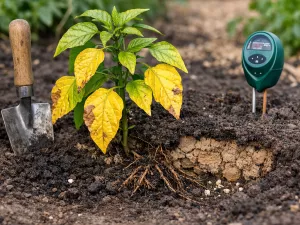
For plants in beds, avoid digging right at the crown unless the plant is already failing badly. Instead, use a hand trowel to open a small inspection hole 10 to 15 cm (4 to 6 in) away from the stem for small plants, or farther for shrubs. This lets you check moisture, smell, compaction, and root presence without tearing through the main root mass.
You are looking for roots that have moved into the surrounding soil, not just stayed in the original planting hole. If the soil is sour, gray, sticky, or packed hard, root expansion may be limited even if some roots are present.
Simple evaluation checklist
A quick, consistent checklist helps separate a root issue from a leaf-only problem such as temporary sun scorch or old-age leaf drop.
- Check whether the soil is wet, evenly moist, or dry below the surface.
- Look for a healthy smell; rotten or stagnant odors suggest oxygen problems.
- Assess whether roots are branching outward or circling tightly.
- Note root texture: firm is good, mushy or brittle is not.
- Compare root mass with top growth; a large canopy on a tiny root system indicates imbalance.
If you find only minor root stress, act gently and give the plant time. Major root pruning, repotting, fertilizing, and heavy pruning all at once can overwhelm a weakened plant. Correct the main limiting factor first, then monitor new growth over the next 2 to 4 weeks (14 to 28 days).
Methods to stimulate stronger and deeper root growth
Building better roots is usually a matter of improving conditions rather than forcing growth. Plants respond well when watering, soil structure, container size, and feeding are brought into balance. Once roots begin branching actively again, leaf color often improves gradually as the plant restores normal uptake.
The goal is not just more roots, but a healthier root pattern: deeper, wider, and better able to cope with changing weather and watering intervals.
Adjust watering to encourage depth
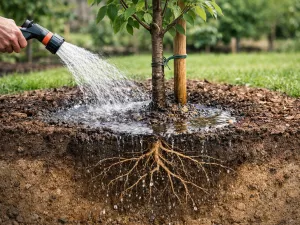
Deep, thorough watering followed by an appropriate drying period encourages roots to move downward. The exact interval depends on the plant, season, and soil, but the principle is consistent: water enough to moisten the full root zone, then allow oxygen to return before watering again.
- In beds, water slowly so moisture reaches beyond the top 10 cm (4 in) of soil.
- In containers, water until excess drains out, then empty saucers if the plant does not tolerate standing water.
- Use mulch 5 to 7.5 cm (2 to 3 in) deep to reduce surface drying while keeping the stem base clear.
Improve the root environment
Roots expand best in soil that holds moisture but still drains well. Adding compost to garden beds, using a well-aerated potting mix, and avoiding compaction all make a major difference. If a plant is rootbound, moving it up only one or two pot sizes is usually safer than placing it into an oversized container.
For compacted ground, gentle long-term improvement works better than aggressive digging around established plants. Top-dressing with organic matter, using mulch, and reducing foot traffic can gradually increase biological activity and structure.
Feed carefully to support recovery
Once roots are functioning again, light feeding can help the plant rebuild. Use a balanced fertilizer at a modest strength rather than a strong dose meant to push rapid top growth. Applying feed to already moist soil reduces the chance of root burn.
Plants recovering from root damage often respond better to patience than to heavy intervention. Watch for greener new leaves, steadier water use, and improved stem firmness as signs that the root system is strengthening.
| Method | How it helps roots | Best use |
|---|---|---|
| Deep, less frequent watering | Encourages roots to explore lower soil layers | Shallow-rooted or heat-stressed plants |
| Repotting into a slightly larger container | Provides fresh space and medium for branching | Rootbound houseplants and patio plants |
| Adding compost or organic matter | Improves structure, moisture balance, and microbial activity | Beds with poor texture or low fertility |
| Reducing fertilizer strength | Prevents salt stress on tender recovering roots | Plants with yellow leaves and recent feeding |
Stronger roots do not appear overnight, but they do rebuild when conditions improve. The clearest sign of success is not the old yellow foliage turning green again, since badly damaged leaves often stay discolored. Instead, look for healthier new growth, better water balance, and a plant that begins to hold its color and vigor more consistently.