Watering Shrubs for Consistent and Even Growth

 Here we why steady watering matters for shrub development and how uneven moisture can lead to stress and uneven growth. It also explains good watering methods, how often to water in different conditions, how soil affects moisture distribution, signs of healthy even growth, and mistakes to avoid.
- Why consistent watering is important for shrub development
- How shrubs respond to uneven moisture levels
- Best watering techniques for balanced growth
- How often to water shrubs in different conditions
- Soil factors that affect moisture distribution around shrubs
- Signs shrubs are growing evenly and healthily
- Common mistakes that cause uneven shrub growth
Healthy, even shrub growth depends not only on how much water plants receive, but also on timing and consistency. Problems such as sparse leaves, weak branching, or uneven shape often result from watering that is too shallow, too frequent, or irregular during the growing season. A steady routine encourages roots to grow deeper and spread more evenly, which supports balanced top growth and helps shrubs stay stronger during heat, wind, and dry periods.
Why consistent watering is important for shrub development

Shrubs grow best when moisture in the root zone stays reasonably steady. They do not need constantly wet soil, but they do benefit from a predictable supply of water that lets roots, stems, and leaves develop at the same pace. When the soil swings from very dry to very wet, the plant has to keep shifting its energy from growth to survival, and that often shows up as patchy shape, sparse foliage, or one-sided development.
Consistent watering supports even cell expansion, reliable nutrient uptake, and balanced root growth. A shrub that receives moisture regularly is more likely to produce uniform shoots around the plant instead of pushing a burst of growth only after heavy watering or rainfall. This matters most during the first one to three growing seasons, when roots are still spreading into surrounding soil.
How steady moisture supports balanced structure
Water is not just a way to prevent wilting. It is part of how shrubs build tissue. New stems lengthen, leaves unfold, and roots branch properly when moisture is available in the right amount. If one side of the root zone dries out repeatedly, the top growth above that area may lag behind, creating an uneven outline.
- Root expansion: Even moisture encourages roots to explore outward instead of staying clustered in one damp spot.
- Nutrient movement: Minerals move through moist soil more effectively, helping all parts of the shrub receive what they need.
- Shoot development: Regular hydration supports steady branch extension rather than stop-start growth spurts.
- Stress reduction: Plants under less moisture stress are less likely to drop leaves or abort new buds.
Why young and established shrubs differ
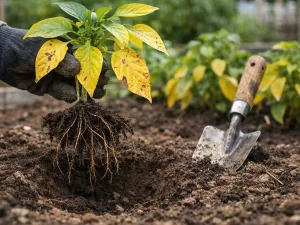
Newly planted shrubs are especially sensitive because their roots occupy a limited area, often close to the original root ball. If that small zone dries too quickly, the shrub cannot compensate by drawing water from farther out. Established shrubs usually tolerate short dry periods better, but they still become uneven if only part of the root system receives water over time.
For larger shrubs, consistency also helps maintain a full canopy. Once a plant develops bare sections from repeated drought stress, it can take a full season or longer to refill those gaps, and some species never regain a perfectly symmetrical shape without corrective pruning.
Editor’s note: If a shrub was planted within the last 12 months, think less about “watering the plant” and more about “watering the whole root zone.” A narrow splash at the base often leaves the outer roots dry, which slows establishment and leads to lopsided growth.
Steady watering also works together with other care practices. Mulch slows evaporation, sensible pruning keeps top growth in proportion to the roots, and proper feeding prevents soft, thirsty growth that is hard to support. When these factors are aligned, shrubs tend to fill out more evenly and hold their shape with less intervention.
How shrubs respond to uneven moisture levels

Shrubs react quickly when moisture is distributed unevenly through the soil. The response may be subtle at first, such as smaller leaves on one side or slower extension of a few branches. Over time, however, irregular watering patterns can create obvious differences in density, height, and color across the plant.
The reason is simple: roots grow where conditions are favorable. If one section of soil stays moist while another dries repeatedly, the root system becomes more active in the better-watered area. The top growth often mirrors that imbalance, because the strongest roots support the strongest shoots.
Visible growth patterns caused by patchy watering
Uneven moisture does not always cause immediate wilting. More often, it changes the way the shrub allocates energy. Some branches may continue growing while others pause. This can make a shrub look misshapen even when it is technically alive and still producing new leaves.
- One-sided fullness: The side with better access to moisture often becomes denser and greener.
- Short internodes and small leaves: Drier sections may produce tighter, weaker growth.
- Premature leaf drop: Stressed roots may shed older foliage to reduce demand.
- Tip dieback: Repeated drying can kill the ends of branches, especially in broadleaf evergreens.
- Delayed flowering: Shrubs under irregular moisture often form fewer buds or bloom unevenly.
What happens below the soil surface
The hidden response is often more important than the visible one. In dry pockets, fine feeder roots die back first. These are the roots responsible for most water and nutrient absorption. If wet areas remain too wet while dry areas stay dry, roots may also avoid oxygen-poor zones, leading to a shallow or poorly distributed root system.
That imbalance makes the shrub less stable in wind and more vulnerable during heat. A plant with roots concentrated in a small section of soil can look acceptable during mild weather, then suddenly struggle during a hot spell above 30°C (86°F) or after several rain-free days.
Stress cycles and recovery
Shrubs can recover from occasional inconsistency, but repeated cycles of drought followed by heavy soaking are hard on them. Rapid rewetting after severe dryness may trigger a flush of soft growth that is more prone to pests, scorch, or winter injury. Recovery is usually strongest when moisture is restored gradually and maintained at a moderate level.
Watch for patterns rather than isolated symptoms. If the same side of a shrub always appears thinner, or if growth repeatedly stalls after dry weather, the issue is often not total water volume but uneven delivery across the root area. Correcting that pattern usually improves shape more effectively than adding fertilizer alone.
Best watering techniques for balanced growth

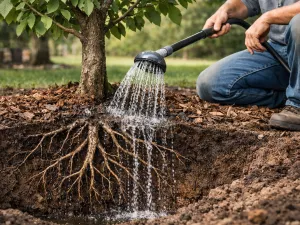
The best watering method is one that wets the root zone thoroughly and evenly, without creating runoff or leaving dry pockets. Shrubs do better with deep, deliberate watering than with frequent light sprinkling. Surface wetting encourages shallow roots, while deeper soaking promotes a stronger, wider root system that supports balanced top growth.
Technique matters as much as frequency. A shrub can receive enough total water over a week and still grow unevenly if the water is always applied to one side, too close to the trunk, or too quickly for the soil to absorb.
How to apply water effectively
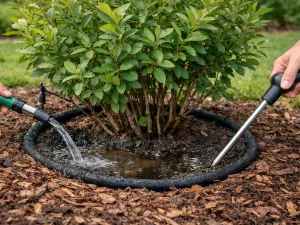
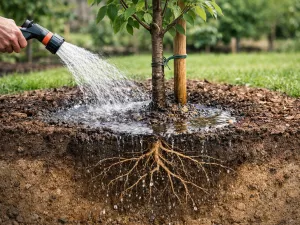
Start by aiming water at the area from just outside the main stems to slightly beyond the branch spread. For newly planted shrubs, include the entire root ball and the surrounding soil. For established shrubs, widen the watering zone so roots are encouraged to expand outward.
- Water slowly enough that the soil absorbs moisture instead of shedding it.
- Move the hose or emitter pattern so all sides of the shrub receive similar coverage.
- Moisten the soil to a depth of about 15 to 30 cm (6 to 12 in) for most medium shrubs.
- Check the depth with a trowel or soil probe before assuming the water reached the roots.
- Finish by replacing mulch if it was moved, keeping it a few centimeters away from the stems.
Comparing common methods
Different tools can work well, but each has strengths and limitations. The goal is even soil moisture, not simply convenience.
| Method | Best use | Main advantage | Common drawback |
|---|---|---|---|
| Soaker hose | Rows, hedges, and grouped shrubs | Distributes water slowly across a broad area | Can leave dry spots if sections clog or overlap poorly |
| Drip emitters | Individual shrubs and mixed beds | Precise delivery with low evaporation | Too few emitters may wet only part of the root zone |
| Hand watering with a hose | New plantings and spot correction | Lets you adjust placement and observe runoff | Easy to under-water if done too quickly |
| Sprinklers | Large beds when no other system is available | Covers a wide area | More evaporation and less efficient root-zone targeting |
Using mulch to support even watering
A mulch layer helps keep moisture levels more stable between waterings. Organic mulch such as shredded bark, leaf mold, or composted wood chips slows evaporation and reduces temperature swings in the upper soil. A layer around 5 to 8 cm (2 to 3 in) deep is usually enough. More than that can block air exchange or shed water if it becomes compacted.
Mulch is especially useful on sloped ground or in sandy soil, where water tends to move away quickly. It does not replace watering, but it makes each watering more effective and helps the whole root area stay more uniform.
Practical tip: If water runs off before soaking in, pause for 10 to 15 minutes, then water again. Two shorter passes often wet the soil more evenly than one long application, especially on dry or compacted ground.
How often to water shrubs in different conditions

There is no single schedule that suits every shrub, because watering frequency depends on weather, soil type, plant age, exposure, and season. A newly planted shrub in sandy soil may need attention several times a week, while an established shrub in loam may only need deep watering during extended dry periods. The aim is to water according to conditions rather than following the calendar blindly.
Frequency should also change as roots develop. Shrubs need more regular help during establishment, then fewer but deeper soakings once they are settled. This shift encourages roots to move outward and downward instead of staying near the surface.
General timing by situation
The table below gives practical starting points. Actual needs vary by species and climate, so use it as a guide and confirm by checking soil moisture 10 to 15 cm (4 to 6 in) below the surface.
| Condition | Typical watering pattern | What to watch for | Adjustment |
|---|---|---|---|
| Newly planted shrub in mild weather | Every 2 to 4 days | Root ball drying faster than surrounding soil | Water deeply and widen coverage gradually |
| Newly planted shrub in hot, windy weather | Every 1 to 3 days | Wilting by afternoon, dry top 5 cm (2 in) | Increase checks, add mulch, water early in the day |
| Established shrub in average garden soil | About once every 7 to 14 days during dry spells | Loss of gloss, slower growth, dry soil below surface | Deep soak rather than light top-ups |
| Established shrub in sandy soil | Every 4 to 7 days in warm periods | Water drains quickly and foliage dulls fast | Use slower application and organic mulch |
| Established shrub in clay soil | Less often, but for longer intervals between checks | Surface cracks, but lower soil may still be moist | Test before watering to avoid saturation |
Seasonal changes that affect frequency
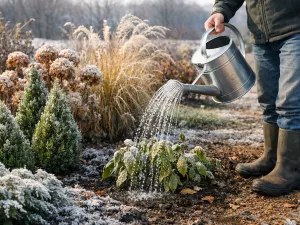
Spring growth often increases water demand as leaves and shoots expand. Summer heat raises evaporation and transpiration, especially in exposed sites. In autumn, many shrubs still need moisture while roots continue growing in cooling soil, so stopping irrigation too early can weaken them before winter. During winter in mild climates, evergreens may need occasional water if the ground is not frozen and weather stays dry.
- Cool spring: Water less often, but do not let new roots dry out.
- Hot summer: Check more frequently, especially after several days above 27°C (81°F).
- Dry autumn: Maintain moisture so shrubs enter winter well hydrated.
- Mild winter: Water evergreens during prolonged dry spells if soil is workable.
When time of day matters
Morning is usually the best time to water. The soil has time to absorb moisture before the hottest part of the day, and foliage dries more quickly than it would after evening watering. Late afternoon can also work, but avoid soaking leaves overnight if disease is already a concern.
What matters most, though, is thoroughness. A well-timed shallow watering is still less useful than a properly deep soak at a less-than-perfect hour. If your schedule is limited, focus first on depth and coverage, then refine timing.
Soil factors that affect moisture distribution around shrubs

Water does not move through every garden soil in the same way. Texture, structure, organic matter, compaction, slope, and existing root competition all influence where moisture goes after watering or rain. Understanding these factors helps explain why one side of a shrub may stay damp while another dries quickly.
Good watering practice starts with reading the soil you have, not the soil you wish you had. A method that works perfectly in loam may fail in clay or sand unless it is adjusted.
Texture and drainage
Sandy soils drain quickly and often dry unevenly because water moves downward before it spreads sideways. Clay soils hold water longer, but they can absorb it slowly and develop hard, dry zones if they become compacted. Loam usually offers the best balance, allowing water to spread through the root zone while still retaining enough moisture for steady uptake.
In mixed soils, moisture can behave unpredictably. For example, a planting hole filled with loose compost in dense clay may act like a basin, trapping water around the root ball. The opposite can happen in sandy ground, where a root ball dries out faster than the surrounding soil if it was not fully moistened at planting.
Compaction, slope, and competition
Compacted soil reduces pore space, limiting both water movement and oxygen. On sloped sites, water tends to run downhill before soaking in, leaving the upper side of a shrub drier. Nearby trees, large perennials, or turfgrass can also intercept moisture before it reaches shrub roots, especially in the top 15 cm (6 in) of soil.
- Compaction: Causes shallow runoff and patchy wetting.
- Slope: Pulls water away from the uphill side of the root zone.
- Dense feeder roots from nearby plants: Increase competition and dry the soil faster.
- Thatch or crusted surface: Slows infiltration and creates dry pockets underneath.
How to improve moisture distribution
Small changes in soil management often make a big difference. Adding organic matter over time, maintaining mulch, and watering slowly can improve uniformity without major renovation. If the site is badly compacted, careful aeration around the planting area may help, but avoid damaging major roots.
It is also useful to test several spots around the shrub after watering. Check near the trunk, at the edge of the canopy, and on different sides. If one area is wet and another remains dry 10 cm (4 in) below the surface, the issue is distribution, not total volume.
Editor’s note: Many “thirsty shrubs” are really growing in competitive soil. If a shrub sits beside mature tree roots or a lawn edge, it may need slower, wider watering than the same species planted in an open bed.
Feeding and pruning interact with soil conditions too. Heavy feeding in poor, unevenly moist soil can push growth that the roots cannot support. Likewise, hard pruning may stimulate fresh shoots that demand more water than the root system can supply evenly. Matching these practices to actual soil performance keeps growth steadier and more balanced.
Signs shrubs are growing evenly and healthily

A healthy shrub does not have to look perfectly symmetrical, because natural growth varies by species and light exposure. Still, there are clear signs that water is reaching the root zone evenly enough to support balanced development. These signs are best judged over several weeks rather than from a single day’s appearance.
When moisture is consistent, new growth tends to appear at a similar rate around the plant, leaf size is fairly uniform, and color remains steady from one side to the other. The shrub also recovers well from warm afternoons without repeated wilting or leaf drop.
What to look for in the canopy
Above ground, even growth shows up as a full, proportionate outline. Branches extend without obvious weak sections, and foliage density stays reasonably consistent. Flowering shrubs often set buds more uniformly when they are not dealing with repeated moisture stress.
- Uniform leaf size: New leaves are similar in size across the shrub.
- Balanced branching: No obvious side is racing ahead while another stalls.
- Steady color: Foliage remains evenly green or true to the cultivar.
- Reliable seasonal growth: The plant puts on expected extension for its type.
- Minimal dieback: Branch tips stay alive and continue maturing properly.
What to check at soil level
Healthy top growth should be matched by healthy soil conditions. The mulch layer should stay slightly moist underneath, not soggy and not powder dry. Soil 10 to 15 cm (4 to 6 in) down should feel cool and lightly damp after a proper watering, then gradually dry before the next one. A sour smell, algae, or constantly wet mulch can signal overwatering rather than good consistency.
You can also look for signs of root establishment. A shrub that resists a gentle tug, produces stronger spring growth, and needs less frequent emergency watering than it did last season is usually rooting out well and using moisture more efficiently.
Growth quality compared with stress growth
Even, healthy growth is usually firm and proportionate. Stress growth often looks different: long weak shoots after heavy watering, sparse leaves after drought, or repeated flushes followed by pauses. If the shrub keeps alternating between these extremes, the watering pattern is still uneven even if the plant remains alive.
Pruning response is another clue. A well-watered shrub generally fills in after light shaping with multiple healthy shoots. A moisture-stressed shrub may respond with patchy regrowth or leave some pruned sections bare for much longer than expected.
Common mistakes that cause uneven shrub growth
Uneven shrub growth is often caused less by neglect than by inconsistent habits. Gardeners may water faithfully but still create imbalance by applying water too quickly, too close to the stems, or only when the plant already looks stressed. Correcting these patterns usually improves shape and vigor more effectively than extra fertilizer or repeated pruning.
Most mistakes come down to poor distribution, poor timing, or poor coordination with soil and site conditions. Once you identify which of these is happening, the fix is usually straightforward.
Watering errors that create imbalance
Light surface watering is one of the most common problems. It dampens the top few centimeters of soil but leaves deeper roots dry, encouraging shallow rooting and unstable growth. Another frequent issue is watering only one side of a shrub because of hose position or emitter placement.
- Too little depth: Frequent shallow watering keeps roots near the surface.
- Too much force: Fast application causes runoff and misses part of the root zone.
- Watering at the base only: Outer roots stay dry, limiting balanced uptake.
- Waiting for visible wilt: Repeated stress cycles slow even development.
- Ignoring rainfall patterns: A brief shower may not moisten soil more than 2 to 3 cm (1 in).
Site and maintenance mistakes
Sometimes the watering itself is reasonable, but other practices work against it. Thick turf around shrubs competes heavily for moisture. Excess fertilizer can push lush top growth that outpaces root support. Hard pruning during hot, dry weather can also expose inner growth and increase stress on already unevenly watered plants.
Planting depth matters too. Shrubs set too deeply may suffer from poor oxygen at the root crown, while those planted high can dry out around the upper root ball. Both situations lead to irregular uptake and patchy growth.
How to correct the pattern
Improvement usually comes from a few targeted changes rather than a complete overhaul of care. Start by checking soil moisture in several spots, then adjust the watering method so the entire root area is wetted more uniformly. If needed, combine this with mulch, reduced competition, and lighter feeding until the plant stabilizes.
- Map the actual root zone and water beyond the stem base.
- Slow the application rate so moisture penetrates instead of running off.
- Check soil depth after watering rather than guessing from the surface.
- Remove grass or weeds within at least 30 to 60 cm (12 to 24 in) of the shrub where practical.
- Delay strong feeding until growth becomes steady and balanced again.
- Use selective pruning to correct shape only after the watering pattern improves.
When shrubs receive water evenly, the rest of their care becomes easier. Feeding is used more efficiently, pruning results are more predictable, and the plant is better able to handle heat, wind, and seasonal changes. Consistency does not mean constant moisture; it means giving the root system a stable, well-distributed supply that supports the whole plant instead of only part of it.