Proper Watering Depth for Young Garden Trees

 This article explains why watering depth matters for newly planted trees, how far moisture should reach, how soil type changes the approach, the effects of shallow vs. deep watering, signs of good hydration, and mistakes that weaken root growth.
- Why watering depth matters for young tree establishment
- How deep water should reach in the root zone
- Differences between shallow and deep watering effects
- How soil type influences watering depth
- Best practices for watering newly planted trees
- Signs young trees are receiving proper hydration
- Mistakes that prevent proper root development
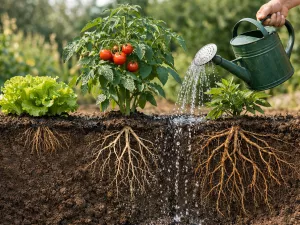
Water reaching the root zone is essential for helping newly planted garden trees establish well. A common mistake is wetting only the soil surface, which can lead to shallow roots and uneven growth. Instead, young trees benefit from a slower, deeper soaking that carries moisture down where roots need it most. This encourages stronger root development, improves resilience during dry weather, and supports more reliable establishment over the first few growing seasons.
Why watering depth matters for young tree establishment

Young trees do not become stable and self-sufficient just because they are watered often. What matters more is how far that moisture moves into the soil. A newly planted tree has a limited root system, and those roots need water at a depth that encourages them to spread outward and downward rather than staying close to the surface.
When irrigation only wets the top few centimeters, the tree learns to depend on that shallow layer. That creates a weak root pattern, especially during heat, wind, or dry spells when the upper soil dries first. Water that reaches the full active root zone helps the tree anchor itself better, tolerate stress, and establish more quickly over its first one to three growing seasons.
Root growth follows moisture
Roots tend to grow where conditions are favorable. In practical terms, that means they follow oxygen, temperature, and moisture. Deep, thorough watering creates a larger zone of usable moisture below the surface, which encourages roots to explore deeper soil layers. That is especially important after transplanting, when a tree is adjusting from nursery conditions to open ground.
This deeper rooting pattern improves access to stored moisture between waterings. Instead of needing frequent rescue irrigation, the tree can draw from a broader soil reservoir. That makes it more resilient during summer heat and less likely to suffer from sudden wilt.
Establishment is about consistency, not constant wetness
There is a difference between keeping a tree hydrated and keeping the soil saturated. Good establishment depends on cycles of deep watering followed by a period in which the soil begins to dry slightly. That pattern supports root expansion while still leaving enough air in the soil for healthy root function.
- Deep moisture supports stronger structural roots and feeder root development.
- Shallow moisture encourages roots to remain near the surface, where temperatures fluctuate more.
- Overly wet soil reduces oxygen around roots and can slow establishment even if the tree never looks dry.
- Even watering depth around the root ball helps prevent one-sided root growth.
A tree that is watered “a little every day” often struggles more than one watered thoroughly every few days. Frequent light watering can make the soil surface look cared for while the lower root zone stays dry.
How deep water should reach in the root zone

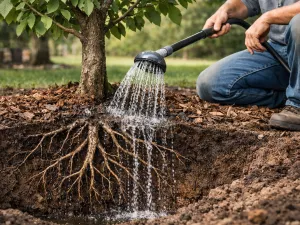
For most young garden trees, water should soak beyond the top layer and reach the main rooting area beneath the original root ball. A practical target is usually 20 to 30 cm (8 to 12 in) deep for very new plantings, increasing toward 30 to 45 cm (12 to 18 in) as the tree settles and roots begin moving outward. The exact depth depends on tree size, soil texture, and how long the tree has been in the ground.
The goal is not to flood the planting hole alone. Water should move through the root ball and into the surrounding native soil so roots are encouraged to leave the original nursery media. If only the root ball gets wet, the tree may remain confined and establish slowly.
Depth targets by stage of establishment
Freshly planted trees need moisture concentrated where roots already exist, but that zone should gradually widen and deepen. As the tree enters its second season, watering should cover a broader circle around the trunk rather than staying in one tight spot.
- First weeks after planting: Aim to moisten roughly 20 to 25 cm (8 to 10 in) deep, focusing on the root ball and just beyond it.
- First growing season: Increase to about 25 to 35 cm (10 to 14 in) where soil and drainage allow.
- Second season and beyond: In many gardens, a target of 30 to 45 cm (12 to 18 in) helps support a wider root system.
How to check the actual depth
Gardeners often guess wrong about how deeply water has penetrated. The surface may look soaked while the lower soil remains dry. The simplest way to check is to wait a few hours after watering and test the soil with a trowel, soil probe, or long screwdriver.
- Water the tree slowly and thoroughly.
- Wait about 30 minutes to 2 hours so moisture can move downward.
- Probe the soil near the edge of the root ball and a little farther out.
- Check where the soil changes from moist to dry.
- Adjust the next watering session if moisture is not reaching the target depth.
If the probe slides easily to 25 cm (10 in) or more and comes out with damp soil attached, the watering is likely reaching a useful depth. If resistance starts at 8 to 10 cm (3 to 4 in), the tree is probably only getting shallow moisture.
Differences between shallow and deep watering effects

The difference between shallow and deep watering shows up over time, not just on the day of irrigation. A tree can look fine after a quick surface soak, but repeated shallow watering changes how roots develop and how the tree handles stress. Deep watering, by contrast, builds a more durable root system and improves the tree’s ability to cope with normal weather swings.
Surface-level irrigation also causes faster evaporation losses, especially in warm weather or exposed sites. That means more water is used, but less of it benefits the tree. Deep soaking is usually more efficient because a larger share of the moisture ends up where roots can actually use it.
| Watering pattern | Typical root response | Effect on tree health |
|---|---|---|
| Frequent shallow watering | Roots stay near the top 5 to 10 cm (2 to 4 in) of soil | Higher stress during heat, wind, and short dry spells |
| Deep watering with long soak time | Roots move lower into cooler, steadier soil layers | Better drought tolerance and steadier growth |
| Irregular heavy flooding | Roots may suffer from low oxygen, especially in dense soil | Risk of root decline, yellowing leaves, and slow establishment |
| Deep watering followed by partial drying | Balanced root growth with good air and moisture exchange | Strong establishment and improved resilience |
Visible symptoms can be misleading
A shallow-watered tree may produce soft, quick top growth for a while, especially if fertilized. That can make it seem healthy even though the root system is underdeveloped. Later, the same tree may scorch, wilt by afternoon, or drop leaves early because it cannot draw enough moisture from deeper soil.
Deep-watered trees often establish more quietly. They may not push excessive top growth at first, but they usually become steadier and less reactive to weather. That is the kind of progress gardeners want in the long term.
If a tree wilts every hot afternoon but perks up by evening, do not assume it needs more frequent surface watering. Check moisture depth first; repeated shallow watering often makes this cycle worse.
How soil type influences watering depth

Soil texture changes how quickly water enters, how far it spreads, and how long it stays available. That means the right watering depth is tied not only to the tree but also to the ground it is planted in. Sandy soil drains quickly and often needs slower, more frequent deep watering sessions, while clay holds water longer but absorbs it more slowly.
Ignoring soil type leads to common mistakes. In sandy ground, water may move down too fast and beyond the active roots if applied too heavily at once. In clay, water may puddle on the surface and run off before it penetrates. Loam is usually the easiest to manage because it balances drainage and retention.
How different soils behave
Understanding the basic behavior of your soil helps you choose both watering volume and application speed. The depth target may be similar, but the method used to reach it often differs.
| Soil type | Water movement | Practical watering approach |
|---|---|---|
| Sandy soil | Fast infiltration, low water holding capacity | Apply water slowly but check more often; mulch helps reduce drying |
| Loamy soil | Moderate infiltration and good moisture balance | Deep soaking usually works well at regular intervals |
| Clay soil | Slow infiltration, high water holding capacity | Use a very slow flow rate and allow time for absorption |
| Compacted soil | Poor infiltration and restricted root growth | Water in cycles and improve soil surface conditions with mulch and aeration practices |
Mulch changes the equation
An organic mulch layer 5 to 8 cm (2 to 3 in) deep can make watering more effective in nearly any soil. It slows evaporation, moderates soil temperature, and helps moisture remain in the upper root zone long enough to move deeper. Keep mulch a few centimeters away from the trunk, ideally about 5 to 8 cm (2 to 3 in), so the bark stays dry.
Mulch does not replace deep watering, but it makes each irrigation more useful. In difficult soils, especially heavy clay or very sandy beds, it can be one of the simplest ways to improve results.
Best practices for watering newly planted trees

Good watering technique is less about a fixed schedule and more about applying enough water, slowly enough, in the right area. Newly planted trees need consistent support while they rebuild fine roots lost during transplanting. The best routine wets the root ball and surrounding soil to the desired depth, then allows the upper layer to begin drying before the next session.
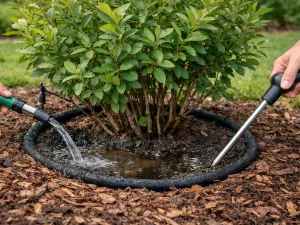
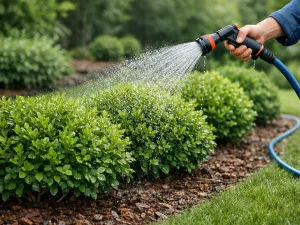
A hose set to a trickle, a watering bag, or drip irrigation usually works better than a fast spray. Slow application reduces runoff and gives moisture time to penetrate. It also helps avoid washing soil away from the planting area.
Where to apply the water
Do not pour all the water directly against the trunk. The most useful zone is the root ball and the soil just beyond it. As the tree settles in, expand the watering ring outward to match the growing root spread.
- First month: Water over the root ball and a narrow ring around it.
- After early establishment: Widen the area to encourage roots into surrounding soil.
- During hot periods: Keep coverage broad rather than increasing only trunk-side watering.
Practical routine for the first season
The exact frequency depends on weather, tree size, and soil, but a simple check-and-adjust approach works well in most gardens. Rather than watering by the calendar alone, inspect the soil before deciding.
- Check moisture 10 to 15 cm (4 to 6 in) below the surface near the root ball.
- If that layer is dry or only faintly damp, water deeply.
- Apply enough water to reach roughly 20 to 30 cm (8 to 12 in) deep for a new planting.
- Pause if runoff starts, then resume after a short wait.
- Recheck depth occasionally so you know the routine is working.
In warm weather, many young trees need deep watering once or twice a week rather than daily light watering. In cool or rainy periods, they may need much less. The soil should guide the decision.
Morning is usually the easiest time to water because evaporation is lower and you can judge the tree’s condition later in the day. Evening watering is acceptable too, but avoid creating constantly soggy soil around the trunk.
Signs young trees are receiving proper hydration

A properly watered young tree looks steady rather than dramatic. It does not need to be pushing rapid growth every week, but it should hold its leaves well, maintain normal color, and show gradual extension of shoots during the growing season. The soil should feel moist below the surface after watering, then slowly move toward lightly damp before the next irrigation.
Hydration is best judged through a combination of plant signals and soil checks. Leaves alone can be misleading because heat, wind, transplant shock, and even temporary midday stress can mimic drought. Looking at the whole pattern gives a more accurate picture.
What healthy moisture management looks like
When watering depth is appropriate, the tree usually becomes less reactive to short weather changes. It may still slow down in extreme heat, but it should recover quickly without repeated collapse or scorch.
- Leaves remain reasonably firm through most of the day, with only minor temporary droop in extreme heat.
- Color stays normal for the species, without widespread yellowing or crisp brown edges.
- New growth matures gradually instead of appearing soft and weak from constant surface moisture.
- Soil below the surface is evenly moist to the target depth after watering, not muddy at the top and dry underneath.
- The tree needs fewer emergency waterings because roots are accessing a larger soil volume.
How to tell hydration from overwatering
Some symptoms overlap. A tree in waterlogged soil can wilt just like a dry tree because damaged roots cannot take up moisture properly. The difference is usually in the soil condition and the timing. Dry stress often comes with hard, dusty soil and leaf scorch, while overwatering often brings persistently wet soil, yellowing, and sluggish growth.
If you are unsure, inspect the soil before adding more water. A simple moisture check is more reliable than reacting to leaf droop alone.
Mistakes that prevent proper root development
Many watering problems come from good intentions applied the wrong way. Young trees are often overmanaged near the surface and undermined below ground. The most common errors keep roots confined, deprive them of oxygen, or train them to stay in the least stable part of the soil profile.
Correcting these habits early can make a major difference in establishment speed and long-term strength. A tree that develops a broad, deep root system in its first years is easier to care for later and usually performs better in drought, wind, and summer heat.
Common watering and planting errors
Several mistakes work together to limit root spread. Some are obvious, such as daily light watering, while others are less noticeable, such as watering only inside a narrow planting basin for too long.
- Frequent shallow irrigation: Keeps roots near the top few centimeters of soil instead of encouraging depth.
- Watering only at the trunk: Leaves the outer root zone dry and discourages lateral spread.
- Letting water run off: Fast application on sloped, dry, or clay soil can waste much of the irrigation.
- Keeping the soil constantly saturated: Reduces oxygen and can trigger root rot or weak growth.
- Ignoring soil texture: The same watering routine does not work equally well in sand, loam, and clay.
- Mulch piled against the trunk: Can trap moisture on bark and create decay problems while not improving root depth.
- Planting too deep: Even perfect watering cannot fully compensate for a buried root flare and poor gas exchange.
How to avoid long-term setbacks
Root development improves when watering is paired with sound overall care. Proper planting depth, a mulch ring, and moderate feeding all support better moisture use. Heavy fertilizing is rarely helpful during early establishment because it can push top growth faster than the root system can support.
Pruning should also be conservative at planting time. Removing dead or damaged wood is useful, but heavy shaping can reduce the leaf area the tree needs to fuel root recovery. The better strategy is to water deeply, protect the root zone, and let the tree direct energy into establishment.
If a young tree struggles despite regular watering, look below the surface before changing products or adding fertilizer. Poor planting depth, compacted soil, or a root ball that never fully wets are often the real causes.