Yellow Leaves on Shrubs – Early Warning Signs

 The article explains why shrubs can start yellowing before other plants. It covers root competition, tired soil, shrub-specific watering mistakes, seasonal stress, pests and diseases, signs of deeper structural problems, and practical steps to keep shrubs healthy.
- Why shrubs show yellowing earlier than other plants
- Root competition and soil exhaustion in shrubs
- Watering mistakes specific to shrubs
- Seasonal stress factors affecting shrub health
- How pests and diseases trigger early yellowing
- Signs that indicate deeper structural problems
- Preventive care to keep shrubs consistently healthy
Yellowing shrub foliage is often an early warning that something is wrong before more serious damage appears. Noticing the color change quickly can help gardeners identify possible causes such as overwatering, underwatering, nutrient deficiencies, poor drainage, pest activity, or normal seasonal stress. Understanding these signs makes it easier to act promptly and keep a minor issue from developing into a larger plant health problem.
Why shrubs show yellowing earlier than other plants

Shrubs often act like early-warning plants in the garden. They sit in the same spot for years, draw from the same root zone season after season, and are expected to keep producing dense foliage through heat, wind, pruning, and changing soil conditions. Because of that long-term pressure, a shrub may show yellow leaves before nearby perennials, annuals, or lawn grass reveal any obvious stress.
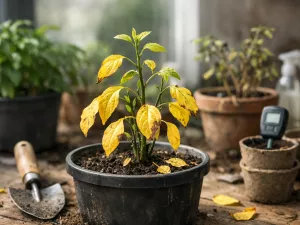
Another reason is structure. A shrub has a permanent woody framework that must support both old growth and fresh leaves. If water, oxygen, nutrients, or root space become limited, the plant has to decide where to send its energy. One of the first visible responses is chlorosis, where leaves lose green pigment and fade to pale yellow.
Why established shrubs are especially revealing
Newly planted specimens can yellow from transplant shock, but older shrubs are often more informative. They reflect what has been happening below ground for months or even years. When a mature shrub starts yellowing, it is rarely random. It usually points to a gradual issue such as compacted soil, poor drainage, depleted nutrients, or root disturbance from nearby planting or construction.
- Deep dependence on one site: Unlike bedding plants that are replaced often, shrubs must cope with the same soil profile year after year.
- Large leaf mass: Dense canopies lose color quickly when uptake is interrupted, making stress easier to spot.
- Permanent framework: Energy is divided between maintaining stems, roots, and foliage, so shortages show up sooner.
- Less forgiving root zones: Mulch buildup, foot traffic, edging, and lawn competition can slowly reduce root performance.
Yellowing patterns that matter
The pattern of yellowing gives clues. If the oldest inner leaves are yellowing and dropping, the shrub may be under mild seasonal or light-related stress. If the newest leaves are pale with green veins, iron or manganese uptake may be restricted, often because soil pH is too high or roots are waterlogged. If the whole plant looks washed out, look first at watering and root health rather than fertilizer alone.
It also helps to compare one shrub with another of the same type. If only one plant is yellowing, the problem is usually local: a blocked downspout, buried root flare, reflected heat from paving, or a damaged root zone. If several shrubs in the same bed are affected, the issue is more likely linked to irrigation, soil chemistry, or weather stress.
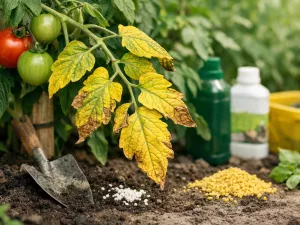
Editor’s note: When a shrub yellows early, avoid reaching for fertilizer first. A quick feed can mask the symptom for a short time while the real problem—often drainage or root stress—keeps getting worse underneath.
Root competition and soil exhaustion in shrubs

Shrubs may look sturdy above ground, but their root systems are often working in crowded conditions. In mixed borders, roots compete with trees, hedges, lawn grass, and even neighboring shrubs for moisture, oxygen, and nutrients. Over time, this competition can leave a shrub with just enough resources to survive but not enough to maintain rich green foliage.
Soil exhaustion is common in long-established beds. Repeated planting, shallow feeding, and constant moisture swings can strip the upper root zone of balance. Even when nutrients are technically present, they may no longer be available to the plant because of compaction, poor pH, or salt buildup from fertilizers or winter de-icing products.
How nearby plants steal resources
Tree roots are especially aggressive. Fine feeder roots from a mature tree can spread well beyond the canopy and occupy the same upper 15 cm to 30 cm (6 in to 12 in) of soil that shrubs rely on. Lawn grass is another hidden competitor because it forms a dense mat that intercepts light watering before it reaches deeper roots.
- Trees: Pull large amounts of moisture during warm weather, especially in dry spells.
- Groundcovers and turf: Capture surface water and shallow nutrients quickly.
- Tightly spaced shrubs: Create a crowded root zone where no plant performs at its best.
- Foundation plantings: Often face dry soil under roof overhangs and heat reflected from walls.
Signs the soil itself is losing function
Exhausted soil does not always look poor from the surface. It may still appear dark and crumbly after rain, yet roots below can be struggling. Watch for water that sits after irrigation, a hard crust that forms in dry weather, or mulch that has broken down into a dense layer that sheds water. These are signs the root environment is no longer balanced.
If you dig a small test hole 10 cm to 15 cm (4 in to 6 in) deep near the drip line, healthy shrub soil should be slightly moist, open, and easy to crumble. A sour smell, sticky texture, or dusty dryness suggests the roots are cycling between too wet and too dry. Both conditions can trigger yellow leaves.
| Root-zone issue | What you may see above ground | Likely cause below ground |
|---|---|---|
| Yellowing on outer canopy in hot weather | Leaf fade, slight wilting by afternoon | Competition from trees or dry soil pockets |
| Pale new growth with weak extension | Smaller leaves, reduced vigor | Nutrient lockout from high pH or depleted soil |
| General yellow cast after rain | Soft leaves, slow recovery | Compaction and low oxygen around roots |
| Patchy decline on one side of shrub | Uneven color and sparse branching | Localized root damage from digging, edging, or paving |
Improving the root zone usually works better than adding stronger feed. A 5 cm to 7.5 cm (2 in to 3 in) mulch layer spread over the root area, but kept a few centimeters away from the stems, helps stabilize moisture and temperature. In very tired beds, top-dressing with compost each spring can gradually restore structure without forcing soft, weak growth.
Watering mistakes specific to shrubs

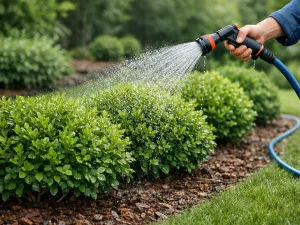
Shrubs are often watered as if they were annual flowers: a quick splash near the base, frequent but shallow irrigation, or automatic sprinklers that wet the leaves more than the root zone. That approach can leave woody plants chronically stressed. Most shrubs need water to penetrate deeply enough to reach the active roots spread around and beyond the canopy edge, not just the soil touching the stem.
Yellow leaves commonly appear when watering is inconsistent rather than simply too low. Long dry gaps followed by heavy soaking can damage fine roots and reduce nutrient uptake. The result can look like deficiency, but the real issue is unstable moisture.
Common shrub-watering errors
Many irrigation problems come from placement and timing. Foundation shrubs may get almost no natural rainfall because rooflines block it. On the other hand, shrubs near downspouts may stay too wet. Drip systems can also be misleading if emitters are placed too close to the trunk and never expanded as the shrub matures.
- Watering too close to the stem: Encourages shallow rooting and leaves the outer feeder roots dry.
- Short daily watering: Moistens only the top few centimeters and promotes weak surface roots.
- Ignoring mulch: Bare soil dries faster and can become hydrophobic in heat.
- Using lawn sprinklers for shrubs: Coverage is often too light and too shallow for woody plants.
- Not adjusting by season: Spring rainfall, summer heat, and autumn cooling all change demand.
How to check whether water is really reaching the roots
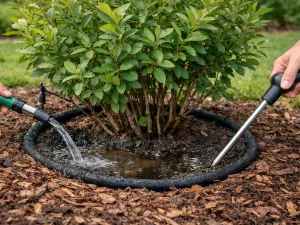
A simple soil check is more useful than guessing from the surface. Push a trowel or soil probe into the ground 15 cm to 20 cm (6 in to 8 in) deep after watering. If the soil is dry below the top layer, the shrub has not been watered deeply enough. If it is sticky and airless for days, drainage is poor or watering is too frequent.
As a rough guide, many established medium shrubs respond better to a slower soak that wets the root zone to around 20 cm to 30 cm (8 in to 12 in), followed by time for the soil to partly dry. The exact frequency depends on soil type, weather, and plant species, but the principle is consistent: deep and appropriate beats frequent and shallow.
Practical tip: If a shrub sits under eaves, check it separately after rain. Beds that look evenly moist from a distance can contain one surprisingly dry root ball where the rain never reaches.
When overwatering looks like drought
One of the most confusing shrub problems is that soggy roots and dry roots can create similar yellowing. In both cases, roots fail to supply the leaves properly. Overwatered shrubs may also wilt in warm afternoons because damaged roots cannot keep up with demand. If leaves are yellow, soft, and dropping while the soil stays wet, reduce irrigation and improve drainage before considering feed.
Seasonal stress factors affecting shrub health

Yellow leaves do not always point to one single mistake. Shrubs are exposed to a sequence of seasonal pressures, and the timing of yellowing often explains the cause. A plant that looked healthy in spring can begin fading in midsummer because roots never fully recovered from winter wet, late frost, or a dry spring. Reading the season helps narrow the diagnosis.
Woody plants also react more slowly than softer garden plants. Damage may occur weeks before leaves change color. By the time yellowing appears, the shrub may already be dealing with accumulated stress from temperature swings, wind, and uneven moisture.
Spring and early summer pressures
In spring, shrubs push new growth using stored energy. If the previous year ended badly—drought, root disturbance, or heavy pruning—the new leaves may emerge pale or weak. Late frosts can also injure tender growth, causing yellow patches or distorted leaves that are often mistaken for nutrient deficiency.
Early summer brings a different challenge: rapid top growth. If roots are still in cold, wet soil while the canopy is expanding quickly, the plant can struggle to support that growth. This mismatch often shows up as a washed-out color rather than dramatic wilting.
Midsummer and heat-related yellowing
Heat stress is especially hard on broadleaf evergreens and recently planted shrubs. High temperatures above 30°C (86°F), reflected heat from paving, and drying winds can push transpiration faster than roots can replace water. Leaves may yellow at the edges first, or the whole shrub may lose depth of color.
- Hot walls and fences: Raise leaf temperature and dry nearby soil faster.
- Container-grown shrubs planted late: Often have circling roots that struggle in summer heat.
- Mulch that is too thin: Allows repeated drying of the upper root zone.
- Heavy midsummer feeding: Can stimulate soft growth that scorches or yellows under stress.
Autumn and winter carryover effects
Autumn yellowing can be normal in deciduous shrubs, but premature color change is different. If leaves yellow and drop weeks early, the plant may be reacting to drought, root injury, or disease. Evergreens may not show damage until late winter or early spring, when roots in cold soil cannot replace moisture lost to sun and wind.
Winter salt is another overlooked factor. Salt spray from roads and paths, or runoff from de-icing products, can accumulate in the soil and interfere with water uptake. The next growing season, shrubs may respond with yellow margins, weak growth, or sparse foliage.
| Season | Typical stress trigger | Common yellowing response |
|---|---|---|
| Spring | Cold soil, late frost, weak stored reserves | Pale new growth or patchy yellow leaves |
| Summer | Heat, drought, reflected light, rapid transpiration | Overall fading, edge yellowing, leaf drop |
| Autumn | Early drought stress or root decline | Premature color change and thinning canopy |
| Winter | Salt exposure, frozen soil, drying winds | Delayed yellowing and poor spring recovery |
How pests and diseases trigger early yellowing

When shrubs yellow unexpectedly, pests and diseases should be considered alongside watering and soil issues. Insects and pathogens rarely produce a generic response. They interfere with the plant in specific ways: sucking sap, blocking vascular tissue, damaging roots, or causing leaf tissue to collapse. The yellowing pattern often reveals which type of problem is involved.
Not every infestation is dramatic. A shrub can host mites, scale, or root disease for quite some time before obvious decline appears. By the time leaves turn yellow, the plant may already be under sustained stress.
Insect damage that alters leaf color
Sap-feeding pests remove moisture and nutrients directly from the plant. This can create stippling, mottling, or a dull yellow cast. Spider mites are common in hot, dry conditions and often affect the inner and lower foliage first. Scale insects may be harder to spot because they cling to stems and leaf undersides, but they can weaken a shrub steadily over time.
- Spider mites: Fine speckling, dusty-looking leaves, and sometimes webbing.
- Scale: Sticky residue, yellow leaves, and gradual loss of vigor.
- Aphids: Distorted soft growth and honeydew that can lead to sooty mold.
- Root-feeding larvae: Sudden yellowing and poor water uptake despite moist soil.
Disease-related yellowing patterns
Leaf spot diseases can cause yellow halos around dark lesions, while root rots often lead to a more general pale appearance. If the soil stays wet and the shrub still wilts or yellows, root disease becomes more likely. Fungal issues are especially common where air circulation is poor, pruning is dense, or irrigation keeps foliage wet for long periods.
Vascular diseases are more serious because they interfere with internal transport. In these cases, one branch or one side of the shrub may yellow first, even though the rest still looks normal. Cutting into a symptomatic stem may reveal brown streaking in the wood, which suggests the problem is deeper than leaf-level stress.
Editor’s note: Always inspect the undersides of leaves and the stems before treating. Many yellow-leaf problems blamed on deficiency are actually caused by mites or scale, and feeding the plant will not solve that.
When treatment should focus on conditions, not chemicals
Many disease problems improve more from cultural correction than from spraying. Better spacing, selective thinning, watering at soil level, and removing badly infected material can shift the environment enough to stop repeated outbreaks. Chemical controls are sometimes useful, but they work best when the root cause—excess moisture, crowding, or weak plant vigor—is also addressed.
Signs that indicate deeper structural problems

Sometimes yellow leaves are only the visible tip of a larger issue. A shrub may be struggling not because of a temporary nutrient shortage but because its structure, planting depth, or woody framework has been compromised. In these cases, leaf color changes are paired with symptoms that suggest the plant’s long-term stability and health are at risk.
Structural problems can develop slowly. A shrub planted too deeply may survive for years before decline becomes obvious. Repeated shearing can create a dense outer shell that shades the interior, while old storm damage may leave stems partly split or decayed. Yellow leaves are then part of a wider pattern of weakening.
Warning signs in stems, crown, and branching
Look beyond the foliage. Check whether the base of the shrub is visible or buried under soil and mulch. A hidden crown can trap moisture against bark and encourage stem rot. Also inspect branch unions for cracks, rubbing stems, and dead wood that no longer leafs out evenly.
- Buried crown or root flare: Often linked to chronic yellowing, poor vigor, and stem decay.
- Dieback at branch tips: Suggests root loss, canker, or vascular restriction.
- One-sided thinning: May indicate root damage or a split main stem.
- Dense outer shell with bare interior: Common after years of shallow shearing.
- Suckering from the base: Can be a stress response to injury higher up.
Planting and pruning issues that show up later
Shrubs planted with circling roots may establish poorly even if they looked fine at first. As those roots enlarge, they can restrict water movement and reduce stability. Likewise, repeated hard pruning at the wrong time can remove too much foliage, expose bark to sunscald, or force weak regrowth that yellows easily under stress.
If a shrub has been topped, heavily clipped, or cut back into old wood repeatedly, inspect the interior. Dead stubs, congested branching, and poor airflow can all contribute to decline. Structural correction may require staged pruning over one or two seasons rather than one severe cut.
When replacement is more realistic than rescue
Not every shrub can be restored fully. If more than one-third of the framework is dead, the crown is rotting, or the root system has been severely damaged by excavation, recovery may be slow and uncertain. In those cases, replacing the plant and correcting the site problem first is often the better long-term choice.
A useful test is whether the shrub is producing healthy new shoots from appropriate points on the plant, not just weak growth from the base. Strong, well-placed regrowth suggests recovery is possible. Sparse, yellow, or stunted shoots usually mean the underlying structure is failing.
Preventive care to keep shrubs consistently healthy
The best way to avoid yellow leaves is to make shrubs less vulnerable to stress in the first place. Consistent care does not mean constant intervention. It means maintaining a stable root zone, matching the plant to the site, and checking for small changes before they turn into visible decline. Healthy shrubs usually tolerate short dry spells, minor pest pressure, and seasonal shifts far better than neglected ones.
Prevention also depends on timing. A shrub that is mulched, watered deeply, pruned thoughtfully, and monitored through the year is less likely to give sudden warning signs. The goal is steady growth and balanced foliage, not rapid, overly soft growth pushed by excess fertilizer.
Core habits that protect leaf color and vigor
Routine observation matters as much as any product. Walk past shrubs closely every week or two during the growing season. Compare leaf color, shoot length, and soil moisture from one side of the plant to the other. Early differences are easier to correct than full-plant decline.
- Mulch properly: Apply 5 cm to 7.5 cm (2 in to 3 in) of organic mulch over the root zone, keeping it clear of stems.
- Water deeply when needed: Soak the wider root area rather than sprinkling the base lightly.
- Feed only when justified: Use soil condition and plant performance to guide feeding, not habit alone.
- Prune for structure: Remove dead, crossing, or congested growth to improve airflow and light penetration.
- Check soil pH if yellowing repeats: Especially important for acid-loving shrubs growing in alkaline ground.
- Inspect for pests early: Leaf undersides, stems, and inner growth often reveal problems first.
Matching care to shrub type
Not all shrubs want the same conditions. Acid-loving plants such as camellia, rhododendron, and blueberry are more prone to chlorosis in alkaline soils. Mediterranean shrubs prefer sharper drainage and may yellow if kept too wet. Fast-growing hedging plants often need more regular thinning and moisture than slower ornamental specimens.
Knowing the plant’s natural preference helps prevent repeated correction attempts that miss the real issue. A shrub in the wrong place will always demand more troubleshooting than one suited to the site.
Practical recommendation: Keep a simple garden note of when yellowing appears, after what weather, and on which plants. Patterns over one or two seasons often reveal whether the trigger is heat, drainage, pruning time, or a recurring pest.
Where shrubs have struggled before, improve the site gradually rather than making several drastic changes at once. Adjust irrigation, refresh mulch, thin crowded growth, and test the soil if needed. That measured approach makes it easier to see what works and helps shrubs return to steady, reliable health without creating new stress.