How to Water Shrubs Without Shallow Rooting

 This article explains why improper watering leads to shallow shrub roots, how root systems develop over time, and the best ways to water and space irrigation for deeper growth. It also covers helpful soil conditions, signs of healthy roots, and mistakes that weaken anchoring.
- Why shallow roots develop with improper watering
- How shrubs form root systems over time
- Best watering methods to encourage deeper roots
- How to space watering to promote root depth
- Soil conditions that support strong root anchoring
- Signs shrubs have developed healthy root systems
- Common mistakes that lead to weak shallow roots
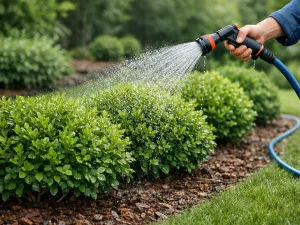
Many shrubs do poorly when they receive frequent, shallow watering, because it keeps roots close to the surface. As a result, plants become less stable and more likely to suffer during hot, dry weather. A better method is to water more deeply and less often so moisture reaches farther into the soil and roots grow downward. Paying attention to timing, water volume, and soil conditions helps shrubs develop stronger, more resilient root systems.
Why shallow roots develop with improper watering

Shrubs respond to the way water moves through the soil. When moisture stays near the surface, roots have little reason to travel downward. The plant simply builds most of its feeder roots where water is easiest to find, which often means the top 5 to 10 cm (2 to 4 in) of soil. That creates a root system that dries quickly, le-heaves more easily in winter, and struggles in hot weather.
Improper watering usually means either frequent light watering or water that never penetrates deeply enough. A quick sprinkle may dampen mulch and the upper soil layer, but it rarely reaches the depth where shrubs need stable moisture. Over time, the plant adapts to that pattern. The result is not a “lazy” shrub, but one shaped by the conditions it has been given.
How surface watering changes root behavior
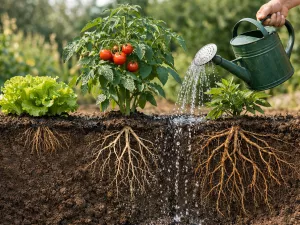
Roots grow toward oxygen, moisture, and workable soil. In most garden soils, the best balance of those factors can exist deeper down if watering is thorough. But if irrigation is shallow and frequent, the upper layer becomes the most dependable moisture zone. Fine roots then concentrate there, especially during the establishment period.
- Frequent light watering: Encourages roots to remain close to the surface because moisture is repeatedly available there.
- Short irrigation cycles: Wet the top layer but leave the root ball and surrounding soil dry below.
- Watering only around the trunk base: Limits lateral root spread and creates a small, weakly anchored root area.
- Relying on rain alone after planting: Can be too inconsistent to draw roots outward and downward, especially in dry spells.
Why shallow-rooted shrubs are less resilient
A shallow root system is more exposed to temperature swings and rapid drying. On a warm, breezy day, the top few centimeters of soil can lose moisture fast, even if the soil below is still damp. Shrubs with most of their roots near the surface often wilt sooner, need more frequent irrigation, and may show leaf scorch during summer stress.
Anchoring is another issue. While many shrubs naturally have broad rather than very deep root systems, they still need roots distributed through a wider and deeper soil profile to stay stable. A plant with roots concentrated in a thin upper layer is more vulnerable to leaning after heavy rain, wind, or repeated freeze-thaw cycles.
Editor’s note: If a shrub seems thirsty every day in summer, do not assume it needs more frequent watering. Often it needs slower, deeper watering so the root zone extends beyond the surface layer.
How shrubs form root systems over time

Shrub roots do not develop all at once. They expand in stages, and watering should match those stages. A newly planted shrub begins with the root mass it had in its container or field-grown root ball. During the first season, the main goal is to help roots move out into surrounding soil. Later, the aim shifts toward building a broader, stronger network that can support the plant through dry periods without constant attention.
This process is influenced by species, soil texture, drainage, temperature, and planting method. Even drought-tolerant shrubs need regular moisture while establishing. What changes over time is not whether they need water, but how often and how deeply that water should be applied.
The establishment phase
For the first several months after planting, roots are mostly confined to the original root ball and just beyond it. That area dries faster than undisturbed garden soil, especially if the shrub was root-bound in its pot. Watering must be directed to the root ball and the surrounding backfill so roots are encouraged to cross the boundary into native soil.
During this stage, a shrub often benefits from deeper watering every few days rather than daily splashing. The exact interval depends on weather and soil, but the principle stays the same: keep the root zone evenly moist, not constantly soggy.
The expansion phase
Once new roots begin spreading beyond the planting hole, the shrub becomes more self-sufficient. This is when watering should gradually cover a wider area and happen less often. The plant now needs moisture not just at the center, but farther out where new feeder roots are exploring.
- Year 1: Focus on consistent moisture through the original root area and just outside it.
- Year 2: Water a wider ring around the plant to support lateral spread and stronger anchoring.
- After establishment: Shift toward occasional deep irrigation during dry periods rather than routine shallow watering.
What mature shrubs usually look for in the soil
Most established shrubs develop a root system that is wider than the branch spread and concentrated in the upper to middle soil layers, not extremely deep like a taprooted tree seedling. Still, “not deep” does not mean “surface-only.” Healthy shrubs often occupy the top 20 to 45 cm (8 to 18 in) of soil with roots distributed through that zone, depending on species and soil conditions.
That distribution matters. A shrub with roots spread through 30 cm (12 in) of soil handles drought better than one using only the top 8 cm (3 in). The deeper profile stays cooler and more evenly moist, and that gives the plant a larger reserve to draw from between waterings.
Best watering methods to encourage deeper roots

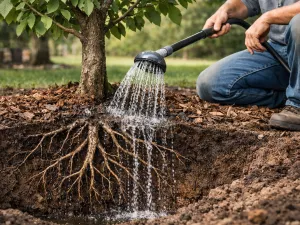
The best method is one that wets the root zone thoroughly without causing runoff. For most shrubs, that means applying water slowly enough that it soaks in rather than racing away from the base. A deep soak trains roots to occupy more of the soil profile, while a quick spray only rewards surface growth.
Method matters because different tools deliver water at different speeds. Fast delivery can be wasteful on compacted or sloped ground. Slow delivery gives the soil time to absorb moisture and reduces the chance that only the mulch gets wet.
Methods that work well
These approaches are especially useful because they can be controlled and repeated consistently. The goal is not just to water, but to water in a way that reaches the active root zone.
- Soaker hose: Good for shrub borders and hedges. Run it long enough to moisten soil to roughly 15 to 25 cm (6 to 10 in) deep for young shrubs, or deeper for established ones.
- Drip irrigation: Useful where water conservation matters. Place emitters around the root zone rather than directly against the stem.
- Slow hose trickle: Effective for individual shrubs. Let water run at a low flow for 20 to 60 minutes, depending on soil type and plant size.
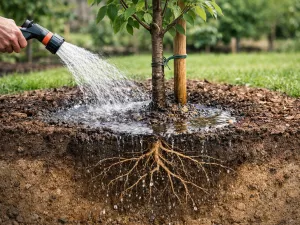
- Watering basin: A shallow ring around a newly planted shrub helps hold water in place so it sinks down instead of spreading away.
Methods that often fall short
Some common habits look helpful but do little for root depth. Overhead sprinklers, for example, may wet foliage and the top layer of soil while failing to recharge the deeper root zone. Hand watering can work well, but only if it is slow and sustained long enough to penetrate.
A useful test is to check the soil after watering. Push a trowel or soil probe into the ground 15 to 20 cm (6 to 8 in) from the stem. If moisture has reached only the top few centimeters, the method or duration needs adjustment.
Practical recommendation: After a deep watering, wait 30 minutes and then inspect the soil. This simple pause gives water time to move downward and tells you more than watching the surface ever will.
Matching method to soil type
Different soils absorb water at different rates. The same watering routine can be too little in sand and too much in clay. Matching the delivery method to the soil helps roots develop evenly instead of clustering where moisture briefly lingers.
| Soil type | How water moves | Best approach | What to watch for |
|---|---|---|---|
| Sandy soil | Drains quickly and dries fast | Use slower, longer watering and check depth often | Water may pass below young root zones if applied too fast |
| Loam | Balances drainage and moisture retention | Deep watering at moderate intervals works well | Do not assume rainfall always reaches the full root zone |
| Clay soil | Absorbs slowly but holds moisture longer | Apply water very slowly, sometimes in two shorter sessions | Runoff and waterlogging if too much is applied at once |
| Compacted soil | Resists infiltration and limits root movement | Use slow soaking and improve soil structure over time | Surface pooling can hide dry soil below hard layers |
How to space watering to promote root depth

Spacing matters as much as volume. Roots grow best when the soil has a cycle of moisture followed by slight drying, not constant saturation. If water arrives too often, oxygen levels in the soil fall and roots stay near the easiest moisture source. If it arrives too rarely during establishment, fine roots die back before they can expand. The right interval encourages roots to search farther between waterings.
There is no universal schedule because weather and soil change the pace of drying. Still, the pattern should move from more frequent support after planting to less frequent, deeper soaking as the shrub establishes.
A practical spacing strategy
For many newly planted shrubs, watering every 3 to 5 days in mild weather is more useful than a daily splash. In hot, windy periods, that may tighten to every 2 to 3 days. In cool weather or heavier soil, it may stretch longer. The important part is checking the root zone before watering again rather than following the calendar blindly.
- Water deeply enough to moisten the root ball and nearby soil.
- Wait until the top few centimeters have begun to dry, while deeper soil remains slightly moist.
- Check moisture 10 to 15 cm (4 to 6 in) down with a trowel or finger.
- Water again before the root zone becomes fully dry during the establishment period.
- Gradually increase the interval as the shrub shows steady growth and less midday stress.
Seasonal adjustments
Spring and autumn usually require less frequent irrigation than midsummer because evaporation is lower and natural rainfall is often more useful. During heat waves, even established shrubs may need a deep soak once or twice a week. In contrast, cool-season watering may be needed only every 7 to 14 days, depending on rainfall and soil.
Mulch helps here by slowing surface evaporation. A layer of 5 to 8 cm (2 to 3 in) of organic mulch can make the spacing between waterings more effective because more moisture remains available below the surface. Keep mulch a few centimeters away from the stems, about 5 cm (2 in), to reduce rot risk.
Editor’s note: If you are unsure whether to water, check the soil first thing in the morning. Midday heat can make leaves droop temporarily even when the root zone still has enough moisture.
Soil conditions that support strong root anchoring

Watering alone cannot build a strong root system if the soil is hostile to root growth. Shrubs anchor best in soil that drains well, contains enough air, and allows roots to move outward without hitting hard barriers. Good soil structure encourages both moisture retention and oxygen exchange, which is exactly what roots need to branch and strengthen.
Many shallow-rooting problems blamed on watering are actually a combination of poor irrigation and poor soil conditions. If the ground stays soggy, dries like dust, or is compacted into a hard layer, roots remain restricted no matter how carefully you water.
Physical conditions that matter most
Roots need pores in the soil. Large pores let excess water drain and bring in oxygen; smaller pores hold moisture the plant can use later. A balanced soil has both. Heavy foot traffic, repeated digging when wet, and construction activity can crush those spaces and leave shrubs with a dense, airless rooting area.
- Good drainage: Prevents roots from sitting in water, which can lead to rot and weak growth.
- Loose structure: Allows new roots to penetrate beyond the planting hole.
- Organic matter: Improves both moisture retention and aeration in many soils.
- Stable moisture: Supports fine feeder roots, which do most of the water uptake.
- Correct planting depth: A root flare buried too deeply can reduce oxygen around the base and limit healthy root spread.
Soil chemistry and root strength
While physical structure matters most for anchoring, soil chemistry also plays a role. Extremely acidic or alkaline soil can limit nutrient uptake, which weakens overall plant growth and root development. Shrubs also need balanced feeding. Excess nitrogen can push soft top growth faster than the roots can support it, especially if watering is shallow.
A moderate feeding plan is usually better than heavy fertilizing. If growth is pale or slow, a soil test gives better guidance than guessing. Healthy roots depend on the whole environment, not just one input.
Improving difficult soil without harming roots
Established shrubs should not have their root zones heavily dug over. Instead, improve conditions gradually from the surface. Top-dressing with compost, refreshing mulch, and preventing compaction are safer long-term strategies than aggressive cultivation around the plant.
Where drainage is poor, it may be better to redirect runoff or plant on a slight mound 10 to 20 cm (4 to 8 in) high rather than trying to solve everything with more water. In very dense clay, splitting irrigation into two cycles with a pause between them often improves infiltration and reduces runoff.
Signs shrubs have developed healthy root systems

You rarely see the roots directly, so you learn to read the plant above ground. A healthy root system shows up as steadier growth, better drought tolerance, and stronger anchoring. The shrub does not need constant watering to stay turgid, and it resumes growth well after seasonal stress. These signs are more reliable than assuming age alone means the plant is established.
Root health is best judged by patterns over time. One good week does not mean the root system is strong, but a season of stable performance usually does.
Above-ground clues to look for
Well-rooted shrubs usually hold their leaves better between waterings and recover faster after hot afternoons. New growth appears in normal proportion to the plant, and the canopy fills evenly rather than only at the tips. The plant also feels more secure in the ground, with little movement at the base once established.
- Reduced wilting: Leaves stay firm longer during warm weather.
- Even growth: Shoots develop across the shrub, not just on one side or at the outer edges.
- Improved drought response: The plant can go longer between deep waterings without severe stress.
- Firm anchoring: The shrub does not rock easily in the soil after wind or rain.
- Healthy leaf size and color: Foliage matches the species and season without chronic scorch or undersized leaves.
How to confirm without disturbing the plant
You do not need to dig up roots to assess progress. Instead, monitor how quickly the soil dries, how the plant responds to a longer interval between waterings, and whether new growth continues through the season. If a shrub remains stable after a deep watering every 7 days in moderate summer weather, that often suggests roots are occupying a useful volume of soil.
Another clue is where the soil stays moist. If water applied in a broad ring around the shrub is being used effectively, the plant is likely rooting beyond the original planting hole. That is a good sign of establishment and stronger anchoring.
Common mistakes that lead to weak shallow roots
Most shallow-root problems come from a few repeated habits rather than one dramatic error. Gardeners often water too little at one time, too often, or in too small an area. Others unintentionally create poor rooting conditions by overmulching, planting too deeply, or compacting the soil around the shrub. These mistakes are common because the plant may look fine for a while before stress shows up.
The good news is that many of these issues can be corrected. Shrubs can often be retrained toward better rooting if watering is adjusted and soil conditions improve.
Watering errors
These are the most direct causes of surface-root dependence. They tend to keep moisture in the wrong place or at the wrong frequency.
- Daily light watering: Keeps only the top layer moist and discourages deeper exploration.
- Stopping too soon: Surface looks wet, but the root zone below remains dry.
- Watering only at the stem: Prevents roots from spreading outward where they should anchor.
- Ignoring rainfall quality: A brief shower may wet mulch but not recharge the soil deeply enough to skip irrigation.
Planting and soil mistakes
Even a good watering schedule cannot fully compensate for poor planting technique. A shrub set too deep, circling roots left uncorrected, or soil packed tightly around the root ball can all restrict normal root development. In compacted soil, roots may turn sideways and remain close to the surface because that is the only zone with enough oxygen.
- Planting too deep: Reduces oxygen near the crown and can slow root spread.
- Leaving root-bound plants untouched: Circling roots may continue to wrap instead of growing outward.
- Piling mulch against stems: Holds excess moisture at the base and can encourage stem problems rather than healthy rooting.
- Heavy foot traffic over the root zone: Compresses soil and limits both water infiltration and root expansion.
Care practices that indirectly weaken roots
Some problems come from trying to help too much. Overfeeding with high-nitrogen fertilizer can produce lush top growth that demands more water than the roots can supply. Severe pruning at the wrong time can also upset the balance between top and root growth. Likewise, placing thirsty annuals right over the shrub root zone may increase competition for surface moisture and encourage more frequent shallow watering.
The strongest long-term approach is simple: water deeply, widen the wetted area as the shrub establishes, protect soil structure, and let the plant adapt to a sensible interval between soakings. That combination builds a root system that is broader, steadier, and far less dependent on constant attention.