Watering Plants According to Root System Depth

 Here we how root depth affects watering needs, including the different water use of shallow and deep roots. It also explains how to adjust watering so moisture reaches the full root zone, how soil changes water access, signs of correct depth, and common mistakes.
- Why root depth determines watering needs
- How shallow and deep roots use water differently
- Adjusting watering techniques based on root structure
- How to ensure water reaches the full root zone
- Soil conditions that affect root moisture access
- Signs plants are receiving water at the correct depth
- Common mistakes when watering without considering roots
Watering is most effective when it matches the depth of a plant’s roots, since moisture levels can vary a lot between the soil surface and deeper layers. Plants with shallow roots usually do best with lighter, more frequent watering to keep the upper soil from drying out. Deep-rooted plants need slower, deeper soaking that reaches the full root zone, supports steady moisture, and helps promote stronger, healthier growth over time.
Why root depth determines watering needs

A plant’s root depth tells you where it actually drinks. Water sitting near the surface may briefly dampen the soil, but that does not mean the plant has access to enough moisture. A shallow-rooted plant depends on the top few centimeters of soil, while a deep-rooted plant is built to draw water from much farther down. That difference changes how often you water, how long you water, and how carefully you need to check moisture below the surface.
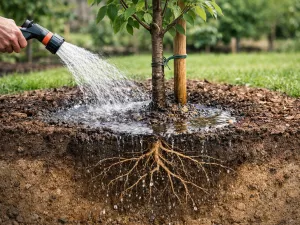
Root depth also affects how quickly a plant feels stress. The upper layer of soil dries first because it is exposed to sun, wind, and heat. Plants with roots concentrated in the top 5 to 15 cm (2 to 6 in) can go from adequately moist to dry very quickly. By contrast, plants with roots reaching 30 to 60 cm (12 to 24 in) or more can often tolerate longer gaps between waterings because deeper soil stays cool and damp for longer.
Why surface moisture can be misleading
Many watering mistakes happen because gardeners judge moisture by appearance alone. A damp-looking surface can hide dry soil underneath, especially in compacted beds, containers, or mulched areas where only the top layer was lightly watered. The reverse can also happen: the top may look dry while deeper soil still holds enough moisture for established plants.
This is why root depth matters more than surface appearance. The goal is not simply to wet the ground. The goal is to moisten the part of the soil profile where the active roots are growing and feeding.
- Seedlings and annuals: Usually rely on a smaller, shallower root zone and need more frequent checks.
- Shrubs and established perennials: Often benefit from slower, deeper watering that reaches farther down.
- Trees: Need moisture distributed over a broad and often deep root area rather than a quick soak at the trunk.
Root depth changes with age and conditions
Plants are not fixed in one pattern forever. Young plants usually begin with a limited root system, so they need closer attention. As they establish, roots spread and descend, allowing the plant to use water stored deeper in the soil. Soil texture, drainage, container size, and planting method all influence how deep those roots can go.
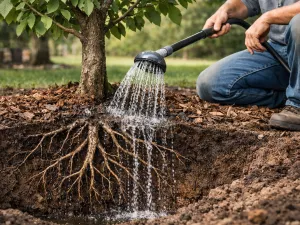
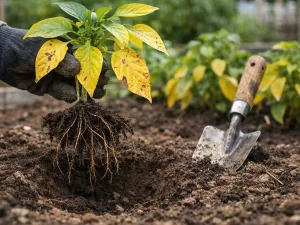
Editor’s note: If you are unsure how deeply a plant roots in your garden, dig a small test hole near the drip line after watering. Seeing where the moisture stops often explains why a plant still looks thirsty.
When watering matches root depth, plants become more stable, less stressed in hot weather, and less dependent on constant shallow irrigation. That is the basis of efficient watering in both garden beds and containers.
How shallow and deep roots use water differently

Shallow and deep root systems do not just sit at different levels in the soil; they use water in different ways. Shallow roots are quick to absorb recent rainfall or irrigation, but they are also quick to dry out. Deep roots access a larger reservoir of moisture, so they usually support steadier growth between waterings. Understanding this difference helps explain why two plants growing side by side may need very different care.
Shallow-rooted plants
Plants with roots concentrated near the surface tend to respond fast to changing weather. A warm, breezy day can remove a surprising amount of moisture from the top 5 to 10 cm (2 to 4 in) of soil. Lettuce, many bedding annuals, and recently planted flowers often fall into this group. They usually need smaller amounts of water more often, especially in sandy soil or containers.
Because their roots occupy the most vulnerable layer of soil, shallow-rooted plants are more affected by mulch gaps, reflected heat from paving, and competition from neighboring plants. Even a light feeding schedule matters here, since nutrients in the upper layer can wash through quickly if watering is too frequent.
Deep-rooted plants
Plants that develop deeper roots use water more slowly but more thoroughly. Many shrubs, vines, established perennials, and trees perform best when the soil is soaked deeply and then allowed to partly dry before the next irrigation. This pattern encourages roots to continue growing downward rather than clustering near the surface.
Deep-rooted plants often cope better with short dry spells, but they are not immune to poor watering. Frequent light sprinkling can leave their lower root zone dry while encouraging weak surface rooting. That can reduce drought tolerance over time.
Practical comparison
The contrast is easiest to understand when you look at how each root type interacts with the soil.
| Root type | Typical water use pattern | Main risk | Best general approach |
|---|---|---|---|
| Shallow roots | Use moisture from the upper soil layer soon after watering | Drying out quickly in heat or wind | Check often and water enough to moisten the top root zone evenly |
| Moderate roots | Draw from both upper and mid-level soil | Uneven watering that wets only the surface | Water thoroughly, then wait until the upper layer begins to dry |
| Deep roots | Rely on moisture stored lower in the ground | Chronic shallow watering that never reaches active roots | Apply water slowly and deeply over a wider area |
| Mixed root systems | Use surface moisture for quick uptake and deeper reserves during dry periods | Inconsistent watering that swings between soggy and bone dry | Maintain even soil structure and adjust timing with weather |
When you recognize which pattern a plant follows, watering becomes more precise. You stop reacting only to wilt and start managing the actual root environment.
Adjusting watering techniques based on root structure

Once you know where roots are growing, you can choose a watering method that fits the plant instead of using the same routine everywhere. The right technique is not just about convenience. It determines whether water soaks in gradually, runs off the surface, or bypasses the root zone entirely.
Matching method to plant type
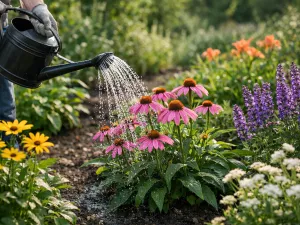
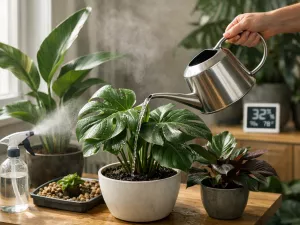
Shallow-rooted plants usually do best with controlled, even moisture. In beds, that may mean a gentle shower from a watering can or hose wand that wets the top layer without blasting the soil away. In containers, it often means watering until excess drains from the bottom, then checking again before the mix becomes fully dry.
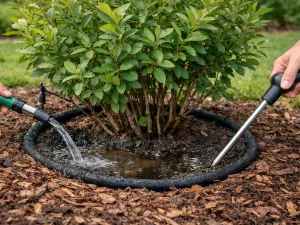
Deeper-rooted plants usually respond better to slower delivery. A soaker hose or drip line gives water time to move downward rather than spreading across the surface. For shrubs and trees, a longer soak around the drip line is generally more useful than a quick spray near the stem.
- Watering cans and hose wands: Useful for seedlings, herbs, and small ornamentals where precision matters.
- Soaker hoses: Good for borders and vegetable rows because they wet the soil steadily with little splash.
- Drip irrigation: Effective for shrubs, fruiting plants, and mixed beds when emitters are placed over the active root area.
- Basins or slow-fill rings: Helpful for young trees that need water directed into the surrounding root zone.
Changing frequency and duration
Root structure should guide not only how you water, but also how long and how often. Frequent short sessions suit plants with limited roots in fast-drying soil. Longer intervals with deeper soaking suit established plants that can draw from below. If you water every plant on the same schedule, some will stay too wet while others remain thirsty.
Feeding and pruning also affect this balance. A heavily pruned plant often uses less water for a short period because it has less leaf area. A fast-growing, recently fed plant may use water more quickly, especially in warm weather above 25°C (77°F). Watering should follow growth stage, not just the calendar.
Practical tip: After switching to deeper, less frequent watering, expect a short adjustment period. Plants that were used to daily surface moisture may look slightly less lush at first while roots begin exploring lower soil.
Special cases: containers, raised beds, and new plantings
Containers and raised beds behave differently from in-ground plantings because they dry faster and have a limited root volume. Even plants that are naturally deep-rooted cannot form the same root depth in a pot. That means they often need more frequent irrigation than the same species planted in open ground.
New plantings are another exception. Until roots spread into surrounding soil, the original root ball is the main zone that must stay evenly moist. Watering should target that area first, then gradually expand outward as the plant establishes.
How to ensure water reaches the full root zone

Getting water to the full root zone requires more than adding a larger amount. The soil must absorb it at a rate that allows moisture to move down instead of running off or collecting in one pocket. This is especially important for larger perennials, shrubs, and trees, where the active roots may extend well beyond the visible base of the plant.
Water slowly enough for infiltration
Fast watering often wastes water. On sloped ground, dry soil, or compacted beds, heavy flow can move sideways before it ever penetrates deeply. Slower application gives capillary movement and gravity time to pull moisture into the profile. If water puddles for long periods, pause and let it soak in before continuing.
For many garden beds, a deep watering session is more effective when split into two passes. Water once, wait 10 to 15 minutes, then water again. This helps dry soil rehydrate more evenly and reduces runoff.
Check the depth instead of guessing
The simplest way to verify success is to inspect the soil after watering. Push a trowel, wooden dowel, or moisture probe into the ground. If the tool meets dry resistance below the surface, the watering did not go far enough. For many established ornamentals, you want moisture to reach at least 15 to 20 cm (6 to 8 in), and for shrubs or young trees often 20 to 30 cm (8 to 12 in), depending on species and soil.
- Water the plant slowly and thoroughly.
- Wait a few minutes for movement through the soil.
- Check moisture depth near, but not directly against, the stem.
- Repeat farther out toward the drip line for larger plants.
- Adjust the next session based on how deep the moisture actually reached.
Cover the whole feeding area
Roots rarely stay packed tightly under the stem. On established plants, the most active feeding roots are often farther out, where rain naturally falls from the canopy edge. Watering only at the base can leave much of the root system dry. This is a common problem with shrubs and trees that receive a quick soak at the trunk but no moisture where the feeder roots are working.
Mulch can help by slowing evaporation and keeping soil open, but it should not be piled against stems. A layer of 5 to 8 cm (2 to 3 in) spread over the root area is usually enough to support more even moisture without trapping excess wetness around the crown.
Soil conditions that affect root moisture access

Root depth alone does not determine how easily a plant can use water. Soil texture, structure, organic matter, and drainage all influence whether moisture remains available or becomes inaccessible. Two plants with similar roots may behave very differently if one grows in loose loam and the other in compacted clay.
Texture changes how water is stored
Sandy soil drains quickly and contains larger pore spaces, so water moves down fast but is not held for long near the roots. Clay soil holds more water, but if it is dense, roots may struggle to penetrate it and oxygen levels can drop after overwatering. Loam sits in the middle, usually offering the best balance of drainage and retention.
This means root depth must always be interpreted through the soil type. A shallow-rooted plant in sand may need frequent irrigation, while the same plant in loam may need much less. A deep-rooted shrub in heavy clay may never fully exploit depth if the lower soil stays compacted and airless.
Structure and compaction matter as much as texture
Compacted soil limits both root growth and water movement. Water may pool on top or travel through cracks and leave surrounding soil dry. In these conditions, plants can suffer from drought stress even after watering because the moisture distribution is uneven.
- Compaction: Restricts root spread and reduces oxygen around roots.
- Low organic matter: Makes soil less able to hold a steady supply of moisture.
- Hydrophobic dry soil: Causes water to bead up and run off instead of soaking in.
- Poor drainage: Keeps roots too wet, especially in cool weather.
Using amendments and surface care wisely
Improving soil is often more effective than simply watering more. Compost helps many soils by increasing moisture retention in sandy ground and improving structure in heavier soils. A topdressing of organic matter and regular mulching can gradually create a root zone that stays evenly moist for longer.
Editor’s note: If a bed dries out unusually fast despite regular watering, do not assume the plant is “extra thirsty.” Check whether roots are crowded, the soil is compacted, or irrigation is only wetting one narrow channel.
Light exposure also interacts with soil conditions. A plant in full sun with reflective heat from walls or paving will lose moisture faster than one in bright shade, even in the same soil. Good watering practice always combines root depth, soil behavior, and site conditions.
Signs plants are receiving water at the correct depth

When watering reaches the right depth, plants usually show a steadier pattern of growth rather than dramatic swings between wilt and recovery. Leaves remain firm through the warmest part of the day, new growth is proportionate, and the soil does not stay soggy at the surface while deeper layers remain dry. The signs are often subtle but consistent.
What healthy moisture balance looks like
A well-watered root zone supports even uptake of both water and nutrients. That usually means fewer scorched leaf edges, less flower drop during warm spells, and stronger resistance to temporary heat stress. In edible gardens, crops often develop more evenly when roots can access moisture below the surface instead of relying on daily shallow wetting.
Growth should look active but not overly soft. Constantly saturated surface soil can push weak, lush growth that is more vulnerable to pests and disease. Correct-depth watering tends to produce sturdier stems and a more resilient plant overall.
Useful signs to watch for
Instead of focusing on one symptom, look for a pattern over several days or weeks.
- Leaves stay turgid: Foliage remains firm into the afternoon, not just in the morning.
- Soil dries gradually: The top layer begins to dry while deeper soil still feels lightly moist.
- Roots spread outward: Plants establish faster and anchor more securely in the ground.
- Fewer watering emergencies: Plants do not collapse suddenly after one warm day.
- Balanced growth: New leaves and shoots are normal in size, not stunted or excessively soft.
How to confirm with simple checks
Visual signs are helpful, but direct checks are better. Insert a finger, probe, or narrow trowel to compare surface and lower moisture. In containers, lift the pot before and after watering to learn the weight difference. In beds, inspect several points around the plant because one wet spot can give a false impression.
If the plant is receiving water at the correct depth, you should find a moist but not saturated zone where the active roots are concentrated. Over time, the plant should need fewer rescue waterings and show more consistent performance between irrigation sessions.
Common mistakes when watering without considering roots
Most watering problems come from treating every plant and every soil the same. When root structure is ignored, gardeners often respond to symptoms rather than causes. A wilted plant gets more water, a dry-looking surface gets another quick spray, and a struggling shrub is watered at the trunk again. These habits can keep the real root zone either too dry or too wet.
Frequent shallow watering
This is one of the most common mistakes. Light daily watering may keep the surface dark and cool, but it often encourages roots to remain near the top where conditions fluctuate most. Plants become dependent on constant attention and less able to tolerate heat or missed watering days.
Shallow watering is especially unhelpful for shrubs, climbers, and trees that should be developing a broader, deeper root system. It can also increase weed growth because weed seeds thrive in repeatedly damp surface soil.
Watering by schedule alone
A fixed routine such as “every evening” or “twice a week” sounds organized, but it ignores weather, soil, and plant stage. Cool cloudy periods reduce water use, while wind and active growth increase it. A schedule can be a starting point, but it should never replace checking the root zone.
Missing the actual feeding roots
Another mistake is placing all the water too close to the stem. For many mature plants, the most active roots are farther out. Watering only at the base can leave the wider root system dry and may even create crown problems if the area around the stem stays wet too often.
- Ignoring mulch and soil crusting: Water may run off before it reaches the root zone.
- Assuming wilt always means drought: Overwatered roots can also cause limp foliage.
- Using the same method for pots and ground beds: Containers dry faster and need different timing.
- Failing to adjust after planting: New transplants need targeted moisture until roots spread outward.
Correcting the pattern
The solution is usually simple: water with purpose, then verify results. Match the method to the plant, apply water slowly enough to penetrate, and check how deep the moisture actually goes. Also consider pruning, feeding, and sun exposure, since all three affect water demand. A heavily flowering plant in full sun will not behave like a recently cut-back perennial in partial shade.
When watering is guided by the root system rather than habit, plants become easier to manage. You use less water, reduce stress, and build stronger root growth that supports healthier plants through changing weather.