How to Water Perennials for Stable Seasonal Growth

 Here we how to water perennials through the year. It explains why steady watering matters, how roots develop over time, how to adjust watering in active growth and dormancy, how seasons and soil affect moisture, the best deep-watering methods, signs of proper hydration, and common mistakes.
- Why perennials need consistent watering across seasons
- How perennial root systems develop over time
- Adjusting watering frequency during active and dormant phases
- How seasonal changes affect moisture needs in perennials
- Best watering techniques for deep and stable root growth
- Soil conditions that support long-term perennial health
- Signs perennials are receiving proper hydration
- Common mistakes when watering perennials throughout the year
Maintaining the right level of moisture throughout the growing season helps perennial plants develop evenly, bloom reliably, and come back stronger year after year. Too little water can slow root growth and stress leaves, while too much can weaken plants and encourage rot. Rather than following a rigid schedule, it is better to watch conditions closely, since weather, soil type, and plant maturity can all shift from spring through fall.
Why perennials need consistent watering across seasons

Perennials are often described as low-maintenance because they return year after year, but that does not mean they can thrive on neglect. Their long-term performance depends on steady moisture patterns that support root health, leaf production, flowering, and recovery after stress. Unlike annuals, which complete their life cycle in one season, perennials must carry stored energy from one growing period into the next, so repeated swings between drought and saturation can weaken them over time.
Consistent watering does not mean giving the same amount every week regardless of weather. It means keeping soil moisture within a healthy range so plants are not repeatedly forced to shut down growth, drop buds, or sacrifice root development. A perennial that receives even moisture in spring, summer, autumn, and winter is better able to maintain strong crowns, resist pests, and survive temperature extremes.
Why stability matters more than occasional heavy watering
Many gardeners try to make up for dry spells with a single drenching. While a deep soak can help, a cycle of severe drying followed by flooding is hard on roots. Fine feeder roots die back in dry soil, then struggle in waterlogged conditions if drainage is poor. The result is uneven growth above ground and a plant that looks older and weaker before its time.
- Steady moisture supports regular nutrient uptake, especially nitrogen, potassium, and trace minerals.
- Balanced hydration helps stems stay firm and allows flower buds to develop without aborting.
- Reduced stress lowers the chance of leaf scorch, premature dormancy, and poor winter preparation.
- Healthier crowns are less likely to rot or split when soil conditions remain predictable.
Seasonal continuity protects long-term vigor
A perennial does not stop needing care when flowering ends. Moisture in late summer and autumn helps the plant rebuild reserves in roots and crowns. Winter watering can also matter in regions with dry cold winds, especially where soil stays unfrozen for long periods. The goal is not constant wetness, but a dependable environment that lets the plant shift naturally from active growth to rest and back again.
Editor’s note: A plant that “survives” on rainfall alone is not always thriving. If flowering gets shorter each year or clumps stop expanding, inconsistent moisture is often part of the problem even when the plant is still alive.
How perennial root systems develop over time

Understanding how roots change as a perennial matures makes watering decisions much easier. Newly planted specimens rely on a limited root ball and a small ring of surrounding soil. Established plants, by contrast, often spread roots well beyond the visible crown. Their ability to handle dry periods improves with age, but only if early watering encourages roots to move downward and outward instead of staying near the surface.
Root development is not uniform across all perennial types. Fibrous-rooted plants such as coreopsis and asters tend to fill the upper soil layers quickly, while fleshy-rooted or tuberous plants such as daylilies and peonies store moisture and energy differently. Deep-rooted species can access water lower in the profile, but they still need support while they are establishing.
Early establishment versus mature growth
During the first growing season, roots are concentrated near the original planting hole. That area dries faster than surrounding ground, particularly in raised beds or sandy soil. Frequent checks are important until the plant begins producing new top growth and shows signs of anchoring firmly in place.
By the second or third year, many perennials can draw from a broader soil volume. At that stage, less frequent but deeper watering is usually better than shallow irrigation. Deep moisture encourages roots to follow water downward, which improves resilience during summer heat and reduces dependence on daily attention.
How root type influences watering style
Different root structures respond differently to the same watering routine. Matching irrigation to the plant’s natural habit prevents both under-watering and root rot.
- Fibrous roots prefer evenly moist upper soil and benefit from mulch that slows evaporation.
- Taprooted perennials need deep watering that penetrates well below 15 cm (6 in), especially while young.
- Rhizomatous plants spread laterally and can suffer if only the center of the clump is watered.
- Fleshy-rooted types store moisture, so they often need fewer waterings but better drainage.
Feeding and pruning also affect root growth. Too much high-nitrogen fertilizer can push soft top growth before roots are ready to support it. Hard cutting back during heat or drought may reduce water demand temporarily, but it can also interrupt energy storage if done repeatedly. Healthy root systems develop best when watering, feeding, and grooming are handled as one connected care routine.
Adjusting watering frequency during active and dormant phases

Perennials do not use water at the same rate all year. When shoots are emerging, leaves are expanding, and flower stems are forming, demand rises quickly. During dormancy, water use drops because there is little or no active top growth. The challenge is to reduce watering without letting roots become dust-dry for long periods, especially in containers, under eaves, or in regions with dry winters.
Rather than watering by the calendar alone, it helps to observe growth stage, soil texture, and weather together. A cool week in late spring may call for less irrigation than a hot, windy spell in early autumn, even if the date suggests otherwise.
When plants are actively growing
Spring through midsummer is usually the period of strongest demand. New foliage loses moisture rapidly, and flowering requires steady access to water and nutrients. If the soil dries too often during this phase, plants may stay shorter, produce fewer blooms, or develop weak stems that flop.
- Check the top 5 to 8 cm (2 to 3 in) of soil every few days in dry weather.
- Water when the surface is dry but the root zone below is only slightly moist, not bone dry.
- Apply enough water to moisten at least 15 to 20 cm (6 to 8 in) deep for most border perennials.
- Pause before watering again until the upper layer begins drying, so roots still receive oxygen.
When growth slows or stops
After flowering, some perennials continue building roots and storing energy, while others begin a clear rest period. Dormant plants still need some moisture around the crown and roots, but they are much more vulnerable to rot if the soil stays wet. This is especially true for lavender, salvia, yarrow, and other plants that prefer lean, well-drained conditions.
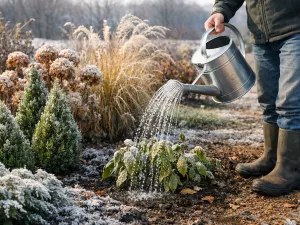
In autumn, reduce frequency gradually rather than stopping abruptly. In winter, water only when the soil is dry below the surface and temperatures are above freezing, ideally earlier in the day. In climates with winter rain, natural precipitation may be enough, but sheltered beds and pots often dry out more than expected.
Practical tip: If a perennial disappears underground for winter, mark its position before the foliage dies back. It is much easier to check soil moisture accurately when you know where the crown actually sits.
How seasonal changes affect moisture needs in perennials

Seasonal shifts change far more than temperature. Day length, sun angle, wind exposure, humidity, and rainfall patterns all affect how quickly soil loses water and how actively roots can absorb it. A watering plan that works in April may be completely wrong by July, and a bed that stays moist in summer shade may dry surprisingly fast once nearby trees lose their leaves.
Gardeners who pay attention to these changes can prevent stress before it shows up in foliage. This is especially important for mixed borders where plants with different moisture preferences grow close together.
Spring and summer demands
In spring, cool air can hide the fact that plants are using more water as they break dormancy. Rainfall may be generous, but windy conditions and fresh top growth can still dry the root zone quickly. By summer, high light levels and heat increase evaporation from both leaves and soil. Flowering perennials in full sun often need the most support during this period, especially in sandy or shallow soils.
Autumn and winter patterns
Autumn often brings lower evaporation, but roots may remain active while soil is still warm. This is a valuable period for deep watering if the season is dry, because it helps plants enter winter in better condition. In winter, moisture needs depend heavily on climate. Mild, dry winters can dehydrate evergreen perennials and newly planted divisions, while cold, wet winters create the opposite risk: saturated soil and crown rot.
| Season | Main moisture concern | Watering focus |
|---|---|---|
| Spring | Rapid new growth outpaces shallow soil moisture | Monitor frequently and water evenly during emergence and bud formation |
| Summer | Heat, wind, and strong sun increase moisture loss | Water deeply and mulch to reduce evaporation |
| Autumn | Dry spells can limit root storage before winter | Maintain moderate moisture without keeping crowns soggy |
| Winter | Either hidden drought or excess wetness, depending on climate | Water sparingly only when needed and ensure drainage stays open |
Light exposure also changes with the seasons. Beds that are shaded in summer may receive full winter sun, while deciduous tree roots can compete strongly for moisture in late spring and early autumn. Feeding should be adjusted accordingly: heavily fertilized plants in hot weather often need more water to support the extra growth, which can create avoidable stress if irrigation is not increased to match.
Best watering techniques for deep and stable root growth

The best way to water perennials is to deliver moisture slowly enough that it sinks into the root zone instead of running off or evaporating. This encourages roots to grow deeper, where soil stays cooler and more stable. Deep-rooted plants are generally less prone to wilting, recover faster after hot days, and need less frequent intervention once established.
Technique matters as much as timing. A quick splash from above may wet leaves and the soil surface, but it often fails to reach the depth where roots actually need moisture. Over time, that can train roots to remain shallow and vulnerable.
Methods that improve root depth
Slow application is usually the most effective approach. Soaker hoses, drip lines, or a hose set to a gentle trickle allow water to penetrate without compacting soil or washing mulch aside. Hand watering can work just as well if it is done patiently and directed at the base of the plant rather than over the foliage.
- Soaker hoses are useful in mixed borders because they wet a broad area around clumps.
- Drip irrigation is efficient where plants are spaced clearly and water conservation matters.
- Hand watering gives the most control for new plantings, divisions, and problem spots.
- Watering cans are practical for small beds if applied in repeated passes so water soaks in rather than pooling.
Timing and application depth
Early morning is usually the best time to water. Leaves dry quickly, roots can absorb moisture before afternoon heat, and less water is lost to evaporation. Evening watering is acceptable when mornings are not possible, but avoid soaking foliage overnight if mildew is a recurring issue.
For most established border perennials, aim to wet the soil to at least 15 to 20 cm (6 to 8 in) deep. Larger clumps or deep-rooted species may benefit from moisture reaching 25 to 30 cm (10 to 12 in). You can check depth with a trowel or soil probe after watering. If only the top few centimetres are moist, the session was too brief.
Practical recommendation: Watering in two shorter rounds with a 10-minute pause between them often works better than one long blast. The first pass softens dry soil, and the second lets moisture move deeper instead of running off the surface.
Mulch supports these techniques by reducing evaporation and moderating soil temperature. Keep organic mulch about 3 to 5 cm (1 to 2 in) away from the crown to avoid trapping excess moisture directly against the base of the plant.
Soil conditions that support long-term perennial health

Watering success depends heavily on what happens below the surface. Even perfect scheduling will not compensate for soil that drains too fast, stays waterlogged, or has become compacted. Healthy perennial beds hold enough moisture for roots to use between waterings while still allowing oxygen to reach the root zone. That balance is what supports stable growth over many seasons.
Texture, structure, and organic matter all influence how water behaves. Sandy soil drains quickly and may require more frequent irrigation. Clay retains water longer but can suffocate roots if it remains saturated. Loam with added organic matter is often ideal because it stores moisture without becoming airless.
Improving moisture balance in different soils
Before changing your watering routine, it is worth understanding the soil you already have. A simple squeeze test can reveal a lot: sandy soil falls apart, clay forms a sticky ribbon, and loam holds shape briefly before crumbling. Each type benefits from a different management approach.
- Sandy soil improves with compost that increases water-holding capacity and slows drying.
- Clay soil benefits from organic matter and careful planting height so crowns do not sit in wet pockets.
- Compacted soil needs loosening and top-dressing, because water may either puddle on top or bypass roots through cracks.
- Raised beds warm quickly and drain well, but they usually dry faster and need closer monitoring in summer.
Related care practices that affect watering
Soil health is shaped by more than irrigation. Overfeeding can create lush growth that demands more moisture than the roots can supply. Underfeeding may leave plants too weak to make effective use of available water. Pruning also plays a role: thinning overcrowded clumps improves airflow and reduces competition, while division every few years can restore root vigor in plants that have become congested.
If a bed repeatedly swings from soggy to dry, consider the broader site conditions. Downspouts, overhanging roofs, dense tree roots, and hard-packed paths can all change how water enters and leaves the soil. Stable perennial growth usually comes from matching the plant to the site and then adjusting the soil gradually rather than relying on constant corrective watering.
Signs perennials are receiving proper hydration
Well-watered perennials show more than just the absence of wilt. They grow at a steady pace, hold their leaves with good tension, and produce flowers appropriate to their variety and age. The soil around them feels evenly cool and slightly moist below the surface, not muddy and not powder-dry. Looking for these subtle signs helps you water with more confidence and less guesswork.
Hydration should be judged over time rather than from a single afternoon. Some plants naturally droop in intense heat and recover by evening, while others stay upright even when the root zone is too dry. The most reliable clues come from combining plant appearance with a quick soil check.
Visible indicators of good moisture balance
Healthy hydration supports both top growth and root function. Leaves should look full-sized and appropriately colored, and new stems should emerge without stalling. Flowering may not be constant, but buds should develop cleanly rather than shriveling before opening.
- Leaves remain firm through most of the day, with only mild temporary softening in extreme heat.
- New growth appears regularly during the active season instead of stopping abruptly.
- Blooming is consistent for the plant type, without widespread bud drop.
- Soil is moist below the surface at about 5 to 8 cm (2 to 3 in), while the top may be slightly dry.
- Roots stay healthy when dividing or transplanting, showing pale tips rather than blackened, mushy sections.
How to confirm without overreacting
A moisture meter can be useful, but your hands and eyes are often enough. Push a finger or small trowel into the soil near the edge of the root zone, not directly at the crown. If the soil below the surface feels cool and lightly damp and the plant is growing normally, watering can usually wait. If it is dry to that depth and the plant is slowing, a deep soak is more helpful than a light sprinkle.
Keep in mind that proper hydration also supports other maintenance tasks. Plants that are watered well respond better to light feeding, recover faster from deadheading, and are less likely to suffer transplant shock after division.
Common mistakes when watering perennials throughout the year
Most perennial watering problems come from habits that seem helpful at first. Daily shallow watering, automatic schedules that ignore weather, and treating all species the same can create weak roots and recurring stress. Because perennials stay in place for years, these mistakes have a cumulative effect that may not become obvious until flowering declines or plants start disappearing from the center of the clump.
Avoiding common errors is often more important than finding a perfect formula. Good watering is responsive, not rigid, and it respects the plant’s season, soil, and stage of establishment.
Frequent errors that lead to stress
Many issues begin with either too much water near the surface or too little water at depth. Both can produce similar symptoms, including yellowing leaves and poor growth, which is why checking the soil is essential before making changes.
- Watering lightly every day keeps roots near the surface and increases heat stress.
- Ignoring rainfall and temperature leads to overwatering in cool periods and underwatering in hot, windy ones.
- Soaking crowns repeatedly encourages rot, especially in dense or poorly drained soil.
- Using the same routine for every plant overlooks differences between moisture-loving and drought-tolerant species.
- Letting new plantings dry out in the first season slows establishment and can cause long-term weakness.
- Assuming wilt always means drought may result in adding water to already saturated soil.
How to correct the pattern
If a perennial has been watered poorly for some time, improvement may take a few weeks rather than a few days. Start by checking drainage, adjusting frequency, and watering more deeply but less often. Add mulch where appropriate, divide overcrowded clumps if roots are congested, and avoid heavy feeding until the plant has regained balance.
It also helps to group plants with similar needs. A border that mixes moisture-loving astilbes with drought-tolerant salvias in the same irrigation zone is difficult to manage well. Matching plant choice to site conditions reduces the need for constant correction and makes stable seasonal growth much easier to maintain.
When in doubt, observe before acting. A few minutes spent checking soil depth, crown condition, and recent weather will usually tell you more than a fixed schedule ever can.