Watering Trees to Encourage Deep Root Growth

 Here we why deep watering helps trees build stronger root systems and how roots respond to watering depth. It also explains the best watering methods and timing, the soil conditions that improve deep water penetration, the signs of healthy deep roots, and the common mistakes that lead to shallow rooting.
- Why deep watering is important for tree root development
- How tree roots grow and respond to watering depth
- Best watering techniques to encourage deep root systems
- How often to water trees for strong root growth
- Soil conditions that support deep water penetration
- Signs trees are developing healthy deep roots
- Common mistakes that lead to shallow root systems
How you water a tree strongly influences how deep and wide its roots grow, which affects its ability to withstand heat, wind, and drought. Rather than giving frequent, shallow sprinklings, aim to soak the soil thoroughly so moisture reaches deeper layers and encourages roots to grow downward. This approach helps both young and mature trees become more stable, healthier overall, and less reliant on constant attention.
Why deep watering is important for tree root development

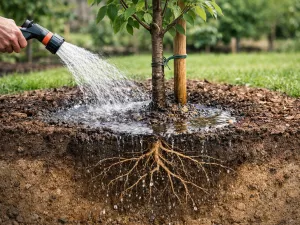
Deep watering encourages a tree to build roots where moisture lasts longer. Instead of concentrating near the surface, roots follow water downward into cooler, more stable soil. That matters because the upper few centimeters of ground can dry quickly in heat, wind, and sun, while lower layers stay usable for much longer.
Trees with deeper root systems usually cope better with summer stress, short dry spells, and temperature swings. They are also less dependent on frequent irrigation. A shallow-rooted tree may look fine after regular light watering, but it often becomes vulnerable as soon as that routine is interrupted.
Why surface watering creates weaker habits
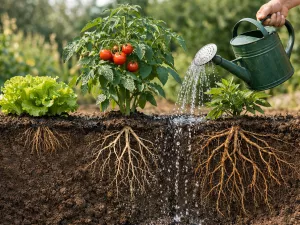
When water is applied lightly and often, the soil surface stays damp while deeper layers remain dry. Roots respond exactly as expected: they stay where the moisture is easiest to reach. Over time, this creates a broad but shallow root zone that dries out fast and needs constant attention.
Shallow roots can also be more exposed to lawn competition, heat reflected from paving, and damage from cultivation. In windy weather, trees with poorly distributed roots may show stress sooner because the topsoil loses moisture first.
- Fast drying: Surface soil can lose water within a day or two in hot conditions.
- Greater competition: Grass and weeds often dominate the same shallow layer.
- Reduced resilience: Trees become more dependent on frequent irrigation.
- Higher stress swings: Moisture levels fluctuate more sharply near the surface.
How deep watering improves long-term stability
A tree that regularly receives water deep into the root zone tends to develop a more balanced underground structure. This does not mean every root grows straight down; many important roots still spread outward. The key is that the active root zone occupies a larger volume of soil, giving the tree access to more stored moisture and nutrients.
Deep watering is especially valuable during establishment. Newly planted trees need consistent moisture to recover from transplanting, but they also need the right pattern of moisture if they are going to root beyond the original planting hole.
Editor’s note: If you only have time for one good watering each week, make it a slow, thorough soak rather than a quick spray. Trees respond more to where the water ends up than to how often the hose appears.
How tree roots grow and respond to watering depth

Tree roots are opportunistic. They expand into parts of the soil where oxygen, moisture, and workable structure are all present. Watering depth strongly influences this pattern because roots proliferate where conditions remain favorable for the longest time. If moisture repeatedly stops at 8-10 cm (3-4 in), much of the feeder root activity will stay in that layer.
Most trees have a combination of larger structural roots and fine feeder roots. The feeder roots do most of the water uptake, and they are the most responsive to irrigation habits. They are also short-lived and constantly replaced, which means your watering routine can shape where new absorbing roots form.
Roots do not simply chase water straight down
A common misunderstanding is that deep watering produces one taproot-like system. In reality, many landscape trees naturally develop wide root systems with important roots in the upper 30-60 cm (12-24 in) of soil. Deep watering still helps, but the benefit comes from encouraging roots to occupy a deeper, broader zone within that range rather than clustering in the top few centimeters.
Soil texture and oxygen levels also affect root placement. In compacted or waterlogged ground, roots may avoid deeper layers even if water is present. In loose, well-drained soil, they are far more willing to colonize lower levels.
How moisture patterns influence feeder root growth
Feeder roots multiply where moisture is reliable but not stagnant. If the soil is soaked and then allowed to drain, roots can use that space effectively. If it stays saturated for too long, oxygen drops and root growth slows. If it dries too quickly, the tree shifts energy into survival rather than expansion.
The table below shows how different watering patterns tend to influence root behavior.
| Watering pattern | Typical moisture depth | Likely root response |
|---|---|---|
| Light daily sprinkling | Often limited to 5-10 cm (2-4 in) | Dense shallow feeder roots, high dependence on frequent water |
| Slow deep soak once or twice weekly | Often reaches 20-40 cm (8-16 in) or more, depending on soil | Broader and deeper active root zone with better drought tolerance |
| Heavy flooding in poorly drained soil | Deep but oxygen-poor | Limited root growth, possible root stress or rot |
| Infrequent but too little volume | Uneven and patchy wetting | Roots stay concentrated where small pockets of water are available |
This is why technique matters as much as schedule. The goal is not just adding water, but placing it where roots can use it and where the soil remains healthy enough to support new growth.
Best watering techniques to encourage deep root systems

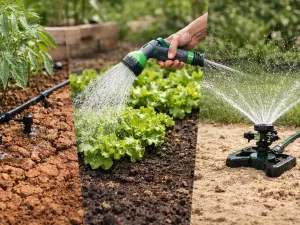
The most effective watering methods for trees are slow and deliberate. You want water to soak in rather than run off. Fast spraying often wets mulch and surface soil but fails to penetrate the full root zone, especially on slopes or compacted ground.
For established trees, the target area is usually wider than the trunk base. Most absorbing roots sit out toward the drip line and beyond, not right against the bark. For newly planted trees, focus first on the root ball and the surrounding backfill, then gradually widen the watering area as roots extend outward.
Methods that work well
Several practical approaches can deliver water deeply without waste. The best choice depends on tree size, soil type, and how much time you can spend monitoring the process.
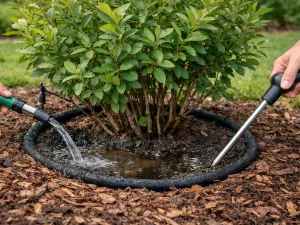
- Soaker hose: Good for slow, even wetting over a broad area. Coil it around the root zone rather than wrapping it tightly against the trunk.
- Drip irrigation: Useful for controlled delivery. Emitters should be placed around the root zone and adjusted as the tree grows.
- Hose on a slow trickle: Simple and effective for individual trees. Move the hose to several points so one spot does not receive all the water.
- Watering bag for young trees: Helpful during establishment, but it should supplement observation rather than replace it. Check that water is soaking into the surrounding soil, not just wetting the immediate planting hole.
How to apply water properly
A deep watering session should be slow enough that the soil absorbs moisture before runoff begins. In many gardens, this means watering for 30-90 minutes depending on flow rate, tree size, and soil conditions. Sandy soil may need a lower volume applied in repeated cycles, while clay may need longer pauses to allow infiltration.
- Pull mulch back slightly if it is packed too tightly, keeping it a few centimeters away from the trunk.
- Start watering at a low flow so the soil darkens gradually rather than puddling immediately.
- Cover several points around the root zone, especially from halfway to the drip line outward.
- After watering, check moisture depth with a trowel or soil probe to see whether water reached at least 20-30 cm (8-12 in) for young trees and often 30-45 cm (12-18 in) for more established ones.
Practical tip: A screwdriver or narrow soil probe is a useful low-tech check. It slides easily into moist soil and stops where the ground is still dry, giving you a quick read on actual penetration.
Avoid blasting water directly at the trunk flare. The goal is to hydrate the root zone, not to keep the bark wet. Consistent deep soaking, followed by a period in which the soil partially dries, usually gives the best signal for roots to expand.
How often to water trees for strong root growth

There is no single watering schedule that fits every tree, because frequency depends on age, weather, soil type, and season. The general principle is simple: water deeply enough to moisten the root zone, then wait until the upper soil begins to dry before watering again. This pattern encourages roots to use a larger volume of soil instead of staying near the surface.
Newly planted trees need more frequent attention than established ones because their roots are still concentrated in a limited area. Mature trees usually benefit from less frequent but more substantial watering, especially during dry periods.
General timing by tree stage
These ranges are starting points, not fixed rules. Always adjust based on rainfall, temperature, wind, and how quickly the soil dries.
| Tree stage | Typical frequency | What to watch for |
|---|---|---|
| Newly planted, first 2-6 weeks | Every 2-4 days in dry weather | Root ball should stay evenly moist but not saturated |
| Newly planted, after initial establishment | About once or twice weekly | Moisture should spread beyond the original planting hole |
| Young trees, second growing season | Every 5-10 days during dry spells | Check soil 15-20 cm (6-8 in) down before watering |
| Established trees | Every 10-21 days in prolonged dry weather | Long, slow soaking is more useful than frequent light watering |
Seasonal adjustments matter
In spring, cool soil and regular rain often reduce the need for irrigation. In midsummer, heat and wind can increase water demand sharply, especially for trees near paving, walls, or lawns. In autumn, trees may still need watering if the weather stays dry, because roots often continue growing while the soil remains above about 7°C (45°F).
Winter watering is sometimes necessary in mild climates or for evergreens during dry, frost-free periods. If the ground is frozen, watering is ineffective because water cannot infiltrate properly.
- Hot weather: Shorten the interval between deep waterings.
- Cool or rainy periods: Extend the interval and check soil before adding more.
- Windy sites: Expect faster moisture loss from leaves and upper soil.
- Mulched root zones: Moisture usually lasts longer, so watering can often be less frequent.
The best schedule is one guided by the soil, not the calendar. If the top few centimeters are dry but the soil below is still moist, it is often better to wait a little longer.
Soil conditions that support deep water penetration

Even the best watering routine will struggle if the soil does not allow water to move downward. For deep root growth, the soil needs a balance of pore space, organic matter, and drainage. Water should infiltrate steadily, spread through the root zone, and leave enough air behind for roots to breathe.
Compacted ground is one of the biggest barriers. In hard soil, water may run off the surface or collect in shallow layers instead of soaking deeper. On the other hand, very sandy soil can drain so quickly that moisture slips beyond the active root zone unless it is applied in measured cycles.
Improving infiltration without harming roots
The safest long-term strategy is to improve the soil surface and reduce stress around the tree rather than digging aggressively through the root zone. A broad mulch layer and gradual addition of organic matter at the surface can make a big difference over time.
- Mulch: Apply 5-8 cm (2-3 in) of wood chips or bark over the root zone, keeping it away from the trunk flare. This reduces evaporation and softens the impact of heavy watering.
- Organic matter: Top-dressing with compost can improve structure gradually, especially in tired urban soils.
- Reduced traffic: Keep foot traffic, mowers, and parked vehicles away from the root area to prevent further compaction.
- Water in cycles: On dense clay, water for a period, pause, then water again so moisture can move downward instead of pooling.
Matching technique to soil type
Different soils need different pacing. Trying to force the same volume into every site often leads to runoff in clay or waste in sand.
| Soil type | Common issue | Best approach |
|---|---|---|
| Sandy | Water drains quickly | Use slower repeated soakings to keep moisture in the root zone longer |
| Loam | Usually balanced but can dry in heat | Deep watering at moderate intervals works well |
| Clay | Slow infiltration and risk of runoff | Apply water very slowly and in stages to allow penetration |
| Compacted urban fill | Uneven wetting and poor aeration | Mulch broadly, reduce traffic, and monitor moisture depth carefully |
Editor’s note: If water stands on the surface for more than a few minutes, do not assume the tree has been watered well. In many cases, that is a sign to slow down the application, not to stop checking.
Signs trees are developing healthy deep roots

You usually cannot see deep root growth directly, but the tree and soil give useful clues. A tree with a well-distributed root system tends to show steadier growth, fewer stress swings, and better performance between waterings. The signs are often subtle at first, especially in established trees.
One of the best indicators is how the tree behaves during warm, dry weather. If it holds leaf color and firmness longer than before, and the soil remains moist below the surface without daily watering, the root zone is likely expanding in a healthy way.
Above-ground signs worth watching
Healthy root development supports the whole canopy. That does not mean rapid top growth at all times, but it does mean balanced, consistent performance.
- Improved drought tolerance: Leaves stay turgid longer between watering sessions.
- Steadier new growth: Shoots and foliage develop without repeated stalls caused by dry surface soil.
- Better leaf color: Fewer episodes of dullness, scorch, or early drop during moderate dry spells.
- More even canopy response: The entire crown looks supported rather than only one side thriving.
Soil and watering clues
The ground itself can tell you whether your watering strategy is working. After a deep soak, moisture should be detectable below the surface, not just in the mulch layer. Over time, you may find that the tree needs watering less often because the soil profile is storing moisture more effectively.
Another good sign is that water begins to infiltrate more evenly as mulch and root activity improve soil structure. Earthworm activity, a softer surface under mulch, and fewer hard-baked patches are all encouraging indicators.
Do not expect overnight changes. Root development is gradual, and the strongest results often appear over one to three growing seasons, depending on the tree species and site conditions.
Common mistakes that lead to shallow root systems
Many shallow root problems are caused by good intentions applied the wrong way. Frequent quick watering, poor soil preparation, and watering too close to the trunk can all train roots into an unhelpful pattern. Once established, shallow rooting can be difficult to correct quickly, so it is worth getting the basics right early.
The goal is not to deprive a tree of water, but to avoid teaching it that moisture only exists at the surface. Trees respond to repeated conditions, and small habits in irrigation can shape root distribution over time.
Watering errors
These are the most common irrigation mistakes that keep roots near the top of the soil.
- Frequent light sprinkling: This wets only the surface and encourages feeder roots to stay shallow.
- Watering only at the trunk: Most absorbing roots are farther out, so this misses the most active zone.
- Using the same schedule year-round: Trees need different timing in cool, wet weather than in hot, dry conditions.
- Ignoring runoff: If water is flowing away, the root zone may still be dry even after a long session.
- Overwatering heavy soil: Saturated clay can exclude oxygen and discourage healthy root expansion.
Site and care mistakes
Root depth is influenced by more than irrigation. Site conditions and general care can either support or undermine your efforts.
- Compacted soil: Hard ground physically limits penetration by both water and roots.
- Grass right up to the trunk: Turf competes strongly for shallow moisture and nutrients.
- Mulch piled against bark: This can trap moisture where it should not be and does nothing to improve deeper hydration.
- Planting too deep: A buried root flare can lead to chronic stress and poor root function.
- Neglect after planting: Newly planted trees need a transition from frequent establishment watering to deeper, wider soaking.
If a tree already has a shallow root habit, correction takes patience. Widen the watering area, slow the application, improve the soil surface with mulch, and lengthen intervals gradually rather than abruptly. Sudden withholding of water can stress the tree before deeper roots have time to develop.
Practical recommendation: When changing an old watering routine, make one adjustment at a time for several weeks. That makes it easier to see whether the tree is adapting well or whether the soil is drying too far between soakings.
Done consistently, these changes help shift moisture deeper into the profile and encourage roots to use it. That is the foundation of a stronger, more self-reliant tree.