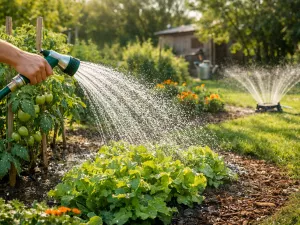
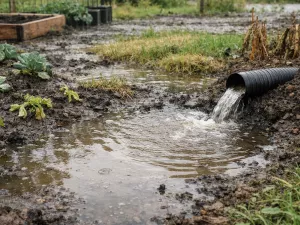
Adjusting Watering Methods to Soil Type

 Here we how soil type affects water absorption and retention, and how watering should change for sandy, clay, loamy, and mixed soils. It also explains useful watering techniques, signs your approach fits the soil, and common mistakes to avoid.
- Why soil type affects how water is absorbed and retained
- How sandy soil changes watering frequency
- How clay soil holds water and drains slowly
- Balancing watering for loamy and mixed soils
- Techniques to adapt watering to different soil conditions
- Signs your watering method matches soil type
- Common mistakes when ignoring soil characteristics
Better watering starts with matching your method to the soil your plants grow in. Sandy soil drains quickly and usually needs more frequent watering, while clay holds moisture longer and can stay wet enough to cause root problems if watered too often. Loam falls in the middle and is generally easier to manage. By adjusting timing and amount to suit each soil type, you can support healthier roots, reduce stress, and encourage steadier growth.
Why soil type affects how water is absorbed and retained

Watering works best when it matches the way soil behaves. Some soils let water rush through, while others hold it so tightly that roots stay wet for too long. The difference comes down to particle size, pore space, and organic matter. Together, these factors determine how quickly water enters the ground, how much stays available to roots, and how much drains away beyond reach.
For gardeners, this matters because the same watering routine can produce very different results in two beds only a few steps apart. A thorough soak that is perfect for one border may leave another dry by the next afternoon, or swampy for several days. Understanding the soil under your plants is often more useful than following a fixed schedule.
Texture, pore space, and root access
Soil texture describes the proportion of sand, silt, and clay. Sandy soil has large particles and large air spaces, so water moves through it quickly. Clay has very fine particles packed closely together, which slows movement and can reduce oxygen around roots. Loam sits in the middle, offering a balance of drainage and moisture storage that suits many garden plants.
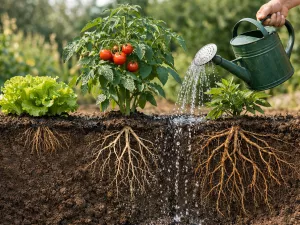
Roots need both water and air. If soil drains too fast, roots may never get a long enough drink. If it drains too slowly, roots can suffocate or rot. This is why watering method matters just as much as watering amount.
Why organic matter changes the picture
Compost, leaf mold, and other organic materials can improve almost any soil, but they do not make every soil behave the same. In sandy ground, organic matter helps hold moisture longer. In clay, it helps create better structure so water can move more evenly and roots can spread more easily. Even adding a 5 cm (2 in) layer of compost to the topsoil over time can noticeably improve how water is absorbed and retained.
- Sandy ground: benefits from extra water-holding capacity and slower drying.
- Clay-heavy ground: benefits from improved aggregation and better air movement.
- Mixed soils: often become easier to water consistently as organic matter evens out extremes.
A quick soil test in the garden is often enough to guide watering. Wet a small handful, squeeze it, and rub it between your fingers. Gritty soil usually drains fast, while sticky, smooth soil tends to hold water longer.
Mulch also affects retention. A surface layer of bark, compost, or shredded leaves around 5 to 8 cm (2 to 3 in) deep reduces evaporation, softens the impact of heavy watering, and helps moisture stay more stable between irrigations. It does not replace proper watering, but it makes any soil easier to manage.
How sandy soil changes watering frequency

Sandy soil usually requires more frequent watering because it drains quickly and stores less moisture near the root zone. Water can move down past active roots before plants have time to use it, especially in hot weather, windy sites, or raised beds. This does not mean plants in sand always need more total water overall, but they often need it delivered in a way that reduces waste.
The main adjustment is to water deeply enough to reach roots, then repeat sooner than you would in heavier soil. Short, light sprinklings are rarely effective because they moisten only the surface, encouraging shallow roots that dry out fast.
How often to check moisture
In sandy beds, it is worth checking moisture more often than the calendar suggests. During warm periods, many plants may need attention every 2 to 3 days rather than once a week. Containers filled with sandy mixes can dry even faster. Push a finger into the soil about 5 to 7.5 cm (2 to 3 in) deep; if it feels dry at that depth, the plant is likely ready for water.
Newly planted shrubs and perennials are especially vulnerable because their roots have not yet spread widely. They may need smaller but more frequent soakings until established.
Best watering approaches for fast-draining ground
The goal is to slow water down so more of it stays where roots can use it. Drip irrigation, soaker hoses, and repeated short cycles with a pause in between are usually more effective than blasting the area once with a hose.
- Water in cycles: apply water for a few minutes, pause, then repeat so the soil has time to absorb it.
- Use mulch: a 5 to 8 cm (2 to 3 in) mulch layer cuts evaporation and keeps the topsoil cooler.
- Target the root zone: place emitters close to the plant rather than watering wide empty spaces.
- Feed carefully: nutrients leach more quickly in sandy soil, so lighter, more frequent feeding often works better than heavy doses.
Plants in sandy soil may also show drought stress sooner in bright sun. Leaves can wilt by midday, flowers may fade quickly, and vegetables can develop uneven growth if watering swings between very dry and very wet. Consistency is more important here than volume alone.
If water seems to vanish instantly, try watering early in the morning and repeating the same zone later that day only if the root area is still dry. Two measured passes are often more useful than one heavy soak on very sandy ground.
Improving the soil is part of the watering strategy. Regular additions of compost can gradually reduce how often you need to irrigate, while also supporting stronger root growth and more even nutrient uptake.
How clay soil holds water and drains slowly

Clay soil behaves almost opposite to sand. It can store a large amount of water, but it absorbs that water slowly and releases it slowly as well. Because the particles are so fine, clay can stay wet for a long time after rain or irrigation. This often leads gardeners to water too soon, especially when the surface looks dry but the root zone below is still moist.
The challenge with clay is not usually getting enough water into the ground over time; it is avoiding saturation and compaction. Once clay becomes waterlogged, roots struggle for oxygen, beneficial soil life declines, and plants become more vulnerable to rot and disease.
Why slow application matters
When water is applied too quickly to clay, it tends to run off instead of soaking in. Sloped beds make this worse, but even flat ground can shed water if the surface has crusted. A slow trickle, drip line, or low-output sprinkler gives the soil more time to absorb moisture evenly.
Deep watering is still useful in clay, but it should happen less often and more patiently. After a proper soak, many established plants can go several more days before needing water again compared with the same plants in sandy soil.
Common drainage-related problems
Because clay stays wet longer, overwatering often looks like underwatering at first. Leaves may yellow, droop, or drop, and gardeners sometimes respond by adding even more water. Looking below the surface is the key step before reacting.
- Persistent sogginess: soil feels sticky and cool several days after watering.
- Surface cracking: clay can crack when it dries, but that does not always mean the lower soil is dry.
- Root stress: plants may wilt despite wet soil because roots are short on oxygen.
- Compaction: walking on wet clay squeezes out air spaces and makes future watering harder.
To improve performance, avoid working clay when it is very wet, and add organic matter gradually over time. Raised beds can also help where natural drainage is poor. If you are planting shrubs or perennials, make sure the crown sits at the right level and is not buried in a basin that collects water.
The table below shows how watering decisions typically shift in clay-heavy ground.
| Situation | Better approach | Why it helps |
|---|---|---|
| Water runs off the surface | Apply water slowly in longer, gentler sessions | Improves absorption before runoff starts |
| Plants wilt but soil is still wet 10 cm (4 in) down | Delay watering and check drainage | Prevents root suffocation from excess moisture |
| Bed stays wet after rain for several days | Use mulch lightly and improve structure with compost | Supports better soil aggregation without sealing the surface |
| Heavy soil in pots or planters | Use a freer-draining potting mix instead of garden clay | Containers need air space and faster drainage than in-ground beds |
Balancing watering for loamy and mixed soils

Loamy soil is often considered ideal because it balances drainage, moisture retention, and root aeration. Water enters reasonably well, stays available for a useful period, and excess moisture usually drains without lingering too long. Even so, loam is not a fixed category. One garden’s loam may lean sandy, while another behaves more like a lighter clay. Mixed soils can vary across the same yard, especially where builders disturbed the ground or different amendments were added over the years.
That means the best watering plan is flexible rather than rigid. In balanced soil, the aim is to keep moisture steady enough for healthy roots without creating constant dampness. Most plants perform best when the soil cycles gently from moist to slightly drier, rather than swinging from bone dry to saturated.
How to manage soil that is mostly balanced
Loamy beds usually respond well to deep, less frequent watering. This encourages roots to grow downward and makes plants more resilient in warm weather. For many ornamental borders and established vegetables, watering when the top 5 cm (2 in) begins to dry is a better guide than watering on the same day every week.
Mixed soils need closer observation. A bed with pockets of sand and clay may dry unevenly, so one side may need water before the other. Drip systems with adjustable emitters are useful here because they let you fine-tune output by zone.
Seasonal and planting differences
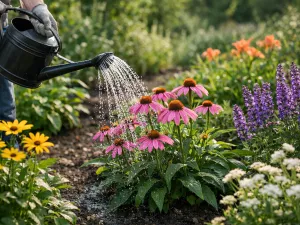
Even good soil behaves differently across the year. Spring soils often stay moist longer, while midsummer heat can shorten the interval between waterings. Plant type matters too. Shallow-rooted annuals and leafy vegetables usually need more regular moisture than established shrubs or drought-tolerant perennials growing in the same bed.
- Seedlings: need the upper soil kept evenly moist until roots develop.
- Established perennials: usually prefer a deeper soak followed by a drying interval.
- Vegetables and fruiting crops: benefit from consistent moisture to prevent stress, splitting, or blossom-end issues.
- Trees and shrubs: should be watered over a wider root area, not just at the trunk base.
Feeding and watering also interact. In loamy soil, nutrients are often held more evenly than in sand, but overwatering can still wash them below the root zone or encourage lush, weak growth. If plants are growing soft and floppy, review both fertilizer rates and irrigation timing rather than adjusting only one factor.
When a bed contains mixed soil, mark a few test spots and check them after watering. You may find one area stays moist for twice as long as another. Small observations like this can save a lot of guesswork over a season.
Mulch remains useful in loam, not because the soil is poor, but because it helps preserve the balance that makes loam valuable in the first place. A moderate mulch layer keeps moisture more even and reduces the need for frequent corrections.
Techniques to adapt watering to different soil conditions

Once you know how your soil behaves, the next step is choosing methods that deliver water at the right speed, depth, and frequency. Good technique can compensate for many soil limitations. It can also prevent common plant problems such as shallow rooting, fungal stress, nutrient loss, and cracked or compacted surfaces.
Different gardens benefit from different tools. Hand watering can work well for close monitoring, while drip systems are excellent for consistency. The best method is the one that matches both the soil and the plants growing in it.
Match delivery speed to infiltration rate
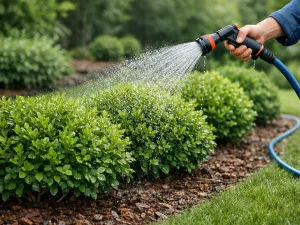
Fast-draining soil can take water quickly, but it may not hold it long. Slow-draining soil needs gentler application so water can soak in rather than run off. This is why the same hose setting should not be used everywhere in the garden.
- For sandy soil: use drip emitters, soaker hoses, or repeated short sessions to keep water near roots.
- For clay soil: use low-flow irrigation over a longer period to improve absorption and reduce puddling.
- For loam: use steady deep watering, then allow moderate drying before the next session.
- For mixed beds: divide zones where possible so each area gets a more suitable amount.
Adjust depth, not just timing
Watering depth should reflect root depth. Lawns, annuals, vegetables, shrubs, and trees all use water differently. If only the top few centimeters or inches are moistened, roots stay near the surface and become more vulnerable to heat and drying winds. In most garden beds, it is better to wet the root zone thoroughly and then wait until the soil begins to dry before repeating.
A practical way to check depth is to inspect the soil after watering. Dig a narrow test hole or use a trowel to see how far the moisture has moved. For many established plants, reaching 15 to 20 cm (6 to 8 in) is a useful baseline, though larger shrubs and trees need moisture deeper and over a broader area.
Use supporting practices that improve watering results
Watering does not work in isolation. Soil structure, mulch, spacing, and even pruning affect how efficiently plants use moisture. Improving these factors often reduces the need to water as often.
- Apply mulch to reduce evaporation and moderate soil temperature.
- Add compost regularly to improve both sandy and clay-heavy soils.
- Water early in the day so foliage dries quickly and less moisture is lost to heat.
- Group plants with similar moisture needs together instead of watering all beds the same way.
- Check drainage around pots and raised beds, where soil can behave differently from in-ground areas.
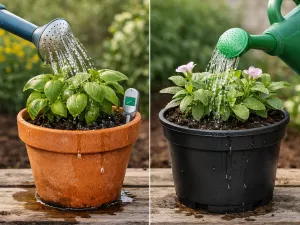
For container plants, remember that potting mixes are designed to drain more freely than garden soil. A plant in a 30 cm (12 in) pot may need water much sooner than the same species planted in the ground, even if both are growing in the same weather.
Signs your watering method matches soil type

When watering is suited to the soil, plants tend to look steady rather than dramatic. You see fewer sudden wilting episodes, less yellowing from stress, and more even growth. The soil itself also gives clues. It should feel appropriately moist below the surface after watering, without staying swampy or turning dusty too quickly.
Matching method to soil type is not about perfect precision every day. It is about creating a pattern where roots can access moisture consistently and breathe properly between waterings. Healthy roots usually show up above ground as stronger stems, better leaf color, and improved flowering or fruiting.
What healthy moisture balance looks like
In a well-managed bed, water reaches the root zone, then gradually declines as the plant uses it. The surface may dry before the lower soil does, especially in clay or mulched beds, and that is normal. What matters is whether the active root area stays in a useful range rather than flipping between extremes.
- Leaves remain firm: plants recover from daytime heat without repeated collapse.
- Growth is even: new leaves and shoots are not stunted by repeated drought stress.
- Soil smells fresh: there is no sour odor from stagnant, airless conditions.
- Roots spread well: plants anchor firmly and do not sit in a constantly wet pocket.
- Feeding works predictably: nutrients are taken up steadily instead of being leached or locked out by poor moisture management.
Simple checks that confirm you are on track
Visual signs are useful, but direct checks are better. Look at the soil 5 to 10 cm (2 to 4 in) below the surface before and after watering. If it is dry again within a day in sandy soil, that may be expected. If it remains saturated for several days in clay, that points to overwatering or poor drainage. Keep notes for a couple of weeks and patterns become much easier to see.
You can also monitor how plants respond after pruning, feeding, or heat waves. If recovery is smooth, your watering routine is likely supporting the soil well. If stress symptoms keep returning despite regular irrigation, the method may be wrong for the soil texture or root depth involved.
Common mistakes when ignoring soil characteristics
Many watering problems come from treating all soil as if it behaves the same. Gardeners often follow a fixed schedule, use the same hose pressure everywhere, or assume wilt always means thirst. These habits can lead to weak roots, disease, wasted water, and disappointing plant performance even when the garden seems to be receiving plenty of care.
The biggest mistake is focusing only on the surface. Soil can look dry on top and still be wet below, especially in clay. In sandy beds, the opposite can happen: the surface may look freshly watered while the moisture has already moved beyond the main root zone. Without checking the actual soil profile, it is easy to misread what plants need.
Frequent errors that cause stress
Some mistakes are especially common because they seem sensible at first. In practice, they often create the opposite of the intended result.
- Watering by the calendar alone: weather, plant size, and soil texture all change how fast moisture is used.
- Applying water too quickly: this causes runoff on clay and wasteful deep loss in sand.
- Using shallow sprinklings: frequent light watering encourages weak, surface-level roots.
- Ignoring mulch and organic matter: this makes moisture swings more severe and increases evaporation.
- Treating containers like garden beds: pots dry at different rates and need separate attention.
- Overcorrecting after wilt: adding extra water without checking the soil can worsen root problems.
How to avoid repeating the same problem
A better approach is to build watering decisions around observation. Check soil depth, note how long moisture lasts, and adjust one variable at a time. If a plant struggles, review drainage, light exposure, root competition, and feeding as well as irrigation. Watering is central, but it is part of a larger care system.
It also helps to think in zones. A sunny border with sandy soil, a shaded bed with heavier ground, and a row of vegetables in raised beds should not be watered as if they were one uniform area. Separating them, even informally, leads to better results and less waste.
When soil characteristics are respected, watering becomes simpler rather than more complicated. You stop chasing symptoms and start working with the natural strengths and limits of the ground you have. That is usually when plants settle, roots strengthen, and the garden becomes much easier to manage through changing weather.