What Makes Soil Healthy for Plant Growth

 This article explains what defines healthy soil, including fertile structure, active microbes, and nutrient balance. It compares moisture retention with aeration, lists warning signs of unhealthy soil, and outlines how to restore soil health plus long-term maintenance practices.
Healthy garden soil is more than dirt; it supports reliable growth by balancing structure, moisture, air, nutrients, and active microbes so roots can feed and spread. Learn how to spot good soil and improve it with simple steps like adding compost, mulching, avoiding compaction, watering wisely, and rotating crops to keep beds productive season after season.
What defines healthy soil
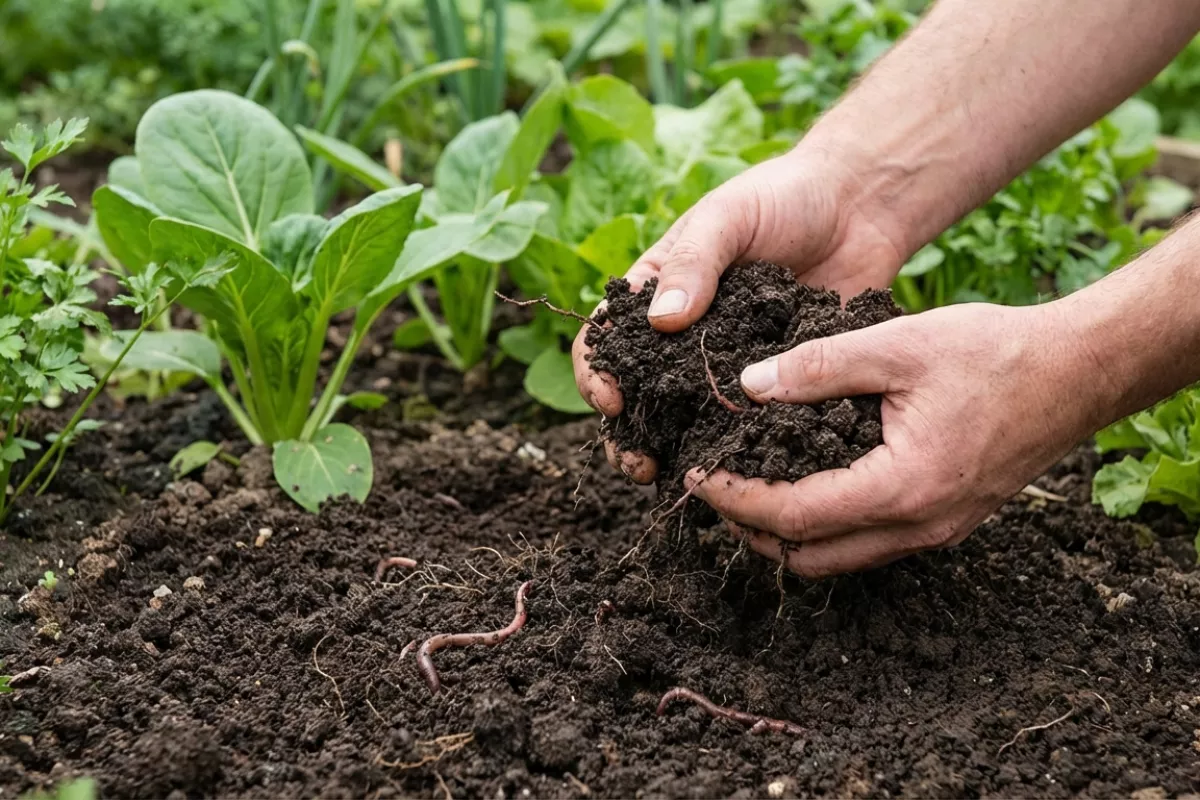
Good garden earth is more than “dirt.” It’s a living system that holds together without turning to concrete, drains without drying out overnight, and supports steady root growth with fewer nutrient swings. You can usually spot it by how it smells (earthy, not sour), how it crumbles in your hand, and how quickly plants recover after heat, heavy rain, or a missed watering.
- Balanced structure (tilth): Aggregates (small crumbs) create pores for air and water. Roots can push through easily, and you’ll see fewer puddles after rain and less crusting on top.
- Reliable water behavior: It soaks up water, stores some, and lets excess drain. In practice, it feels moist a few cm (a few in) down, not powder-dry or sludge-like.
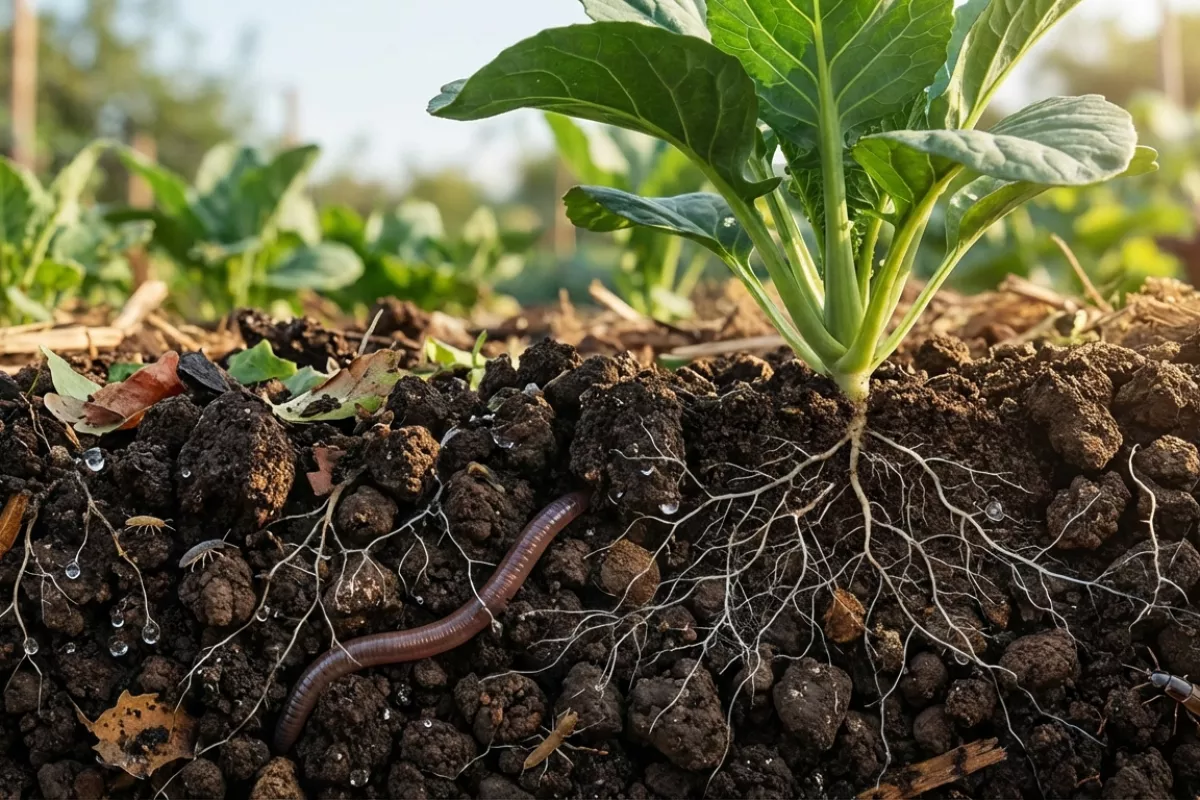
- Active biology: Earthworms, fungal threads, and diverse microbes recycle residues into plant-available nutrients. A lively soil food web also helps suppress some diseases by outcompeting problem organisms.
- Steady nutrient supply: Fertility isn’t just “high NPK.” It’s nutrients in forms roots can access over time, with minimal leaching and fewer deficiency spikes.
- Appropriate pH for the crops: Most vegetables and ornamentals do well around pH 6.0–7.0, while some plants prefer more acidic or alkaline conditions. The key is that pH matches what you’re growing so nutrients stay available.
- Organic matter in the right range: Enough decomposed material to feed microbes and improve water-holding, but not so much fresh, undecomposed residue that it ties up nitrogen or turns anaerobic.
- Low compaction: A healthy profile has pore space at the surface and below. Compacted layers restrict roots, reduce oxygen, and make watering and fertilizing less effective.
| Indicator you can check | What “healthy” tends to look like | What it often means if it’s off |
|---|---|---|
| Smell and color | Earthy smell; darker top layer from humus | Sour/rotten odor can signal poor drainage or low oxygen; very pale soil may be low in organic matter |
| Crumb test (hand feel) | Breaks into small crumbs; not dusty, not sticky | Dusty can indicate low organic matter; sticky/cloddy can indicate high clay or compaction |
| Infiltration after watering/rain | Water soaks in without long puddling | Slow soaking suggests compaction or surface crusting; instant runoff suggests poor structure |
| Root growth when you dig | Roots spread in many directions and reach deeper layers | Roots circling near the surface can indicate hardpan, compaction, or waterlogging below |
| Visible life (worms, insects, fungal threads) | Regular signs of organisms, especially under mulch | Very little life can mean low organic inputs, frequent disturbance, or chemical/heat stress |
One helpful way to think about it: soil health is the combination of physical traits (structure, porosity, water movement), chemical traits (nutrient balance, pH, salinity), and biological traits (microbes and soil animals). When those three line up, plants tend to grow more evenly, with fewer extremes—less wilting after a hot day and fewer stalls after a storm.
Physical structure of fertile soil
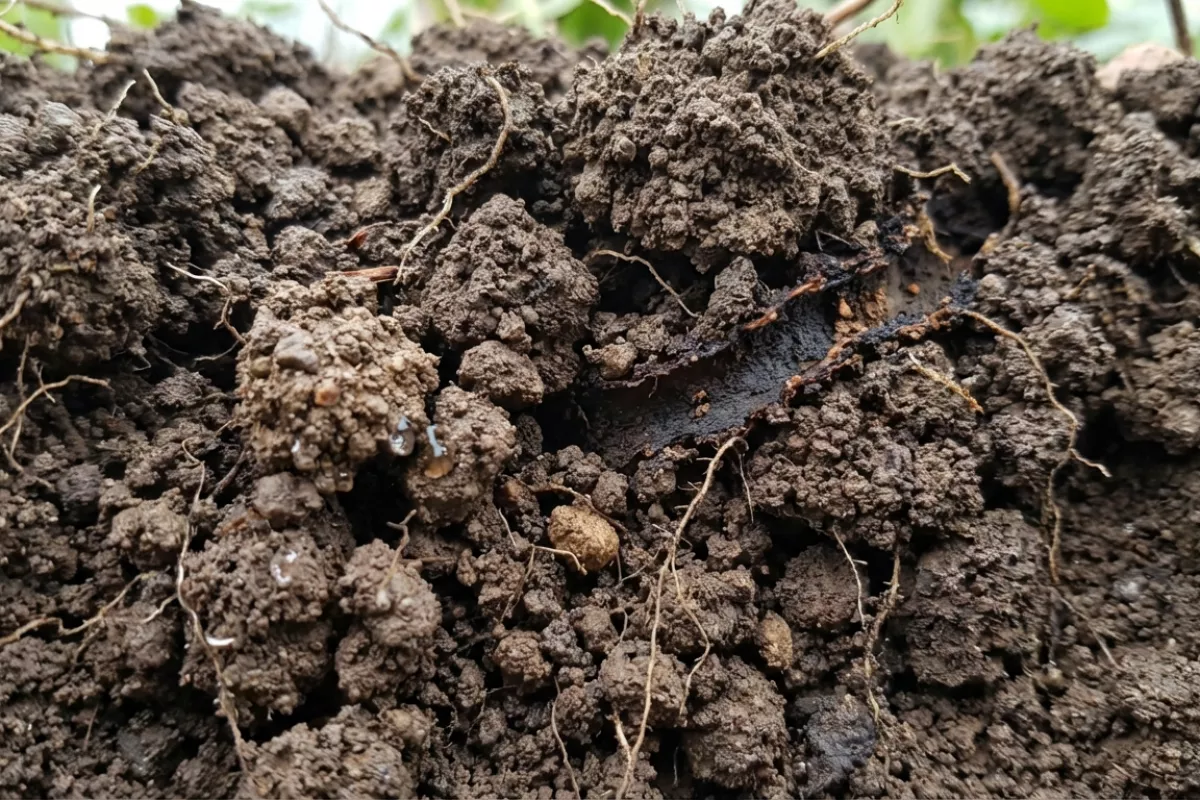
Good soil isn’t just “dirt”; it’s a living framework of mineral particles, organic matter, water, and air arranged in a way that roots can explore easily. When that framework is stable, plants get steady moisture, enough oxygen for root respiration, and room for beneficial organisms to move and work.
The big idea is aggregation: tiny particles (sand, silt, clay) clump into crumbs or granules. Those aggregates create a mix of pore sizes—larger pores drain excess water and let air in, while smaller pores hold moisture between rain or irrigation cycles. A healthy balance reduces puddling after storms and slows drying during hot spells.
- Texture (sand–silt–clay mix): Texture sets the baseline for drainage and water-holding. Sandy soils drain fast and warm quickly; clay-heavy soils hold more water but can stay saturated and sticky. You can’t easily change texture, but you can manage structure on top of it with organic matter and gentle handling.
- Soil structure (how particles are arranged): Granular or “crumb” structure is ideal for most garden and field crops because it supports both aeration and water storage. Blocky or massive structure often signals compaction or low biological activity.
- Porosity and aeration: Roots need oxygen as much as they need water. If pores stay filled with water for long periods, roots can suffocate and disease pressure rises. Good tilth keeps enough air-filled pores even after watering.
- Compaction resistance: Heavy foot traffic, repeated passes with equipment, or working soil when it’s wet can squeeze pores shut. Compacted layers restrict rooting depth, so plants become more drought-sensitive and less able to access nutrients deeper down.
- Infiltration and drainage: When water enters the soil quickly, it reduces runoff and erosion. Slow infiltration often points to surface crusting, compaction, or low aggregate stability.
| Structural sign you can observe | What it usually means for plants | Practical ways to improve it |
|---|---|---|
| Water pools on the surface after rain/irrigation | Poor infiltration; likely crusting or compaction limiting pore space | Add compost, keep soil covered with mulch, avoid working soil when wet, use deep-rooted cover crops |
| Hard layer that stops a trowel or roots at 10–20 cm (4–8 in) | Compacted “pan” reduces rooting depth and drought tolerance | Reduce traffic, use broadforking or targeted subsoiling when conditions are right, grow tap-rooted species to open channels |
| Soil breaks into hard clods instead of crumbs | Weak aggregation; uneven water/air supply around roots | Increase organic inputs, minimize aggressive tillage, maintain living roots longer through the season |
| Soil dries into a crust; seedlings struggle to emerge | Surface sealing reduces gas exchange and water entry | Mulch lightly, add organic matter, use gentle watering, protect the surface with residue or groundcovers |
| Few earthworms; little visible pore space | Lower biological “engineering” of channels and aggregates | Keep consistent organic matter, reduce pesticide overuse, avoid frequent disturbance, maintain moisture with mulch |
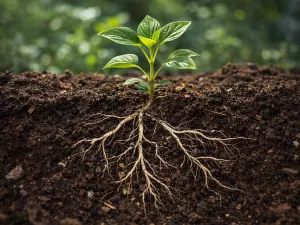
If you want a quick hands-on check, dig a small hole and look at a slice of soil. In fertile ground you’ll usually see crumbly aggregates, fine roots extending in many directions, and pores or channels from old roots and soil organisms. If the profile shows a dense, smooth-faced layer or roots turning sideways, that’s a clue that the structure—not just nutrients—is limiting growth.
Biological activity and microbes
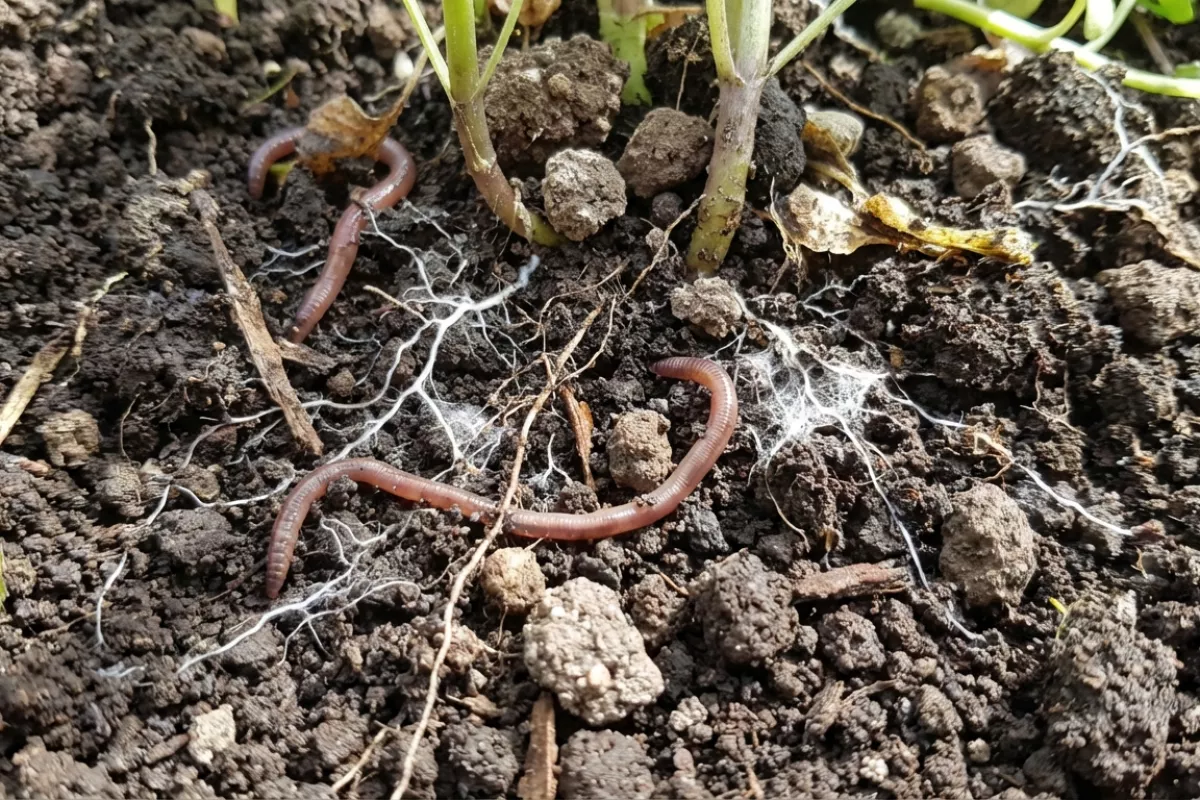
Soil comes alive when bacteria, fungi, protozoa, nematodes, and larger organisms like earthworms are active. This living community turns dead plant material into available nutrients, builds stable aggregates that improve structure, and helps roots cope with stress. When that community is missing or disrupted, plants may still grow, but they rely more on added inputs and are often less resilient to drought, compaction, and disease pressure.
What these organisms do is less mysterious if you think in terms of jobs rather than species names:
- Decomposition and nutrient cycling: Microbes break down residues and release nitrogen, phosphorus, sulfur, and micronutrients in plant-usable forms. This “slow release” depends on moisture, temperature, and having a steady supply of organic matter.
- Building soil structure: Fungal hyphae and microbial “glues” help bind particles into aggregates, which improves pore space for air and water movement and reduces crusting.
- Root partnerships: Mycorrhizal fungi extend the effective root system, improving access to water and nutrients (especially phosphorus) and sometimes helping plants tolerate salinity and heat.
- Natural disease suppression: Diverse communities can outcompete or prey on pathogens, and some microbes trigger plant defenses. This doesn’t make plants immune, but it can lower the odds of outbreaks.
- Detox and buffering: Certain bacteria transform harmful compounds and help stabilize pH swings or excess nutrients, reducing stress on roots.
Many gardeners notice the results before they can name the cause: soil that smells earthy, crumbles instead of clods, and drains without turning hydrophobic. Those are often signs of active fungal networks, balanced bacterial populations, and plenty of organic inputs feeding the food web.
| Soil life group | Main role for plants | Common sign it’s present |
|---|---|---|
| Bacteria | Fast nutrient cycling; supports early decomposition; some fix nitrogen in association with plants | Quick breakdown of soft residues; good response after adding compost |
| Fungi (including mycorrhizae) | Builds aggregates; decomposes tougher materials; improves water and phosphorus access via root symbiosis | White threads in mulch/soil; crumbly structure; strong plant performance with fewer inputs |
| Protozoa & nematodes (beneficial types) | Grazers that release plant-available nutrients by feeding on bacteria and fungi | Steady growth without frequent fertilizing; fewer nutrient “boom-bust” cycles |
| Earthworms & arthropods | Shred residues; mix organic matter; create channels that improve aeration and infiltration | Worm casts, burrows, and faster water soak-in after rain or irrigation |
To support this ecosystem, focus on habitat and food. Keep the surface covered with mulch or living plants, add compost or chopped leaves, and avoid frequent deep disturbance that breaks fungal networks. Also watch moisture: consistently soggy conditions can push soils toward low-oxygen microbes that produce sour smells, while extremely dry soil slows decomposition and nutrient release. A simple rule is to aim for evenly moist (not wet) conditions through the root zone, especially in the top 10–20 cm (4–8 in) where most activity happens.
Nutrient balance essentials
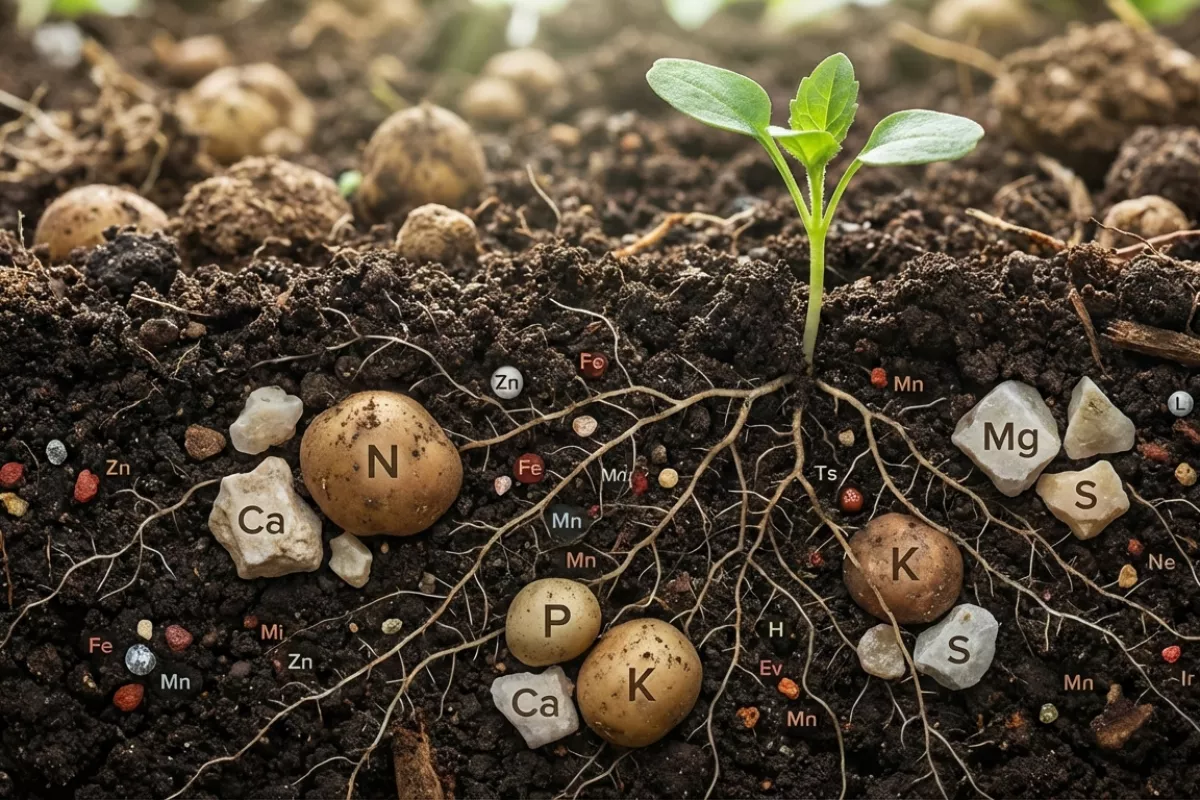
Plants don’t just need “more fertilizer”—they need the right mix of nutrients in forms roots can absorb. Healthy soil supplies a steady baseline of nitrogen (N), phosphorus (P), potassium (K), plus secondary nutrients and trace elements, without letting any one of them build up to the point that it blocks uptake of others.
A useful way to think about it is balance across three layers: the big-ticket nutrients (N-P-K), the supporting cast (calcium, magnesium, sulfur), and the micronutrients (iron, manganese, zinc, copper, boron, molybdenum, chlorine, nickel). Deficiencies slow growth, but excesses can be just as harmful—often showing up as “mystery” symptoms even when plenty of fertilizer has been applied.
- Macronutrients drive growth. Nitrogen fuels leafy growth, phosphorus supports roots and flowering, and potassium helps water regulation and stress tolerance. Too much N can cause lush leaves with weak stems and fewer flowers or fruits.
- Secondary nutrients shape structure and chemistry. Calcium supports cell walls and root tips, magnesium sits at the center of chlorophyll, and sulfur is tied to protein formation. Imbalances here can mimic N-P-K problems.
- Micronutrients are small but essential. They act like switches in plant enzymes. A little goes a long way, and over-application (especially of boron or copper) can become toxic.
- pH controls availability. Many nutrients become less available when soil is too acidic or too alkaline. If plants look deficient despite fertilizing, pH is often the real bottleneck.
- Organic matter buffers the system. Compost and humus hold nutrients, reduce leaching, and feed microbes that convert nutrients into plant-available forms.
When balance is off, the “fix” depends on what’s driving it. For example, repeated high-phosphorus inputs can tie up iron and zinc, leading to chlorosis even though the soil test shows plenty of P. Likewise, excess potassium can interfere with magnesium uptake, especially in sandy soils that don’t hold nutrients well.
| Common imbalance | What you may notice | Practical correction |
|---|---|---|
| Too much nitrogen | Fast leafy growth, weak stems, delayed flowering/fruiting | Reduce high-N feeds, add carbon-rich mulch (e.g., shredded leaves), prioritize balanced inputs |
| High phosphorus buildup | Micronutrient deficiency symptoms (often iron/zinc), slow growth despite fertilizing | Avoid “bloom booster” overuse, rely on compost, confirm with a soil test before adding more P |
| Excess potassium relative to magnesium | Interveinal yellowing on older leaves, weak vigor | Cut back on K-heavy fertilizers, consider magnesium sources if a test confirms low Mg |
| pH too low or too high | Nutrients present but unavailable; patchy deficiencies | Adjust pH gradually (lime for acidic soil; sulfur-based amendments for alkaline soil), then retest |
The most reliable path is to match amendments to evidence. A basic soil test, plus observing which leaves show symptoms first (new vs. old growth), helps you avoid chasing problems with random products. In healthy soil, nutrients cycle steadily—plants get what they need, and the soil isn’t left overloaded with salts or a single nutrient that throws everything else out of sync.
Moisture retention vs aeration
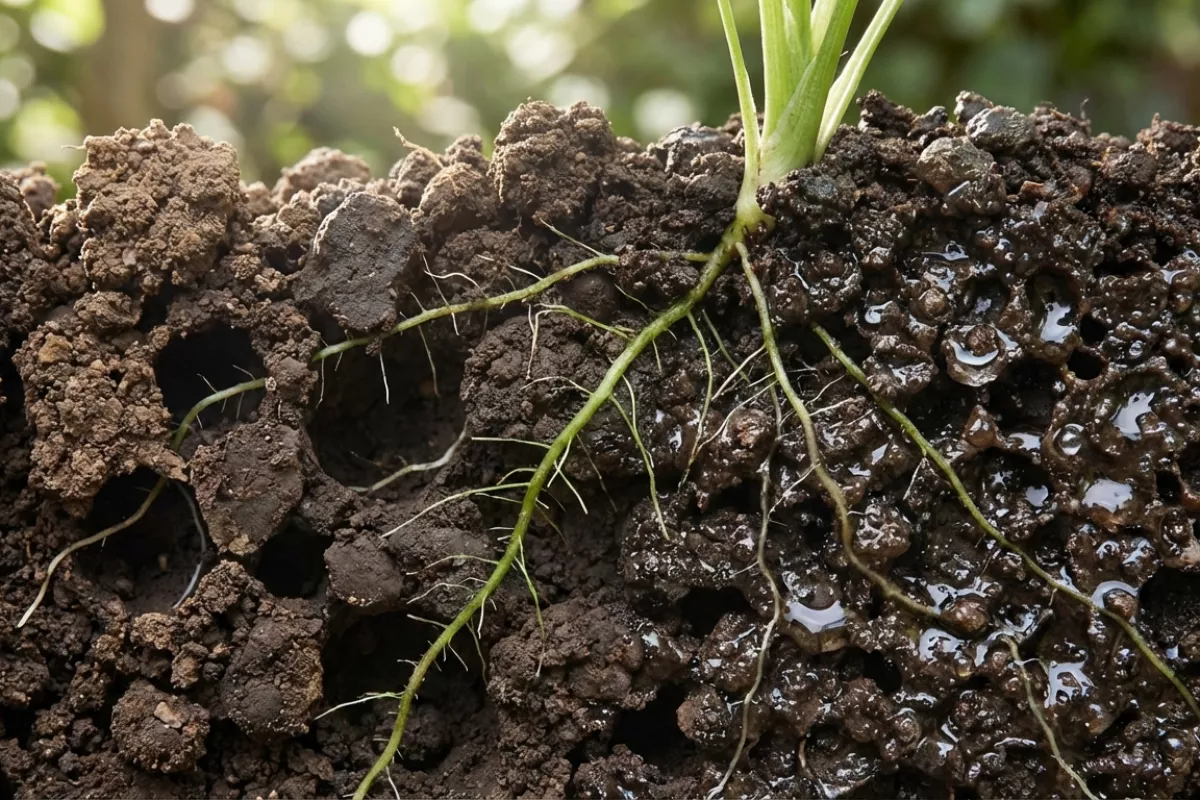
Healthy soil has to do two jobs at once: hold enough water for roots and leave enough air space for oxygen. Those needs can pull in opposite directions because the same pores that store water are also the pathways that let air move in and carbon dioxide move out.
Think of soil like a sponge with different-sized holes. Large pores (macropores) drain quickly and refill with air after rain or irrigation. Small pores (micropores) hang onto water longer, which helps plants ride out dry spells. When most pores are tiny, soil stays wet but can become oxygen-poor; when most pores are large, it drains fast but dries out quickly.
| Soil condition | What’s happening in the pore space | Common plant signals | Practical fixes |
|---|---|---|---|
| Too wet / poorly drained | Micropores dominate; water fills most spaces, limiting oxygen diffusion | Yellowing leaves, slow growth, wilting even when soil is wet, root rot odors | Add organic matter, avoid overwatering, improve drainage with raised beds, reduce compaction |
| Too dry / excessively fast draining | Macropores dominate; water moves through quickly and isn’t stored near roots | Frequent midday wilt, crispy leaf edges, stunted growth between waterings | Increase compost or leaf mold, use mulch, water more deeply but less often, add finer particles only where appropriate |
| Compacted soil | Pores collapse; both air and water movement are restricted, and roots can’t explore | Puddling after rain, shallow roots, poor vigor despite fertilizing | Limit foot traffic, use broadfork/aeration where suitable, keep soil covered, add organic matter over time |
| Well-structured soil (ideal balance) | A mix of pore sizes; water is stored in small pores while large pores stay open for airflow | Even growth, less stress between irrigations, roots spread easily | Maintain structure with compost additions, mulch, diverse plantings, and minimal disturbance |
Texture sets the baseline. Sandy soils tend to drain quickly and need more organic inputs to improve water-holding. Clay-heavy soils can store lots of moisture but often struggle with airflow when compacted or worked wet. Structure is the part you can improve: stable aggregates create both storage pores and air channels, which is why compost, roots, and soil life matter so much.
If you want a quick field check, dig a small hole about 15 cm (6 in) deep and look at the crumb structure. Soil that breaks into small, stable clods with visible pores usually supports both hydration and oxygen. Soil that smears into a slick ribbon when wet or forms hard plates when dry is more likely to swing toward waterlogging or drought stress, depending on conditions.
Warning signs of unhealthy soil
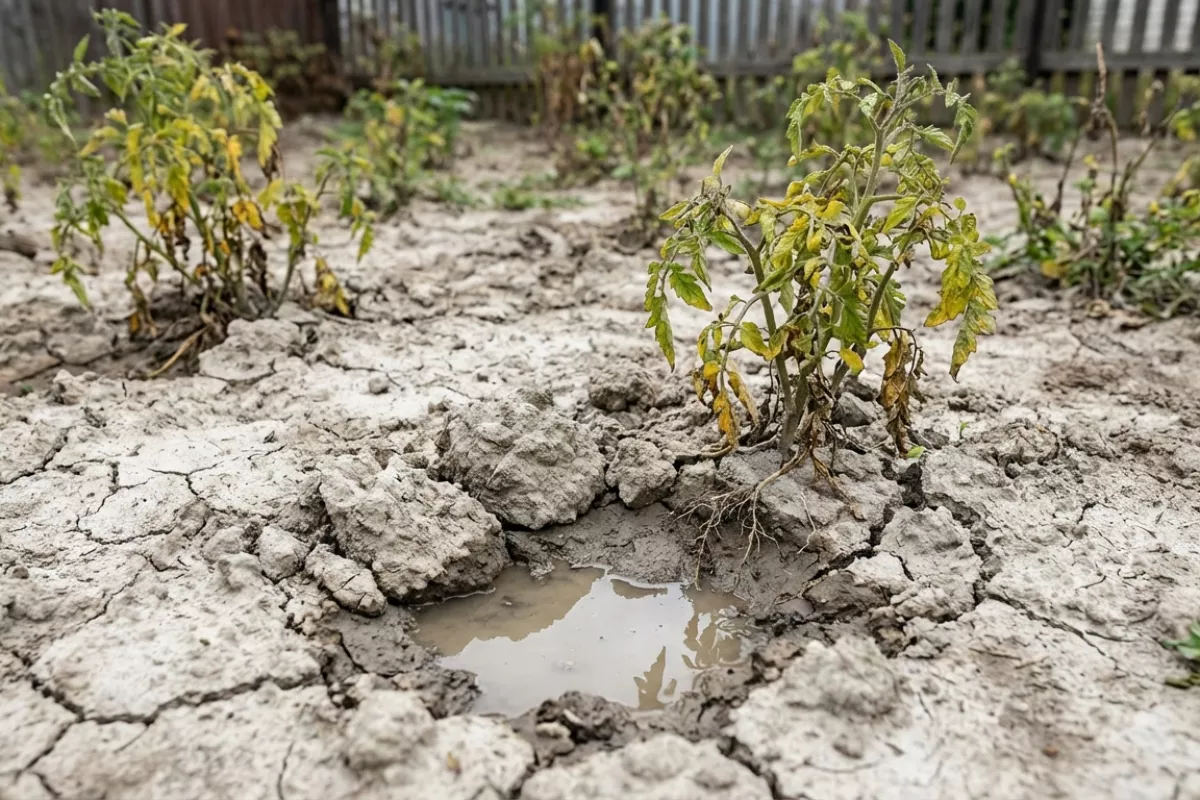
Poor ground conditions usually show up first in plant behavior and how the surface looks and feels. If growth is slow despite regular watering and light, or if you’re seeing repeated pest and disease issues, it’s worth checking what’s happening below the surface. These clues often point to compaction, nutrient imbalance, weak biology, or drainage problems.
- Water puddles or runs off quickly: Standing water after rain or irrigation suggests slow infiltration, often from compaction or heavy clay. On the flip side, water that disappears immediately can indicate overly sandy soil with low water-holding capacity.
- Hard, crusty surface and poor root penetration: A sealed crust, especially after watering, can block air exchange and make it difficult for seedlings to emerge. If you dig a small hole and roots are shallow or circling, the subsoil may be dense.
- Soil smells sour or “rotten”: A healthy bed often smells earthy. A sulfur-like odor can signal anaerobic conditions from waterlogging, meaning roots and beneficial microbes aren’t getting enough oxygen.
- Few earthworms and little visible life: Turning over a small patch should reveal some insects, fungal threads, or worms. A near-sterile look can point to low organic matter, frequent disturbance, or chemical stress.
- Plants look hungry even after feeding: Yellowing between leaf veins, purpling, or stunted growth may reflect pH issues or nutrient lockout rather than a simple lack of fertilizer. Repeated deficiencies across different plants are a common hint.
- Uneven growth in the same bed: Patchy performance can come from buried debris, compacted tracks, localized salt buildup, or abrupt texture changes that interrupt drainage and root growth.
- White crust or burned leaf edges after watering: This can indicate excess salts from some fertilizers, manure, or hard irrigation water. It’s more likely in containers or arid climates where evaporation concentrates minerals.
- Topsoil disappears quickly or forms rills: Erosion after storms, exposed roots, or muddy runoff suggests weak structure and low aggregation. That often tracks with low organic matter and limited ground cover.
- Persistent weeds that love stress: Some species thrive in compacted, low-fertility, or disturbed ground. A sudden shift toward those “tough” weeds can be a useful diagnostic signal.
If several of these signs show up together, do a quick check: dig a small test hole about 20 cm (8 in) deep, look for layering or a hardpan, and note how quickly water soaks in. That simple observation can tell you whether the next step is improving structure with compost, reducing tillage, adjusting pH, or fixing drainage before adding more nutrients.
How to restore soil health
Bring tired ground back by fixing the biggest limiting factor first: compaction, low organic matter, poor drainage, or nutrient imbalance. Start with simple observations (puddling after rain, crusting, weak root growth, few earthworms), then make changes that protect soil structure while feeding the biology that builds it.
- Test before you add anything. A basic soil test for pH and major nutrients prevents guesswork and over-fertilizing. If you can, include organic matter percentage and a texture estimate (sand/silt/clay), since clay-rich soils respond differently than sandy ones.
- Reduce disturbance to protect structure. Frequent deep tilling breaks aggregates and speeds organic matter loss. If you need to loosen soil, try shallow cultivation, a broadfork, or targeted aeration rather than repeated full-depth turning.
- Relieve compaction where roots actually grow. Work when soil is moist but not wet (a squeezed handful should crumble, not smear). Avoid driving or walking on beds, and use permanent paths. Compaction relief is most effective when followed by roots (cover crops) that keep pores open.
- Feed the soil food web with organic inputs. Add finished compost as a thin top-dressing, and keep a steady supply of plant residues (mulch, chopped leaves, grass clippings that haven’t been treated with persistent herbicides). A layer around 5–8 cm (2–3 in) of mulch moderates temperature swings and reduces evaporation.
- Keep living roots in the ground as much as possible. Cover crops (such as clover, rye, oats, or buckwheat) prevent erosion, add biomass, and support beneficial microbes. Terminate them before they set seed, and leave residues on the surface when you can.
- Correct pH gradually and only as needed. Many nutrients become less available when pH is far from neutral. Use lime to raise pH or sulfur to lower it, but apply in measured steps and re-test; big swings can stress plants and soil life.
- Water to encourage deep rooting. Infrequent, thorough watering is usually better than daily sprinkles. Aim to wet the root zone, then let the surface dry slightly; this reduces fungal issues and helps roots explore deeper layers. Watch for runoff—if water sheets off, infiltration needs improvement.
- Prevent bare soil and erosion. Wind and water remove the finest particles first, which are also the most nutrient-rich. Use mulch, cover crops, and contour planting on slopes to keep topsoil in place.
- Use fertilizers as a supplement, not the foundation. If a test shows a deficiency, apply targeted nutrients at modest rates and pair them with organic matter additions. Over-application can harm microbial balance and increase salt stress, especially in containers and arid climates.
- Rotate crops and diversify plantings. Different roots and residues support different microbes. Rotations also break pest and disease cycles and reduce the chance of depleting the same nutrients year after year.
| Problem you see | Likely cause | What to do next |
|---|---|---|
| Puddles linger; soil stays slick when wet | Compaction or poor structure | Limit traffic, add mulch/compost, plant deep-rooted covers, loosen carefully when not wet |
| Hard crust on the surface; seedlings struggle | Low organic matter; fine particles sealing the top | Top-dress compost, keep a 5–8 cm (2–3 in) mulch layer, avoid overhead watering that pounds the surface |
| Plants look pale despite fertilizing | pH lockout or poor root function | Test pH, adjust slowly, improve drainage/aeration, avoid excess nitrogen |
| Soil dries out quickly and feels loose/gritty | Sandy texture; low water-holding capacity | Add organic matter regularly, mulch, use compost and cover crops to increase moisture retention |
| Stunted growth; roots are short and thick | Compacted layer or waterlogging | Check for a hardpan, use deep-rooted covers, consider raised beds, improve infiltration |
Expect improvement in stages: surface tilth and moisture retention can change in a few weeks, while rebuilding stable aggregates and organic matter often takes a full season or more. The most reliable approach is consistent: protect the surface, keep roots growing, add carbon-rich materials, and only “fix” chemistry when a test shows it’s truly limiting.
Long-term soil maintenance practices
Keep soil productive by treating it like a living system: feed it regularly, disturb it less, and protect it from erosion and compaction. The goal is steady organic matter, stable structure, and a diverse community of microbes and soil animals that cycle nutrients for plants.
- Build organic matter in small, repeated doses. Add compost, leaf mold, or well-rotted manure as a thin top-dressing rather than a one-time dump. A layer around 2–5 cm (0.8–2 in) once or twice a year is often enough to improve aggregation and water-holding without smothering the surface.
- Keep the ground covered. Use mulch, living groundcovers, or crop residues to reduce evaporation, buffer temperature swings, and prevent crusting. Aim for roughly 5–8 cm (2–3 in) of coarse mulch around established plants, keeping it a few cm (about 1 in) back from stems to reduce rot risk.
- Rotate crops and vary root types. Alternating plant families and mixing shallow- and deep-rooted species helps break pest cycles and opens different soil layers. Deep-rooted cover crops can also improve infiltration by creating channels that later roots follow.
- Use cover crops during “empty” seasons. Grasses add carbon, legumes add nitrogen, and broadleaf species can scavenge nutrients. Terminate them before they set seed, then leave residues on the surface or lightly incorporate only the top 2–5 cm (0.8–2 in) if needed.
- Minimize disturbance. Frequent tilling breaks aggregates and speeds organic matter loss. If you need to loosen compacted areas, try a broadfork or targeted aeration rather than full-depth inversion, and avoid working soil when it’s wet enough to form a ribbon.
- Prevent compaction with traffic control. Keep wheelbarrows, mowers, and foot traffic on set paths. In beds, avoid stepping where roots grow; compaction reduces oxygen and slows nutrient cycling.
- Water to support roots, not just to “wet the surface.” Deep, less frequent irrigation encourages deeper rooting and better drought resilience. As a starting point, many gardens do well with about 25 mm (1 in) per week from rain plus irrigation, adjusted for heat, wind, and soil texture.
- Test periodically and amend with restraint. A soil test every 2–3 years can prevent over-fertilizing and catch pH drift early. If pH needs adjustment, apply lime or sulfur in split doses and recheck; sudden swings can disrupt nutrient availability.
- Feed biology with diverse inputs. Mix materials (compost, shredded leaves, grass clippings, woody chips used as surface mulch) to support different decomposers. Diversity tends to stabilize nutrient release and improves structure over time.
- Watch and respond using simple indicators. Track infiltration after rain, how easily a trowel enters, earthworm presence, and whether the surface crusts. These cues often reveal soil health trends before plants show deficiency symptoms.
| Practice | What it improves | How often to revisit |
|---|---|---|
| Compost/top-dressing | Organic matter, nutrient buffering, aggregation | 1–2 times per year, thin layers |
| Mulch or living cover | Moisture retention, temperature stability, erosion control | Maintain year-round; replenish as it breaks down |
| Crop rotation/plant diversity | Pest pressure reduction, varied rooting, nutrient balance | Each planting cycle/season |
| Cover crops | Nutrient capture, nitrogen addition (legumes), structure | During fallow periods; terminate before seed set |
| Reduced tillage/targeted loosening | Aggregate stability, fungal networks, carbon retention | Only when needed; avoid routine deep tilling |
| Traffic management | Lower compaction, better aeration and root growth | Ongoing; set paths once and stick to them |
| Soil testing and pH correction | Nutrient availability, prevents over-application | Every 2–3 years (or after major amendments) |
If you only change two habits, make them “keep it covered” and “add organic matter regularly.” Those two steps quietly improve structure, water behavior, and nutrient cycling, which is what makes soil stay workable and fertile season after season.