How Soil Affects Plant Growth and Health

 Soil drives plant success by shaping root development, nutrient uptake, and moisture retention. It also explains how soil microorganisms support plant health, what problems poor soil causes, and practical steps to optimize soil for stronger growth.
Healthier plants often start below the surface, where soil structure supports roots, stores water, and supplies nutrients. Texture and drainage affect airflow and moisture, while pH and organic matter influence nutrient availability and microbial life. By learning these basics, you can pick the right amendments, avoid overwatering, and build stronger, more resilient growth with fewer setbacks.
Why soil determines plant success
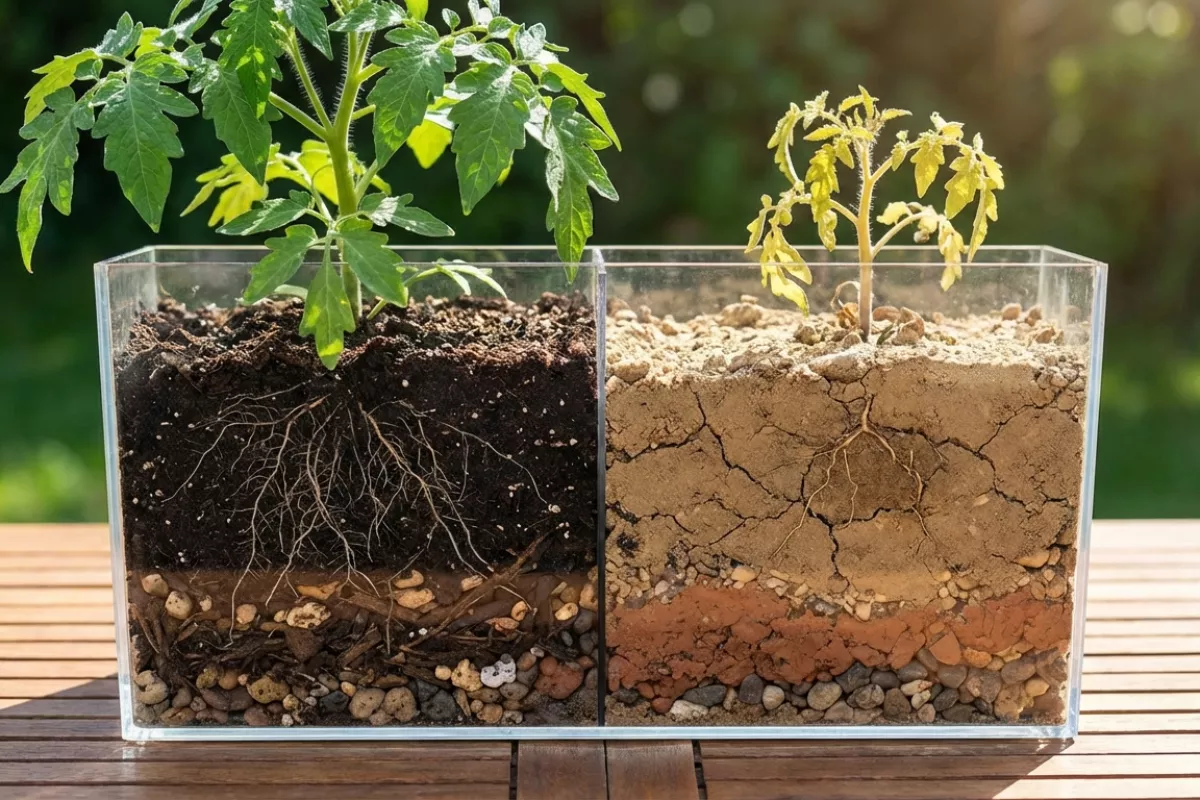
Plant performance starts below the surface because soil is more than “dirt.” It’s a living system that controls how roots access water, oxygen, and nutrients, and it also buffers plants from stress. When the ground environment is balanced, plants can build stronger roots, resist disease, and handle heat or dry spells with less setback.
Most growth problems trace back to a few soil fundamentals. If any one of them is out of range, the plant may look like it has a nutrient deficiency or pest issue even when the real cause is poor root conditions.
- Structure and texture: Sand, silt, and clay determine how tightly particles pack together. Good structure creates pores for air and water movement; compacted ground squeezes those pores shut, slowing root growth and increasing rot risk.
- Drainage and water-holding: Roots need steady moisture without staying waterlogged. Too much drainage can cause frequent drought stress; too little drainage limits oxygen and encourages root diseases.
- Oxygen availability: Roots respire just like leaves. In saturated or compacted conditions, low oxygen reduces nutrient uptake and can stunt plants even if fertilizer is present.
- Nutrient supply and storage: Soil organic matter and clay surfaces hold onto nutrients so they aren’t washed away. Low organic matter often means nutrients spike and crash, which leads to uneven growth.
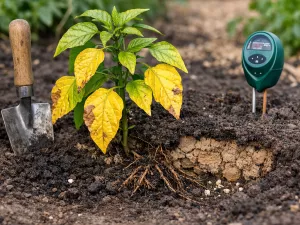
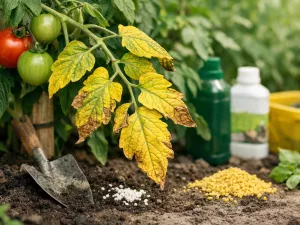
- pH and chemistry: pH influences what nutrients are “unlocked” for uptake. For example, very acidic or very alkaline conditions can tie up iron, phosphorus, or other essentials, causing yellowing and weak growth despite adequate fertilization.
- Biology and the soil food web: Beneficial fungi and bacteria help cycle nutrients and can improve root access to water. Healthy microbial activity also competes with some pathogens, lowering disease pressure.
- Temperature buffering: Dark, organic-rich ground warms and cools more gradually than bare, depleted soil, which can reduce stress on roots during temperature swings.
| Soil factor | What the plant experiences | Common above-ground signs | Practical first response |
|---|---|---|---|
| Compaction / poor structure | Shallow roots, low oxygen, slow water infiltration | Stunting, wilting after rain, uneven growth | Reduce foot traffic, add compost, loosen soil carefully to 20 cm (8 in) where appropriate |
| Waterlogged conditions | Oxygen starvation and higher root-rot risk | Yellowing, droop, leaf drop, blackened roots | Improve drainage, raise beds 15–30 cm (6–12 in), avoid overwatering |
| Low water-holding capacity | Rapid drying and frequent drought stress | Crispy edges, midday wilt, slow recovery | Mulch 5–8 cm (2–3 in), increase organic matter, water deeply but less often |
| pH out of range | Nutrients become less available even if present | Chlorosis (yellow leaves), poor flowering/fruiting | Test soil, adjust gradually with lime or sulfur per label directions |
| Low organic matter / weak biology | Fewer nutrient reserves and less microbial cycling | Pale growth, low vigor, higher stress sensitivity | Add compost, leave roots in place, avoid excessive tilling |
In practice, improving soil health usually beats chasing symptoms. A simple soil test, attention to drainage, and steady additions of organic matter often do more for long-term plant growth than repeated quick fixes, because they address the root environment where growth actually begins.
Root development and soil conditions
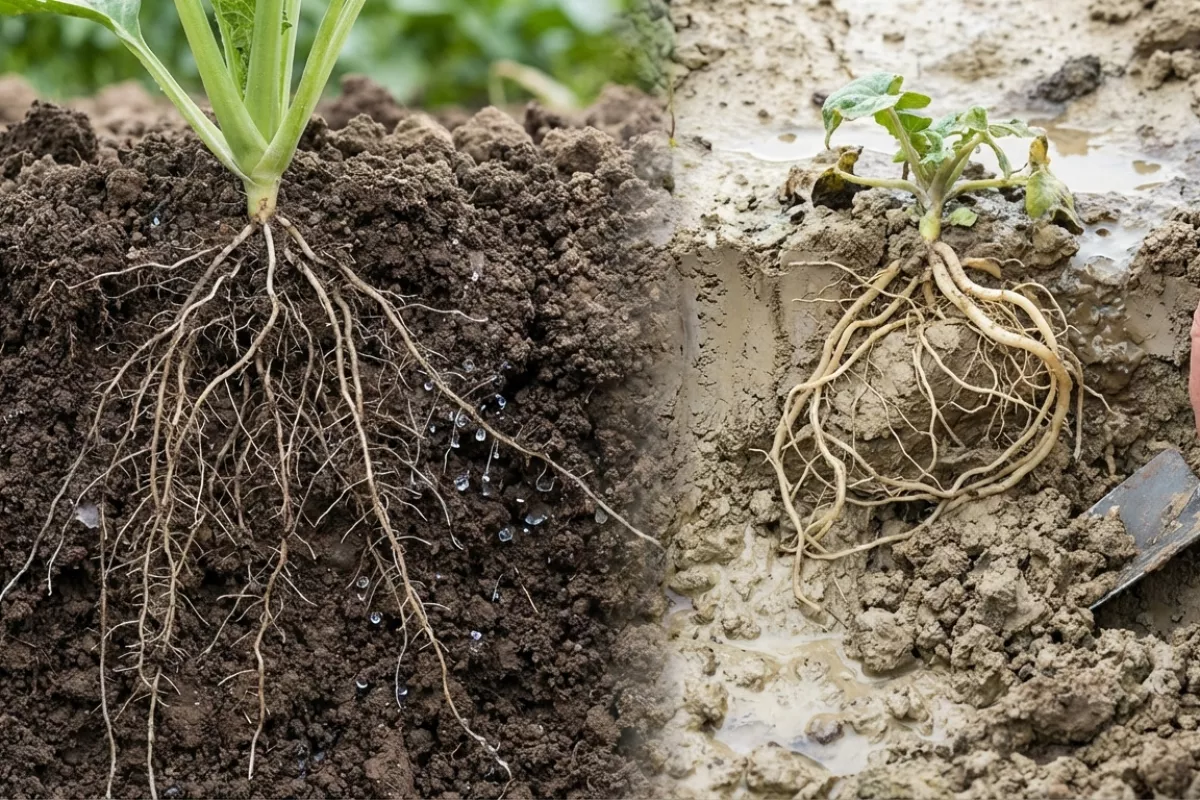
Healthy plants start with what happens underground: roots need oxygen, steady moisture, and enough physical space to explore. When soil is too compacted, waterlogged, or crusted on top, roots tend to stay shallow, branch poorly, and struggle to take up nutrients even if fertilizer is present.
Texture and structure shape how easily roots can move. Sandy soils drain quickly and can leave roots chasing water; heavy clays hold water longer but can become airless after rain or overwatering. The most root-friendly ground usually has stable aggregates (crumbly structure) that create a mix of pores: larger pores for air and drainage, smaller pores for water storage.
- Compaction: Limits root penetration and reduces oxygen. You’ll often see stunted growth and plants that wilt quickly because the root system can’t expand. Loosening the top 15–30 cm (6–12 in) and adding organic matter can improve pore space over time.
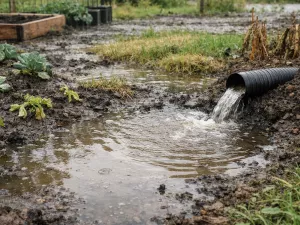
- Drainage and aeration: Roots respire; saturated soil pushes out air and can trigger rot. If puddles linger longer than 24 hours (1 day), consider raised beds, improved grading, or incorporating compost to support better structure.
- Moisture swings: Repeated cycles of bone-dry to soaked can cause fine roots to die back. A mulch layer of about 5–8 cm (2–3 in) helps buffer moisture and temperature at the surface.
- Soil pH: pH influences nutrient availability and root function. Many garden plants do well around pH 6.0–7.0; outside that range, key nutrients can become less available even when present in the soil.
- Salts and fertilizer burn: High soluble salts pull water away from roots, leading to leaf scorch and poor establishment. If you suspect salt buildup, deep watering (when drainage allows) and avoiding over-fertilizing can help.
- Temperature: Cold ground slows root growth; hot soil can damage root tips. Keeping soil covered and evenly moist reduces extremes, especially in containers and raised beds.
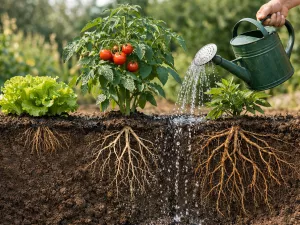
Root architecture also responds to where resources are. If water and nutrients are always near the surface, plants may develop a dense, shallow network that’s vulnerable to heat and drought. Occasional deeper watering encourages roots to follow moisture downward, improving resilience when the top layer dries out.
| Soil condition | What it does to roots | What you can do |
|---|---|---|
| Compacted or crusted surface | Restricts penetration; fewer fine roots; poor uptake | Avoid working wet soil; add compost; aerate or gently loosen top 15–30 cm (6–12 in) |
| Waterlogged after rain/irrigation | Low oxygen; higher risk of root rot and nutrient loss | Improve drainage, use raised beds, reduce watering frequency, increase organic matter |
| Very fast-draining, drought-prone | Roots chase water; stress during heat; nutrient leaching | Mulch 5–8 cm (2–3 in); add compost; water deeply and less often |
| pH too low or too high | Nutrients become less available; weak growth despite feeding | Test soil; adjust gradually with lime or sulfur as needed; use appropriate fertilizers |
| High salt or excess fertilizer | Root tip damage; reduced water uptake; leaf scorch | Follow label rates; flush with water if drainage is good; use slow-release options |
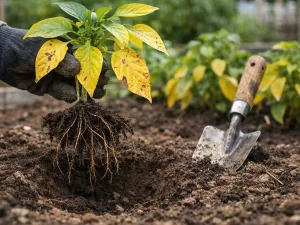
As a quick check, dig a small hole and look for roots: lots of fine, pale roots spread through the profile is a good sign. If roots are circling, clumped near the surface, or missing below a hard layer, the soil’s physical condition is likely the limiting factor—not just nutrients.
Nutrient uptake from soil
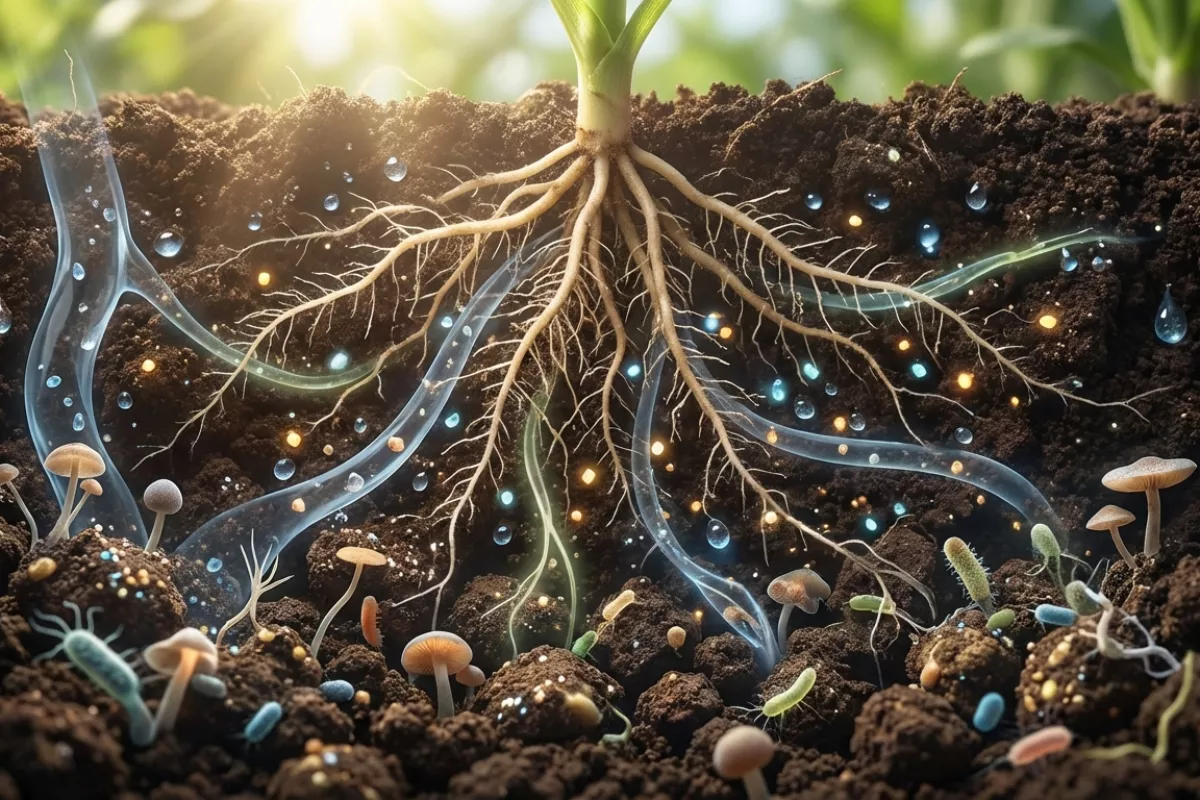
Plants don’t “eat” dirt; they absorb dissolved nutrients and water through roots. That process depends on how minerals are held on soil particles, how easily water moves through pore spaces, and whether roots and microbes can stay active. When any of those pieces are off, you can have plenty of fertilizer present but very little actually entering the plant.
Most essential elements reach roots in three main ways: mass flow (nutrients moving with water toward the root), diffusion (ions moving from higher to lower concentration near the root surface), and root interception (roots physically growing into new soil). Soil texture and structure influence all three by controlling drainage, aeration, and how long moisture stays available after rain or irrigation.
- pH controls availability. Many nutrients become less soluble outside a moderate pH range. In acidic conditions, aluminum and manganese can become overly available and stress roots; in alkaline conditions, iron, zinc, and phosphorus often become harder to access.
- Organic matter acts like a nutrient reservoir. As it decomposes, it releases nitrogen, sulfur, and micronutrients, and it also improves cation exchange capacity so potassium, calcium, and magnesium are held in a plant-available form instead of washing away.
- Soil moisture is a delivery system. Too dry and diffusion slows; too wet and oxygen drops, reducing root respiration and limiting uptake even if the soil solution is nutrient-rich.
- Compaction blocks roots and air. Dense soil reduces pore space, making it harder for roots to explore and for oxygen to reach them. This can mimic nutrient deficiency symptoms because the plant can’t access what’s there.
- Temperature sets the pace. Cool soils slow microbial mineralization and root activity; warm soils speed processes up until heat or drought stress takes over. Even a shift of 10°C (18°F) can noticeably change nutrient release and demand.
| Soil factor | What it changes | Common plant sign | Practical adjustment |
|---|---|---|---|
| pH too low (acidic) | Higher solubility of some metals; reduced availability of phosphorus, calcium, magnesium | Stunting, purpling, weak roots | Use lime where appropriate; add organic matter; avoid over-acidifying fertilizers |
| pH too high (alkaline) | Lower availability of iron, zinc, manganese; phosphorus ties up | Yellowing between veins on new leaves | Use acid-forming amendments when suitable; choose chelated micronutrients; add compost |
| Low organic matter | Less nutrient storage and slower nutrient cycling | Pale growth, uneven vigor | Incorporate compost, mulch, cover crops; reduce excessive tillage |
| Compaction/poor structure | Restricted rooting, low oxygen, reduced water infiltration | Wilting despite moist soil, shallow roots | Avoid working wet soil; add organic matter; use deep-rooted cover crops; aerate if appropriate |
| Waterlogged conditions | Oxygen loss; altered nitrogen forms (denitrification) | Yellowing, slow growth, root rot risk | Improve drainage; raise beds; adjust irrigation timing and volume |
| Droughty/sandy soil | Fast leaching; limited mass flow to roots | Leaf scorch, frequent deficiency symptoms | Mulch; increase organic matter; split fertilizer applications; irrigate more evenly |
Microbes also do a lot of the behind-the-scenes work. Mycorrhizal fungi extend the effective root system and can improve access to phosphorus and water, while bacteria drive nitrogen transformations that determine whether nitrogen is available or lost. Supporting that biology with steady moisture, organic inputs, and minimal compaction often improves nutrient efficiency more than simply increasing fertilizer rates.
Moisture retention effects
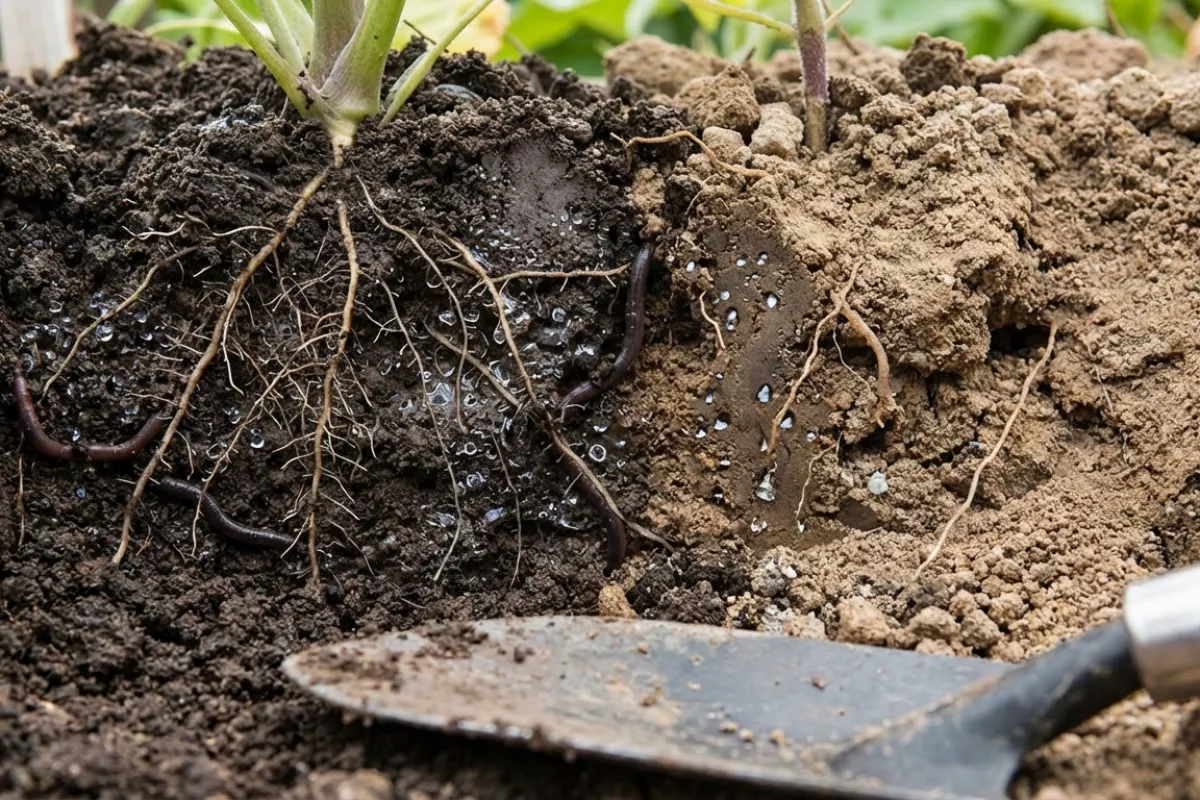
How long water stays available in the root zone shapes almost everything about plant performance, from steady leaf growth to how well roots can access nutrients. Soil that holds a useful amount of water between irrigations buffers plants from short dry spells, while soil that drains too fast (or stays saturated) can trigger stress even when you’re watering “enough.”
The goal isn’t maximum water storage; it’s the right balance of water and air. Roots need oxygen to function, so a soil that stays waterlogged after rain or irrigation can reduce root respiration and invite rot. On the other hand, very fast-draining mixes can dry out in a day during hot weather, forcing plants into repeated wilt-and-recover cycles that slow growth.
- Texture sets the baseline. Sandy soils drain quickly and often need smaller, more frequent watering. Clay-heavy soils can store more water but may hold it too tightly or drain slowly, especially when compacted.
- Organic matter acts like a sponge. Compost, leaf mold, and well-decomposed organic material increase water-holding capacity while also improving structure, which helps water soak in rather than run off.
- Soil structure controls infiltration and storage. Stable aggregates create a mix of pore sizes: larger pores move water and air; smaller pores retain water for later use. Compaction collapses pores and can cause puddling at the surface even when deeper layers are dry.
- Salts and poor drainage change the “usable” water. In saline conditions, plants may struggle to take up water even when soil seems moist, because the roots must work against osmotic pressure.
- Mulch reduces losses. A mulch layer around 5 cm (2 in) to 8 cm (3 in) can cut evaporation and soften temperature swings, helping the root zone stay evenly damp.
| Soil type / condition | Typical water behavior | What plants often show | Practical adjustment |
|---|---|---|---|
| Sandy or very gritty soil | Rapid drainage; low storage between waterings | Quick wilting on warm days; uneven growth | Water more often in smaller doses; add organic matter and mulch |
| Loam with good structure | Balanced holding capacity and aeration | Steady growth; fewer stress swings | Maintain with compost top-dressing and minimal compaction |
| Clay-heavy, compacted soil | Slow infiltration; can stay saturated, then crack when dry | Yellowing, stunting, root problems after heavy watering | Improve drainage with organic matter; avoid working soil when wet; relieve compaction |
| Raised beds / container mixes | Drain faster due to gravity and airflow at sides | Frequent drying; salt buildup if over-fertilized | Use water-retentive amendments; flush occasionally; monitor moisture depth |
A simple way to judge whether your soil is holding water appropriately is to check moisture below the surface, not just the top layer. Dig down about 10 cm (4 in): if it’s dusty and dry, you’re likely losing water too quickly; if it’s sticky and smells sour, drainage and aeration are probably limiting root health.
Soil microorganisms and plant health
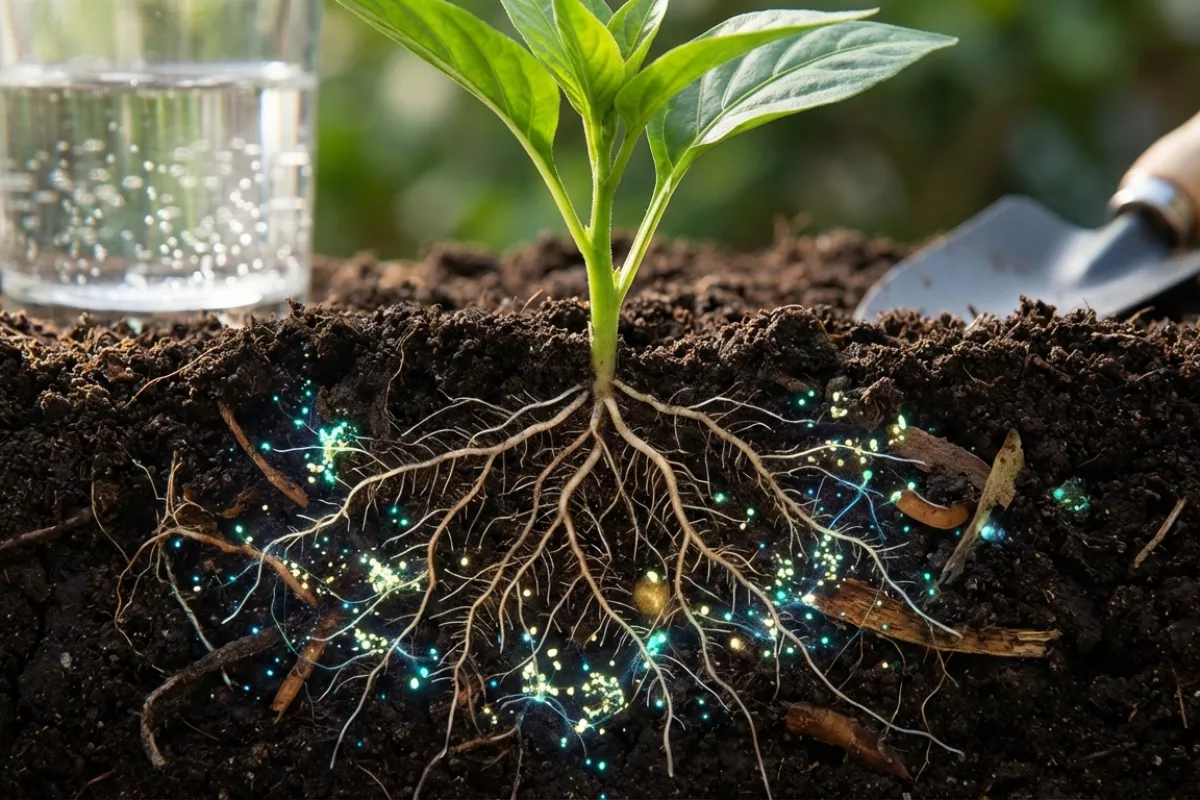
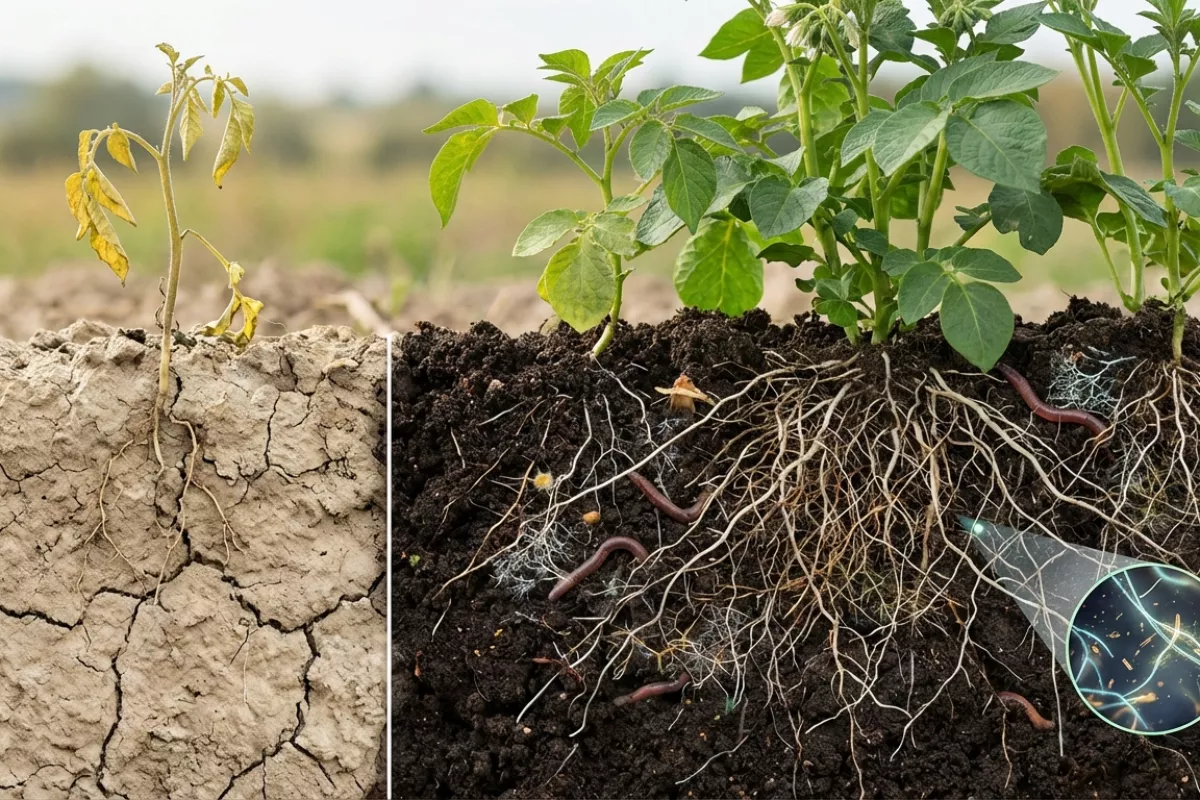
Most of what plants “eat” is processed by living organisms in the soil. Bacteria, fungi, archaea, protozoa, and beneficial nematodes break down organic matter, release nutrients in plant-available forms, and influence how roots grow and defend themselves. When this underground community is diverse and active, plants tend to handle stress better and make more efficient use of water and fertilizer.
These organisms don’t just float around randomly. Many gather in the rhizosphere—the thin zone around roots where plants leak sugars and other compounds. In exchange, microbes help with nutrient cycling, produce growth-promoting substances, and compete with disease-causing organisms. The result is a kind of “biological buffering” that can make the difference between a plant that limps along and one that thrives.
- Nutrient release and recycling: Decomposers convert dead plant material into simpler compounds, gradually releasing nitrogen, phosphorus, and micronutrients. This reduces nutrient losses and helps prevent sudden deficiency swings.
- Improved nutrient access: Some bacteria and fungi solubilize phosphorus and other minerals that would otherwise stay locked in soil particles, making them easier for roots to absorb.
- Root expansion and water uptake: Mycorrhizal fungi extend threadlike hyphae beyond the root zone, effectively increasing the plant’s “reach” into small pores where water and nutrients sit.
- Disease suppression: Beneficial microbes crowd out pathogens, produce natural antibiotics, and trigger plant immune responses, lowering the odds of root rots and wilts taking hold.
- Soil structure building: Fungal networks and microbial byproducts help bind soil into stable aggregates, improving aeration, drainage, and moisture retention.
| Microbe group | What they do for plants | Common signs they’re active |
|---|---|---|
| Decomposer bacteria | Break down fresh residues; release nitrogen and micronutrients as they cycle | Faster breakdown of mulch/compost; fewer nutrient “crashes” after watering |
| Actinomycetes | Decompose tougher materials; produce compounds that can suppress some pathogens | Earthy smell after rain or irrigation; crumbly topsoil |
| Mycorrhizal fungi | Expand nutrient and water capture; improve phosphorus uptake; support stress tolerance | Better performance in dry spells; improved transplant establishment |
| Protozoa and beneficial nematodes | Graze on bacteria and fungi, releasing plant-available nutrients in the process | Steady, moderate growth without heavy feeding; fewer pest outbreaks in balanced soils |
If you want to support this living network, focus on habits that keep food and habitat in place. Add organic matter (compost, leaf mold, or well-aged manure), avoid leaving soil bare, and minimize aggressive tilling that tears up fungal strands and collapses aggregates. Also be cautious with broad-spectrum pesticides and repeated high-salt fertilizers; they can reduce microbial diversity and push the system toward more disease-prone conditions.
Moisture and oxygen matter as much as “fertility.” Microbes need water, but they also need air spaces—waterlogged soil can turn anaerobic and shift biology toward organisms that produce compounds harmful to roots. A simple goal is evenly moist soil with good drainage, plus mulch to reduce temperature swings and evaporation. Over time, a biologically active soil becomes easier to manage because it holds structure, cycles nutrients more predictably, and helps plants stay resilient.
Problems caused by poor soil
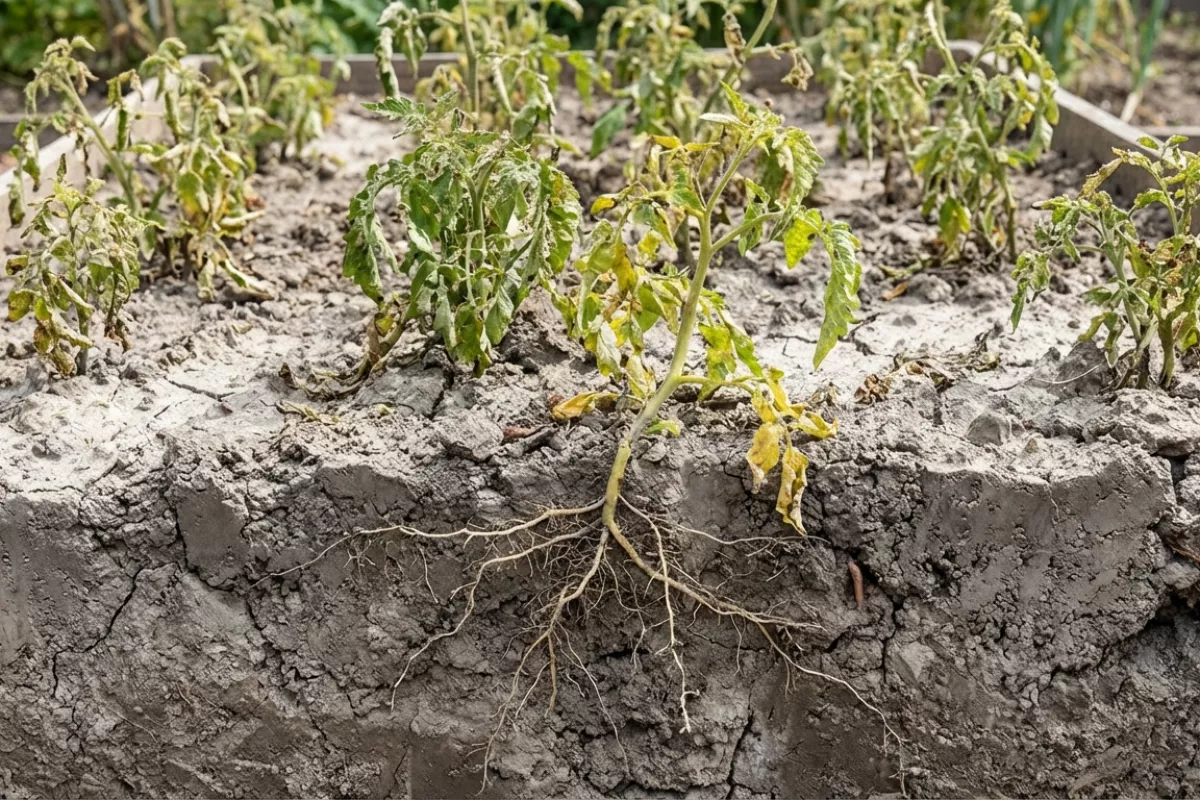
When the ground is compacted, unbalanced, or low in organic matter, plants often struggle even if you water and fertilize regularly. The root zone becomes a bottleneck: roots can’t explore, oxygen is limited, and nutrients either lock up or wash away. The result is slow growth, uneven performance across the garden, and higher susceptibility to pests and disease.
| Soil issue | What you’ll notice above ground | What’s happening below ground | Common knock-on effects |
|---|---|---|---|
| Compaction and poor aeration | Stunted growth, wilting on warm days even after watering, shallow roots when you pull a plant | Low oxygen and high resistance make it hard for roots to expand; beneficial microbes decline | Nutrient uptake drops; plants become more prone to root diseases |
| Poor drainage or waterlogging | Yellowing leaves, slow growth, sudden collapse after heavy rain | Water fills pore spaces, pushing out oxygen; roots suffocate and rot organisms thrive | Root rot, fungus gnat problems, reduced flowering/fruiting |
| Low water-holding capacity (very sandy soil) | Frequent wilting, leaf scorch at edges, inconsistent growth | Water and dissolved nutrients move through too quickly for roots to capture | More frequent irrigation needs; fertilizer leaching and salt stress |
| Nutrient deficiencies or imbalances | Chlorosis (yellowing), purpling, weak stems, poor yields | Too little of key nutrients, or antagonism where one nutrient blocks another (for example, excess potassium limiting magnesium) | Reduced photosynthesis; delayed maturity; lower resilience to stress |
| pH too acidic or too alkaline | “Fertilizer doesn’t work” symptoms, patchy growth, micronutrient deficiency signs | Nutrients become less available outside the preferred pH range; some elements can become overly available and toxic | Iron or manganese issues, poor root development, reduced microbial diversity |
| Low organic matter and weak soil structure | Crusting on the surface, poor seedling emergence, plants that don’t “take off” | Fewer stable aggregates and less microbial activity; reduced nutrient storage and buffering | More erosion, bigger swings between soggy and dry conditions |
| Salinity or salt buildup | Leaf tip burn, slowed growth, plants look drought-stressed even in moist soil | High salt concentration makes it harder for roots to pull in water (osmotic stress) | Seed germination failures; long-term decline in soil biology |
| Contamination (herbicide carryover, heavy metals) | Twisted new growth, poor germination, unexplained dieback | Toxic compounds interfere with cell division, root function, or microbial communities | Crop failure risk; edible gardens may become unsafe depending on contaminant type |
These issues often stack together. For example, compacted ground tends to drain poorly, which then limits oxygen and triggers nutrient lockout. If you’re troubleshooting, look for patterns: symptoms that worsen after rain point to drainage and aeration, while problems that show up during dry spells often trace back to low water retention or shallow rooting.
How to optimize soil for growth
Better plant performance starts with getting the basics right: structure, drainage, nutrients, and a living soil food web. The goal is to create a root zone that holds moisture without staying soggy, contains enough air for respiration, and supplies steady nutrition rather than spikes and crashes.
- Test first, then change one thing at a time. A simple soil test (or at least a pH test) prevents guesswork. Retest after a season so you can see whether your adjustments actually moved the needle.
- Dial in pH for nutrient availability. Most garden plants take up nutrients best in slightly acidic to neutral conditions, roughly pH 6.0–7.0. If soil is too acidic, lime can raise pH; if it’s too alkaline, elemental sulfur or acid-forming organic materials can help. Make changes gradually—large swings can stress roots and soil microbes.
- Improve structure with organic matter. Compost, leaf mold, and well-rotted manure increase aggregation, which boosts both water-holding capacity and aeration. As a practical starting point, top-dress with about 2–5 cm (1–2 in) of finished compost and let earthworms and watering move it downward over time.
- Fix drainage and compaction at the source. If water puddles for hours after rain, roots can suffocate. Avoid working soil when it’s wet, reduce foot traffic, and use paths to protect beds. For heavy clay, repeated organic additions and deep-rooted cover crops are usually more effective than mixing in sand, which can create a concrete-like texture if the ratios aren’t right.
- Balance fertility instead of overfeeding. Nitrogen drives leafy growth, phosphorus supports rooting and flowering, and potassium helps stress tolerance. Too much fertilizer—especially quick-release nitrogen—can cause weak, lush growth and salt buildup. Slow-release sources (compost, balanced organic blends) tend to feed plants and microbes more evenly.
- Mulch to stabilize moisture and temperature. A mulch layer reduces evaporation, buffers heat, and limits weed competition. Apply 5–8 cm (2–3 in) of straw, shredded leaves, or bark around plants, keeping a small gap around stems to reduce rot risk.
- Water in a way that encourages deep roots. Frequent light watering keeps roots near the surface. Instead, water thoroughly, then allow the top layer to dry slightly before watering again. In many soils, wetting to roughly 15–25 cm (6–10 in) is a useful target for established plants.
- Support soil biology. Microbes and fungi help cycle nutrients and improve aggregation. Minimize unnecessary tilling, keep living roots in the ground when possible (cover crops or interplanting), and avoid broad-spectrum pesticides that can disrupt beneficial organisms.
| Soil issue you notice | What it often means | Practical adjustment |
|---|---|---|
| Water pools or soil stays slick and sticky | Poor drainage, compaction, low oxygen in the root zone | Add organic matter, protect beds from traffic, consider raised beds, and use deep-rooted cover crops to open channels |
| Soil dries fast and feels gritty | Low water-holding capacity, often sandy texture | Top-dress compost, mulch 5–8 cm (2–3 in), and water less often but more deeply |
| Plants look pale despite watering | Possible nitrogen deficiency or pH limiting uptake | Check pH, add a balanced fertilizer or compost, and avoid overwatering that leaches nutrients |
| Stunted growth with purplish leaves (common in cool weather) | Phosphorus tied up by cold soil or pH imbalance | Warm soil with mulch, correct pH gradually, and use a moderate phosphorus source if a test confirms need |
| Leaf tips brown and soil surface crusts white | Salt buildup from overfertilizing or hard irrigation water | Flush with deep watering when drainage is good, reduce fertilizer rates, and add organic matter to buffer salts |
If you’re unsure where to start, focus on compost plus mulch and a basic pH check. Those three steps improve texture, moisture management, and nutrient access in most gardens without forcing drastic changes all at once.