Aeschynanthus — Trailing Plant With Tubular Flowers and Easy Care

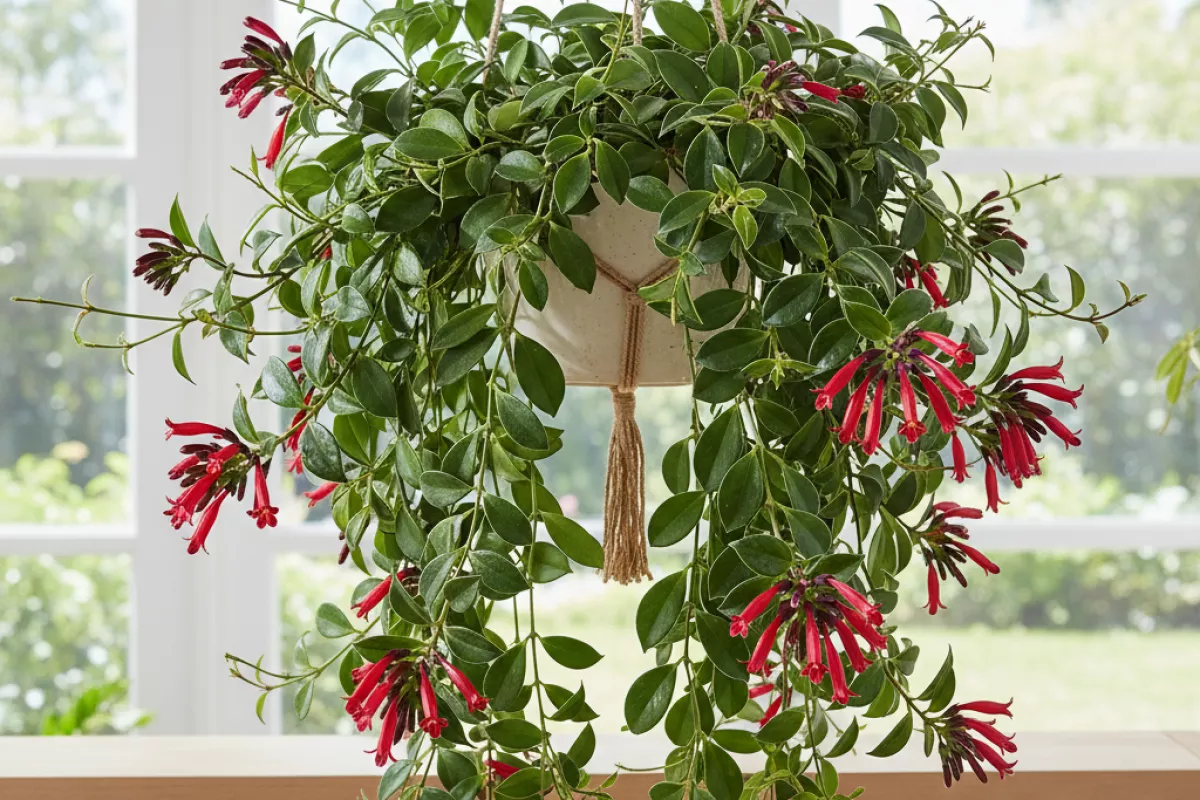 This article explains Aeschynanthus: a tropical forest trailing vine with cascading stems and seasonal tubular blooms. It covers light for flowering, soil and watering balance, temperature and humidity, routine care, propagation, and common pests and health issues.
- Aeschynanthus plant overview and trailing traits
- Native tropical forest habitats
- Growth pattern and cascading stems
- Light requirements for Aeschynanthus flowering vines
- Soil and watering balance for Aeschynanthus
- Temperature and humidity needs for Aeschynanthus
- Routine care for healthy trailing growth
- Propagation methods for trailing plants
- Seasonal blooming behavior
- Common Aeschynanthus pests and plant health issues
Aeschynanthus is an easygoing trailing houseplant with bright, tube-shaped blooms, ideal for shelves or hanging baskets. It stays neat, flowers repeatedly with consistent care, and can handle occasional missed waterings. For the best growth, vivid color, and more blooms, focus on bright light, even watering without soggy soil, and light pruning to encourage branching.
Aeschynanthus plant overview and trailing traits
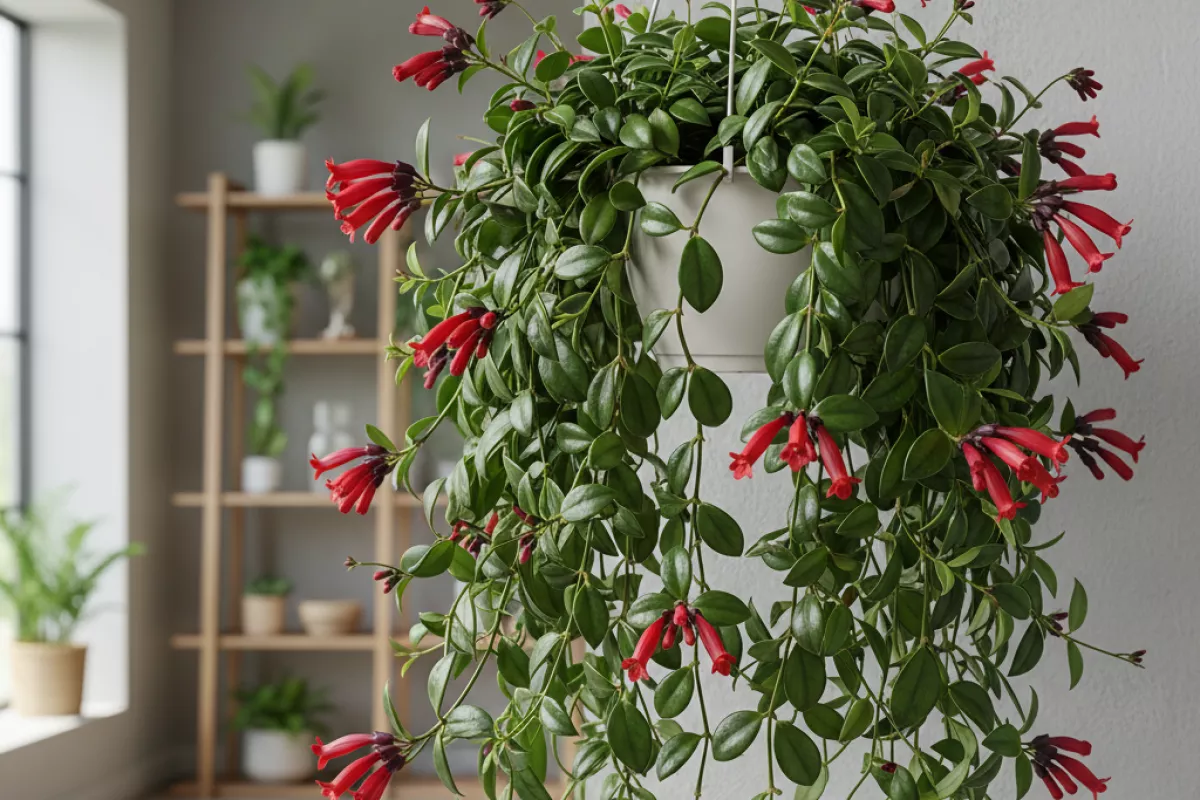
This genus of tropical epiphytes (often called lipstick plants) is grown mainly for its arching, cascading stems and clusters of tubular blooms that look like they’re emerging from a “tube.” In the home, it behaves like a relaxed, hanging houseplant: stems drape naturally, leaves stay fairly dense, and flowering tends to happen when the plant gets bright light and steady care.
Most species and hybrids have glossy, slightly succulent leaves that store a bit of moisture, which is part of why they’re forgiving if you’re occasionally late with watering. The flowers are typically red to orange-red, though some cultivars lean coral, yellow, or bicolor. Blooms form near the tips of trailing growth, so the plant looks best when it has room to spill over the edge of a pot or basket.
- Growth habit: Trailing to semi-trailing stems that branch with time; great for hanging baskets, high shelves, and wall planters.
- Typical size indoors: Stems commonly reach 30–90 cm (12–35 in) depending on variety and conditions, with a similar spread as it fills out.
- Texture and look: Leafy, draping silhouette; flowers add bold, tube-shaped accents at stem ends.
- How it climbs (or doesn’t): It isn’t a true climber and won’t attach to supports; it simply hangs and arches.
- Where flowers appear: Mostly on newer growth near the tips, which is why light pruning after flowering can encourage a fuller, bloomier plant.
Its trailing nature also affects day-to-day care. Because the stems hang, the top of the pot can dry faster than you expect while the center stays damp, especially in deep containers. A shallow hanging basket often dries more evenly and shows off the drape better than a tall pot.
| Trait | What it means in a home setting |
|---|---|
| Epiphytic roots (in nature) | Prefers airy, fast-draining mixes and dislikes sitting in soggy soil for long. |
| Trailing stems | Looks best elevated; rotate the pot occasionally for even growth and a balanced cascade. |
| Blooms on newer tips | Pinching or trimming 2–5 cm (1–2 in) after flowering can promote branching and more future bud sites. |
| Slightly succulent leaves | Tolerates brief dryness better than constant wetness; leaves may wrinkle a bit when very thirsty. |
| Compact nodes and leaf density | Good light keeps internodes shorter; low light can cause sparse, “stringy” growth. |
Native tropical forest habitats

These plants come from warm, humid forest regions where light is filtered through tree canopies and air movement is gentle. In the wild, many Aeschynanthus species live as epiphytes or lithophytes, clinging to branches, mossy trunks, or rocky crevices rather than rooting in deep soil. That background explains why they prefer bright, indirect light, steady moisture, and a potting mix that drains fast but doesn’t dry out instantly.
Forest conditions also shape how the plant grows. Long, trailing stems help it reach pockets of light along branches, while the tubular flowers are well-suited to pollinators that can hover or probe into narrow blooms. Indoors, you’re essentially trying to mimic a sheltered perch in a tree: airy roots, consistent warmth, and humidity that doesn’t turn the pot soggy.
- Light: Dappled sun to bright shade under the canopy; direct midday sun is often blocked by leaves and branches.
- Moisture pattern: Frequent rain or mist followed by quick drying on bark or rock surfaces, so roots get oxygen between waterings.
- Humidity: Commonly high, often around 60–90% relative humidity, especially in sheltered forest layers.
- Temperature: Generally warm and stable, often around 18–30°C (64–86°F), with little tolerance for cold snaps.
- Rooting surface: Moss, decaying leaf litter caught in branch forks, or thin organic debris on stone—nutrient light but regularly replenished.
- Airflow: Not windy, but not stagnant; gentle movement helps foliage dry after moisture and reduces rot risk.
| In the forest | What to copy at home |
|---|---|
| Filtered light under a canopy | Bright, indirect light near an east window or set back from a south/west window behind a sheer curtain |
| Roots on bark/rock with rapid drainage | Chunky, airy mix (for example, bark + perlite + a little coco coir/peat) in a pot with drainage holes |
| Regular moisture with oxygen between rains | Water thoroughly, then let the top 2–3 cm (0.8–1.2 in) dry before watering again |
| Warm, humid air | Keep 18–27°C (64–81°F) and aim for moderate-to-high humidity; group plants or use a humidifier if air is very dry |
If your Aeschynanthus struggles, the habitat clues usually point to the fix: pale leaves and few blooms often mean not enough light; limp stems can mean either dry roots or roots that stayed wet too long; and crispy edges often show up when humidity is low or the plant gets hot, direct sun. Thinking “tree-branch conditions” tends to solve most care puzzles.
Growth pattern and cascading stems
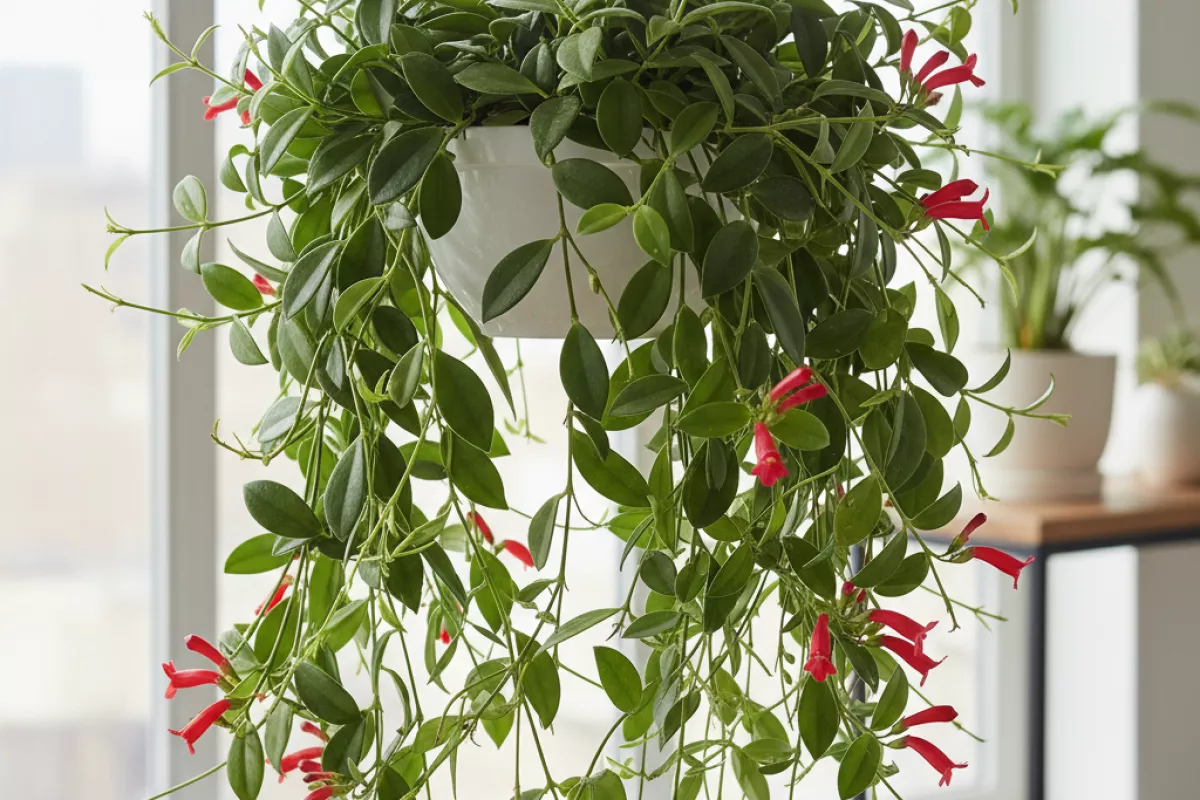
Aeschynanthus naturally grows as a trailing epiphyte, sending out flexible, leafy shoots that drape rather than stand upright. New growth starts near the tips, then lengthens into long, rope-like lines that look best when the plant can spill over the edge of a pot or basket.
Most types form a dense crown at the base and then extend outward, so the plant gets fuller with time as side shoots branch from older stems. If it seems sparse, it usually isn’t “unhappy” so much as it needs a bit more light or a light prune to encourage branching.
- Stem habit: Soft, arching stems that gradually become more pendulous as they lengthen; they’re not meant to climb without support.
- How it fills in: Branching happens at nodes along the stems, especially after pinching or trimming the tips.
- Typical drape length indoors: Often 30–90 cm (12–35 in) over time, depending on variety, light, and pot size.
- Leaf spacing: In brighter conditions, leaves tend to sit closer together for a fuller look; in lower light, internodes stretch and the plant looks “leggy.”
- Flower placement: Tubular blooms usually form toward the ends of mature stems, so letting shoots reach some length before cutting can improve flowering.
To show off the cascading look, give it room to hang and keep the stems from being constantly bumped or twisted. Rotating the pot every week or two helps keep the drape even, since stems will lean toward the brightest side.
If you want a thicker curtain of foliage, trim back a few of the longest runners by about 5–10 cm (2–4 in) and use those cuttings to start new plants or to tuck back into the pot. That combination of pruning and replanting is the easiest way to turn a few strands into a fuller, layered cascade.
Light requirements for Aeschynanthus flowering vines
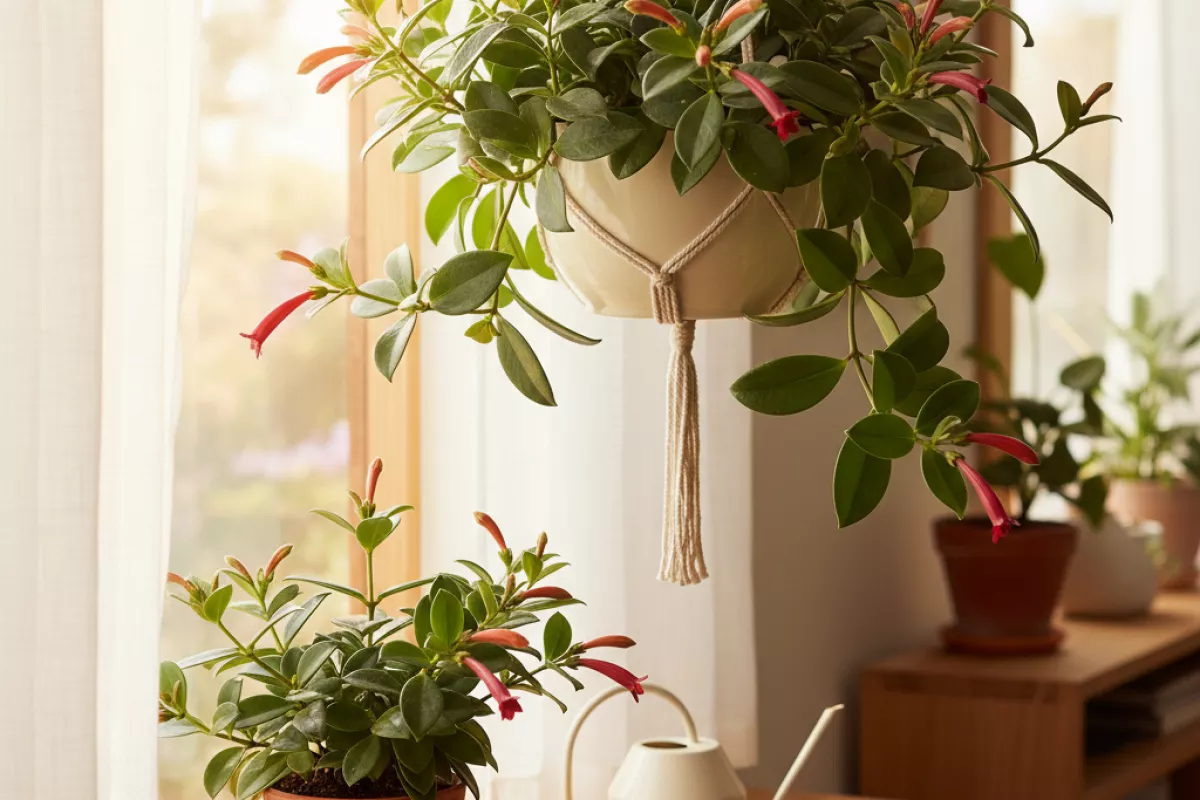
Give this trailing plant plenty of brightness, but keep it out of harsh, direct midday sun. The goal is strong, filtered light that supports dense foliage and bud formation without scorching the leaves.
- Best window exposure: An east window is ideal for gentle morning sun. A bright north window can work if the room is very well lit. South or west windows are fine if you diffuse the sun with a sheer curtain or place the pot about 30–90 cm (12–36 in) back from the glass.
- How much direct sun is safe: Up to 1–3 hours of mild morning sun is usually helpful. Avoid intense afternoon rays, especially in summer, which can bleach foliage and dry the pot too fast.
- Signs it needs more light: Long, thin stems with wide gaps between leaves, smaller new leaves, slow growth, and few or no blooms. If you see this, move it closer to the window in small steps of about 15–30 cm (6–12 in) every week.
- Signs it’s getting too much sun: Pale patches, crispy edges, or a dull, washed-out look. Shift it to brighter shade, or use a sheer curtain to soften the light.
- Seasonal adjustments: In winter, it often benefits from being closer to the brightest window because day length and intensity drop. In summer, provide more diffusion or a little extra distance from the glass.
- Artificial lighting: If natural light is limited, a grow light can keep growth compact and encourage flowering. Aim for about 10–12 hours per day, keeping the lamp roughly 20–40 cm (8–16 in) above the foliage, and adjust if leaves fade or stretch.
For reliable flowering, keep the light consistent once buds start forming. Frequent moves between dim and bright spots can cause bud drop, so make changes gradually and then let the plant settle.
| Light situation | What you’ll notice | Simple fix |
|---|---|---|
| Too little light | Leggy growth, fewer blooms, slow drying soil | Move closer to a bright window or add a grow light 10–12 h/day |
| Bright, indirect light (ideal) | Compact stems, healthy leaf color, better bud set | Maintain position; rotate the pot weekly for even growth |
| Too much direct sun | Leaf scorch, bleaching, crispy edges, rapid drying | Use a sheer curtain or pull back 30–90 cm (12–36 in) from the window |
| Inconsistent light | Buds abort or drop, uneven growth direction | Stop relocating; make small adjustments and keep conditions steady |
Soil and watering balance for Aeschynanthus
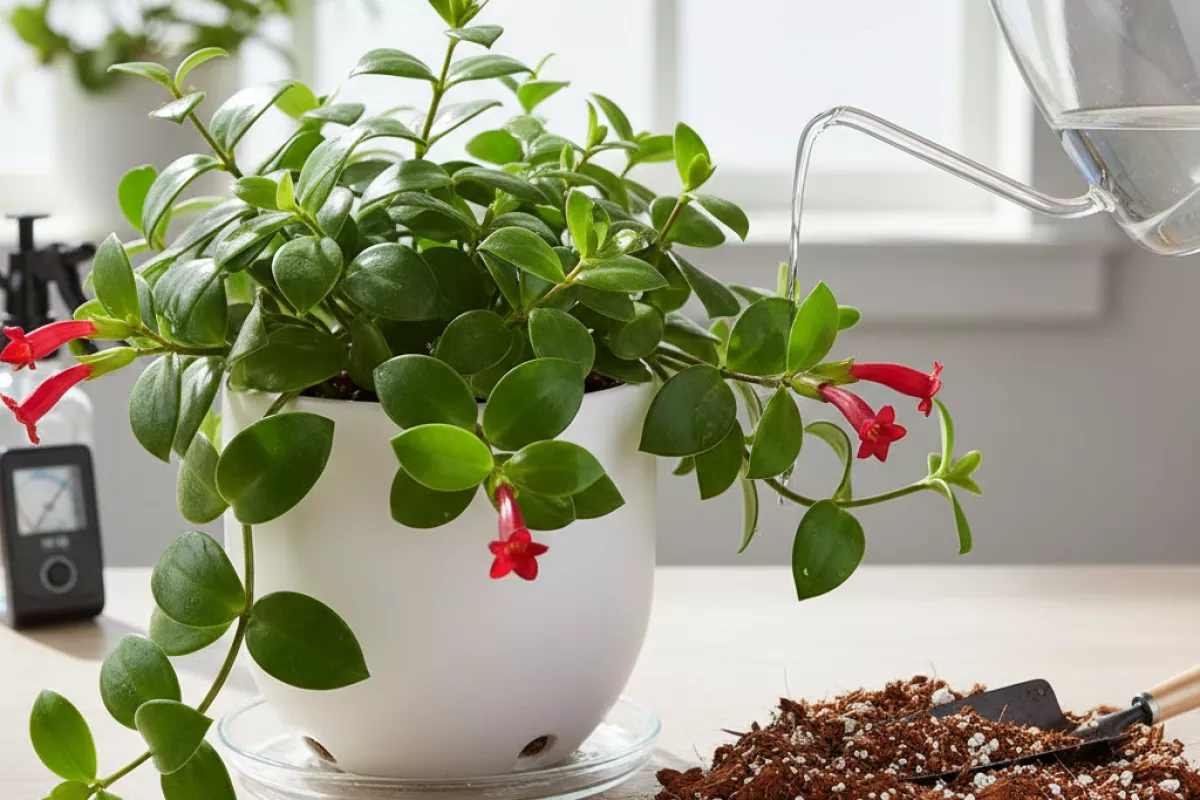
Healthy growth comes down to two things: a potting mix that drains fast and a watering routine that lets the roots breathe. Aeschynanthus stores some moisture in its fleshy leaves and stems, so it prefers an “evenly moist, never soggy” rhythm rather than constant wetness.
Choose a loose, airy mix so water moves through quickly and oxygen reaches the roots. A good goal is a medium that feels light in the hand and doesn’t compact after a few waterings.
- Base: high-quality houseplant mix or coco coir-based mix for consistent moisture without heaviness.
- Drainage boosters: add perlite/pumice and fine orchid bark to create air pockets and prevent waterlogging.
- What to avoid: dense garden soil, heavy peat-only blends that stay wet, or mixes that turn muddy when watered.
- Pot choice: a container with drainage holes is non-negotiable; a slightly snug pot helps prevent excess wet mix around the roots.
Water by dryness, not by the calendar. Let the upper layer dry a bit, then water thoroughly until excess drains out. Empty the saucer or cachepot so the roots aren’t sitting in runoff.
| Situation | What the plant prefers | Practical watering cue | Common mistake to avoid |
|---|---|---|---|
| Active growth (spring–summer) | Moderately moist mix with plenty of air | Water when the top 2–3 cm (0.8–1.2 in) is dry | Small “sips” that only wet the surface |
| Cooler/low-light period (fall–winter) | Slightly drier between waterings | Wait until the top 4–5 cm (1.6–2.0 in) is dry | Keeping the mix constantly damp |
| Hanging basket in bright light | More frequent moisture, still fast drainage | Check mid-week; baskets dry faster than pots | Assuming it dries evenly (edges dry first) |
| Heavy mix or oversized pot | Extra oxygen around roots | Extend the dry-down time; consider repotting into a smaller pot | Watering on schedule despite slow drying |
Read the signals. Limp leaves that perk up after watering usually mean it dried too far. Leaves that yellow and drop, plus a musty smell or constantly wet mix, point to overwatering or poor drainage. If you suspect root trouble, let the pot dry more, increase airflow, and consider refreshing the substrate with more perlite/bark.
Water quality and temperature matter. Use room-temperature water around 20–22°C (68–72°F) to avoid shocking the roots. If your tap water is very hard, occasional watering with filtered or rainwater can help reduce mineral buildup, especially if you notice crust on the soil surface.
Temperature and humidity needs for Aeschynanthus
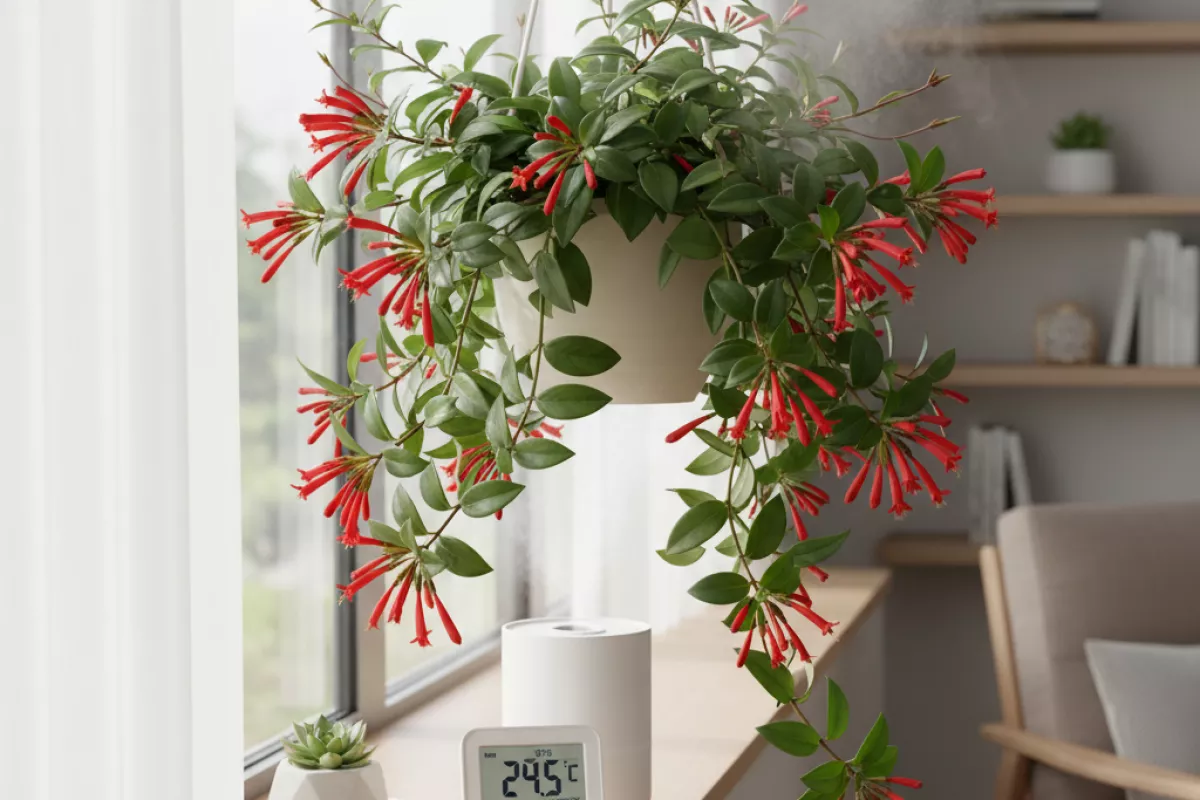
Keep this plant in a steady, warm indoor range and it will stay compact, leafy, and more willing to bloom. Big swings (especially cold drafts) are what usually trigger leaf drop, stalled growth, or buds that dry up before opening.
- Ideal daytime range: 18–27°C (65–81°F). Growth is fastest and foliage stays lush here.
- Night range: 16–21°C (60–70°F) is comfortable; slightly cooler nights can help with bud formation as long as it stays stable.
- Lower limit: try not to let it sit below 13°C (55°F). Brief dips happen, but repeated chill slows roots and can cause yellowing leaves.
- Heat notes: above 30°C (86°F), it can wilt or drop buds unless humidity is higher and the mix is evenly moist (not soggy).
Humidity matters because Aeschynanthus naturally grows in moist air. It can adapt to average homes, but it looks best with moderate to higher moisture in the air, especially in winter heating season.
- Best humidity: 50–70% is a sweet spot for plump leaves and fewer crispy edges.
- Minimum to “get by”: around 40% is usually workable, but watch for brown tips and slow growth.
- Simple ways to raise humidity: group plants together, run a humidifier nearby, or place the pot on a pebble tray with water (keep the pot base above the waterline).
- What to avoid: cold window glass, AC vents, radiators, and exterior doors. Drafts plus cool air are harder on it than warm, still air.
If you mist, do it lightly and early in the day so foliage dries by evening; constantly wet leaves in cool rooms can invite spotting. When you’re dialing in conditions, aim for consistency first, then fine-tune temperature and humidity based on how the leaves and buds respond.
Routine care for healthy trailing growth
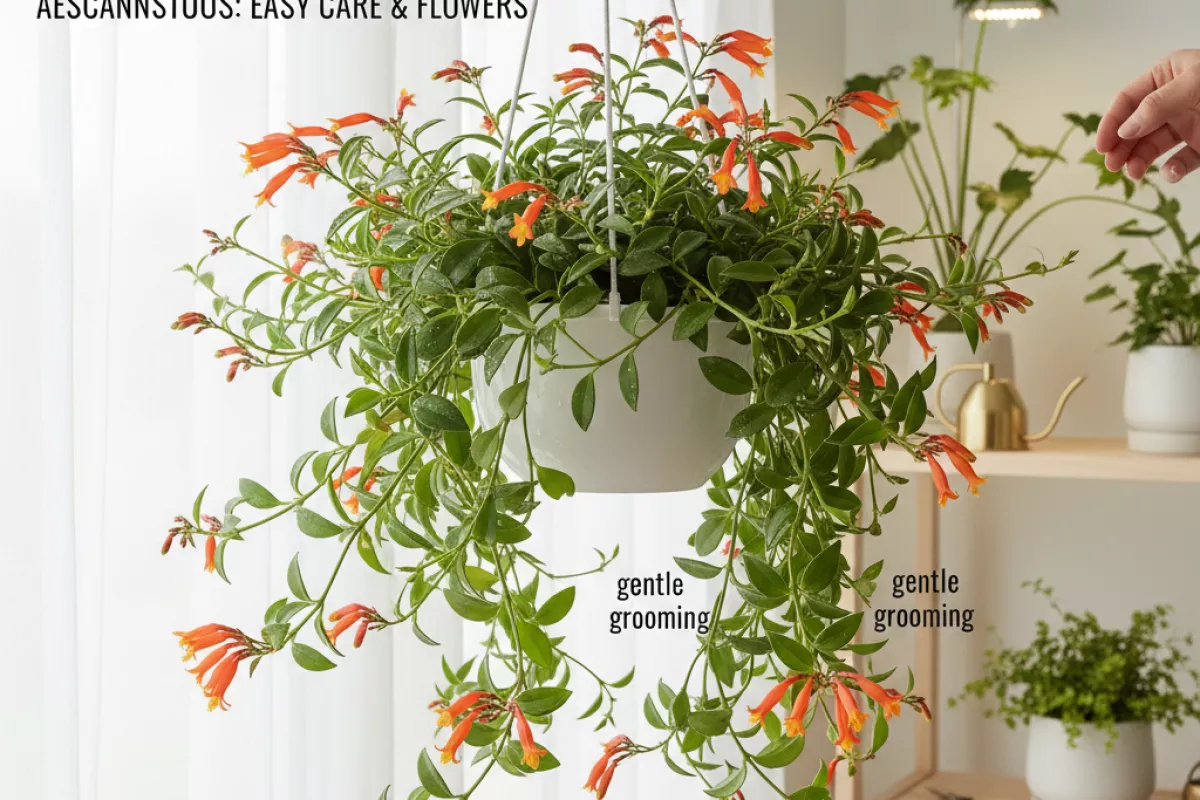
Keep your Aeschynanthus looking full and cascading by balancing light, moisture, and gentle grooming. Most problems—leggy stems, leaf drop, or reluctant flowering—trace back to either low light, inconsistent watering, or a potting mix that stays wet too long.
- Light: Aim for bright, indirect light near an east or filtered south/west window. If stems stretch and leaves space out, move it a little closer to the window or add a grow light. Avoid harsh midday sun that can scorch leaves.
- Watering rhythm: Water thoroughly, then let the top 2–3 cm (0.8–1.2 in) of mix dry before watering again. Empty the saucer so roots don’t sit in water. In winter, growth slows, so the plant usually needs less frequent watering.
- Humidity and airflow: Average indoor humidity is often fine, but steadier humidity helps prevent crispy leaf edges. If your home is dry, group plants or use a humidifier. Keep air moving gently; stagnant, humid corners can invite pests.
- Temperature: A comfortable indoor range works best—about 18–27°C (65–81°F). Try to avoid cold drafts and temperatures below 13°C (55°F), which can trigger leaf drop and stalled growth.
- Soil and pot choice: Use a chunky, fast-draining mix (for example, potting mix cut with orchid bark and perlite). A pot with drainage holes is non-negotiable. If the mix stays wet for days, roots can decline quickly.
- Feeding: During active growth, feed lightly every 2–4 weeks with a balanced fertilizer at half strength. If you’re seeing lots of leaves but few blooms, ease up on nitrogen-heavy feeding and keep light levels high.
- Pruning for a thicker cascade: Pinch or trim back long, bare sections after flowering or whenever stems get straggly. Cutting just above a leaf node encourages branching, which makes the plant look fuller in a hanging pot.
- Support and placement: Let stems trail freely from a shelf or hanger, and rotate the pot every week or two so one side doesn’t become sparse. Avoid brushing stems against high-traffic areas where they can snap.
| What you notice | Likely cause | What to adjust |
|---|---|---|
| Long gaps between leaves, “stringy” growth | Not enough light | Move to brighter indirect light or add a grow light; rotate weekly |
| Yellowing leaves, soft stems, soil stays damp | Overwatering or dense mix | Let the top 2–3 cm (0.8–1.2 in) dry; repot into a chunkier, draining mix |
| Crispy edges, buds dropping | Dry air or inconsistent watering | Water more evenly; raise humidity; keep away from heater vents |
| Few or no tubular flowers | Light too low or feeding out of balance | Increase brightness; feed lightly; prune after blooming to encourage new flowering stems |
| Sticky residue or distorted new growth | Mealybugs/aphids | Rinse foliage, isolate the plant, treat with insecticidal soap; repeat weekly as needed |
Repot only when the root ball is crowded—typically every 1–2 years—moving up just one pot size (about 2–4 cm / 0.8–1.6 in wider). Too much extra soil can hold excess moisture, which is the opposite of what this trailing bloomer prefers.
Propagation methods for trailing plants
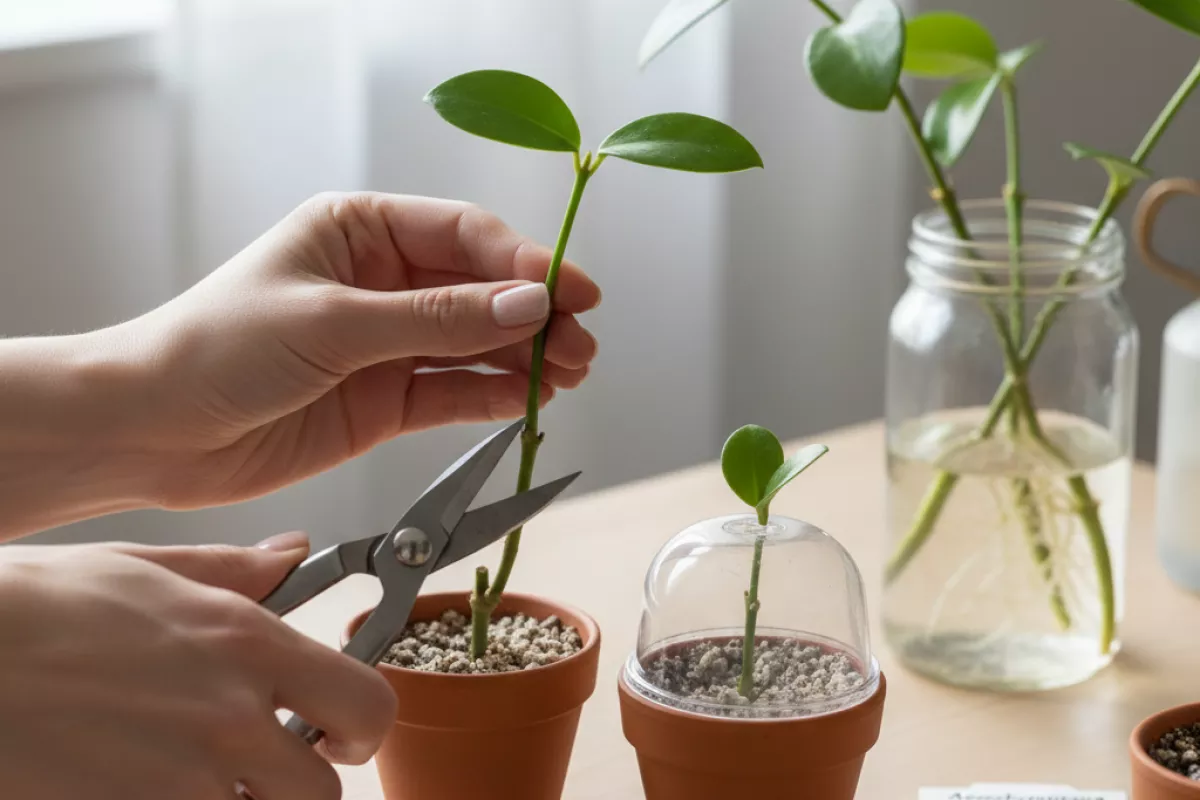
The easiest way to make new Aeschynanthus plants is to take stem cuttings from healthy, non-flowering growth. You can root them in water or in a light potting mix; both work well as long as you keep warmth, gentle moisture, and bright, indirect light consistent.
1) Stem cuttings in potting mix (most reliable)
- Pick the right stem: Choose a firm, green trailing shoot with 2–4 nodes. Cut a piece about 8–12 cm (3–5 in) long, using clean scissors.
- Prep the cutting: Remove the lowest leaves so at least 1–2 nodes are bare. If the leaves are large, trim them by about one-third to reduce moisture loss.
- Use an airy medium: A mix like 2 parts coco coir or peat + 1 part perlite works well. Moisten it so it’s damp, not dripping.
- Plant and support: Insert the cutting so the bare nodes are under the surface (about 2–3 cm / 1 in deep). Firm lightly to remove air pockets.
- Create humidity: Cover with a clear bag or place in a propagation box, leaving a small vent for airflow. Aim for 60–80% humidity.
- Warmth and light: Keep at 21–24°C (70–75°F) in bright, indirect light. Avoid hot sun on the cover.
- Watering: Keep the mix lightly moist. If condensation is heavy, vent more to prevent rot.
- Check for roots: In about 3–6 weeks, gentle resistance when tugged usually means rooting. Pot up once you see new growth.
2) Water rooting (simple for beginners)
- Set up: Place a prepared cutting in a glass so 1–2 nodes sit in water, with leaves kept above the surface.
- Change water: Refresh every 3–5 days to keep oxygen levels up and reduce bacterial buildup.
- Timing: Roots often appear in 2–5 weeks. Move to potting mix when roots reach about 2–4 cm (1–1.5 in) long; longer water-roots can struggle more during transfer.
- Transition tip: After potting, keep humidity slightly higher for 7–10 days to help the cutting adapt.
3) Layering (low-risk, slower)
If you don’t want to cut the plant right away, layering is a gentle option. Pin a section of trailing stem onto the surface of a nearby pot filled with the same airy mix, making sure a node touches the medium. Keep that spot evenly moist. Once it roots (often 4–8 weeks), you can cut the connection to the mother plant and pot it up.
| Method | Best for | Typical time to roots | Common pitfall |
|---|---|---|---|
| Stem cuttings in mix | Fast, sturdy starts that transition easily | 3–6 weeks | Mix staying too wet and causing stem rot |
| Water rooting | Seeing progress and learning timing | 2–5 weeks | Weak roots if left in water too long |
| Layering | Highest success with minimal stress | 4–8 weeks | Node not in contact with the medium |
| Division (rare for Aeschynanthus) | Only if the plant has multiple rooted crowns | Immediate (already rooted) | Breaking brittle stems and setting growth back |
Small details that improve success
- Timing: Late spring through summer is easiest, when growth is active and light levels are higher.
- How many per pot: Plant 3–5 cuttings in one 10–12 cm (4–5 in) pot for a fuller trailing look.
- Aftercare: Once established, gradually reduce humidity and let the top 2–3 cm (1 in) of mix dry slightly between waterings.
- Avoid setbacks: Skip fertilizer until you see new growth; then feed at quarter strength.
Seasonal blooming behavior
Blooming in Aeschynanthus tends to come in waves rather than as a constant trickle of flowers. Most plants ramp up bud production when days are brighter and growth is active, then slow down when light levels drop or the plant is recovering from a heavy flush.
Indoors, the calendar is flexible: a plant near a bright window may flower from late spring into summer, while one under steady grow lights can shift its timing. What matters more than the month is whether the plant is making fresh trailing growth and getting enough light to fuel buds.
- Spring to summer: Most common peak. New shoots elongate and mature, and buds form at the tips. Keep conditions steady so developing buds don’t abort.
- Late summer to early fall: Many plants produce a second, lighter round of tubular flowers if they weren’t stressed by heat or drought.
- Late fall to winter: Often a rest or slow-growth phase indoors. Flowering can still happen, but it’s usually sparser unless light is strong and consistent.
Temperature and day length influence the rhythm. Aim for warm, stable growing conditions during the active season, roughly 18–27°C (65–81°F). If your home runs cooler in winter, keeping nights around 15–18°C (59–65°F) can help the plant “reset” without forcing it into a hard stop, but avoid cold drafts that can cause bud drop.
The biggest driver is light. When the plant is bright enough to grow, it’s bright enough to bloom. If you notice long gaps between leaves (leggy trails) and few buds, increase light gradually. If using a grow light, a consistent schedule (for example, 12–14 hours daily) often keeps growth steady and can encourage off-season flowering, though the flushes may still come in cycles.
| Seasonal cue | What you’ll likely see | What to do |
|---|---|---|
| Brighter days, active growth | New tips, thicker leaves, buds forming near shoot ends | Keep evenly moist (not soggy), feed lightly, avoid moving the plant once buds appear |
| Heat spikes (above ~30°C / 86°F) | Wilting, bud drop, flowers fading quickly | Increase humidity, water earlier, provide gentle shade from harsh sun |
| Lower light and shorter days | Slower growth, fewer buds, longer internodes | Move closer to a bright window or add a grow light; reduce fertilizer |
| After a heavy bloom | Pause in flowering while the plant rebuilds | Trim only lightly, keep care consistent, let new growth mature before expecting the next flush |
Pruning affects when you’ll see flowers because buds form on newer, mature tips. If you cut back hard right before the plant’s usual flowering window, you may delay the next flush while it regrows. A good compromise is to pinch or trim lightly after a bloom cycle, removing only 2–5 cm (0.8–2 in) from overly long trails to encourage branching without sacrificing all the future bud sites.
If flowering is irregular, look for patterns: sudden drying, frequent relocation, or big swings in temperature and light are common reasons a plant “skips” a season. Once conditions stabilize, Aeschynanthus usually returns to its normal cycle within a few months of healthy new growth.
Common Aeschynanthus pests and plant health issues
Most problems on lipstick plants show up either as sticky residue, distorted new growth, or leaves that yellow and drop. The good news is that the causes are usually straightforward: sap-sucking insects, overly wet potting mix, or stress from low humidity and temperature swings.
| Symptom you notice | Likely cause | What to do | Prevention tips |
|---|---|---|---|
| Sticky leaves, shiny film, or black sooty mold | Mealybugs, scale, or aphids producing honeydew | Isolate the plant. Wipe stems and leaf undersides with a damp cloth, then treat with insecticidal soap or horticultural oil. Repeat every 7–10 days until clear. | Check leaf nodes weekly, especially on trailing stems. Avoid overfeeding; soft, lush growth attracts pests. |
| Fine webbing, stippled or bronzed leaves, leaf drop in dry rooms | Spider mites (often triggered by low humidity) | Rinse foliage thoroughly (including undersides). Follow with soap/oil treatments. Increase humidity and keep the plant away from hot, dry vents. | Maintain moderate humidity and rinse dust off leaves regularly so mites are easier to spot early. |
| White cottony clumps in joints, slow growth, distorted tips | Mealybugs hiding in nodes and along midribs | Remove visible clusters with cotton swabs, then treat the whole plant. Prune heavily infested trailing sections. | Quarantine new plants for 2–3 weeks and inspect hanging baskets where pests are easy to miss. |
| Yellowing leaves, soft stems, musty soil smell | Root rot from waterlogged mix or a pot without drainage | Unpot and trim mushy roots. Repot into an airy mix and a pot with drainage holes. Water only when the top 2–3 cm (1 in) dries. | Use a chunky, fast-draining medium and empty saucers after watering. |
| Brown leaf tips/edges, buds dropping before opening | Dry air, inconsistent watering, or hot/cold drafts | Stabilize care: water evenly, raise humidity, and move away from drafts. Aim for 18–27°C (65–81°F). | Keep conditions steady during bud formation; avoid moving the plant frequently. |
| Leaves pale, weak flowering, long bare stems | Not enough light or nutrients; old growth not pruned | Move to bright, indirect light. Feed lightly in the growing season and pinch/prune after flowering to encourage branching. | Rotate the pot for even light and trim back leggy vines by about 5–10 cm (2–4 in) when needed. |
| Small brown spots or spreading patches on leaves | Leaf spot from wet foliage + poor airflow (sometimes fungal/bacterial) | Remove affected leaves, improve airflow, and avoid splashing water on foliage. If it spreads, use an appropriate fungicide labeled for houseplants. | Water at the soil line and let the surface dry slightly between waterings. |
- Quick inspection routine: Look under leaves and along nodes once a week; pests often start where stems branch.
- When to isolate: If you see honeydew, webbing, or cottony clusters, keep the plant separate until treatments are finished.
- Don’t confuse stress with insects: Aeschynanthus can drop leaves after a cold night below about 15°C (59°F) or after repeated soggy watering, even when no pests are present.