Top Ways to Prevent Aphids Long-Term

 The article explains how to prevent aphids by keeping plants healthy and less stressed with proper watering, light feeding, clean leaves, good airflow, and stable conditions. It also covers weekly checks, rinsing plants, neem oil, insecticidal soap, companion plants, ladybugs, and removing badly infested parts.
- Maintain proper watering to avoid plant stress
- Avoid over-fertilizing, especially with nitrogen-rich feeds
- Improve airflow between plants to reduce pest spread
- Use companion plants that naturally repel aphids
- Apply neem oil regularly as a preventive treatment
- Use insecticidal soap before infestations grow
- Rinse plants with water to remove early colonies
- Encourage beneficial insects like ladybugs
- Inspect plants weekly for early detection
- Remove heavily infested plant parts immediately
- Keep plant leaves clean from dust and residue
- Stabilize plant conditions to avoid stress and weakness
Long-term aphid control works best as prevention rather than repeated rescue sprays. The most effective strategy is to make plants less attractive to pests by keeping them healthy, avoiding excess fertilizer that causes soft new growth, and inspecting new plants carefully before bringing them into the garden. It also helps to support a balanced environment where ladybugs and other natural predators can thrive. With a few steady habits, serious outbreaks become much less likely.
Maintain proper watering to avoid plant stress

Aphids are far more likely to settle on plants that are already struggling. One of the most common causes of that stress is inconsistent watering. When roots swing between being too dry and too wet, plants produce weak, soft growth and lose some of their natural ability to resist sap-sucking insects.
Good watering is not about following a rigid schedule. It is about matching moisture to the plant, the pot or bed size, the season, and the weather. A container on a hot patio may need water every day, while a shrub in open ground may only need a deep soak every several days.
How to water in a way that supports stronger growth
The goal is to keep the root zone evenly moist without leaving it soggy. Deep watering encourages roots to grow down rather than staying near the surface, and deeper roots usually mean a more resilient plant.
- Check before watering: Insert a finger 2.5 cm to 5 cm (1 in to 2 in) into the soil. If it is still damp at that depth, wait.
- Water thoroughly: Moisten the full root area rather than giving a light surface sprinkle that dries quickly.
- Adjust for weather: Heat, wind, and low humidity increase water loss, while cool cloudy periods slow it down.
- Use mulch outdoors: A layer of mulch 5 cm to 7.5 cm (2 in to 3 in) thick helps keep soil moisture steadier.
Signs watering stress may be inviting pests
Plants often show early clues before aphids become obvious. If new leaves are curling, stems are limp by midday, or growth is unusually pale and weak, review your watering habits first. Overwatered plants may also show yellowing leaves and slow growth, both of which can reduce vigor.
For indoor plants, drainage matters just as much as frequency. Pots should empty fully after watering, and saucers should not stay full for hours. Constantly wet roots create a stressed plant that is easier for pests to exploit.
Editor’s note: If you keep getting aphids on the same plant, track watering for two weeks before changing anything else. A simple note on when the soil actually dries often reveals the real problem faster than repeated spraying.
Avoid over-fertilizing, especially with nitrogen-rich feeds

Heavy feeding, especially with nitrogen-rich fertilizer, can create exactly the kind of growth aphids prefer. Fast, lush shoots are tender, full of sap, and easy for colonies to exploit. Plants may look impressively green at first, but that softness often comes with lower resistance.
Long-term prevention works better when feeding supports balanced growth rather than pushing the plant to grow as quickly as possible. This is especially important for roses, peppers, leafy ornamentals, and many houseplants that respond rapidly to rich fertilizer.
Why excess nitrogen attracts trouble
Nitrogen drives leafy growth. In moderation, that is useful. In excess, it can produce long, weak stems and oversized new leaves that are more appealing to aphids than firmer, slower-grown tissue. Repeated high-nitrogen feeding can also throw off the plant’s overall balance, reducing root development and structural strength.
Smarter feeding habits
Use fertilizer according to the plant’s growth stage and only when active growth calls for it. A dormant or slow-growing plant rarely benefits from frequent feeding.
- Read the label carefully: Apply at the recommended rate, and reduce strength for sensitive plants if needed.
- Feed during active growth: Most plants use nutrients best in spring and summer, not year-round.
- Choose balanced formulas when appropriate: Constant use of high-nitrogen products can encourage soft growth.
- Flush container soil occasionally: Running water through the pot helps remove excess salts that build up from repeated feeding.
If a plant is already producing long, weak shoots, pause fertilizer and focus on light, watering, and pruning. Correcting the environment often helps more than adding more nutrients.
Improve airflow between plants to reduce pest spread

Crowded plants create a sheltered environment where pests move easily from leaf to leaf. While aphids do not depend on stagnant air in the same way fungal diseases do, dense growth still helps colonies remain unnoticed and spread faster. Better airflow makes plants easier to inspect and less likely to stay soft and humid around the newest growth.
This matters in vegetable beds, greenhouse benches, balcony containers, and indoor plant shelves. If leaves are constantly touching, pests can travel without much interruption.
Where crowding commonly happens
Gardeners often space plants well at planting time, then forget how much they will fill in later. A bed that looked open in spring may become tightly packed by early summer. Indoors, houseplants grouped for humidity can become too compressed, especially if several have broad foliage.
Ways to open up planting areas
Improving airflow does not mean stripping plants bare. The idea is to create enough space for light and air to move through the canopy.
- Thin crowded stems: Remove a few interior shoots so air can pass through the center.
- Space containers apart: Leave at least 5 cm to 10 cm (2 in to 4 in) between pots when foliage is mature-sized.
- Train climbing plants: Tie stems to supports so leaves do not collapse into a dense mass.
- Prune surrounding growth: Nearby plants can block circulation just as much as the host plant itself.
Outdoors, try to water early in the day so foliage dries quickly and the planting area does not stay damp and still. Indoors, a gentle fan in a bright room can help, as long as it does not blast the plants continuously.
Use companion plants that naturally repel aphids

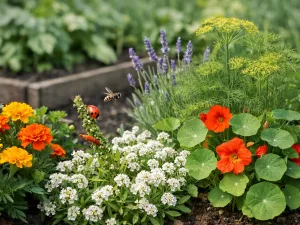
Companion planting is not a magic shield, but it can make a garden less inviting to aphids and more attractive to their natural enemies. Strongly scented herbs and flowers can confuse pest location cues, while nectar-rich plants help support hoverflies, lacewings, and parasitic wasps that feed on or attack aphids.
The best results come when companion plants are used as part of a wider prevention plan rather than as the only defense. Placement matters too. A repellent or insect-supporting plant needs to be close enough to influence the area around vulnerable crops.
Useful companion choices
Different gardens benefit from different combinations, but a few plants are repeatedly useful around susceptible vegetables, roses, and soft new ornamentals.
- Chives and garlic: Their strong smell can help mask nearby plants.
- Marigolds: Often used near vegetables and annual beds for mixed pest management benefits.
- Nasturtiums: These can act as a trap plant, drawing aphids away from more valuable crops.
- Dill, fennel, and coriander: Their flowers attract beneficial insects when allowed to bloom.
- Mint: Useful in containers near problem plants, though it spreads aggressively in open soil.
How to use them strategically
Instead of planting one companion at the far end of the garden, weave them through the growing area. Tuck herbs between vegetables, place flowering annuals along bed edges, and use trap plants where you can monitor them easily. If nasturtiums become heavily colonized, remove the worst growth before the aphids migrate back.
Practical recommendation: Companion planting works best when bloom times overlap with the period aphids usually appear in your garden. If beneficial insects arrive weeks too late, the support plants are in the wrong place or flowering at the wrong time.
Apply neem oil regularly as a preventive treatment

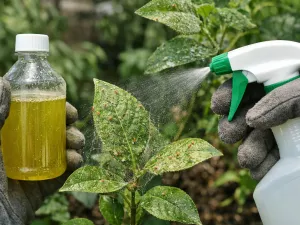
Neem oil can be a useful preventive tool when used lightly and consistently rather than as a last-minute rescue after a severe outbreak. It works by coating soft-bodied pests and, depending on the product, may also interfere with feeding and development. For long-term prevention, the key is timing and careful application.
Neem is most effective on early pest pressure and exposed insects. It is less helpful when leaves are already tightly curled or colonies are buried deep in distorted growth. That is why regular inspection and early use matter so much.
How often to use it
Frequency depends on the product label, plant type, and weather. In active growing periods when aphids are common, gardeners often apply preventively every 7 to 14 days, provided the label allows it. Outdoor applications may need repeating after heavy rain.
Safe application habits
Neem can stress plants if sprayed in strong sun or high heat. It should be applied when temperatures are mild and pollinators are less active.
- Spray early or late: Apply in the early morning or evening, not during hot midday sun.
- Cover both sides of leaves: Aphids often gather on undersides and around soft shoot tips.
- Test first: Spray a small area and wait 24 hours before treating the whole plant.
- Mix accurately: Follow the label exactly; stronger is not better and may burn foliage.
Neem should not be used so heavily that leaves stay greasy or clogged. A fine, even coating is enough. Indoor plants should be kept out of direct sun until the spray has dried fully.
Use insecticidal soap before infestations grow
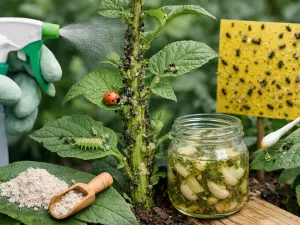
Insecticidal soap is one of the most practical ways to stop a small aphid problem from becoming a large one. It works on contact, disrupting the outer layer of soft-bodied insects. Because it does not leave a long-lasting residue, it is best used at the first sign of pests rather than after colonies have spread across multiple stems.
This treatment is especially useful on houseplants, patio containers, herbs, and tender ornamentals where quick, targeted action is possible. It is less effective if you miss hidden clusters under leaves or inside tightly packed growth.
Best stage for treatment
Soap sprays are ideal when you see scattered individuals, a few small clusters, or sticky honeydew beginning to appear. Once leaves are badly curled and aphids are sheltered inside, pruning and washing may need to come first.
Application tips that improve results
Coverage matters more than quantity. A light but thorough spray is better than drenching only the top of the plant.
- Move the plant into bright shade or wait for a cool part of the day.
- Spray shoot tips, leaf undersides, stems, and any folded new growth.
- Let the solution sit for the label-recommended time.
- Repeat after several days if fresh aphids appear, again following the product instructions.
Avoid using soap on drought-stressed plants or on foliage that is already scorched. Some plants with delicate or hairy leaves can react poorly, so a small test area is always worth doing first.
Rinse plants with water to remove early colonies
A strong rinse with plain water is one of the simplest and most underused ways to prevent aphids from gaining a foothold. Early colonies often cling to tender tips and leaf undersides, and a directed stream can dislodge many of them before they multiply. This is especially useful on sturdy outdoor plants and on indoor plants that can be moved to a sink, shower, or sheltered outdoor area.
Water rinsing works best when done early and repeated as needed. It is not a one-time cure for a severe infestation, but it can reduce numbers enough for beneficial insects or follow-up treatments to do the rest.
When rinsing makes the most sense
Use this method when you spot the first clusters, sticky residue, or a few curled leaves. It is also a good maintenance step for plants that repeatedly attract aphids each season.
How to rinse without damaging the plant
The force should be firm enough to knock pests off but not so harsh that it tears foliage or snaps stems.
- Support soft stems: Hold the stem gently while spraying delicate growth.
- Aim underneath: Most aphids gather on the lower leaf surface and around new shoots.
- Repeat regularly: Every 2 to 3 days can be effective during an early flare-up, depending on plant tolerance.
- Let foliage dry: Good airflow afterward helps prevent lingering dampness.
For potted plants, tip the pot slightly so runoff drains well and does not pool around the crown. If the soil becomes too wet from repeated rinsing, wait until the top layer dries before watering again.
Encourage beneficial insects like ladybugs
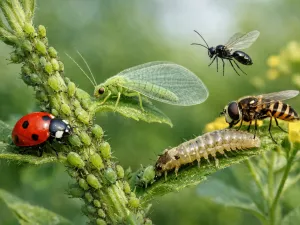
Natural predators are one of the strongest long-term checks on aphid populations. Ladybugs are the best-known example, but they are only part of the picture. Lacewing larvae, hoverfly larvae, and tiny parasitic wasps can all reduce colonies significantly when the garden gives them food, shelter, and a pesticide-light environment.
Instead of trying to eliminate every insect, aim to build a planting space where helpful species can remain active through the season. That means having some diversity in flowers, leaf shapes, and bloom timing.
What beneficial insects need
Predators and parasitoids need more than aphids. Many adults rely on nectar and pollen, especially from small open flowers that are easy to access. They also need places to rest and reproduce without being wiped out by broad-spectrum sprays.
| Beneficial insect | How it helps | What encourages it |
|---|---|---|
| Ladybugs | Adults and larvae eat aphids directly | Mixed planting, reduced pesticide use, nearby flowering herbs |
| Lacewings | Larvae feed heavily on soft-bodied pests | Yarrow, dill, and other nectar sources |
| Hoverflies | Larvae consume aphid colonies in clusters | Open flowers such as alyssum and coriander blooms |
| Parasitic wasps | Lay eggs in aphids, reducing future generations | Small flowering plants and minimal insecticide disruption |
Practices that help them stay
Grow a few flowering plants continuously through the season, avoid unnecessary spraying, and leave some low-risk habitat nearby such as mixed borders or herb patches. If you buy ladybugs, release them only where food and moisture are available; otherwise, many will simply fly away.
Editor’s note: If you see swollen, bronze-colored aphid “mummies,” do not remove them all. They often contain developing parasitic wasps that are already helping you.
Inspect plants weekly for early detection
Weekly inspection is one of the most reliable habits for preventing repeat aphid problems. Colonies can build quickly, especially on fresh spring growth, but they are much easier to control when found early. A five-minute check once a week often prevents the need for stronger action later.
The most important areas to inspect are the softest ones: shoot tips, flower buds, leaf undersides, and tightly folded new leaves. Aphids prefer these spots because the tissue is easy to pierce and rich in sap.
What to look for besides the insects themselves
Aphids are small and easy to miss at first, so indirect signs matter. Honeydew, distorted leaves, ants moving up stems, and a dull sticky sheen on foliage can all point to an early colony nearby.
- Leaf curl: New leaves twisting or puckering can hide insects inside.
- Sticky surfaces: Honeydew often appears before a large colony is obvious.
- Ant activity: Ants may protect aphids in exchange for honeydew.
- Black sooty coating: Sooty mold can develop on honeydew if the problem continues.
Make inspections more effective
Check plants in good natural light and turn leaves over rather than only looking from above. Keep a hand lens nearby if you grow roses, peppers, or indoor tropicals that produce dense new growth. It also helps to inspect after fertilizing or after a flush of new growth, since those are common times for aphids to appear.
Remove heavily infested plant parts immediately
When a stem tip or leaf cluster is already packed with aphids, removing it can be faster and more effective than trying to spray through a dense mass. This is especially true if the growth is badly curled, sticky, or stunted. Pruning out the worst area reduces the breeding population immediately and makes follow-up treatment easier.
This approach is most useful on vigorous plants that can replace a small amount of growth quickly. On slow-growing or specimen plants, remove only what is necessary and combine pruning with gentler control methods on the remaining foliage.
What should be removed
Target the most infested soft growth, not random healthy leaves. Focus on shoot tips, flower stems, and tightly curled leaves where colonies are concentrated and difficult to reach.
How to do it cleanly
Use clean scissors or pruners and cut back to a healthy node or leaf junction. Place removed material straight into a bag or covered container rather than dropping it onto the soil, where live aphids may crawl back.
- Prune early: Removing one infested tip is easier than dealing with ten later.
- Do not compost severe infestations immediately: Bag and dispose of the worst material if your compost does not heat thoroughly.
- Recheck in 2 to 3 days: New colonies often remain on nearby stems.
After pruning, inspect the surrounding growth carefully. Aphids rarely stay in only one place, and small colonies often remain just below the removed section.
Keep plant leaves clean from dust and residue
Dusty, sticky leaves are harder to inspect and often less efficient at photosynthesis. While dust alone does not cause aphids, a dirty plant is easier to overlook, and stress from reduced light capture can weaken growth over time. Honeydew residue from past pest activity can also attract ants and encourage sooty mold, making future problems more complicated.
Leaf cleaning is especially valuable for houseplants, greenhouse plants, and patio specimens that do not get regular rain. Outdoors, natural rainfall helps, but sheltered plants under eaves or dense covers may still collect grime.
Simple cleaning methods
Choose the gentlest method that suits the leaf texture. Smooth leaves can usually be wiped, while fuzzy or delicate foliage may do better with a light rinse.
- Soft cloth wipe: Use lukewarm water on broad, smooth leaves and support each leaf underneath.
- Gentle shower rinse: Good for many indoor plants with many small leaves.
- Target sticky spots: Remove honeydew before it builds into a film that traps dust.
Avoid using oily leaf-shine products. They can leave residue, interfere with gas exchange, and make it harder to spot early pests. Clean leaves also let preventive sprays such as insecticidal soap or neem contact the surface more evenly when needed.
Stabilize plant conditions to avoid stress and weakness
Plants cope better with pests when their environment stays steady. Sudden changes in light, temperature, watering, humidity, or feeding can trigger weak, uneven growth that aphids exploit. Long-term prevention is not only about what you spray or prune; it is also about reducing the stress swings that make plants vulnerable in the first place.
This is especially important for indoor plants, seedlings, greenhouse crops, and newly transplanted garden plants. A plant that is repeatedly moved, chilled, overheated, or allowed to dry out too far will often produce the kind of tender recovery growth aphids prefer.
Conditions worth keeping consistent
Stability does not mean perfection. It means avoiding sharp fluctuations that repeatedly interrupt healthy growth.
- Light: Do not move plants suddenly from low light to intense direct sun without acclimating them.
- Temperature: Protect from hot drafts, cold windows, and rapid day-night swings where possible.
- Humidity: Very dry indoor air can stress soft foliage, especially in heated rooms.
- Root disturbance: Repot only when needed and avoid damaging roots unnecessarily.
Build a routine that keeps plants resilient
Group plants with similar needs, keep them in suitable light, water according to actual soil moisture, and avoid sudden bursts of fertilizer after periods of neglect. For outdoor plants, harden off new transplants gradually over several days instead of placing them straight into wind and full sun.
When conditions remain stable, growth is steadier, leaves are firmer, and pest pressure is easier to manage. That consistency is what makes all the other prevention steps work better over the long run.