Aphid Life Cycle – Eggs and Nymphs

 Here we the aphid life cycle on plants, including what eggs and nymphs look like and how quickly aphids reproduce in ideal conditions. It also explains why infestations grow fast, when to target each stage, and how timing improves treatment success before populations explode.
Understanding how aphids start and develop helps gardeners catch problems before colonies spread across tender new growth. In spring, overwintering eggs hatch into tiny nymphs that begin feeding on fresh leaves and stems almost at once. These early stages explain why aphid infestations can seem to appear overnight. Knowing this cycle makes it easier to inspect vulnerable plants at the right time and take action before damage becomes severe.
Stages of the aphid life cycle on plants

Aphids do not all follow one identical pattern, but on garden plants the life cycle usually moves through a simple sequence: egg, nymph, and adult. The detail that surprises many gardeners is that adults often give birth to live young during the growing season, so eggs may be absent for long stretches of the year. On roses, vegetables, fruit trees, and houseplants, you are often seeing several generations living together at once.
In temperate climates, many species overwinter as eggs on stems, bark, buds, or near the base of host plants. When spring temperatures rise, those eggs hatch into the first nymphs. These immature aphids feed immediately by inserting their mouthparts into tender growth and drawing out sap. After several molts, they become adults and begin producing more young, often without mating.
Typical seasonal pattern
The exact timing depends on species and climate, but the broad rhythm is fairly consistent outdoors. Warm, sheltered gardens and greenhouses can compress the cycle even further, which is why infestations seem to appear overnight.
- Winter: Eggs remain attached to woody growth, buds, or protected plant surfaces in cold regions.
- Early spring: Eggs hatch as fresh growth appears, and the first nymphs cluster on soft shoots and leaf undersides.
- Spring to summer: Multiple generations of nymphs and adults overlap, with rapid live birth on actively growing plants.
- Late season: Winged forms may move to new hosts, and some species switch back to producing eggs before cold weather returns.
Where each stage is usually found
Knowing where to look is as important as knowing what stage is present. Eggs are usually tucked onto perennial or woody hosts, while nymphs and adults gather where plant tissue is softest and easiest to pierce.
- Eggs are often found near buds, in bark crevices, or on thin stems of shrubs and fruit trees.
- Nymphs collect on shoot tips, folded leaves, flower buds, and the undersides of young leaves.
- Adults may remain in those same areas or spread across stems and developing flowers when numbers increase.
Editor’s note: If you only inspect the top surface of leaves, you will miss many early colonies. Turn leaves over and check the newest growth first, especially after a flush of soft spring growth or a nitrogen-rich feed.
What aphid eggs and nymphs look like

Aphid eggs and nymphs are easy to overlook because both stages are small and often blend into the plant. Eggs are usually much easier to spot on dormant woody plants than on leafy annuals. Nymphs, by contrast, are commonly visible during active growth, especially when clustered in groups around tender stems or curled leaves.
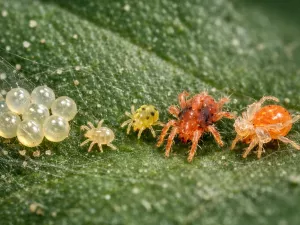
Freshly laid eggs are often oval, smooth, and tiny, usually around 0.5-1 mm (0.02-0.04 in) long depending on species. Their color can vary from pale yellow or green when first laid to shiny black as they mature. Because of that color shift, older overwintering eggs may look like tiny varnished dots near buds.
How to recognize eggs
Eggs are not scattered randomly like dust. They are attached individually and tend to appear in protected spots where weather and predators are less likely to remove them.
- Shape: Oval or slightly elongated, not cottony or fuzzy.
- Texture: Smooth and glossy rather than powdery.
- Placement: Close to buds, bark fissures, stem joints, or old leaf scars.
- Color change: Often lighter at first, then darker before hatching.
How to recognize nymphs
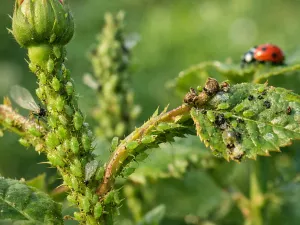
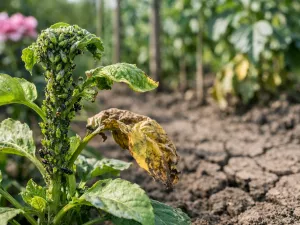
Nymphs look like miniature adults, but they are smaller, softer, and not yet fully developed. Most are pear-shaped with long antennae and visible legs. Depending on the species, they may be green, yellow, black, gray, pink, or pale brown. Some have a dusty or waxy coating that makes them look slightly bluish or chalky.
One useful clue is their behavior. Nymphs usually stay packed together and move slowly unless disturbed. They leave behind white cast skins after molting, and those empty skins often collect on leaves like tiny flakes. If you see sticky honeydew, ants, or distorted new growth, look very closely for these immature aphids.
- They are usually wingless in early stages.
- They cluster tightly on soft tissue rather than roaming widely.
- They may cause leaf curl, puckering, or twisted shoot tips before the colony becomes obvious.
- White shed skins are often the giveaway even when the insects themselves are hard to see.
How fast aphids reproduce in ideal conditions

Aphids reproduce at a speed that catches even experienced gardeners off guard. In mild weather with abundant soft growth, many species can mature from newborn nymph to reproductive adult in about 7-10 days. Under especially favorable greenhouse or indoor conditions, that timing can be even shorter. Once mature, a single female may produce several young per day without needing to mate.
Ideal conditions usually mean temperatures around 18-27°C (64-81°F), low plant stress, and a steady supply of nitrogen-rich new growth. Plants pushed by frequent feeding or heavy pruning often produce exactly the tender tissue aphids prefer. If natural predators are absent, every generation adds to the next with almost no interruption.
Why the numbers rise so fast
The key is overlapping generations. While one group of nymphs is still developing, older siblings may already be reproducing. This creates a layered colony in which tiny nymphs, larger nymphs, and adults all feed on the same plant at the same time.
That is why a plant can look clean one week and heavily infested the next. The insects were not necessarily arriving in huge numbers from elsewhere; they were multiplying in place.
| Condition | Effect on reproduction | What gardeners usually notice |
|---|---|---|
| 20-25°C (68-77°F) with soft new growth | Fast nymph development and steady live birth | Colonies double quickly on shoot tips |
| Greenhouse or indoor shelter | Continuous breeding with little weather interruption | Persistent infestations on houseplants and seedlings |
| High nitrogen feeding | Produces lush, sappy tissue that supports larger colonies | Heavy buildup on the newest leaves |
| Few predators present | More nymphs survive to adulthood | Little natural slowdown in population growth |
Practical recommendation: If a plant has been fed recently and is pushing very soft growth, inspect it twice a week rather than once. That small change in routine often catches colonies before leaves curl around them.
Why infestations grow so quickly

Fast reproduction is only part of the story. Infestations also expand quickly because aphids feed where gardeners do not always look, and because the plant itself can hide them. Curled leaves, tight flower buds, and dense shoot tips create protected pockets where nymphs can feed with little disturbance from rain, sprays, or predators.
Another reason is that aphids are strongly attracted to fresh, juicy growth. A plant that has been heavily watered, recently pruned, or fertilized with a high-nitrogen product often produces tender tissue that is easy to pierce. On stressed plants, the balance can be even worse: weak growth is less able to outgrow damage, and sticky honeydew begins to coat leaves and stems.
Common triggers that accelerate a colony
Several garden conditions make a small problem turn into a serious one. These are not always the original cause, but they often explain why one plant becomes covered while another nearby stays relatively clean.
- Sheltered positions: Plants against warm walls, in greenhouses, or under cover experience less weather disruption.
- Soft new growth: Flushes after pruning or feeding provide ideal feeding sites.
- Ant activity: Ants protect aphids from predators in exchange for honeydew.
- Missed early signs: A few hidden nymphs can become a visible colony before weekly checks catch them.
- Dense planting: Crowded growth reduces airflow and makes inspection harder.
Plant symptoms that appear before severe damage
By the time stems are coated with insects, the problem is already established. Earlier warning signs are more subtle and worth learning.
- New leaves look puckered or slightly twisted.
- Flower buds fail to open cleanly or become distorted.
- Leaf surfaces feel sticky from honeydew.
- Ants repeatedly travel up stems to young growth.
- Sooty mold begins to darken honeydew-coated leaves.
These clues matter because they point to hidden feeding even when the aphids themselves are tucked into folded tissue.
Best timing to target aphids at each stage

Timing makes a major difference because not every treatment works equally well on eggs, nymphs, and adults. In practice, the easiest stage to control is the nymph stage, when aphids are exposed on soft growth and before leaves curl tightly around them. Eggs can sometimes be reduced during dormancy on woody plants, while adults are manageable if caught before they produce a large new generation.
For outdoor shrubs and fruit trees, dormant-season action can reduce spring pressure. For vegetables, roses, and houseplants, regular checks during active growth are more important than any one dramatic treatment. The goal is to interrupt the cycle before colonies become layered and sheltered.
When each stage is most vulnerable
Different approaches fit different points in the cycle. Matching the method to the stage usually gives better results than repeating the same spray at random intervals.
- Egg stage: Best addressed on dormant woody plants with seasonal cleanup and, where appropriate, a dormant horticultural oil before bud break.
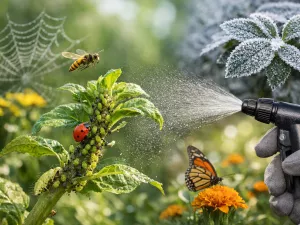
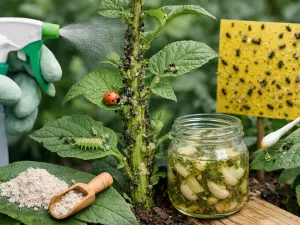
- Early nymph stage: Best targeted with a firm water spray, insecticidal soap, or horticultural oil while colonies are still exposed.
- Adult stage: Still treatable, but more likely to rebound quickly if follow-up checks are skipped.
Practical timing by plant type
Gardeners get better control when they tie inspection to plant growth rather than the calendar alone. New shoots are the signal to start watching closely.
- Check roses and soft perennials as soon as spring shoots reach 5-10 cm (2-4 in).
- Inspect brassicas, beans, peppers, and leafy crops twice weekly during warm spells above 18°C (64°F).
- On houseplants, look after repotting, feeding, or moving plants into brighter light, since these changes often trigger tender growth.
- On fruit trees and shrubs, inspect buds and young leaves just after they open, before leaves begin to curl.
Editor’s note: A strong jet of water works best in the morning, giving foliage time to dry. Repeat every few days rather than blasting once and assuming the colony is gone.
How life cycle affects treatment success
Many aphid treatments fail not because the product is wrong, but because the life stage was wrong or the follow-up was mistimed. Eggs can survive measures that easily kill exposed nymphs. Adults may be removed, yet hidden nymphs inside curled leaves continue feeding and restart the colony. Understanding that overlap is what turns control from reactive to effective.
Contact treatments such as insecticidal soap, horticultural oil, or a direct water spray only work where they actually reach the insects. They are most successful when aphids are still exposed on stems and leaf undersides. Once leaves are twisted or folded, coverage becomes patchy. At that point, pruning out the worst tips can be more effective than repeated weak spraying.
Why repeat treatments are often necessary
Because generations overlap, a single pass rarely catches every individual. New nymphs may emerge or previously hidden insects may move into exposed positions a few days later. That is why repeat applications are usually scheduled every 3-7 days, depending on the method, weather, and label directions for any product used.
- Contact sprays: Good for exposed colonies, but need thorough coverage and repeat checks.
- Pruning: Useful when shoot tips are badly curled and hard to penetrate with sprays.
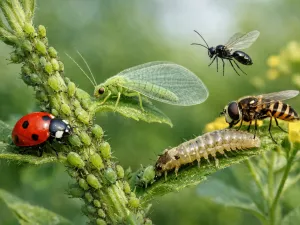
- Biological control: Ladybirds, lacewings, hoverfly larvae, and parasitic wasps help most when broad-spectrum insecticides are avoided.
- Cultural control: Moderate feeding, balanced watering, and better airflow reduce the lush, crowded growth aphids prefer.
How plant care influences results
Aphid control is not only about killing insects. A plant pushed into soft growth by excess fertilizer can become reinfested quickly. Likewise, drought-stressed plants may struggle to recover from feeding damage. Aim for even moisture, not repeated cycles of bone dry soil followed by soaking. For containers, water thoroughly until a little drains out, then wait until the top 2-3 cm (about 1 in) of mix feels dry before watering again, adjusting for the plant type.
Feeding should also be steady rather than heavy. A diluted balanced fertilizer during active growth is usually safer than repeated high-nitrogen applications that create lush, aphid-prone shoots.
Stopping aphids before population explodes
The best prevention is a routine that catches the first few nymphs before they become a colony. Aphids rarely start by covering the whole plant. They begin on one soft stem, one folded leaf, or one cluster of buds. If you inspect often and respond early, control is usually simple. If you wait until honeydew, ants, and distorted growth are obvious, the job becomes slower and more repetitive.
Prevention also depends on how the plant is grown. Overfed plants with crowded, shaded growth are more inviting than sturdy plants kept in balanced conditions. Good light, sensible watering, and moderate feeding do not make a plant aphid-proof, but they reduce the kind of weak, lush growth that supports explosive buildup.
A simple prevention routine
This kind of routine is practical for most home gardens and indoor collections. It focuses on the moments when aphids are easiest to stop.
- Inspect new growth at least once a week, and twice a week in warm spells above 20°C (68°F).
- Pinch out or prune heavily infested tips before colonies spread further.
- Wash off small groups with water, aiming at leaf undersides and shoot tips.
- Control ants around affected plants so predators can work more effectively.
- Avoid overusing high-nitrogen fertilizer, especially on roses, peppers, and soft annuals.
- Space plants and thin dense growth to improve airflow and visibility.
When to escalate your response
Sometimes early action is missed, especially during warm weather. If several stems are infested, leaves are curling tightly, or sticky honeydew is spreading onto nearby foliage, move from casual removal to a more structured plan. Combine pruning, repeated washing or soap treatment, and closer monitoring for 2-3 weeks. On valuable plants, isolate infested containers from clean ones to slow spread.
Stopping aphids before the population explodes is really about interrupting the nymph stage again and again. Once you understand where eggs are hidden, how fast nymphs mature, and why adults multiply so rapidly, the life cycle becomes less mysterious and much easier to manage.