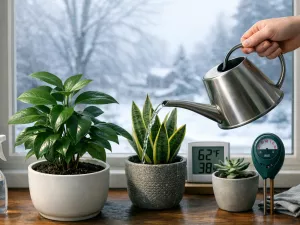
Yellow Leaves After Temperature Changes

 Here we how sudden temperature swings stress plants, especially leaves, and why unstable weather makes it hard for them to adapt. It also explains the common signs of temperature shock, how to protect plants from abrupt changes, and how to stabilize conditions for recovery and seasonal prevention.
- How sudden temperature shifts stress plants
- Impact of rapid cooling or heating on leaves
- Why plants struggle to adapt to unstable climates
- Common symptoms of temperature shock
- How to protect plants from abrupt changes
- Stabilizing growing conditions for recovery
- Preventing stress from seasonal fluctuations
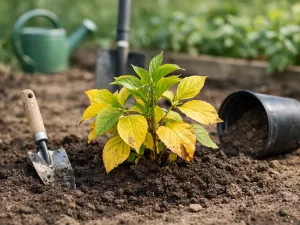
When leaves start turning yellow after a sudden spell of heat or cold, plants are usually showing signs of stress rather than a serious disease. This can happen indoors or outdoors when roots, watering, humidity, or light exposure become unbalanced after the temperature change. Understanding how sudden shifts affect leaf health helps you identify the problem early and make small care adjustments before the plant suffers more lasting damage.
How sudden temperature shifts stress plants

Plants cope best when change happens gradually. A mild drop over several days gives roots, stems, and leaves time to adjust their water use, sugar movement, and growth rate. Trouble starts when a warm afternoon is followed by a cold night, or when a plant goes from a heated room to a chilly patio in a few hours. That fast shift can interrupt normal cell function and show up as yellowing leaves soon after.
Temperature affects nearly every process in a plant. Water moves more slowly in cool conditions, roots absorb nutrients less efficiently, and leaves may keep losing moisture even when the root zone cannot keep up. In hot spells, the opposite problem can happen: leaves transpire quickly, tissues dry out, and chlorophyll begins to break down. Yellow leaves are often the visible result of this internal imbalance rather than a simple sign of old age.
Why the transition itself matters
A plant can often tolerate a temperature that would be harmless on its own, but the speed of the change is what creates stress. A houseplant that lives comfortably at 18°C (64°F) may still react badly if it spent the previous day at 28°C (82°F). The plant has already adjusted its metabolism to one set of conditions and suddenly has to operate under another.
- Cell membranes stiffen or loosen too fast, which affects how water and nutrients move between cells.
- Root activity lags behind leaf activity, especially after a cold snap, so the top growth demands more than the roots can supply.
- Stored energy is redirected, meaning the plant pauses growth and uses reserves for survival rather than healthy foliage.
- Protective pigments change, and chlorophyll may degrade faster than the plant can replace it.
Plants most likely to react
Not all plants respond the same way. Tropical foliage plants, seedlings, newly transplanted specimens, and anything grown in a container are usually the first to show damage. Pots heat and cool much faster than garden soil, which means roots experience sharper swings than plants in the ground.
Fast-growing plants are also vulnerable because they have softer tissue and higher water demand. A tomato seedling, basil plant, calathea, or young citrus tree may yellow quickly after a sudden weather shift, while a mature shrub in the landscape may show slower, subtler symptoms.
Editor’s note: If yellowing appears right after a cold night or a heat spike, resist the urge to fertilize immediately. Feeding a stressed plant too soon often pushes weak roots harder instead of solving the underlying problem.
Impact of rapid cooling or heating on leaves

Leaves are the first part of the plant to register abrupt temperature changes because they are exposed directly to air, sun, and wind. When temperatures swing quickly, leaf tissue can lose moisture faster than the roots can replace it, or it can become chilled enough that normal photosynthesis slows sharply. In both cases, the green pigment that keeps leaves healthy starts to break down, and yellow patches or full-leaf discoloration can follow.
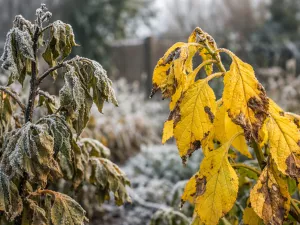
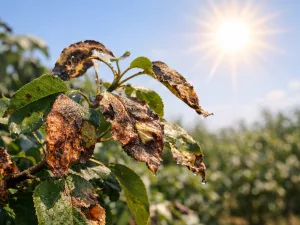
Rapid cooling often causes a dull, washed-out yellowing that may later turn tan or translucent. Rapid heating tends to produce yellowing with crisp edges, dry spots, or pale areas facing the sun. The pattern matters because it helps separate temperature stress from other issues such as pests, nutrient deficiency, or overwatering.
What cold does to leaf tissue
When leaves cool too quickly, water inside and between cells stops moving efficiently. Even before frost damage occurs, chilled tissue can struggle to process light. The plant is still receiving sunlight, but the leaf machinery that turns light into energy is slowed, so stress compounds quickly.
- Leaves may turn pale yellow between veins.
- Soft foliage can become limp by morning and slightly leathery by afternoon.
- Edges may look water-soaked before they dry and brown.
- New growth often shows damage before older, thicker leaves.
What sudden heat does to leaf tissue
A quick rise in temperature, especially with direct sun or dry wind, can scorch leaves that were not acclimated. Indoor plants moved outdoors and greenhouse plants exposed to an unexpectedly hot day are common examples. Heat increases transpiration, and if the root ball is even slightly dry, yellowing can appear within a day or two.
The combination of hot surfaces and reflected light can worsen the problem. A plant near a south-facing wall, patio stone, or window glass may experience leaf temperatures much higher than the surrounding air, sometimes above 35°C (95°F) even when the forecast is lower.
| Condition | Typical leaf response | What it often looks like |
|---|---|---|
| Rapid cooling | Slowed water movement and reduced photosynthesis | General yellowing, limp leaves, translucent patches |
| Cold night after warm day | Metabolic shock between day and night cycles | Yellow lower leaves, droop at dawn, stalled new growth |
| Sudden heat spike | Excess moisture loss and pigment breakdown | Pale yellow areas, dry margins, sun-facing scorch |
| Hot wind or radiator blast | Localized dehydration | One-sided yellowing, curled edges, brittle tips |
Why plants struggle to adapt to unstable climates

Plants are highly responsive, but they are not fast movers. They cannot step into shade, leave a drafty windowsill, or seek warmer soil when the weather turns. Their adaptation depends on gradual internal changes: adjusting stomata, thickening leaf tissue, slowing growth, shifting root activity, and balancing stored carbohydrates. When the climate keeps swinging, the plant stays in a near-constant state of correction and never fully settles.
This is why unstable spring and autumn weather often trigger yellow leaves even when no single temperature extreme seems severe. A few warm days may encourage fresh growth, then a cold night checks that growth abruptly. The plant has already committed energy to tender tissue that is poorly equipped for the next swing.
Roots and shoots respond at different speeds
One of the biggest reasons adaptation fails is that roots and leaves do not react at the same pace. Air temperature can jump within hours, but soil temperature changes more slowly, especially in large containers or heavy ground. A plant may have warm leaves and cool roots, or cool leaves and a root zone that is still warm and active. That mismatch disrupts water balance and nutrient uptake.
For example, roots in wet, cold potting mix may absorb very little nitrogen, magnesium, or iron, even when those nutrients are present. The leaves then begin to yellow, not because the soil is empty, but because the plant cannot access what it needs under unstable conditions.
Repeated stress weakens resilience
A single temperature shock can be survivable. Repeated swings are more damaging because they drain reserves. Plants use sugars to repair tissue, maintain cell pressure, and restart growth after each setback. If those reserves are repeatedly spent, leaves are shed earlier and recovery slows.
- New transplants have limited root systems and little buffering capacity.
- Container plants experience faster root-zone swings than in-ground plants.
- Tropical species often lack tolerance for nights below 12°C (54°F).
- Plants under low light produce less energy, so they recover more slowly from stress.
Practical recommendation: If a plant has been through several temperature swings, judge its health by new growth rather than damaged old leaves. Older yellow leaves may never green up again, even after conditions improve.
Common symptoms of temperature shock

Yellow leaves are common, but they are rarely the only sign of temperature shock. The full symptom pattern helps identify whether the problem came from a cold draft, a heat wave, a chilly root zone, or a sudden move between indoor and outdoor conditions. Looking at where the damage appears and how quickly it developed can save time when troubleshooting.
Symptoms may show within hours after a severe event or over several days after a series of smaller swings. In many cases, the plant looks wilted first, then yellowing becomes more obvious as damaged tissue loses chlorophyll.
Leaf and stem warning signs
Most temperature-related damage starts in the foliage, but stems can also reveal stress. Tender growth may soften after cold exposure, while hot, dry conditions can leave stems slightly shriveled near the tips.
- Uniform yellowing often points to overall stress rather than a single nutrient shortage.
- Yellow edges with brown crisping are more common after heat or dry wind.
- Patchy yellow areas can follow sudden sun exposure or uneven chilling.
- Leaf drop is common in ficus, citrus, hibiscus, and many indoor tropical plants.
- Drooping despite moist soil suggests roots are not functioning well at the current temperature.
- Blackened or translucent spots may indicate cold injury rather than simple dryness.
How to separate temperature shock from other causes
It is easy to confuse temperature stress with watering mistakes or nutrient problems because the symptoms overlap. The timing usually gives the clearest clue. If yellowing started right after a cold night, a heater turning on, a move outdoors, or a hot spell, temperature is a likely trigger.
Another clue is the distribution of damage. Leaves nearest a window, exterior wall, vent, or sun-exposed side often show the strongest symptoms. Nutrient deficiencies are usually more systematic, while temperature injury is often linked to location and recent weather patterns.
| Symptom | More likely temperature-related when... | Often confused with |
|---|---|---|
| Sudden yellowing | It appears within 1 to 3 days of a weather swing | Overwatering |
| Leaf drop | It follows a move between rooms or outdoors | Low humidity |
| Yellow with crisp edges | It affects exposed leaves first | Underwatering |
| Pale, limp foliage | It appears after cold nights or drafts | Root rot |
| Stalled growth | It follows repeated hot-cold fluctuations | Nutrient deficiency |
How to protect plants from abrupt changes

Protection works best when it is planned before the weather turns. Once leaves are damaged, the goal shifts to preventing further stress. Garden plants, houseplants, seedlings, and patio containers all benefit from a buffer between them and the sudden change. That buffer may be shade, insulation, spacing, airflow control, or simply better timing.
The main idea is to slow the rate of change. If the plant experiences a gentler transition, it has a much better chance of keeping leaves healthy and roots functional.
For indoor plants
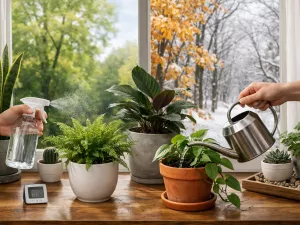
Indoor conditions can change more abruptly than many growers realize. A plant near a window may face cold nighttime glass, then warm dry air from a heater by morning. Air conditioning can create the same kind of instability in summer.
- Move plants at least 30 cm (12 in) away from cold glass or heating vents during extreme weather.
- Avoid placing foliage directly in the path of forced air from radiators, heat pumps, or air conditioners.
- Water in the morning when possible so roots are not sitting cold and wet overnight.
- Rotate plants only if light is uneven; do not keep moving them between rooms with different temperatures.
For outdoor plants and containers
Outdoor plants need physical protection and better placement. Containers are especially vulnerable because the entire root ball can cool or heat rapidly. Grouping pots together helps reduce exposure, and moving them against a sheltered wall can lessen wind stress.
- Use frost cloth or lightweight covers on nights expected to drop near a plant’s limit.
- Mulch the soil surface with 5 to 8 cm (2 to 3 in) of organic material to slow root-zone swings.
- Shift containers out of reflected afternoon heat during sudden hot spells.
- Water deeply before a heat event so the root ball is evenly moist, not dry at the center.
- Delay transplanting until nights are consistently mild instead of reacting to one warm weekend.
Editor’s note: Covers protect best when they trap warmth from the soil, not when they press tightly on leaves. If possible, support the fabric so it sits above the plant and reaches the ground around it.
Stabilizing growing conditions for recovery

Once yellowing has started, recovery depends less on quick fixes and more on consistency. A stressed plant needs steady moisture, moderate light, and a root zone that is neither cold and soggy nor hot and bone dry. The aim is to reduce demands on the plant while it rebuilds healthy function in the roots and new leaves.
Do not expect damaged foliage to turn green again. Recovery is usually measured by firmer stems, reduced leaf drop, and fresh growth that emerges normally over the next one to three weeks, depending on the species and season.
Water, light, and feeding during recovery
Watering should be careful rather than generous. Saturated compost or garden soil can worsen stress if cool temperatures have already slowed root activity. Check moisture below the surface before watering. In containers, feel the mix 2 to 4 cm (1 to 1.5 in) down; if it is still damp, wait.
Light should be bright but not harsh. A recovering plant placed in intense direct sun may lose more water than it can replace. On the other hand, very low light reduces energy production and slows repair. Filtered light, bright shade, or an east-facing window often works well for a short recovery period.
- Hold fertilizer temporarily until you see active new growth.
- Remove only fully dead leaves and keep partly green leaves if they still contribute energy.
- Improve drainage if the potting mix stays wet for many days after watering.
- Increase humidity moderately for tropical plants, but avoid constantly wet foliage in cool rooms.
When pruning helps and when it does not
Pruning can reduce stress if tissue is clearly dead, mushy, or scorched beyond recovery. It should not be used to “reset” a plant that is already weak. Heavy pruning forces new growth, and that new growth may fail if temperatures are still unstable.
Use clean tools and remove damaged sections back to healthy tissue. For larger plants, spread pruning over several sessions rather than cutting everything at once. This is especially helpful after cold damage on shrubs or after heat stress on potted citrus and tender ornamentals.
Preventing stress from seasonal fluctuations
Seasonal change is normal, but the transition periods of spring and autumn are when yellow leaves most often appear. Prevention comes from anticipating those swings instead of reacting after the damage is visible. Plants that enter a new season gradually are far more resilient than those pushed into abrupt shifts in temperature, light, watering, and feeding all at once.
A good routine combines observation with small adjustments. Watch nighttime lows as closely as daytime highs, and remember that patios, balconies, windowsills, and greenhouses can run several degrees warmer or colder than the local forecast.
Build a gradual transition plan
Acclimation is one of the best tools a grower has. When moving plants outdoors in spring, increase exposure over 7 to 10 days instead of placing them straight into full sun and open air. In autumn, bring tender plants in before nights regularly drop below 10°C (50°F), even if days still feel warm.
- Change watering with the season, because cooler weather usually means slower drying.
- Reduce feeding in late season, especially for houseplants and tender container plants.
- Refresh mulch before temperature swings, not after roots are already stressed.
- Repot at stable times, avoiding periods with large day-night temperature gaps.
Seasonal checks that prevent yellowing
Small checks done regularly can prevent larger problems later. This is especially true for plants grown in pots, raised beds, conservatories, and bright indoor rooms where temperatures can shift quickly.
| Seasonal check | Why it matters | Practical target |
|---|---|---|
| Night temperature monitoring | Prevents exposure below a plant’s comfort range | Track forecast lows and move tender plants before nights fall below 10 to 12°C (50 to 54°F) |
| Root-zone insulation | Buffers containers from rapid cooling and heating | Use mulch or pot sleeves around exposed containers |
| Watering review | Avoids cold, soggy soil in cool weather and drought in heat | Adjust frequency weekly rather than following a fixed schedule |
| Light exposure changes | Reduces shock when sun angle and intensity shift | Introduce stronger light gradually over several days |
| Vent and draft check | Prevents hidden indoor hot and cold spots | Keep plants clear of direct airflow by at least 30 cm (12 in) |
When a plant repeatedly yellows during seasonal changes, the answer is usually not a stronger fertilizer or more frequent watering. It is a steadier environment. By smoothing out the sharp edges of weather and indoor climate changes, you give roots and leaves time to stay in balance, and that is what keeps foliage green for longer.