Cold Damage and Yellow Leaves Explained

 This article explains how cold affects plant cells, leaves, and roots, how to spot early cold stress, and how frost damage differs from mild chilling. It also covers protection during temperature drops, recovery steps, and ways to prevent future yellowing.
When leaves turn yellow after a chilly night, the problem is often cold stress rather than poor watering. Low temperatures can slow root activity, injure leaf tissue, and disrupt the movement of water and nutrients, causing plants to look pale, limp, or spotted. Understanding how cool weather affects foliage helps gardeners recognize the signs early and choose the best response, whether that means waiting, adding protection, pruning damaged growth, or adjusting routine care.
How low temperatures affect plant cells

Cold injury starts at the cellular level long before a whole plant collapses. When temperatures fall, the membranes around plant cells become less flexible, water movement slows, and the chemistry that supports growth and repair begins to stall. Leaves may still look normal for a short time, but the damage process can already be underway.
The biggest problem is that plant cells depend on water staying in the right place. In cool conditions above freezing, cells can still function, though more slowly. As temperatures approach 0°C (32°F), water may move out of the cells into spaces between them. If temperatures drop further, ice can form outside or inside the cells. Once that happens, tissues can rupture, collapse, or dry out rapidly after sunrise.
Membrane damage and slowed metabolism
Cell membranes act like selective barriers, controlling what enters and leaves each cell. In warm weather they stay fluid enough to work properly, but cold makes them rigid. That rigidity interferes with nutrient transport, sugar movement, and normal respiration. The result is poor energy production, weak growth, and a higher chance of leaf discoloration.
Photosynthesis also slows sharply in cold weather, especially if bright sun follows a chilly night. The leaf may absorb more light than it can safely process, which adds stress and can bleach or yellow sensitive tissues.
- Reduced water flow: Cold slows the movement of water from roots to leaves, so tissues lose turgor more easily.
- Interrupted nutrient uptake: Essential elements such as nitrogen, magnesium, and iron become harder for the plant to absorb and move.
- Lower enzyme activity: Growth processes and repair reactions run poorly when temperatures stay below a plant’s preferred range.
- Greater leakiness: Damaged membranes allow cell contents to escape, which leads to soft, water-soaked, or translucent patches.
What happens when ice forms
Freezing is more destructive than simple chilling. Ice crystals outside the cells pull water out of the tissues, causing dehydration. If ice forms inside the cells, the sharp crystals can physically tear structures apart. Some hardy plants protect themselves by increasing sugars and other compounds that lower the freezing point of cell sap, but tender houseplants and warm-season crops usually lack that protection.
A leaf that looks only slightly limp at dawn can turn brown by afternoon once the sun hits damaged cells. That delayed collapse often makes gardeners think the plant was fine overnight when it was not.
Because of these internal changes, yellowing after a cold spell is not random. It is often a sign that chlorophyll production stopped, stored nutrients were redistributed, or tissues were injured enough that the plant began shedding leaves to conserve energy.
Early signs of cold stress in leaves

Cold stress rarely begins with dramatic blackened foliage. More often, the first clues are subtle changes in texture, posture, and color. Catching those early signs matters because plants can often recover from mild exposure if conditions improve quickly and watering is handled carefully.
Yellow leaves are one of the most common warning signals, but they are not the only one. A chilled plant may also look duller than usual, stop extending new growth, or develop pale areas between the veins. Tender leaves and fresh shoots usually show symptoms first because they contain more water and have thinner cell walls.
Color changes to watch for
Leaf color often shifts in stages. The exact pattern depends on the species, the temperature reached, and how long the plant stayed cold. Some plants yellow from the edges inward, while others develop blotches or an overall washed-out tone.
- Pale green leaves: An early sign that chlorophyll production has slowed.
- Yellow margins: Common when water movement is restricted and outer tissues dry first.
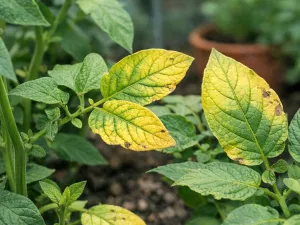
- Interveinal yellowing: The tissue between veins fades while veins remain greener, often because nutrient movement is impaired.
- Bronze or purple tones: A stress response linked to sugar buildup and pigment changes in cool conditions.
- Water-soaked patches: A sign of more serious injury that may later turn tan or brown.
Texture and posture changes
Leaves under cold stress often feel different before they look severely damaged. They may seem limp in the morning, slightly curled, or unusually brittle once temperatures rise again. New growth can twist, pucker, or fail to unfold properly.
If the plant is in a pot near a cold window, you may notice damage only on the side facing the glass. Outdoor plants may show injury on exposed tips while inner foliage remains healthy. That uneven pattern is a useful clue that temperature, not disease, is the main trigger.
If yellowing appears only on the outer canopy after one cold night, inspect the newest leaves and stem tips before reaching for fertilizer. Feeding a chilled plant too soon often adds stress instead of solving the problem.
Not every yellow leaf means lasting harm. If stems remain firm and buds stay green, the plant may simply be shedding a few stressed leaves while preserving its core growth points.
Difference between frost damage and mild chilling

Gardeners often group all cold injury together, but frost damage and mild chilling are not the same. Knowing the difference helps you judge whether a plant needs emergency protection, patient observation, or full replacement. The symptoms can overlap, yet the severity and recovery pattern are usually different.
Mild chilling happens when a plant is exposed to temperatures that are low for that species but still above freezing. Frost damage occurs when plant surfaces or tissues reach freezing conditions and ice forms. Tropical and subtropical plants can suffer chilling injury at 10°C (50°F) or even 13°C (55°F), while hardy perennials may tolerate temperatures near 0°C (32°F) with little trouble.
The comparison below helps separate the two situations.
| Condition | Typical temperature range | Common symptoms | Recovery outlook |
|---|---|---|---|
| Mild chilling | About 1°C to 12°C (34°F to 54°F), depending on species | Yellowing, slowed growth, drooping, dull leaves, minor spotting | Often good if warmth returns gradually and roots stay healthy |
| Light frost | Around 0°C to -2°C (32°F to 28°F) | Water-soaked leaf areas, blackened tips, collapsed soft growth | Partial recovery possible if stems and crown remain alive |
| Hard freeze | Below -2°C (28°F) for sensitive plants | Widespread blackening, mushy tissue, stem splitting, rapid leaf drop | Poor for tender plants; hardy plants may regrow from protected parts |
| Repeated cold nights | Fluctuating near-threshold temperatures | Gradual yellowing, cumulative stress, bud loss, weak new growth | Mixed; depends on duration, plant reserves, and root condition |
How the damage appears differently
Chilling injury usually develops more slowly. Leaves may stay attached but become yellow, patchy, or limp over several days. Frost injury is often faster and more dramatic. Tissues can look dark, translucent, or scorched within hours after thawing.
Another difference is location. Mild chilling may affect the whole plant evenly if the air stayed cool for a long period. Frost often damages exposed surfaces first: upper leaves, outer shoots, blossoms, and the side facing open sky.
Why the distinction matters for care
A mildly chilled plant generally benefits from stable warmth, reduced watering, and time. A frost-hit plant may need damaged tissue left in place temporarily, because dead leaves can shield living buds beneath. Pruning too soon can expose still-viable parts to the next cold snap.
When deciding what to do, focus less on leaf color alone and more on whether stems, crown tissue, and roots remain firm. Those parts determine whether recovery is realistic.
Why roots struggle in cold soil

Leaves get most of the attention after a cold spell, but roots often drive the yellowing that follows. Even when air temperatures recover during the day, cold soil can stay sluggish for much longer. Roots in chilled soil absorb water and nutrients slowly, and that mismatch leaves the top growth under-supplied.
This is especially common in containers, raised beds, and early spring vegetable plots. Pots lose heat quickly on all sides, while wet ground warms slowly. A plant may sit in bright light and start transpiring, yet the roots cannot keep up. The result can look like drought, nutrient deficiency, or transplant shock, even though the real issue is low root-zone temperature.
Water uptake slows before the soil looks dry
Cold roots are inefficient roots. They do not pull moisture upward with the same speed as they do in warm conditions. If the potting mix is also wet, oxygen levels drop and roots become even less active. That combination leads to droop, yellowing, and stalled growth.
Overwatering is a frequent follow-up mistake. Gardeners see limp leaves and assume the plant is thirsty, but saturated cold soil often makes the problem worse by suffocating already stressed roots.
- Container plants: Root balls can chill quickly overnight, especially in pots under 30 cm (12 in) wide.
- Heavy soils: Clay-rich ground stays colder and wetter longer than loose, organic soil.
- Recently transplanted plants: Disturbed roots are less able to cope with cold and moisture swings.
- Warm-season crops: Tomatoes, peppers, basil, and cucumbers often stop growing when soil remains below about 13°C (55°F).
Nutrient lock-up in cool conditions
Cold soil does not always lack nutrients; often the plant simply cannot access them efficiently. Nitrogen uptake slows, magnesium movement becomes uneven, and iron-related chlorosis can appear in sensitive species. That is why yellow leaves after a cold period do not automatically mean the soil needs more fertilizer.
Feeding into cold, inactive soil can leave salts behind and stress roots further. It is usually better to wait until the root zone warms and new growth resumes before applying a full-strength feed.
If a plant is yellowing in cold weather but the soil still feels damp 5 cm (2 in) down, hold off on extra water. Improving warmth and airflow usually helps more than adding moisture.
Healthy roots are the plant’s recovery engine. Protecting the root zone from prolonged chill often prevents more damage than focusing on leaves alone.
How to protect plants during temperature drops

Protection works best when it starts before the coldest hours arrive. A plant that enters a chilly night well-watered, sheltered, and insulated is far more likely to avoid yellowing and tissue collapse than one left exposed in wind or wet, compacted soil. The right method depends on whether the plant is in the ground, in a container, or indoors near a cold source.
The goal is not to create tropical warmth overnight. It is to reduce temperature swings, limit frost settling on leaves, and keep roots from becoming too cold to function.
Outdoor plants in beds and borders
In-ground plants benefit from insulation around the root zone and a cover over the top growth when frost is likely. Covers work by trapping a small amount of ground heat and blocking frost from settling directly on foliage.
- Water the soil earlier in the day if it is dry, but do not leave it soggy by evening.
- Apply a mulch layer 5 cm to 8 cm (2 in to 3 in) thick around the root area, keeping it away from direct stem contact.
- Use frost cloth, horticultural fleece, or a light blanket supported above the foliage so it does not crush tender growth.
- Secure the cover before sunset and remove or vent it in the morning once temperatures rise above about 4°C (39°F).
Container plants and houseplants
Potted plants are more vulnerable because roots are exposed on all sides. Move them against a sheltered wall, under an overhang, or into a garage, porch, or bright indoor room if temperatures are expected to drop below the plant’s comfort range. Even shifting a pot 1 m to 2 m (3 ft to 6.5 ft) away from an exposed edge can make a difference.
Indoors, keep foliage from touching cold glass. A leaf pressed against a window on a freezing night may yellow or turn translucent even when the room itself feels warm enough.
- Cluster pots together: Grouping reduces heat loss and protects smaller root balls.
- Raise pots off cold ground: Use feet, bricks, or wooden slats to improve drainage and reduce direct chill.
- Avoid late feeding: Soft new growth produced by high nitrogen is more easily damaged.
- Watch drafts: Cold air from doors, vents, and poorly sealed windows can stress indoor plants overnight.
What not to do before a freeze
Some well-meant actions increase risk. Heavy pruning stimulates tender regrowth, and late-evening watering on leaves can encourage ice formation on exposed surfaces. Plastic covers placed directly on foliage may also worsen damage where the material touches leaves.
Simple, breathable protection and stable conditions usually work better than dramatic last-minute interventions.
Steps to recover plants after cold exposure

Recovery starts with restraint. Plants that have been chilled or frosted are already under pressure, and too much pruning, watering, or feeding can push them further back. The first task is to assess what is alive and what is only temporarily discolored.
Wait until the plant has thawed fully and daytime temperatures are stable before making major decisions. Some leaves that look poor will dry and drop on their own, while stems and buds may still be viable. Recovery is often uneven, with healthy tissue hidden below damaged outer growth.
First checks in the next 24 to 72 hours
Use touch and color as your guide. Firm stems, green cambium under the bark, and solid crowns usually mean the plant still has a good chance. Mushy stems, blackened crowns, and a sour smell from the root zone suggest more serious injury.
- Inspect stems: Scratch a small area gently; green tissue beneath the surface is a positive sign.
- Check the soil: If it is wet and cold, do not add more water until the top layer begins to dry.
- Remove only clearly collapsed parts: Take off leaves that are slimy or fully dead, but leave borderline tissue for now.
- Improve light carefully: Bright indirect light is better than sudden harsh sun for indoor or recently moved plants.
When to prune and feed
Prune after you can clearly see the line between dead and living tissue. For many outdoor ornamentals, that may mean waiting several days or even until new buds begin to swell. Cut back to healthy tissue with clean tools, but avoid reshaping the whole plant immediately after stress.
Hold fertilizer until the plant resumes active growth. Once new leaves appear and temperatures are reliably warmer, use a diluted balanced feed at half strength rather than a strong dose. For example, if the label suggests 10 ml per 1 L (0.34 fl oz per 34 fl oz), start with 5 ml per 1 L (0.17 fl oz per 34 fl oz).
Supporting regrowth without overdoing it
Plants recover best in steady conditions. Keep moisture even, not constantly wet. If the plant is in a container, make sure excess water drains freely and that the pot is not sitting in a cold saucer of water. Resume normal care gradually as new growth strengthens.
Do not expect damaged leaves to turn green again. The real sign of recovery is healthy new growth, not cosmetic improvement in old foliage.
Preventing cold-related yellowing in the future
Prevention is mostly about matching the plant to the site and reducing stress before cold weather arrives. A strong plant with balanced watering, suitable light, and a healthy root system handles cool spells far better than one already weakened by poor drainage, low light, or overfeeding. Yellowing after cold exposure is often the final symptom of several smaller issues coming together.
Start by learning the temperature limits of the plants you grow. Many common houseplants and summer bedding species begin to struggle well above freezing, while hardy shrubs and perennials can tolerate much lower temperatures if they are gradually acclimated.
Build resilience through routine care
Plants that grow steadily through the season store more energy and develop tougher tissues. That does not mean pushing lush growth late into autumn. It means maintaining even care so plants are not entering cool weather dehydrated, root-bound, or nutrient-starved.
- Water appropriately: Deep, infrequent watering in the growing season encourages stronger roots than constant shallow watering.
- Use free-draining soil: Good structure prevents roots sitting cold and airless during wet spells.
- Adjust feeding seasonally: Reduce high-nitrogen fertilizer as temperatures cool to avoid soft, vulnerable growth.
- Choose the right spot: South- or west-facing walls, sheltered courtyards, and protected patios often stay warmer than open areas.
- Repot on time: A cramped root ball in a small pot chills faster and dries unevenly.
Plan ahead for seasonal cold
Keep frost cloth, mulch, and pot risers ready before the first cold snap. Move tender containers earlier rather than waiting for a forecast surprise. If you garden in a climate with fluctuating spring temperatures, delay planting warm-season crops until nights are consistently suitable and the soil has warmed.
As a practical guide, many warm-season vegetables perform better once soil temperatures are above 16°C (61°F), and tropical houseplants are usually safer when nights stay above 12°C to 15°C (54°F to 59°F), depending on the species.
The best prevention tool is often a notebook or phone log. If the same plant yellows every year in the same spot, the site is telling you something about wind, window chill, drainage, or timing.
Cold-related yellowing is easier to avoid than to reverse. By protecting roots, avoiding excess moisture, and responding early to temperature drops, you give plants the best chance to keep their color and grow on without a setback.