Watering Small vs Large Pots – Key Differences and Techniques

 This article explains how pot size changes watering needs: small pots dry out faster, large pots hold moisture longer, and both need different techniques, schedules, and warning signs. It also covers common mistakes like watering all containers the same way.
- Why pot size directly affects watering needs
- How small pots lose moisture faster than large ones
- Watering techniques for compact containers
- How large pots retain water differently
- Adjusting watering frequency based on pot volume
- Signs of overwatering and underwatering in different pot sizes
- Mistakes when treating all containers the same
Watering plants in small containers differs from watering those in larger pots because soil volume affects how fast moisture is used and lost. A small pot may dry out within a day, while a larger one can stay moist for much longer. Pot size also influences drainage and root space, so understanding these differences helps you adjust timing and water amounts to prevent both dryness and waterlogged soil.
Why pot size directly affects watering needs

Pot size changes far more than the amount of soil around a plant. It affects how quickly water moves through the mix, how long moisture stays near the roots, how much air remains in the container, and how fast the plant can use what is available. A seedling in a 10 cm (4 in) pot and a mature plant in a 30 cm (12 in) pot may sit in the same room, but they do not dry at the same pace or respond to watering in the same way.
Small containers hold a limited reservoir of moisture. Once that small volume of soil dries, roots have nowhere else to search. Large containers hold more water overall, but they can also keep some zones wet for much longer, especially in the lower half of the pot. That is why watering by habit rather than by root-zone conditions often leads to trouble.
Soil volume changes the root environment
The larger the pot, the greater the buffer against sudden drying. More potting mix means more moisture storage, but also more variation from top to bottom. The surface may feel dry while the center is still damp. In a small pot, conditions are more uniform, so the whole root ball tends to swing from moist to dry much faster.
- Small pots: less soil, less stored moisture, faster changes in temperature and dryness.
- Large pots: more soil, slower drying, but a higher chance of hidden wet pockets.
- Shallow containers: often dry quickly because there is less depth to hold moisture.
- Tall containers: may stay wet near the base even when the top 2.5 cm (1 in) looks dry.
Pot size also affects feeding and growth
Watering is tied closely to nutrition and root growth. Plants in small pots often need more frequent feeding because nutrients wash out faster with regular irrigation. In larger pots, feeding can be less frequent, but heavy watering may still leach nutrients from the upper layers. Pruning and light exposure matter too: a heavily leafed plant in strong sun will empty a small pot quickly, while the same plant after trimming may use water more slowly.
Editor’s note: If a plant suddenly becomes “hard to water,” check whether it has outgrown its pot. A root-bound plant in a small container can go from evenly moist to bone dry in a single warm afternoon.
Because pot size shapes both moisture storage and root behavior, the best watering routine is never one-size-fits-all. The container itself is part of the care plan, not just a decorative shell.
How small pots lose moisture faster than large ones

Compact containers dry out quickly because they expose a relatively large amount of soil and pot wall compared with the small volume of mix inside. Heat from sun, indoor heating, or warm windows reaches the root zone faster, and the limited soil mass cannot hold moisture for long. Even a difference between 12 cm (5 in) and 18 cm (7 in) can noticeably change how often a plant needs water.
Evaporation is only part of the story. Plants in small pots often have dense root systems that use water rapidly. Once roots fill most of the container, there is less actual soil left to act as a sponge. This is why nursery plants in undersized plastic pots can seem thirsty all the time.
Why drying speeds up in compact containers
Several factors combine to make small pots lose moisture faster than larger ones. Some are physical, while others are linked to plant growth and placement.
- Higher surface-area effect: more exposure relative to soil volume means faster evaporation.
- Less thermal stability: the root zone heats and cools quickly, increasing water loss.
- Tighter roots: crowded roots absorb moisture fast and leave little buffer.
- Lightweight mixes: many small houseplant pots use airy media that drain and dry rapidly.
- Air movement: fans, breezes, and open windows can dry a 15 cm (6 in) pot much faster than expected.
Practical situations where this matters most
Herbs, flowering annuals, and young vegetable starts are common examples. A basil plant in a 13 cm (5 in) pot on a bright kitchen sill may need water every day or two in summer, while the same basil in a 25 cm (10 in) pot may stay evenly moist much longer. Hanging pots are another special case because air circulates around all sides, accelerating drying.
Material matters as well. Terracotta in a small size dries especially fast because moisture also escapes through the porous wall. Plastic slows that loss, while glazed ceramic sits somewhere in between depending on thickness and finish.
When caring for small pots, checking moisture by touch is more reliable than watering on a calendar. Insert a finger about 2.5 cm (1 in) into the mix, or lift the pot to judge weight. A light pot usually means the root ball is close to dry throughout.
Watering techniques for compact containers

Small pots need precision more than volume. The goal is to moisten the entire root ball without washing soil out, flooding the saucer for hours, or creating dry channels where water runs down the sides and leaves the center untouched. Fast, shallow splashes are usually the least effective method.
Because compact containers dry quickly, many growers respond by watering too often with too little water. That keeps only the top layer damp and encourages shallow rooting. A better approach is to water thoroughly but in a controlled way.
How to water a small pot evenly
Use a narrow-spout watering can or a squeeze bottle so you can direct the flow slowly over the surface. Stop when water begins to drain from the bottom, then let the pot stand for a few minutes before emptying any excess from the saucer or cachepot.
- Check the soil first rather than watering automatically.
- Apply water slowly in a circle over the whole surface.
- Pause for 30 to 60 seconds so dry mix can absorb moisture.
- Water again lightly if the first pass ran through too fast.
- Let excess drain fully before returning the plant to its spot.
When bottom watering helps
Bottom watering can be useful for very dry, root-bound, or peat-heavy mixes that repel water from above. Place the pot in a shallow tray with 2 to 4 cm (about 1 to 1.5 in) of water and leave it for 10 to 20 minutes. Once the top surface feels slightly moist, remove the pot and allow it to drain.
This method is especially helpful for African violets, small ferns, and seedlings, but it should not replace top watering forever. Occasional top watering helps flush out accumulated fertilizer salts, which can otherwise build up in compact containers.
Practical tip: If water races straight down the pot edge, the root ball has probably shrunk from the container wall. Rewet it in two stages rather than pouring more and more water on top.
Fine-tuning by plant type
Not every plant in a small pot wants the same treatment. Succulents prefer the mix to dry much more between waterings, while leafy tropicals usually perform better with moderate, even moisture. Plants under strong grow lights or direct sun may need closer monitoring than those in bright shade. If you prune a plant heavily, reduce watering for a short period because leaf loss lowers water demand.
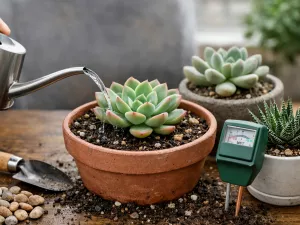
- Succulents and cacti: soak fully, then let the mix dry deeply before watering again.
- Herbs and annual flowers: keep moisture more consistent, especially during active growth.
- Tropical foliage plants: avoid repeated full drying, but do not leave roots sitting in water.
- Seedlings: water gently and more often, since young roots are shallow and sensitive.
How large pots retain water differently

Large containers do not simply hold more water; they hold it unevenly and for longer periods. The upper layer dries first because it is exposed to light, warmth, and air. Lower down, moisture can persist for days or even weeks depending on the mix, drainage holes, pot material, and plant size. This difference is what makes large pots deceptively tricky.
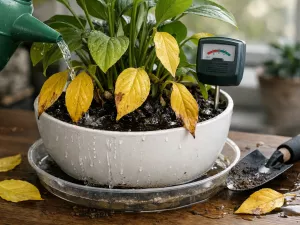
A common mistake is to judge a large container by the dry-looking top alone. If the bottom half remains wet, adding more water can crowd out oxygen around the roots. Roots need both moisture and air, and over time a constantly saturated lower zone can lead to weak growth, yellowing foliage, and root rot.
Why the lower root zone stays wet longer
In a bigger pot, gravity drains excess water downward, but the larger mass of potting mix still holds a substantial amount in small pores. If the plant is not large enough to use that moisture quickly, it lingers. This is especially common when a small plant is placed in an oversized decorative pot “to grow into.”
Heavy mixes with compost, fine peat, or little aeration hold moisture longer than chunky blends containing bark, perlite, or pumice. That means a 30 cm (12 in) pot of dense mix may remain wet much longer than a 30 cm (12 in) pot filled with a coarse aroid blend.
How to assess moisture in bigger containers
For large pots, surface checks are not enough. Use deeper methods to understand what is happening below.
- Finger test: check at least 5 to 7.5 cm (2 to 3 in) down, not just the crust on top.
- Wooden skewer: insert it deep into the mix and pull it out to see whether it comes back damp.
- Pot weight: useful for medium-large containers that can still be lifted safely.
- Moisture pattern: note whether only the center or lower half stays wet for too long.
| Pot situation | Typical moisture pattern | Main risk | Best response |
|---|---|---|---|
| Large pot with small plant | Top dries, lower half stays wet | Root rot from unused moisture | Water less often and confirm deeper dryness first |
| Large pot in low light | Very slow overall drying | Chronic overwatering | Reduce frequency and improve airflow if possible |
| Large pot with fast-growing plant | More even moisture use | Hidden dry pockets if mix shrinks | Water slowly and thoroughly around the full surface |
| Large terracotta pot outdoors | Top and sides dry faster than center | Misreading moisture levels | Check deeper before deciding to water again |
Large pots can be excellent for stable growth, but only when the watering method matches the slower pace of drying. Bigger does not mean safer by default.
Adjusting watering frequency based on pot volume

Watering frequency should be based on how quickly the root zone dries, not on a fixed number of days. Pot volume is one of the strongest influences on that drying rate, but it works together with light, temperature, plant size, season, and soil texture. A larger pot usually needs watering less often, yet when it does need water, the amount applied is greater.
Seasonal shifts matter. During active spring and summer growth, roots use more water and leaves transpire more, especially above 24°C (75°F). In winter, lower light and cooler rooms often slow uptake dramatically. This means a plant in a 20 cm (8 in) pot that needed water every 5 days in July may only need it every 10 to 14 days in January, depending on conditions.
How to build a realistic schedule
Instead of setting rigid reminders, create a checking routine. Small pots may need inspection every day or every other day, while larger containers can often be checked less often. The point is to match observation frequency to drying speed.
- Pots under 15 cm (6 in): often need frequent checks, especially in bright light or warm rooms.
- Pots 15 to 25 cm (6 to 10 in): usually dry at a moderate pace and benefit from regular but not daily monitoring.
- Pots over 25 cm (10 in): may need less frequent watering, but deeper moisture checks are essential.
Other factors that change the interval
Pot volume is only one part of the equation. A large leafy plant in strong sun can use water faster than a small plant in a tiny pot kept in shade. Feeding also plays a role: plants receiving regular fertilizer during active growth often produce more foliage and may drink more. After repotting into a bigger container, watering usually becomes less frequent at first because the fresh mix holds more moisture than the old root-bound pot.
Editor’s note: The best growers are not the ones who water most faithfully on schedule. They are the ones who notice when the schedule no longer fits the season, the light, or the plant’s current size.
If you want a simple rule, let pot volume determine how often you check, but let actual soil moisture determine when you water. That distinction prevents many common problems.
Signs of overwatering and underwatering in different pot sizes

The symptoms of watering stress can look similar at first, especially wilting, but the cause often differs depending on container size. In small pots, underwatering tends to appear quickly and dramatically because the entire root ball dries fast. In large pots, overwatering is often slower and less obvious because the problem develops below the surface over time.
Reading the plant correctly means looking at both the leaves and the soil. Yellowing, drooping, crisp edges, mushy stems, and stalled growth all tell part of the story, but they need context. A limp plant in a tiny pot on a hot day usually points to thirst. A limp plant in a large pot with cool, wet soil may be suffering from oxygen-starved roots instead.
Typical signs by pot size
The table below shows how symptoms often present differently depending on container volume and moisture pattern.
| Condition | Small pots | Large pots | What to check |
|---|---|---|---|
| Underwatering | Rapid wilting, dry lightweight pot, crispy leaf edges | Dry top and dry deeper layers, slower whole-plant slump | Check full root ball dryness and whether water is running off |
| Overwatering | Soft yellow leaves if watered too often despite damp soil | Persistent droop, yellowing, sour smell, slow growth | Probe deeper layers for constant wetness and poor drainage |
| Root-bound stress | Frequent thirst, roots circling, water passes through fast | Less common, but possible in long-term containers | Slide plant from pot if possible and inspect root density |
| Salt buildup | Brown tips, white crust on soil, uneven wetting | Can occur in upper layers with repeated light watering | Look for residue and flush with clean water when appropriate |
How pruning, light, and feeding affect symptoms
A plant that has been recently pruned may use less water, so continuing the old routine can create overwatering symptoms even in a previously well-managed pot. Strong light increases water demand and can make mild underwatering show up faster. Heavy feeding without enough water can scorch roots, while excess fertilizer in a constantly wet large pot can worsen root stress.
If symptoms are unclear, avoid reacting with more water right away. First confirm the moisture level deeper in the pot, then inspect drainage, root health, and recent changes in light or temperature. Correct diagnosis matters more than quick action.
Mistakes when treating all containers the same
The biggest watering mistake is assuming all pots should be handled alike because the plants are in the same room or on the same patio. Container size, shape, material, and plant maturity all affect how moisture behaves. Two plants may sit side by side, yet one can be nearly dry while the other is still wet several centimeters down.
Uniform routines often begin with good intentions. Gardeners want consistency, so they water every Sunday or give each pot the same amount, such as 250 ml (8.5 fl oz). The problem is that equal treatment rarely produces equal results. Small pots may dry out between waterings, while large ones may remain saturated.
Common errors to avoid
These are the habits that most often cause trouble when pot size is ignored.
- Using the same volume of water for every pot: this leaves some root balls barely moistened and others waterlogged.
- Following one calendar schedule: weather, indoor heating, and growth stage constantly change water demand.
- Judging only by the surface: especially misleading in large containers where lower layers stay wet.
- Upsizing too far when repotting: extra soil around a small root system can stay wet for too long.
- Ignoring pot material: terracotta, plastic, fabric, and glazed ceramic all dry differently.
- Forgetting saucers and cachepots: trapped runoff can keep roots wet long after watering.
Better habits for mixed container collections
A more reliable approach is to group plants by watering behavior rather than by appearance. Keep thirstier small pots where they are easy to monitor, and place large slow-drying containers where you can check them deeply before watering. Labeling recent repots can also help, since newly upsized plants often need a slower watering rhythm until roots spread into the fresh mix.
For outdoor collections, remember that wind and sun can turn a 14 cm (5.5 in) pot into a daily task, while a 35 cm (14 in) tub may still be moist after several days. Indoors, low winter light can make large decorative pots especially risky if they are watered on the same schedule as compact nursery containers.
Practical recommendation: If you care for many plants, keep a simple note of which pots dry fastest and which stay wet longest. That small observation habit prevents more losses than any universal watering rule.
Once you stop treating every container the same, watering becomes much more predictable. Plants respond better, roots stay healthier, and problems such as leaf drop, yellowing, and rot become easier to prevent.