Watering Succulents Without Causing Root Damage

 This article explains why succulents are prone to overwatering, how their roots store and use water, and the best way to water them. It also covers drying soil properly, choosing a fast-draining mix, spotting root rot, and avoiding common watering mistakes.
- Why succulents are sensitive to overwatering
- How succulent roots store and use water
- Best watering techniques for healthy succulent growth
- How to allow soil to dry properly between watering
- Choosing the right soil mix for drainage
- Signs of root rot and overwatering in succulents
- Common mistakes when watering succulent plants
Watering succulents is less about following a fixed routine and more about making sure their roots do not stay wet for too long. Because these plants store water in their leaves and stems, they usually need less frequent watering than many other houseplants. Let the soil dry out well between waterings, and use fast-draining soil to help prevent rot and support healthy, steady growth indoors or outdoors.
Why succulents are sensitive to overwatering

Succulents evolved in places where rain is brief, soil drains quickly, and roots are exposed to plenty of air. Because of that background, they are built to handle drought far better than constant moisture. When the potting mix stays wet for too long, the roots cannot breathe properly, and that is when damage begins.
The problem is not simply “too much water” in one moment. More often, root trouble develops because water remains around the roots for days instead of hours. In a dense or slow-draining mix, oxygen levels fall, fine roots die back, and fungi or bacteria can move in. A succulent may still look plump for a while, which is why overwatering often goes unnoticed until the root system is already weak.
Built for dry cycles, not constant moisture
Unlike many leafy houseplants, succulents store water in their leaves, stems, or roots. That storage system allows them to wait through dry spells. If the soil is kept damp all the time, the plant cannot use its natural rhythm of absorb, store, and rest. Instead of encouraging healthy growth, frequent moisture creates stress.
- Thin feeder roots are easily damaged when air spaces in the soil fill with water for too long.
- Stored moisture inside the plant means it does not need repeated top-ups every few days.
- Slow metabolism in cooler or darker conditions reduces how quickly the plant uses water.
Why pots and indoor conditions make the issue worse
Indoor succulents often receive less direct sun and less airflow than plants growing outdoors. That means the potting mix dries more slowly, especially in winter. Decorative containers without drainage, oversized pots, and heavy peat-rich compost all increase the amount of time roots sit in moisture.
A plant in a 15 cm (6 in) pot on a bright windowsill may dry at a reasonable pace, while the same plant in a 20 cm (8 in) pot in a dim room may stay wet for far too long. The watering amount might be identical, but the root environment is completely different.
Editor’s note: If you are unsure whether a succulent needs water, waiting an extra day or two is usually safer than watering early. Most healthy succulents recover from mild dryness much more easily than from root rot.
How succulent roots store and use water

Succulent roots are more dynamic than they appear. They do not just anchor the plant; they also absorb water quickly when it is available and then slow down when conditions turn dry. Some species produce shallow, spreading roots to capture brief rainfall, while others develop thicker roots that act as reserve storage.
Understanding this behavior helps explain why proper watering is less about a fixed schedule and more about matching the plant’s natural cycle. A thorough soak followed by a drying period fits the way these roots are designed to function.
Fast uptake after watering
When dry soil is watered properly, healthy roots take in moisture rapidly. The plant then stores that water in fleshy tissues. This is why a deep watering is usually better than a daily splash. Light, frequent watering often wets only the top layer, encouraging weak surface roots while leaving deeper parts of the root ball unevenly moist.
Once the plant has absorbed what it needs, the roots benefit from a period of air around them. That dry interval is not neglect; it is part of normal care.
Storage differs by succulent type
Not all succulents manage water in exactly the same way. Leafy rosette types, upright stem succulents, and species with swollen underground structures all have slightly different reserve strategies. Even so, they share the same basic need for drainage and oxygen around the roots.
- Echeveria and Graptopetalum store much of their moisture in leaves and prefer to dry fairly quickly.
- Jade plants store water in both stems and leaves, which makes them tolerant of missed waterings.
- Haworthia and Gasteria often use water more slowly, especially in lower light indoors.
- Caudiciform or tuberous succulents may hold reserves below the soil line and are especially vulnerable if kept wet while inactive.
Seasonal changes in root activity
Root growth is not constant all year. Many succulents grow most actively in warm, bright conditions, while some slow down in the heat of midsummer or during the short days of winter. During slower periods, the plant uses less water, so the same watering routine that worked in spring may become risky later on.
As a practical rule, if temperatures drop below 15°C (59°F) indoors near a window or growth noticeably pauses, watering should usually become less frequent. The roots are still alive, but they are not processing moisture at the same pace.
Best watering techniques for healthy succulent growth

The safest approach is to water thoroughly and then allow the potting mix to dry before watering again. This method encourages stronger roots, prevents chronic dampness, and gives the plant access to enough moisture without trapping it in wet soil. Good technique matters as much as timing.
Watering should also match the container, the soil, the season, and the plant’s growth stage. A newly rooted cutting in a small pot needs a different approach from a mature specimen in active growth.
How to water deeply without waterlogging
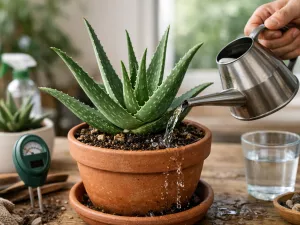
A proper watering should moisten the full root zone. Pour water evenly over the soil surface until it runs from the drainage hole, then let the excess drain away completely. Do not leave the pot standing in a saucer of water for long periods.
- Check that the soil is dry well below the surface.
- Water slowly so the mix absorbs moisture instead of channeling it down the pot sides.
- Continue until water drains freely from the bottom.
- Wait a few minutes and empty any collected runoff.
- Return the plant only after drainage has finished.
Top watering versus bottom watering
Both methods can work, but they serve different purposes. Top watering is usually best for routine care because it flushes salts through the soil and wets the whole root ball. Bottom watering can help if the mix has become very dry and is repelling water, but it should not become the only method.
If bottom watering is used, place the pot in shallow water for about 10 to 20 minutes, then remove it and let it drain fully. For a small pot, that may mean 1 to 2 cm (0.4 to 0.8 in) of water in the tray. Leaving the pot submerged for too long can saturate the mix more than necessary.
When to avoid wetting the leaves
Many succulents tolerate a little splash on the foliage, but water trapped in tight rosettes can increase the risk of rot, especially in cool rooms with poor airflow. Plants with powdery coatings, such as farina on some Echeveria, can also lose their protective finish if handled or splashed repeatedly.
- Water the soil, not the crown when caring for rosette-forming plants.
- Use a narrow-spout can for crowded arrangements or small pots.
- Water in the morning so any accidental splashes dry quickly during the day.
Practical tip: If a succulent has become severely dry and the soil has shrunk from the pot edge, water in two passes a few minutes apart. The first pass breaks surface tension; the second gives a more even soak.
How to allow soil to dry properly between watering

Letting the soil dry is not the same as letting the plant suffer. The goal is to allow excess moisture to leave the pot so roots can breathe and reset before the next watering. This drying period depends on the pot size, the soil blend, room temperature, light intensity, and airflow.
Many watering problems happen because growers judge dryness by the top 1 cm (0.4 in) of soil alone. The surface can look dry while the lower half of the pot is still wet. Checking the full root zone is far more reliable.
Reliable ways to check for dryness
There is no single perfect test, so experienced growers often combine a few simple checks. The more you compare the feel of a freshly watered pot with a dry one, the easier it becomes to judge timing accurately.
- Pot weight is one of the best indicators; a dry pot feels noticeably lighter.
- Wooden skewer test helps reveal hidden moisture if inserted near the root zone and removed after a few minutes.
- Finger check works only for the upper layer and should not be the sole method in deeper pots.
- Observation of growth matters too; a dormant plant may need much longer dry intervals.
Environmental factors that affect drying speed
Drying time can vary dramatically. A terracotta pot in bright light with moving air may dry in several days, while a glazed pot in a cool room may stay damp for more than a week. Seasonal shifts matter just as much as container choice.
| Condition | Effect on drying time | Care adjustment |
|---|---|---|
| Bright window with several hours of sun | Soil dries faster because the plant is using more water | Check moisture more often, but still water only after full drying |
| Cool room below 18°C (64°F) | Evaporation and root activity slow down | Extend the gap between waterings |
| Large pot relative to plant size | Extra mix holds moisture longer than roots can use it | Water less often and consider repotting smaller |
| Low airflow or crowded shelf | Surface and root zone stay damp longer | Increase spacing or improve ventilation |
Why patience matters after watering
It can be tempting to water on a calendar, especially once a week, but succulents do not follow a fixed timetable. One week in summer may call for a drink, while the next week may not. Waiting until the soil has genuinely dried protects the fine roots from repeated stress.
If leaves soften slightly or the plant looks less full after a proper dry interval, that is often a normal signal that it is ready for water. Mushy leaves, black stems, or a constantly damp pot point to a very different problem.
Choosing the right soil mix for drainage

Watering technique works only as well as the potting mix allows. A succulent planted in heavy, moisture-retentive compost can develop root problems even if it is watered carefully. The right mix should drain quickly, hold enough moisture for short-term uptake, and leave air pockets around the roots.
Good drainage does not mean using a completely barren medium that dries in a few hours. The best blends strike a balance: they wet evenly, drain fast, and avoid staying soggy. That balance is especially important indoors, where evaporation is slower than in a greenhouse or outdoor patio.
What a suitable mix should contain
Most growers do well with a blend that combines an organic component for modest moisture retention and a mineral component for structure and airflow. Commercial cactus compost can be a starting point, but many bagged mixes still benefit from extra grit or pumice.
- Pumice or perlite increases air space and reduces compaction.
- Coarse sand or grit improves drainage when used in moderation.
- Bark fines can add structure in some blends, though they are less common for very small succulents.
- Potting compost provides some water-holding capacity and nutrients, but too much can keep roots wet.
Matching the mix to the plant and pot
A gritty blend that works well for a jade plant in a 12 cm (5 in) terracotta pot may dry too fast for a tiny cutting in a warm windowsill propagator. Likewise, a haworthia in lower light may prefer a slightly more moisture-retentive blend than a sun-loving sedum outdoors. The point is not to find one universal recipe, but to create a mix that suits the conditions.
If you use a glazed ceramic pot, you may want a more mineral-heavy mix than you would in terracotta. If your home is humid, adding extra drainage material often helps reduce the risk of water lingering around the roots.
Simple mix guidelines for home growers
The table below offers practical starting points rather than strict formulas. Adjust based on how quickly your pots dry and how your plants respond over several watering cycles.
| Growing situation | Suggested mix approach | Why it helps |
|---|---|---|
| Indoor succulent in average room light | About 1 part potting compost to 1 part pumice or perlite | Balances moisture retention with airflow |
| Bright windowsill or outdoor summer growth | About 2 parts compost to 3 parts mineral material | Prevents waterlogging while supporting active growth |
| Humid climate or cool indoor room | Use a more mineral-heavy blend with reduced peat content | Shortens the time roots remain wet |
| Small offsets or recent cuttings | Use a lightly moist but airy mix with fine drainage particles | Supports root formation without suffocation |
Editor’s note: If water sits on the surface for more than a few seconds before sinking in, the mix may be compacted or too organic. Refreshing the soil often solves watering problems better than changing the watering schedule alone.
Signs of root rot and overwatering in succulents

Root rot usually starts below the soil line, so the earliest warning signs can be subtle. A succulent may stop growing, lose firmness, or begin dropping leaves even while the soil still feels damp. Because stored water keeps the plant looking alive for some time, visible decline can lag behind the actual root damage.
The key is to distinguish between a plant that is thirsty and one that is failing from excess moisture. Both can show wrinkling or leaf loss, but the texture, color, and soil condition tell a different story.
Early warning signs to watch for
In the beginning, overwatered succulents often look dull rather than dramatically collapsed. Leaves may become translucent, unusually soft, or yellow from the bottom upward. The pot may remain heavy for days, and the stem base can feel less firm than normal.
- Persistent wet soil long after watering is one of the clearest risk signals.
- Soft, mushy leaves suggest cells are breaking down rather than simply using stored moisture.
- Yellowing lower leaves can occur naturally at times, but widespread yellowing with wet soil is a warning.
- Stalled growth during the active season often points to root stress.
How root rot differs from underwatering
Underwatered plants usually feel dry, lighter in weight, and may show wrinkled but still intact leaves. Overwatered plants often feel soft, swollen, or unstable at the base. If you gently remove the plant from the pot, healthy roots should be pale and firm, while rotting roots are often brown, black, hollow, or foul-smelling.
One misleading symptom is leaf drop. A thirsty succulent may shed older leaves gradually, but a rotting plant can lose leaves with a slight touch because the tissues near the stem are already breaking down.
What to do if you suspect root damage
Quick action improves the chances of saving the plant. Remove it from the pot, inspect the roots, and trim away any black or mushy sections with a clean blade. Let the cuts dry before repotting into fresh, dry mix. Do not water immediately if significant rot was removed; waiting a few days allows damaged tissue to seal.
- Unpot the plant and shake away old, damp soil.
- Trim dead roots and any soft stem tissue back to firm material.
- Allow the plant to dry in a shaded, airy place for 24 to 72 hours.
- Repot into a clean container with fast-draining mix.
- Resume watering only after the plant has had time to recover and re-establish.
Common mistakes when watering succulent plants
Most succulent losses come from a handful of repeated watering errors rather than from one dramatic mistake. Many of these problems begin with good intentions: watering on schedule, using a decorative pot, or giving a little water whenever the plant looks slightly less plump. Learning what not to do is often the fastest route to healthier roots.
The best care routine is flexible. It responds to season, light, soil, and plant type instead of following a rigid rule. Small adjustments make a big difference over time.
Mistakes that keep roots too wet
Some habits create constant moisture even when the amount of water seems modest. These are especially common with indoor plants kept on shelves, desks, or windowsills where drying is slower.
- Watering by the calendar ignores changes in weather, light, and growth rate.
- Using pots without drainage holes traps excess water where roots cannot escape it.
- Giving small sips too often keeps the upper soil damp and encourages weak rooting.
- Planting in oversized containers leaves too much wet mix around a small root system.
- Keeping succulents in low light reduces water use and slows drying dramatically.
Care habits that indirectly affect watering success
Watering does not happen in isolation. Light, feeding, pruning, and general maintenance all influence how the plant uses moisture. A succulent in strong light can process water efficiently, while one in shade may remain wet long after watering. Fertilizer also matters: overfeeding can push soft growth that is more vulnerable to rot.
During active growth, a diluted balanced feed applied occasionally can support healthy roots, but heavy feeding should be avoided. Pruning or removing dead leaves from the base also improves airflow around the stem and helps you spot early signs of trouble before rot spreads.
A practical checklist for safer watering
Before reaching for the watering can, it helps to run through a quick mental check. This habit prevents routine overwatering and makes care more responsive to the plant’s actual condition.
- Confirm the soil is dry below the surface, not just on top.
- Check whether the plant is in active growth or resting.
- Consider recent weather and room temperature, especially if below 18°C (64°F).
- Look at the pot size and drainage; adjust if the mix stays wet too long.
- Water deeply, then let the pot drain fully before returning it to its place.
Practical recommendation: If you care for several succulents, group plants with similar light and water needs together. That makes it much easier to avoid watering a slow-drying haworthia the same way you would a faster-growing sedum.
When succulent roots stay healthy, the rest of the plant usually follows. Good watering is not about strict frequency but about creating the right cycle: soak thoroughly, drain completely, and wait until the mix has properly dried. Once that rhythm is in place, root damage becomes far less likely and long-term growth becomes much more reliable.