Moisture Management for Perennial Plant Roots

 This article explains how moisture, soil balance, structure, and drainage affect perennial root strength. It covers deep-watering methods, seasonal watering changes, signs of healthy roots, and common mistakes that can weaken perennial plants.
Getting water levels right around established perennial roots is one of the easiest ways to keep plants healthy year after year. Excess moisture can suffocate roots and encourage rot, while soil that becomes too dry can stunt growth and reduce flowering. By paying attention to soil type, mulch, drainage, and changing weather, gardeners can water more effectively, prevent stress, and avoid many common root problems before they start.
How moisture affects perennial root strength

Perennial roots are built for the long term, but their strength depends heavily on how evenly moisture is managed. When soil stays consistently moist rather than swinging between drought and saturation, roots can expand, branch, and anchor the plant more effectively. That steady development supports flowering, winter survival, and the ability to recover after heat, pruning, or division.
Moisture does more than quench thirst. It carries dissolved nutrients to the root surface, helps cells stay firm, and supports the fine feeder roots that do most of the absorption. If the root zone dries too far, those delicate tips can die back. If it remains waterlogged, oxygen levels drop and roots lose the energy needed to function well.
Why steady moisture builds stronger plants
A perennial with access to deep, moderate moisture usually forms a broader and deeper root system than one watered lightly every day. Deep roots are better at finding reserves during hot weather and less likely to fail when the top few centimeters of soil dry out. This is especially important for long-lived border plants such as echinacea, salvias, peonies, and daylilies.
Strong roots also improve top growth in a balanced way. Instead of producing soft, weak stems pushed by shallow watering and excess feeding, the plant develops firmer tissue and more reliable flowering. Root strength and shoot quality are closely linked, even when the connection is not obvious above ground.
What happens when moisture is poorly managed
Roots react quickly to extremes. Dry spells can cause shrinkage of root hairs, while repeated flooding encourages rot organisms and compaction. The damage may not show immediately, but over time plants become less resilient and more dependent on constant attention.
- Too dry: feeder roots die back, nutrient uptake slows, and buds may abort before opening.
- Too wet: oxygen is displaced from pore spaces, roots weaken, and fungal problems become more likely.
- Frequent shallow watering: roots stay near the surface, where temperatures fluctuate more and drought stress arrives faster.
- Erratic cycles: repeated stress can reduce vigor even if the plant survives each episode.
A quick root-strength check is to water thoroughly, then return two days later and feel the soil 10 cm (4 in) below the surface. If it is still slightly cool and moist, your watering depth is probably supporting the lower root zone rather than only wetting the top crust.
Why root health depends on soil balance

Healthy perennial roots need a balanced soil environment, not just water alone. The ideal root zone holds moisture while still leaving enough air spaces for oxygen. It also provides access to nutrients, moderate temperatures, and a stable structure that roots can move through without hitting dense, compacted layers.
Soil balance is the reason two gardens can receive the same rainfall yet produce very different results. A border with loose loam and organic matter may stay evenly moist for days, while a compacted bed nearby can become muddy after rain and hard as brick once it dries. Root health depends on the whole system working together.
Air, water, and nutrient availability
Roots absorb water and minerals best when soil contains a mix of solid particles, moisture, and open pore space. Sandy soils drain quickly and may need more frequent irrigation, but they usually offer good aeration. Clay soils hold more water and nutrients, yet they can exclude oxygen if overwatered or walked on when wet.
Organic matter helps bridge that gap. Well-rotted compost improves moisture retention in light soils and loosens heavier ground so roots can breathe. It also supports beneficial microbial life, which helps break down nutrients into forms roots can use.
How pH and feeding influence moisture use
Even with proper watering, roots struggle if nutrients are locked up by unsuitable pH or excessive fertilizer salts. Many common perennials perform well in slightly acidic to neutral soil, around pH 6.0 to 7.0. Outside that range, the plant may show deficiency symptoms that look like watering problems, even when moisture is adequate.
Overfeeding creates another issue. High salt levels pull water away from root tissues, making plants appear stressed despite damp soil. This is one reason slow, moderate feeding often produces better long-term results than repeated heavy applications of liquid fertilizer.
- Compaction: reduces air flow and slows root spread.
- Low organic matter: causes rapid drying in sandy beds and poor structure in heavier soils.
- Excess fertilizer: can scorch roots and interfere with water uptake.
- Unbalanced pH: limits nutrient access and weakens growth over time.
Watering methods that support deep roots

The best watering methods encourage roots to travel downward instead of clustering at the surface. That means applying enough water to soak the root zone, then allowing the upper layer to dry slightly before watering again. This pattern teaches plants to explore deeper soil where moisture lasts longer and temperatures remain more stable.
For most established perennials, deep and infrequent watering is more effective than a quick daily sprinkle. The exact schedule depends on soil type, weather, mulch, and plant age, but the principle remains the same: water thoroughly enough that moisture reaches the active root area.
Best ways to deliver water
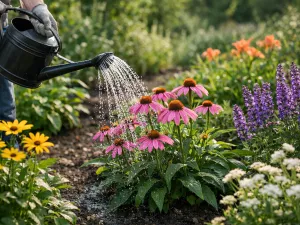
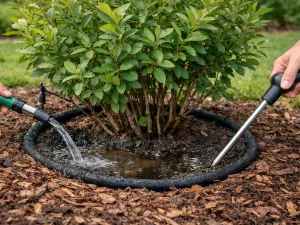
Slow application is usually the most efficient. It reduces runoff, limits splash on foliage, and gives dense soil time to absorb moisture. Drip irrigation, soaker hoses, and a hose set to a gentle trickle all work well for perennial beds.
- Drip lines: ideal for mixed borders because water goes directly to the soil with minimal waste.
- Soaker hoses: useful for long rows or informal plantings where coverage needs to be broad but gentle.
- Hand watering at the base: practical for small beds and newly planted divisions, especially when you need to monitor individual plants.
- Overhead sprinklers: acceptable in some situations, but less efficient and more likely to encourage leaf disease if used late in the day.
How much and how often
Newly planted perennials need closer monitoring because their roots are still concentrated in the original root ball. Established clumps can usually go longer between waterings, provided the soil is soaked deeply. A common target is to wet the soil to around 15 to 20 cm (6 to 8 in) deep for smaller perennials and 20 to 30 cm (8 to 12 in) for larger, mature plants.
Rather than watering by the calendar, check the soil. Insert a trowel or your finger to assess moisture below the surface. If the top 3 to 5 cm (1 to 2 in) are dry but the lower root zone is still damp, you can often wait another day or two.
| Situation | Practical watering approach | What it encourages |
|---|---|---|
| Newly planted perennial | Water every few days as needed, soaking the root ball and surrounding soil to 15 cm (6 in) | Root establishment beyond the original container shape |
| Established border plant in loam | Deep watering when the top 5 cm (2 in) dries, aiming for 20 cm (8 in) depth | Steady, deeper rooting and better drought tolerance |
| Sandy soil bed | Water more often but still slowly, with mulch to reduce evaporation | Less stress from rapid drying |
| Heavy clay bed | Water less often and in stages to avoid runoff and puddling | Improved absorption without waterlogging |
If you are unsure whether a bed has been watered deeply enough, place a straight-sided container nearby during irrigation and measure what falls or is applied. Rough visual estimates are often misleading, especially in mulched borders.
Soil structure and drainage for perennials

Good drainage does not mean soil should dry out immediately. For perennials, the goal is a structure that holds enough moisture for steady growth while letting excess water move away from the root zone. When the soil is open, crumbly, and rich in organic matter, roots can spread easily and remain active for longer periods through the season.
Poor structure is often the hidden reason behind weak plants. A bed may be watered correctly, but if water sits around the crown or roots cannot penetrate compacted layers, growth remains disappointing. Drainage and structure should be assessed together, because one affects the other.
Improving structure without overworking the bed
Adding compost is one of the safest ways to improve most garden soils. Spread 5 to 8 cm (2 to 3 in) over the bed and incorporate it gently where practical, or use it as a top-dressing around established plants. Over time, earthworms and natural soil activity help carry organic matter downward.
Avoid digging or walking on heavy soil when it is wet. That squeezes out air pockets and creates dense clods that can persist for months. In established perennial borders, repeated light improvement is usually better than one aggressive overhaul that disturbs roots too much.
Drainage problems and practical fixes
If water stands on the surface after rain for more than a day, the site needs attention before moisture management can truly improve. Some plants, such as iris, lavender, and many Mediterranean perennials, are especially sensitive to wet feet in winter. Others tolerate more moisture but still suffer if the root crown remains saturated.
- Raised planting areas: lifting the root zone by 15 to 20 cm (6 to 8 in) can help in slow-draining ground.
- Mulch used correctly: a 5 cm (2 in) layer moderates drying, but keep it away from crowns to prevent rot.
- Channeling runoff: redirect downspouts or hard-surface drainage that dumps excess water into beds.
- Plant choice: match moisture-loving species to lower spots and reserve fast-draining areas for drought-tolerant perennials.
It also helps to think below the surface. Sometimes the topsoil looks fine, but roots hit a compacted subsoil layer 20 to 30 cm (8 to 12 in) down. In that case, plants may sit in a perched wet zone after rain. Reworking the bed before planting, or using raised beds where renovation is difficult, often gives better long-term results than trying to compensate with careful watering alone.
Seasonal adjustments in watering routines

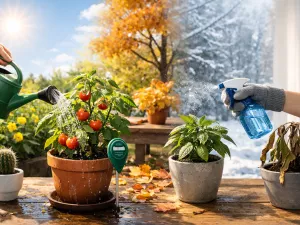
Perennial watering should shift with the season because root activity, evaporation, rainfall, and plant growth all change through the year. A schedule that works in mild spring weather may be completely wrong in midsummer, and late autumn watering has a different purpose again. The aim is to respond to plant demand and soil conditions rather than sticking to one routine.
These adjustments matter because perennial roots are never static. In spring they support fresh shoots and flowering stems. In summer they help the plant cope with heat and replenish moisture lost through leaves. In autumn many perennials continue rooting even as top growth slows, which makes that period important for establishment and winter preparation.
Spring and summer priorities
In spring, soil is often naturally moist, so overwatering is a common mistake. Check before adding more. As temperatures rise beyond 25°C (77°F), transpiration increases and container-grown or recently divided perennials may need closer attention than established clumps in open ground.
During summer heat, water early in the morning when possible. This reduces evaporation and gives foliage time to dry if it gets splashed. A mulch layer can make a major difference by buffering the root zone against rapid moisture loss and temperature swings.
Autumn and winter considerations
Autumn is a valuable time for deep watering, especially during dry spells. Moist soil encourages continued root growth while the ground remains workable. Plants going into winter with hydrated roots are better able to handle cold winds and freeze-thaw cycles.
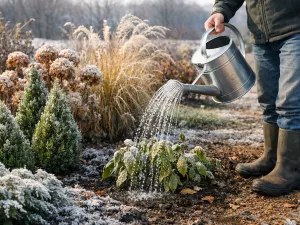
In winter, watering needs drop sharply in many climates, but they do not always disappear. Evergreen perennials and newly planted specimens may still need occasional water during prolonged dry periods when the soil is not frozen. The key is to avoid keeping cold soil constantly wet, which increases the risk of rot.
| Season | Main root-zone concern | Watering adjustment |
|---|---|---|
| Spring | Rapid new growth in cool, often moist soil | Water only after checking soil depth; avoid routine overwatering |
| Summer | Heat stress and faster evaporation | Water deeply in the morning and use mulch to slow drying |
| Autumn | Root establishment before cold weather | Maintain even moisture during dry spells, especially for new plantings |
| Winter | Cold, slow-draining soil and reduced uptake | Water sparingly, only when conditions are dry and the ground is unfrozen |
Do not assume rainfall has fully rehydrated the bed after a storm. Dense foliage, dry soil that sheds water, and overhanging structures can leave the root zone drier than expected even after several millimeters of rain.
Visual signs of healthy root systems

You rarely see perennial roots unless you divide a plant or remove one from a pot, so the best clues are usually above ground. Healthy roots support steady growth, normal leaf size, good color, and a plant that remains upright and resilient between waterings. The signs are often subtle, but together they give a reliable picture of what is happening below the surface.
A strong root system does not always mean rapid top growth. In fact, some of the healthiest perennials grow in a controlled, balanced way rather than producing lush but weak stems. Looking for consistency is more useful than judging by size alone.
Above-ground indicators
When roots are functioning well, the plant tends to recover quickly after hot afternoons, maintain flower buds, and produce leaves that match the expected shape and color for the variety. New growth emerges evenly from the crown, and stems are less likely to flop without a clear reason.
- Even moisture response: the plant stays turgid and does not collapse quickly between waterings.
- Steady flowering: buds develop and open without repeated blasting or shriveling.
- Balanced growth: leaves and stems are proportionate rather than soft, stretched, or stunted.
- Seasonal resilience: the clump returns reliably after winter and fills out gradually each year.
What healthy roots look like during inspection
When dividing or transplanting, healthy roots are usually firm, pale to tan, and branching. Fine feeder roots should be visible around the outer edge of the root mass. A sour smell, black mushy sections, or a tight circling mass with few outward-growing roots suggests problems with drainage, watering, or time spent pot-bound.
If you lift a perennial and find roots concentrated only in the top few centimeters, that often points to shallow irrigation or compacted lower soil. By contrast, a well-established plant in good conditions usually shows roots spreading outward and downward into surrounding soil.
Mistakes that damage perennial roots
Many root problems come from well-meant care that is slightly off in timing or method. Perennials are often forgiving, but repeated mistakes gradually weaken the root system and reduce the plant’s ability to cope with weather stress, pests, and normal seasonal change. The most damaging errors usually involve water, soil handling, or crown management.
Because roots are hidden, gardeners may respond to top growth symptoms with more water or more feed when the real issue is poor drainage, compaction, or damaged feeder roots. A slower, more observant approach usually prevents bigger setbacks.
Common watering and soil errors
Overwatering is one of the most frequent causes of decline, especially in heavy soils or cool weather. Shallow daily watering is another problem because it trains roots to stay near the surface. On the other side, letting newly planted perennials dry out repeatedly before they establish can set them back for an entire season.
- Watering by habit instead of checking soil: leads to unnecessary saturation or missed drought stress.
- Planting too deeply: can bury the crown and keep sensitive tissues damp.
- Piling mulch against stems: traps moisture where rot can begin.
- Working wet soil: creates compaction that limits oxygen and root spread.
- Using strong fertilizer on stressed plants: can burn roots and worsen dehydration.
Handling, pruning, and placement mistakes
Roots can also be damaged during routine garden work. Aggressive hoeing near crowns, careless division, or repeated disturbance around established clumps can break feeder roots that the plant depends on. Poor placement matters too. A moisture-loving perennial in a dry, exposed bed will struggle no matter how carefully it is watered, while a drought-tolerant species in a soggy low spot may slowly rot.
Pruning ties into root health as well. Cutting back too hard during active heat stress can upset the balance between top growth and root demand. Likewise, leaving diseased, collapsed stems around the crown in wet weather can increase fungal pressure where roots and crown tissue meet.
The safest habit is to match plant choice to site, improve soil before problems become chronic, and let the condition of the root zone guide your watering decisions. When perennial roots have air, moisture, and room to grow, most other parts of care become easier and more predictable.