What Is Soil Drainage and Why It Matters

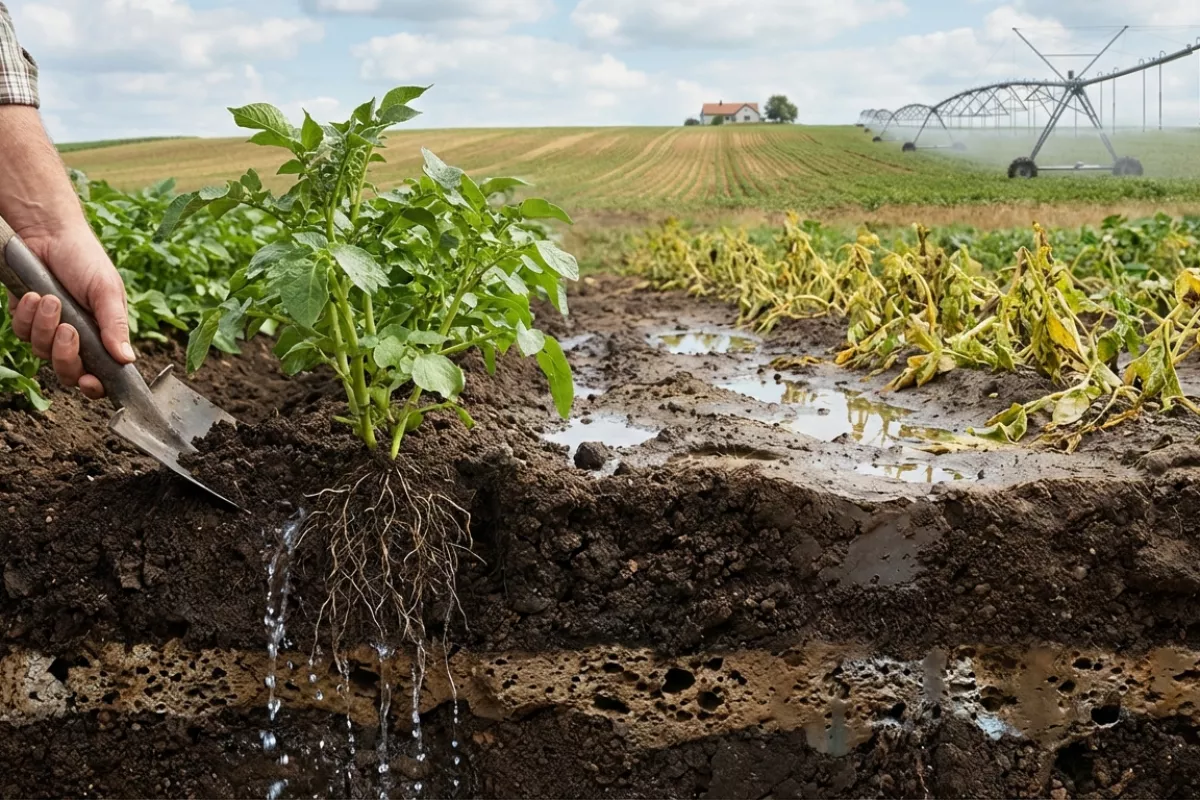 Covers what soil drainage means and why it matters for plant survival. Explains signs of poorly draining soil and problems from waterlogging, shows simple at-home drainage tests, shares ways to improve drainage, and helps you choose plants that match your soil type.
Soil water flow often determines whether plants thrive or struggle. If water can’t escape, roots stay soggy, leading to rot, fungus, and slow growth; if it drains too quickly, plants dry out and nutrients leach away. Learning how drainage works helps you pick the right pot, soil mix, and watering routine for each plant.
What soil drainage means
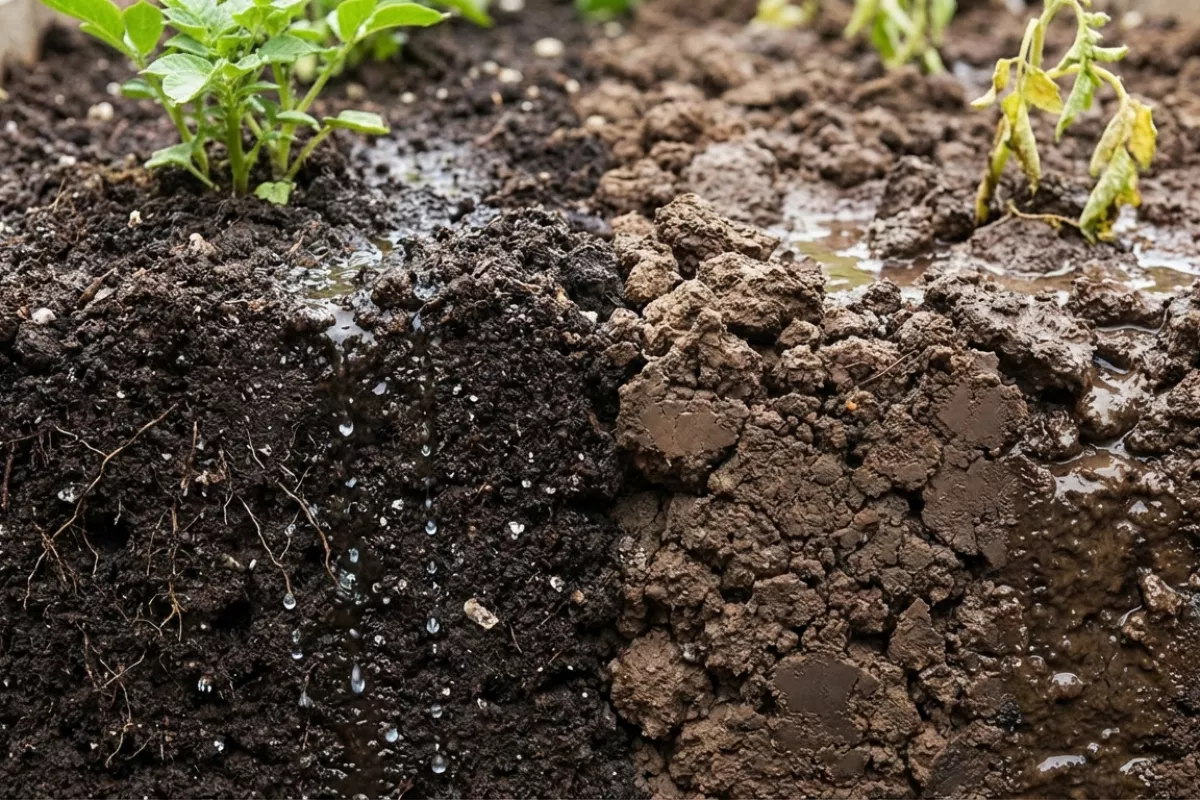
Soil drainage is the way water moves through the ground after rain or irrigation: how quickly it soaks in, how long it stays in the root zone, and how much of it eventually flows away or down. In practical terms, it’s the difference between soil that holds a useful reserve of moisture and soil that stays soggy long enough to stress plants.
Good water movement isn’t “fast” or “slow” by default. The goal is balance: enough pore space for air and roots, plus enough water retention to avoid constant drying out. When the balance is off, problems show up above ground (wilting, yellowing, stunted growth) even though the cause is happening below the surface.
- Infiltration: how easily water enters the soil surface instead of pooling or running off.
- Percolation: how water travels downward through soil layers once it’s inside.
- Water-holding capacity: how much moisture remains available to roots after excess drains away.
- Aeration: how much air-filled space is left for roots and beneficial microbes when the soil is wet.
Drainage is shaped by texture (sand, silt, clay), structure (how crumbs or aggregates form), organic matter, compaction, and what’s happening deeper down (like a dense subsoil layer). That’s why two beds can behave differently even if they look similar on top.
| Drainage pattern | What you typically notice | What it often means |
|---|---|---|
| Rapid | Water disappears quickly; soil dries soon after watering | Large pores (often sandy or very loose soil); low moisture storage |
| Moderate | Soil feels moist but not sticky; puddles fade fairly quickly | Balanced pore sizes; roots get both air and water |
| Slow | Puddles linger; soil stays sticky; footprints or tool marks remain | Fine texture, compaction, or poor structure limiting water movement |
| Restricted by a layer | Topsoil seems fine, but water sits after heavy rain; roots stay shallow | A hardpan, dense clay lens, or abrupt texture change blocking downward flow |
A quick way to think about it: drainage describes both where water goes and what it leaves behind. If water can’t move out, roots lose oxygen. If it moves out too fast, plants can’t access enough moisture between waterings. Understanding that middle ground is what makes the concept useful.
Why drainage affects plant survival
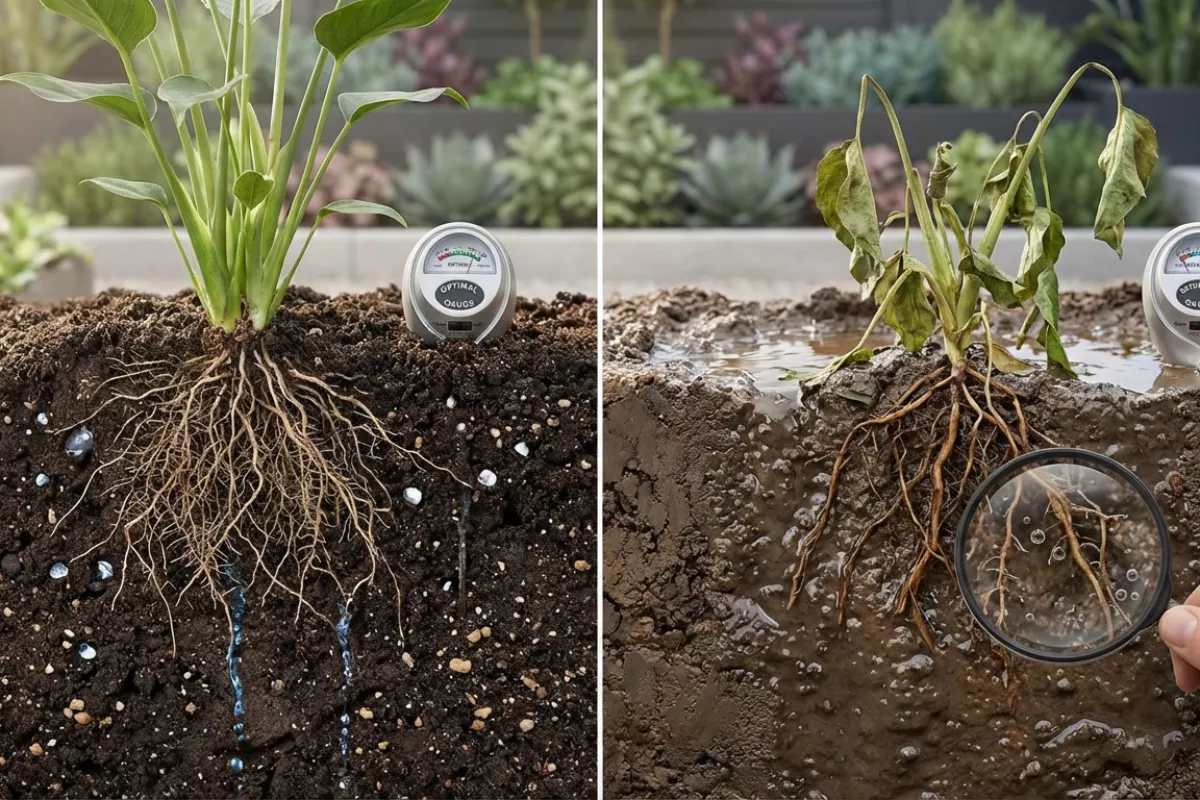
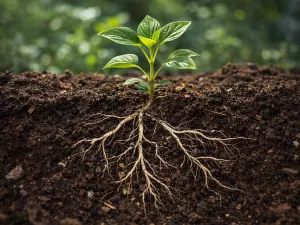
Plant roots need a steady balance of water and oxygen. When soil holds too much water for too long, air spaces fill up and roots can’t “breathe” properly. When water moves through too fast, roots can’t take up enough moisture or nutrients. In both cases, the plant spends energy coping with stress instead of growing.
- Oxygen availability drops in waterlogged soil. Saturated ground limits gas exchange, which slows root respiration and reduces nutrient uptake. Over time, roots weaken and become more vulnerable to disease.
- Root rot and other pathogens thrive in persistently wet conditions. Many harmful fungi and water molds spread faster when the root zone stays soggy, especially in compacted or clay-heavy beds.
- Nutrients can be lost in the wrong direction. Poor percolation can lead to denitrification (nitrogen becomes unavailable), while overly rapid flow can leach mobile nutrients beyond the root zone, leaving plants hungry even if you fertilize.
- Salt buildup is more likely when water can’t flush through. In containers and some garden soils, inadequate outflow lets dissolved salts accumulate, which can burn root tips and stunt growth.
- Temperature swings hit harder when the root zone is stressed. Cold, saturated soil warms slowly in spring, delaying root activity; very dry, fast-draining soil heats up and dries out quickly, increasing wilting risk.
| Drainage pattern | What happens in the root zone | Common plant symptoms |
|---|---|---|
| Too slow (water lingers) | Air spaces stay filled with water; oxygen becomes limited; roots suffocate and decay | Yellowing leaves, stunted growth, soft or dark roots, sudden collapse after rain |
| Too fast (water rushes through) | Moisture and soluble nutrients move below roots before uptake | Frequent wilting, pale foliage, slow growth even with regular watering |
| Uneven (wet pockets + dry pockets) | Roots develop shallowly or avoid saturated zones; uptake becomes inconsistent | Patchy growth, leaf drop during warm spells, inconsistent flowering/fruiting |
| Seasonally blocked (compaction, frozen layers) | Temporary perched water table forms; roots sit in saturated soil after storms or snowmelt | Spring dieback, delayed leaf-out, root damage that shows up weeks later |
A practical way to think about it: good soil drainage isn’t about being “dry.” It’s about water moving through at a pace that keeps the root zone moist while still leaving enough air for healthy root function. When that balance is off, plants may look like they need more water, when the real problem is that the roots can’t use what’s already there.
Signs soil drains poorly
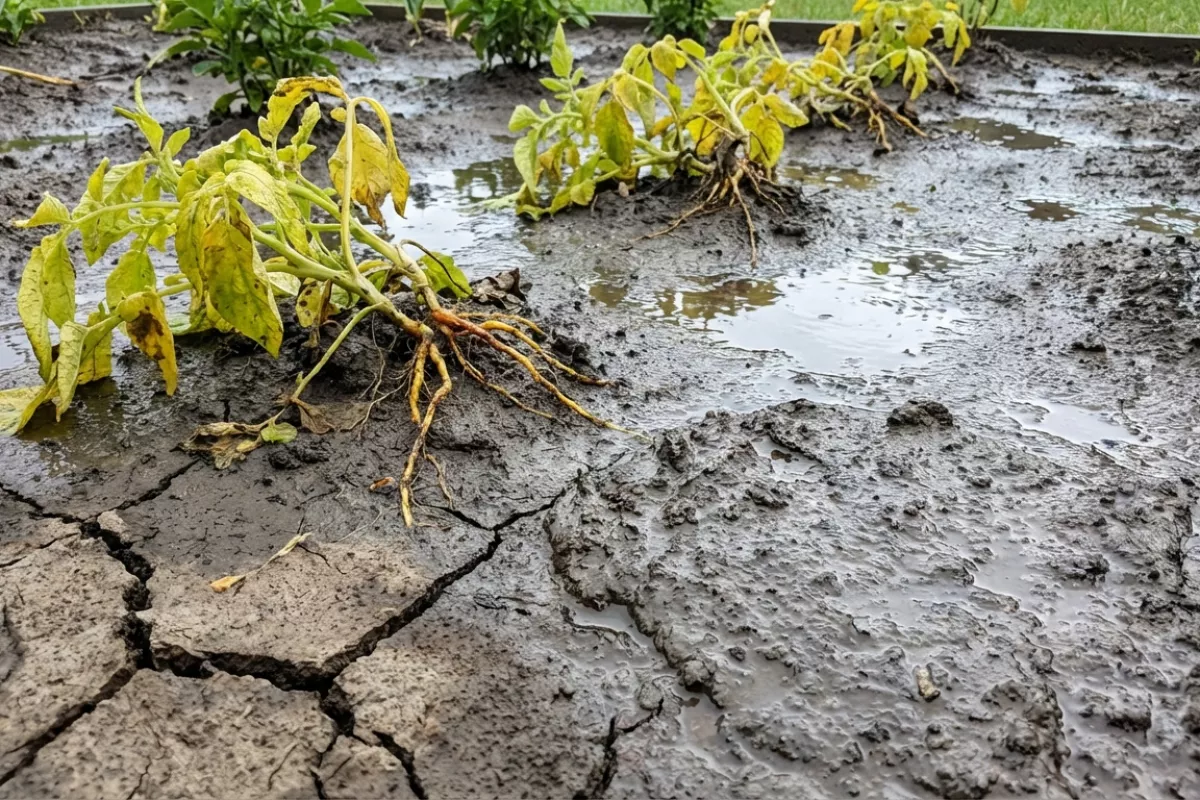
When water can’t move through the ground at a normal pace, plants and soil biology start to show it quickly. Some clues are obvious right after rain or irrigation; others show up over weeks as roots struggle with low oxygen.
- Water sits on the surface for hours after watering or rainfall, forming puddles or a shiny film instead of soaking in.
- Soil feels sticky, smeary, or compacts into a hard crust when you squeeze it, especially in clay-heavy beds. It may also crack when it finally dries, a sign it swings between waterlogged and baked.
- A sour, “rotten egg” smell (often hydrogen sulfide) when you dig 10 cm (4 in) down, suggesting low-oxygen conditions.
- Gray or bluish soil colors (gleying) and rusty orange mottles below the surface, often appearing around 15–30 cm (6–12 in) deep where water lingers.
- Algae, moss, or slime on bare soil in sunny areas, indicating the surface stays wet long enough for them to establish.
- Roots stay shallow and spread sideways rather than growing down; when you pull a plant, you may see dark, soft, or slimy roots instead of firm, pale ones.
- Plants wilt even when the ground is wet because waterlogged soil limits oxygen uptake, so roots can’t function normally.
- Yellowing leaves and slow growth that doesn’t improve with fertilizer, since nutrients can become unavailable or leach unevenly in saturated areas.
- More fungus gnats, mosquitoes, or slug activity around beds that stay damp, especially in shaded spots.
- Footprints and tool marks linger long after you walk through, and the area turns into ruts or mud with light traffic.
If you want a quick reality check, dig a small test hole about 30 cm (12 in) deep, fill it with water, let it drain once, then refill. If the second fill drops very slowly (for example, still mostly full after a couple of hours), that’s consistent with restricted drainage rather than just a dry surface layer.
Problems caused by waterlogging
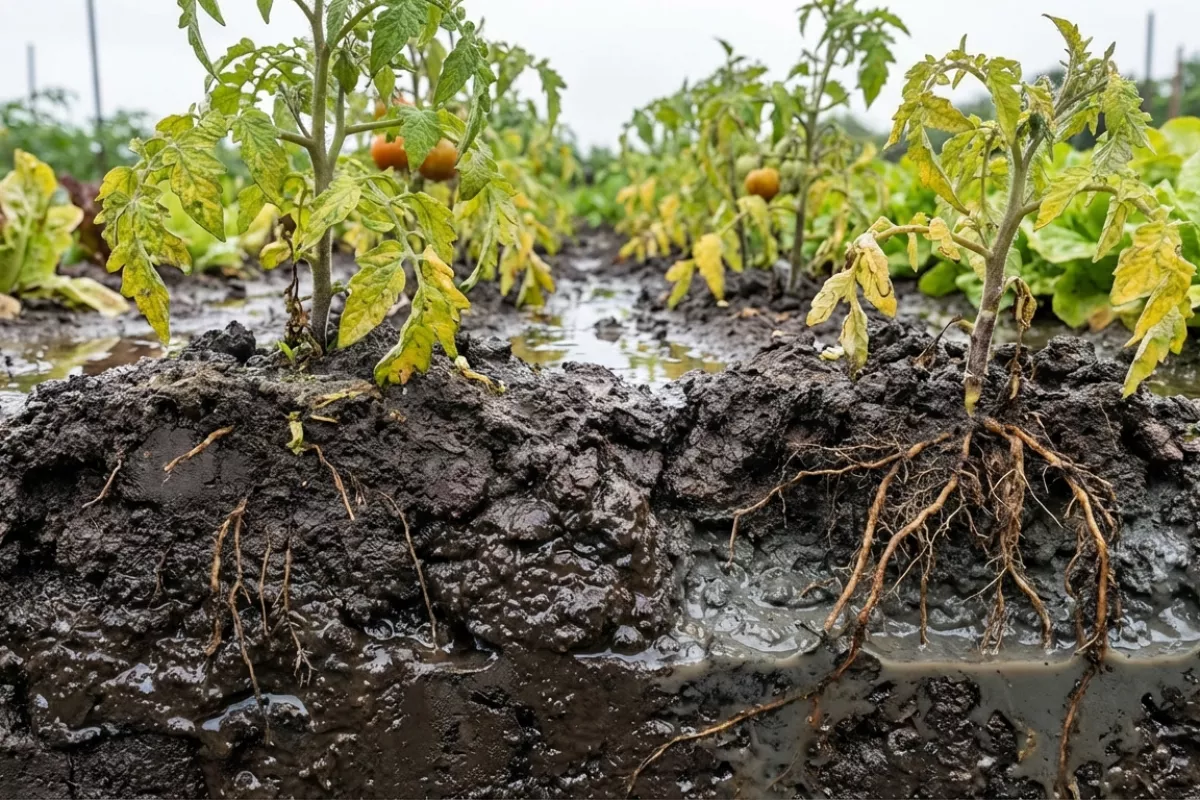
When soil stays saturated for too long, air is pushed out of the pore spaces and roots can’t get enough oxygen. That shift from “moist” to “water-filled” changes everything underground: nutrient cycling slows, beneficial microbes decline, and plants often show stress even though there’s plenty of water present.
- Root suffocation and dieback: In oxygen-poor conditions, roots stop growing, fine feeder roots die, and plants become less able to take up water and nutrients. Symptoms often look like drought stress—wilting and leaf scorch—despite wet ground.
- Higher risk of root diseases: Saturated conditions favor pathogens such as Phytophthora and Pythium. Once roots are damaged, recovery can be slow, especially for woody plants and perennials.
- Nutrient losses and imbalances: Waterlogged soils can lose nitrogen through denitrification (nitrogen gas escapes to the air), while other nutrients may become less available. Yellowing leaves (chlorosis) and stunted growth are common, even in fertilized beds.
- Soil structure damage and compaction: Working or driving on wet ground compresses soil, collapses pore spaces, and creates a long-term drainage problem. A single pass with heavy equipment can leave ruts 5 cm (2 in) deep or more, and the compaction can persist for seasons.
- Reduced germination and poor establishment: Seeds and young seedlings are especially sensitive to low oxygen. Cool, saturated seedbeds delay emergence and increase damping-off losses.
- Weed and pest pressure shifts: Some weeds thrive in soggy areas, and stressed plants attract opportunistic insects. Standing water can also increase mosquito breeding where puddles persist.
- Runoff, erosion, and nutrient movement: Once the soil can’t absorb more, rainfall turns into surface flow. That can carry sediment and dissolved nutrients away from the site, thinning topsoil and muddying nearby hardscapes or waterways.
| What you might notice | What’s often happening below the surface | Why it matters |
|---|---|---|
| Yellowing leaves and slow growth | Nitrogen loss (denitrification) and reduced root uptake | Plants can look “hungry” even with fertilizer present |
| Wilting on sunny days despite wet soil | Damaged roots can’t move water efficiently | Stress compounds quickly and can lead to leaf drop |
| Soft, dark roots with a sour smell | Low oxygen and increased root-rot organisms | Root systems shrink, making recovery harder |
| Puddles that linger for 24 hours (1 day) or more after rain | Infiltration rate is too low; pores are filled or compacted | More runoff, less recharge to the root zone, and higher erosion risk |
In short, excess water isn’t just an inconvenience at the surface—it changes the soil environment in ways that reduce plant resilience and can create a cycle of compaction and poor infiltration. If you’re seeing repeated ponding or stressed plants in the same spots, it’s often a sign that drainage needs attention rather than more watering or more fertilizer.
How to test drainage at home
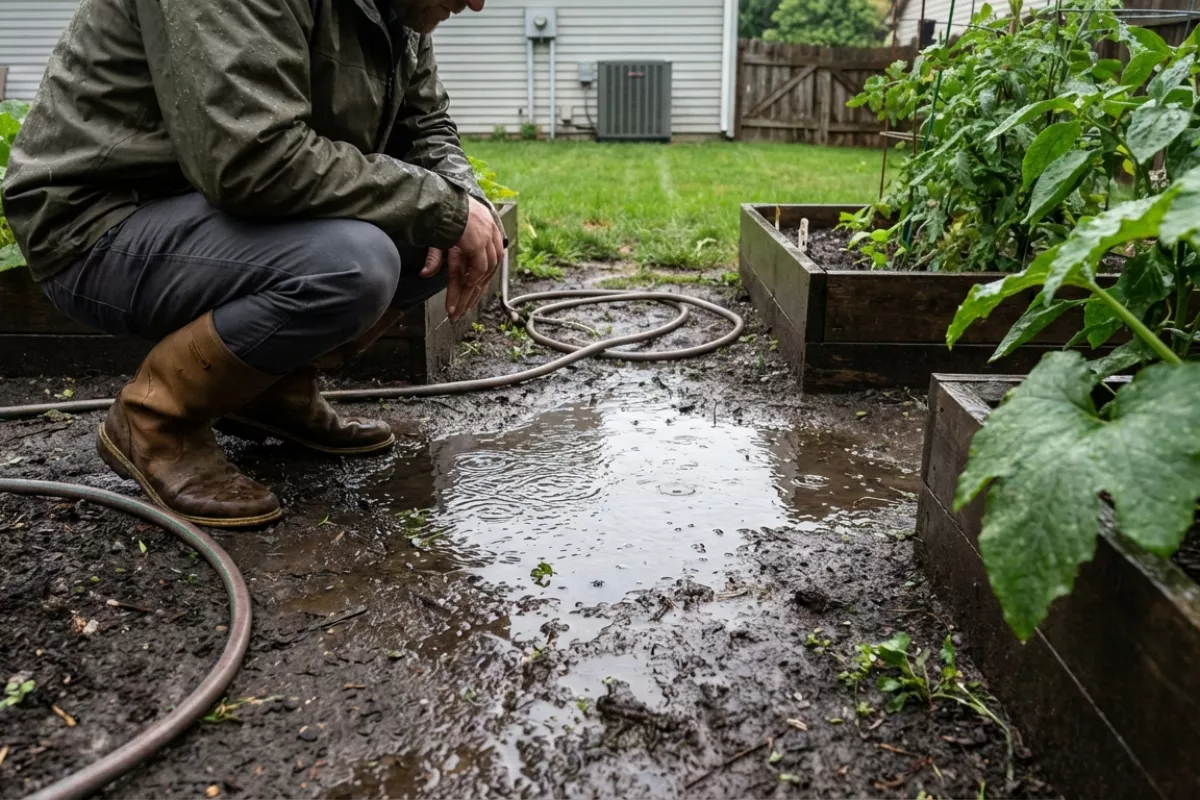
You don’t need lab gear to get a reliable read on how quickly water moves through your yard or garden beds. A couple of simple checks can tell you whether water is soaking in at a healthy pace, pooling near the surface, or disappearing so fast that roots may struggle to stay evenly moist.
-
Do a quick “puddle check” after rain or watering. Walk the area 30–60 minutes after a thorough soak. If you still see standing water in low spots, or the surface stays shiny and slick, infiltration is likely slow. If the top looks dry but plants wilt quickly, the soil may be draining very fast or repelling water.
-
Run a simple jar test to understand texture. Fill a clear jar about 1/3 with soil, add water to near the top, and shake. Let it settle for 24 hours. Sand drops first, then silt, then clay. More clay usually means slower percolation; more sand often means faster flow but less water-holding. This doesn’t measure drainage rate directly, but it explains why you’re seeing what you’re seeing.
-
Use the hole-and-timer percolation test (most useful). Pick a representative spot (or test a few: lawn, bed, low area). Dig a hole about 30 cm deep by 15–20 cm wide (12 in deep by 6–8 in wide). Roughen the sides so water can move naturally, then follow the steps below.
-
Pre-soak: Fill the hole with water and let it drain completely. This reduces “false slow” results in very dry soil.
-
Test: Refill to a measured depth, such as 15 cm (6 in). Start a timer.
-
Measure drop: Check the water level every 30 minutes and record how many centimeters (inches) it falls per hour.
-
| Percolation result (approx.) | What it usually means | Common next step |
|---|---|---|
| Less than 2.5 cm/hour (1 in/hour) | Slow movement; water tends to linger, roots can sit wet, and compaction or clay may be limiting flow. | Add organic matter, avoid working soil when wet, consider aeration or a raised bed in problem areas. |
| 2.5–7.5 cm/hour (1–3 in/hour) | Generally good drainage for many garden plants; moisture and air balance is often workable. | Maintain with compost/mulch and minimize compaction from foot traffic. |
| 7.5–15 cm/hour (3–6 in/hour) | Fast flow; water doesn’t stay long, so soil can dry quickly between irrigations. | Increase water-holding with compost, mulch, and deeper watering less often. |
| More than 15 cm/hour (6 in/hour) | Very rapid drainage (often sandy or gravelly); nutrients may leach and plants may need frequent moisture. | Build organic matter over time, use mulch, and consider plants adapted to drier conditions. |
Tips for more accurate results: test when the soil is not frozen; avoid spots right next to downspouts; and repeat in at least two locations if your yard has obvious slopes or different soil types. If the hole test varies widely from one place to another, drainage is probably uneven—often a sign of localized compaction, buried debris, or a change in soil layer depth.
Ways to improve soil drainage
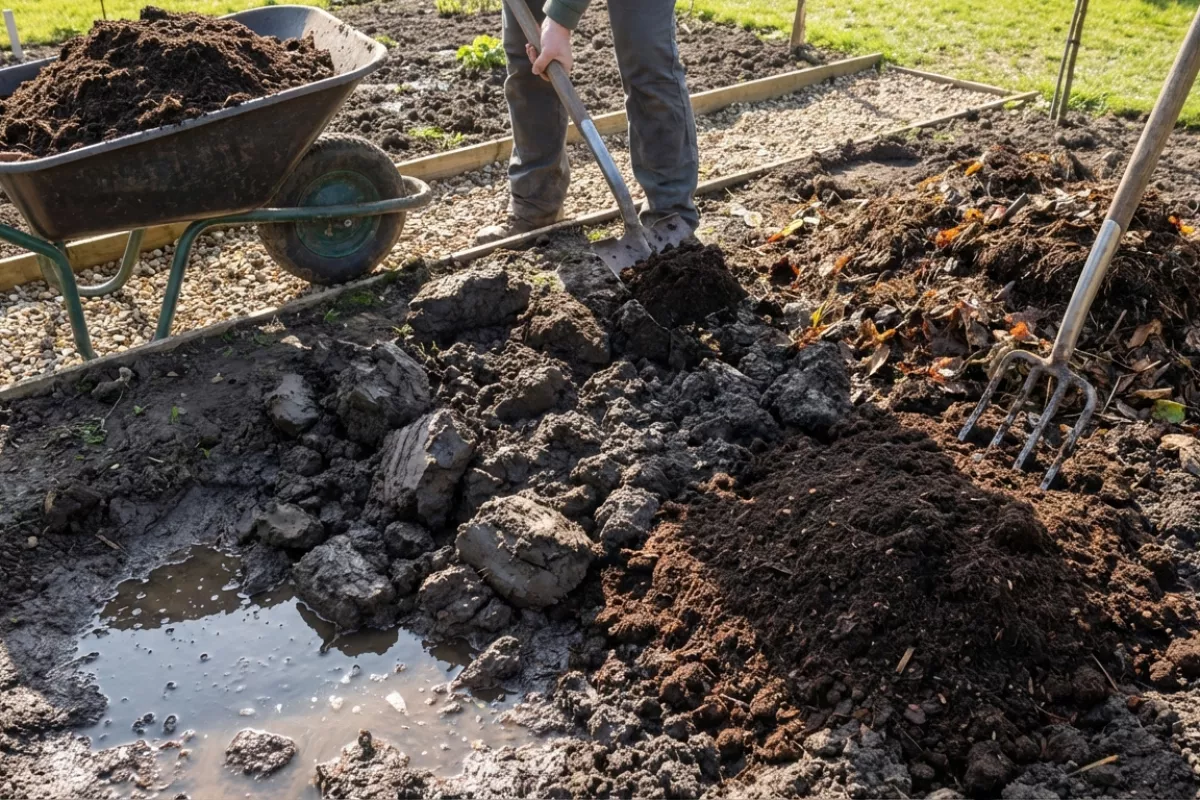
Start by figuring out what’s actually causing the soggy soil: heavy clay that holds water, compaction from foot traffic, a low spot that collects runoff, or a high water table. The best fix depends on whether you need to help water move through the soil, off the surface, or both.
- Add organic matter to improve structure. Mixing in finished compost, leaf mold, or well-rotted manure helps clay form larger aggregates, creating pores that let water and air move. A practical approach is to top-dress 2.5–5 cm (1–2 in) and let worms and roots work it in, or incorporate it into the top 15–20 cm (6–8 in) when establishing a new bed.
- Avoid working wet soil. Digging or tilling when it’s sticky smears clay particles together and makes drainage worse. Wait until a handful crumbles rather than forming a ribbon when squeezed.
- Relieve compaction. For lawns and paths, core aeration removes plugs and opens channels for water infiltration. In beds, a broadfork or garden fork can loosen the soil 20–30 cm (8–12 in) deep without flipping layers, which preserves soil life and reduces re-compaction.
- Create raised beds or mounded rows. Lifting the root zone above saturated ground is often the quickest improvement. Even an extra 15–30 cm (6–12 in) of height can keep roots out of standing water after storms.
- Grade the surface so water has somewhere to go. If puddles form in a low spot, gently re-shaping the area to shed water toward a safe outlet can help. A subtle slope is usually enough; the goal is steady runoff without erosion.
- Use mulch to reduce crusting and improve infiltration. A 5–8 cm (2–3 in) layer of wood chips, shredded leaves, or straw softens the impact of rain, limits surface sealing, and encourages earthworms that create natural drainage channels.
- Choose plants that match the moisture level. In areas that stay damp despite improvements, switch to species that tolerate “wet feet” rather than fighting the site. Deep-rooted perennials can also help open the soil over time.
- Manage irrigation so you’re not adding to the problem. Water less often but more deeply when the soil can accept it, and check output so sprinklers aren’t applying faster than the ground can absorb. Early morning watering reduces prolonged saturation overnight.
- Consider a French drain or subsurface drain for persistent waterlogging. Where water consistently sits for more than 24–48 hours after rain, a perforated pipe set in gravel can intercept and redirect excess water. This is most useful when there’s a clear downhill discharge point and you’re dealing with a “bathtub” effect in the landscape.
| Problem you see | Likely cause | Most effective fix | Notes |
|---|---|---|---|
| Water puddles on the surface after rain | Compaction or surface crusting | Core aeration; add compost; mulch 5–8 cm (2–3 in) | Keep traffic off wet ground to prevent it returning. |
| Soil stays sticky and slow to drain | High clay content and poor aggregation | Regular organic matter additions; broadfork 20–30 cm (8–12 in) | Avoid sand-only additions; it can worsen texture if not balanced with organics. |
| Plants yellow, roots rot, area smells sour | Low oxygen from prolonged saturation | Raised beds 15–30 cm (6–12 in); improve grading | Prioritize getting the root zone above the wet layer. |
| One corner of the yard is always wet | Low spot collecting runoff | Re-grade; add a shallow swale; redirect downspouts | Move roof water away from foundations and planting beds. |
| Water returns quickly even after improvements | High water table or trapped subsurface water | French drain or subsurface drain (pipe in gravel) | Best when you have a legal, safe outlet for discharge. |
If you’re unsure where to start, try the least disruptive options first: reduce compaction, add organic matter, and adjust surface flow. If the area still stays saturated after a day or two, that’s usually the point where raised planting areas or a proper drain system becomes worth considering.
Choosing plants for drainage type
Match plants to how quickly water moves through your soil, and you’ll spend less time fighting yellow leaves, root rot, or constant wilting. Start by noticing what happens after a thorough soak or a solid rain: does water disappear quickly, linger in puddles, or stay evenly moist for days? That simple observation tells you more than a label on a plant tag.
A practical way to think about it is in three buckets: fast-draining (sandy or very loose mixes), medium-draining (crumbly loam that holds moisture but doesn’t stay soggy), and slow-draining (clay-heavy or compacted areas where water sits). Use the examples below as a starting point, then adjust based on sun, wind, and how often you can water.
| Drainage behavior | What it looks like in the garden | Plants that usually cope well | Watch-outs |
|---|---|---|---|
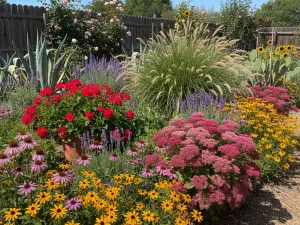
| Fast-draining | Soil dries soon after watering; water runs through quickly; plants may wilt on hot afternoons | Lavender, rosemary, thyme, sedum, yarrow, sage, many Mediterranean herbs | Needs deeper watering less often; mulch helps reduce evaporation; small pots can dry out in 1–2 days |
| Medium-draining | Even moisture; no standing water; soil feels damp but not sticky a day after watering | Most vegetables (tomato, pepper, beans), many perennials (coneflower, daylily), shrubs (hydrangea with consistent moisture) | Overwatering can still cause problems; aim for moisture in the top 10–15 cm (4–6 in), not constant wetness |
| Slow-draining | Puddles after rain; soil stays slick or sticky; footprints linger; plants decline in wet spells | Moisture-tolerant picks like iris (bearded types prefer better drainage, but some irises handle moisture), swamp milkweed, red twig dogwood, elderberry, some willows (space permitting) | Root diseases are common; avoid plants that demand “sharp drainage” (many succulents); consider raised beds 20–30 cm (8–12 in) high |
| Seasonally wet (drains slowly in spring, improves in summer) | Waterlogged during snowmelt or heavy spring rains; acceptable later | Plants that tolerate periodic wet feet: some native grasses, certain viburnums, winterberry holly (where suited) | Spring planting can fail; plant after the wettest period or mound soil 10–20 cm (4–8 in) for sensitive roots |
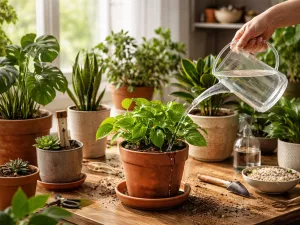
If you’re gardening in containers, drainage is mostly about the pot and mix rather than native soil. A pot needs at least one unobstructed drain hole, and the mix should hold moisture without turning to sludge. As a rule of thumb, plants that like drier conditions do better in a gritty, airy mix, while thirstier plants prefer a mix with more organic matter that still drains freely.
- When soil drains too fast: choose drought-tolerant species, add mulch, and water deeply so moisture reaches 15–20 cm (6–8 in) rather than just wetting the surface.
- When soil drains too slowly: favor wet-tolerant plants, avoid over-amending with fine compost that can worsen compaction, and consider raised beds or planting on mounds 20–30 cm (8–12 in) high.
- When you’re unsure: start with adaptable plants (many grasses, coneflower, daylily) and observe for a full watering cycle before expanding to fussier choices.
The goal isn’t to force every plant into the same conditions; it’s to put the right roots in the right place. Once the drainage pattern and plant preferences line up, watering becomes simpler, growth is steadier, and problems like fungus gnats in pots or chronic leaf yellowing in beds are much less common.