Why Soil Texture Matters for Plant Roots

 Covers what soil texture means, explains sand, silt, and clay types, and shows how texture impacts root growth, water holding, and nutrient access. Also walks through spotting your soil type and improving texture so roots grow better.
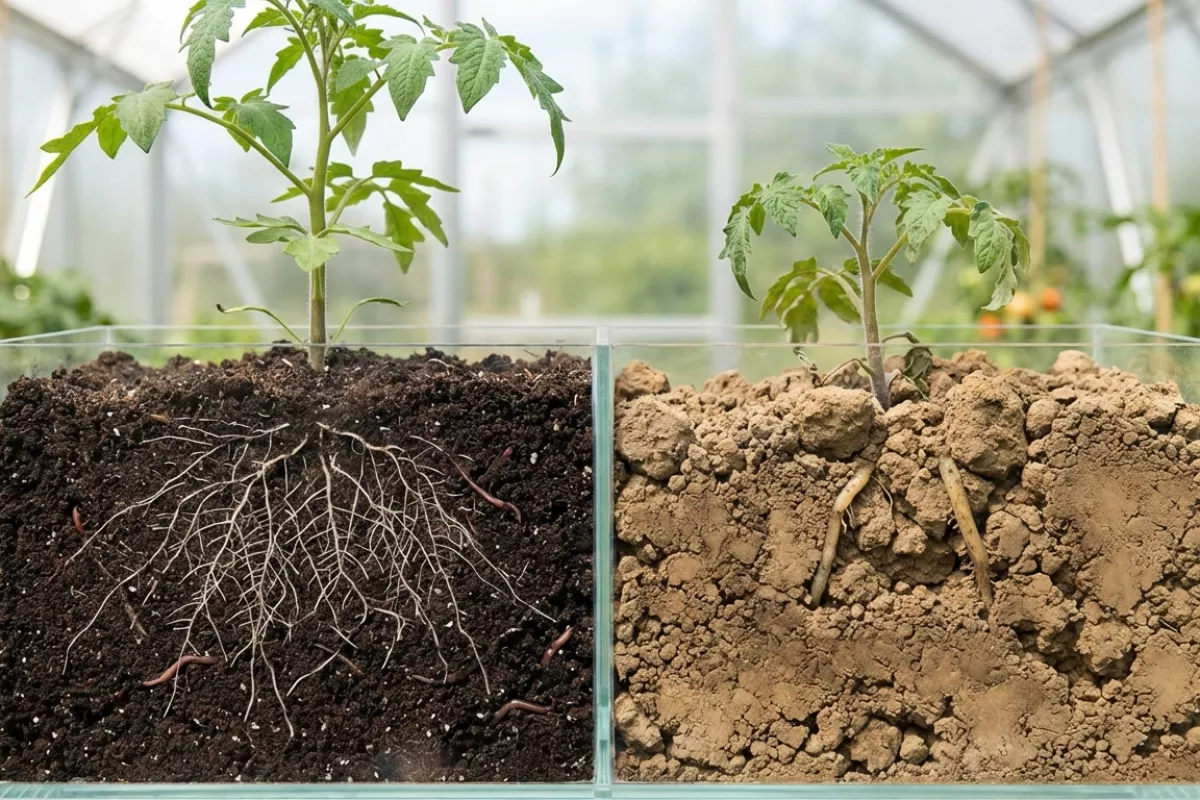
Healthy roots depend on soil texture, the balance of sand, silt, and clay that determines how roots breathe, absorb water, and expand. If soil is too dense, roots struggle, stay wet, and may rot; if it is too loose, moisture drains quickly and plants dry out. Knowing your soil type helps you water more efficiently and select the best amendments for stronger growth.
What soil texture means
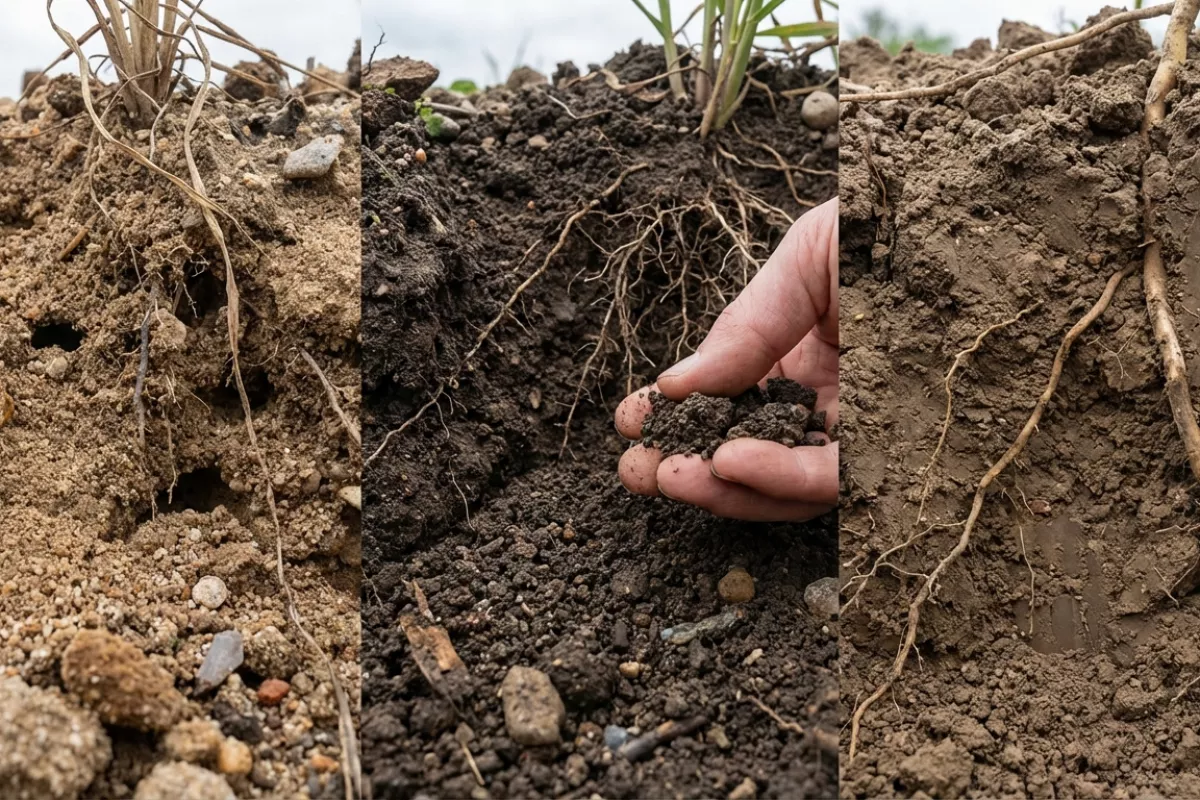
In soil science, texture is the mix of particle sizes that make up the mineral part of the ground: sand (largest), silt (medium), and clay (smallest). It’s not about how the surface feels when it’s dry; it’s about proportions. That blend shapes how tightly particles pack together, how many pores exist between them, and whether those pores tend to be large (fast drainage, lots of air) or tiny (slow drainage, strong water-holding).
It also helps to separate texture from a couple of related terms that people often lump together:
- Structure: how particles clump into aggregates (crumbs, blocks, plates). Two soils can share the same texture but behave differently if one has good aggregation and the other is compacted.
- Organic matter: decomposed plant and animal material. It can make a heavy soil act “lighter” by improving aggregation and pore space, but it doesn’t change the underlying sand–silt–clay ratio.
- Compaction: how squeezed the soil is. Compaction can reduce pore space in any texture, which is why roots sometimes struggle even in a sandy bed.
Because roots grow through pores, the particle-size mix is a practical clue to what roots will experience: how easily they can push through, how long water stays after irrigation or rain, and how much oxygen reaches the root zone. Texture is usually described with names like “sandy loam” or “clay loam,” which are shorthand for specific sand/silt/clay percentages rather than a subjective label.
| Texture group | Typical pore/water behavior | What roots often notice |
|---|---|---|
| Sandy | Many large pores; drains quickly; low water storage | Easy penetration and good aeration, but moisture can drop fast between waterings |
| Silty | Moderate pores; holds more water than sand; can crust when bare | Generally good rooting when well-aggregated; surface crusts can slow seedling roots |
| Clayey | Many tiny pores; slow drainage; high water-holding but less air when wet | Roots may struggle if the soil stays saturated or is compacted; cracks when dry can create channels |
| Loam (balanced mix) | Blend of pore sizes; steadier moisture with decent aeration | Often supports broad, dense root systems because water and oxygen are both reasonably available |
If you’re trying to judge texture at home, a simple “jar test” (soil + water in a clear jar) can give a rough sense of the sand/silt/clay layers after they settle. It won’t replace a lab analysis, but it’s enough to explain why one bed dries out quickly while another stays wet and tight around roots.
Types of soil textures explained
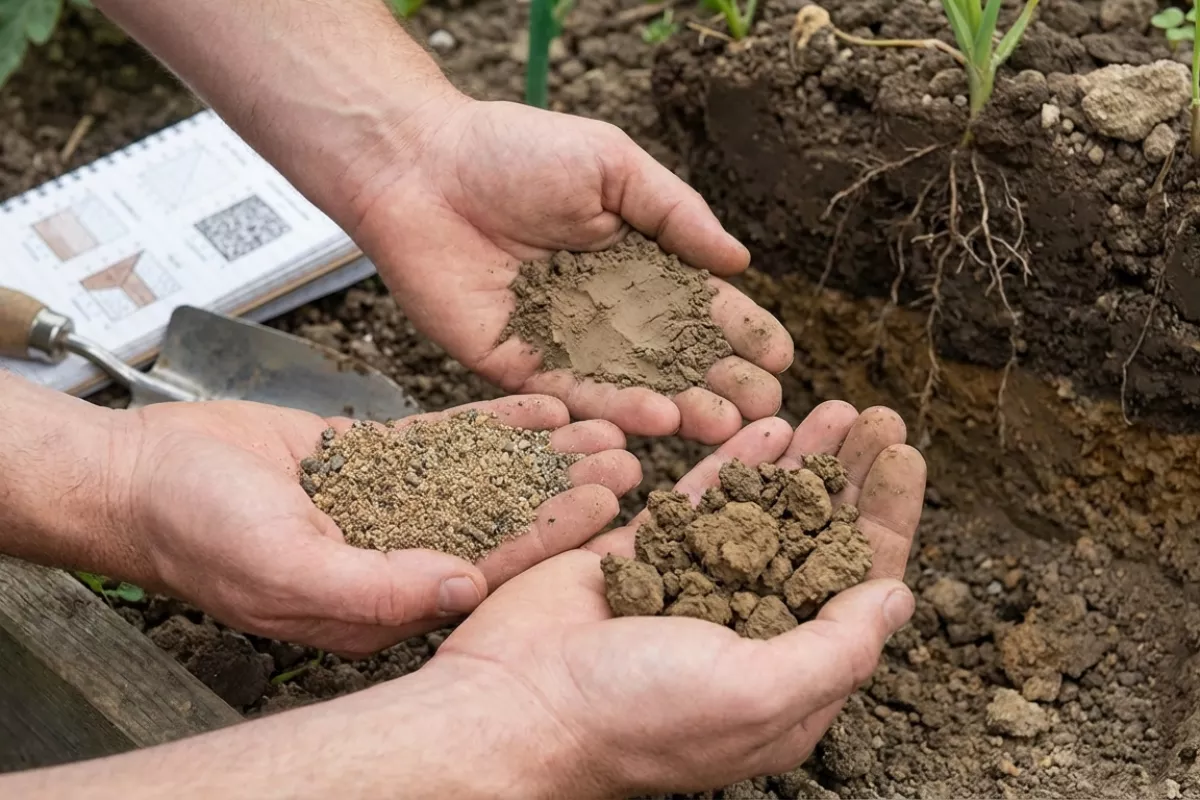
Soil “feel” comes down to the proportion of sand, silt, and clay. Those particle sizes shape how tightly the ground packs, how quickly water moves, and how easily roots can push through or branch out. Most garden beds aren’t a single pure type; they sit somewhere on a spectrum, with loam landing near the middle.
| Texture type | What it’s like | Drainage & aeration | How roots typically respond |
|---|---|---|---|
| Sandy | Gritty, falls apart in your hand | Very fast drainage; lots of air pockets | Roots penetrate easily, but may struggle with steady moisture and nutrients; fine roots can dry out quickly |
| Silty | Soft, floury, smooth when wet | Moderate to slow drainage; can compact | Roots grow well when structure is stable, but compaction can limit oxygen and reduce branching |
| Clay | Sticky when wet; hard clods when dry | Slow drainage; low air exchange when compacted | Roots may thicken or follow cracks and old channels; waterlogging can reduce oxygen and slow growth |
| Loam | Crumbly, holds shape lightly, easy to work | Balanced drainage and airflow | Often supports the most even root spread: good penetration, branching, and access to water and nutrients |
Texture also influences how soil behaves across seasons. Clay-heavy ground can swing from saturated in wet weather to brick-like in drought, while sandy beds can go from moist to dry in a short time. That’s why two gardens with the same watering schedule can produce very different root systems.
- Compaction risk: Silt and clay are more likely to pack down under foot traffic or heavy rain, which can restrict root tips and reduce oxygen around the root zone.
- Water holding vs. water access: Clay holds a lot of water, but not all of it is easy for plants to use; sand holds less, so roots may need to explore a larger volume of soil to keep up.
- Best practical takeaway: Aim for stable structure (crumbs/aggregates) regardless of type—roots care as much about pores and channels as they do about the sand–silt–clay ratio.
How texture affects root growth
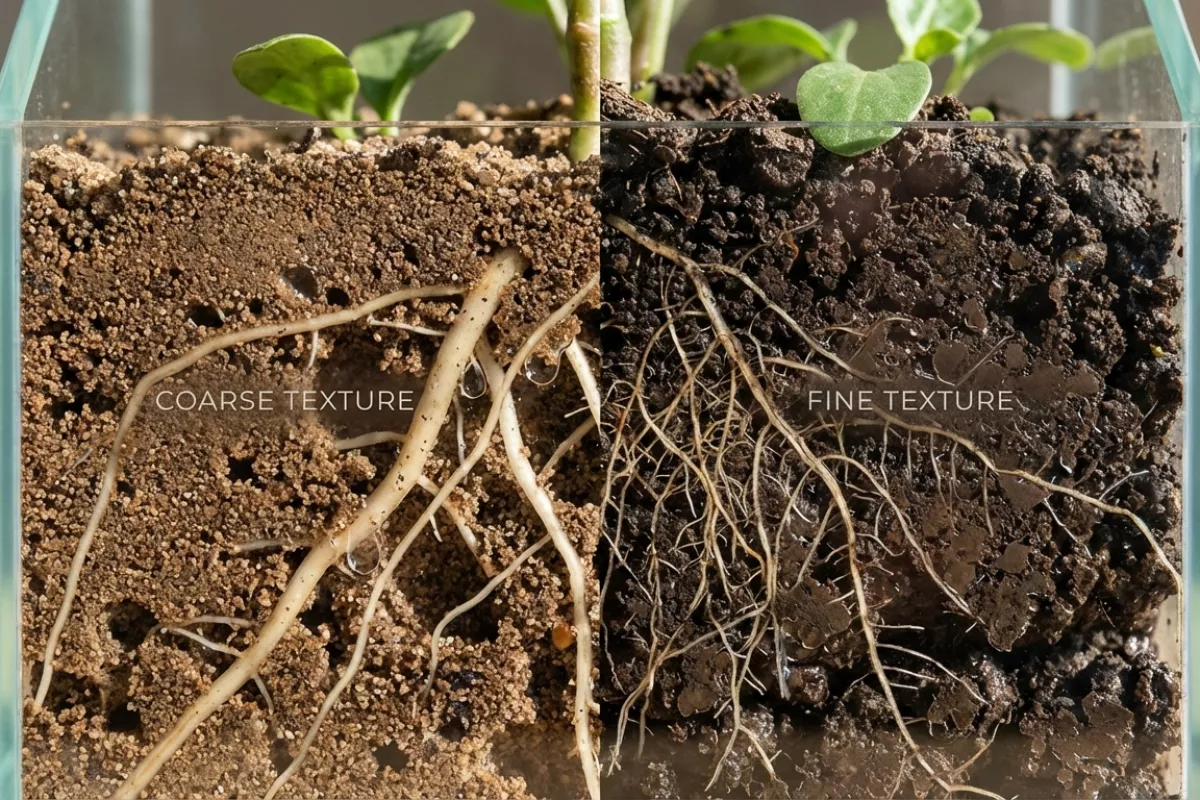
Root systems respond to the “feel” of soil because texture controls the size and arrangement of pore spaces. Those pores decide how easily roots can push forward, how much oxygen reaches the root zone, and how reliably water and nutrients are held between irrigations or rain.
Think of texture as the physical framework roots have to work with. In coarse materials, roots usually travel quickly but may struggle to stay supplied with moisture. In very fine materials, water can linger and air can be limited, which slows root respiration and can reduce branching.
- Penetration and anchorage: Sandy soils tend to offer low mechanical resistance, so roots can extend faster and deeper. Heavy clay can be physically dense when dry, making it harder for fine roots to explore and for seedlings to establish.
- Oxygen supply: Larger pores in coarse-textured ground refill with air quickly after watering. Fine-textured ground has many tiny pores that stay water-filled longer, which can reduce oxygen and encourage shallow rooting.
- Water availability: Sand drains quickly, so plants may cycle between wet and dry more often. Clay holds more total water, but a larger share can be held tightly; plants can still experience stress even when the soil feels damp.
- Nutrient holding and root foraging: Finer particles (especially clay) have more surface area and can hold onto nutrients, often supporting dense, highly branched root networks. Coarser soils may require roots to explore a larger volume to find the same supply.
- Root architecture shifts: When water and nutrients are patchy (common in coarse mixes), plants often invest in longer exploratory roots. When resources are more evenly retained (common in finer mixes), plants often build more lateral branching near the surface.
| Soil texture | Typical pore pattern | What roots often do | Common limitation in the root zone |
|---|---|---|---|
| Sandy (coarse) | More large pores; rapid drainage | Extend quickly; explore deeper for moisture | Frequent drying; nutrients leach more easily |
| Loam (balanced mix) | Mix of pore sizes; steady air/water balance | Branch well; maintain both depth and spread | Usually few texture-related limits; compaction is the bigger risk |
| Clay (fine) | Many tiny pores; slow drainage | Concentrate growth where oxygen is available; can become shallow | Low aeration when wet; hard/strong when dry |
| Silt-dominant (very fine, smooth) | Small pores; can crust at the surface | Seedling roots may struggle to break through crusted layers | Surface sealing reduces infiltration and gas exchange |
Texture doesn’t act alone. Structure, organic matter, and compaction can either open up pathways or shut them down. For example, a clay soil with stable aggregates and organic matter can support surprisingly deep rooting, while a sandy soil that’s compacted can still restrict growth despite being “light.”
Water retention in different textures
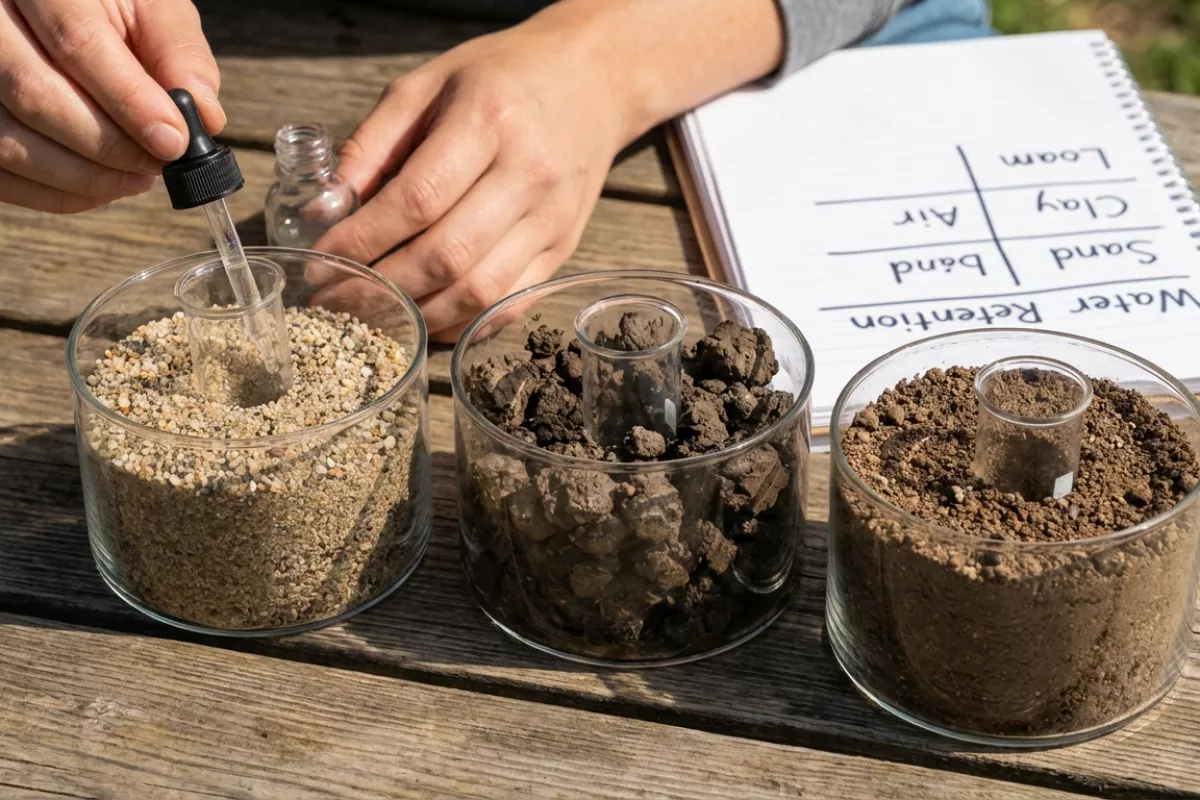
How long soil stays moist after rain or irrigation depends on pore size. Big pores drain quickly under gravity, while tiny pores hold water tightly to particle surfaces. Roots feel the difference as a balance between “water available” and “air available,” and that balance shifts a lot with texture.
| Texture (typical feel) | How it holds and releases water | What roots commonly experience | Practical watering takeaway |
|---|---|---|---|
| Sand (gritty) | Low storage; drains fast because large pores empty quickly. | Plenty of oxygen, but moisture can drop sharply between waterings. | Water more often in smaller doses; add organic matter to increase holding capacity. |
| Silt (smooth/floury) | Moderate storage; holds more than sand and releases water fairly readily. | Often a good balance of air and moisture, but can crust or compact if structure is poor. | Use moderate, even irrigation; protect the surface with mulch to reduce crusting and evaporation. |
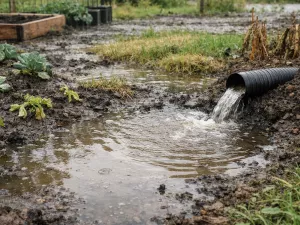
| Clay (sticky when wet) | High total storage, but much of it is held tightly in very small pores. | Can be wet yet hard for roots to extract; aeration drops when saturated. | Water less often but more deeply; avoid frequent light watering that keeps the top layer waterlogged. |
| Loam (balanced mix) | Good storage with a wide range of pore sizes, so it both holds and supplies moisture well. | Typically the easiest texture for steady uptake and root growth. | Aim for deep, infrequent watering; adjust based on weather and plant demand. |
Texture isn’t the whole story: structure can override it. A well-aggregated clay can drain and breathe better than a compacted silt, even if the particle sizes suggest otherwise. That’s why practices that protect pore space—mulch, minimizing compaction, and building organic matter—often improve moisture behavior more than simply knowing the label on a soil test.
- Fast-drying soils (often sandy) benefit from shorter watering intervals and surface cover to slow evaporation.
- Slow-draining soils (often clayey) do better with longer gaps between irrigations so air can re-enter the root zone.
- “Wet but thirsty” situations can happen in fine textures: the soil looks moist, yet plants wilt because much of that water is held too tightly for roots to pull in.
Nutrient availability differences
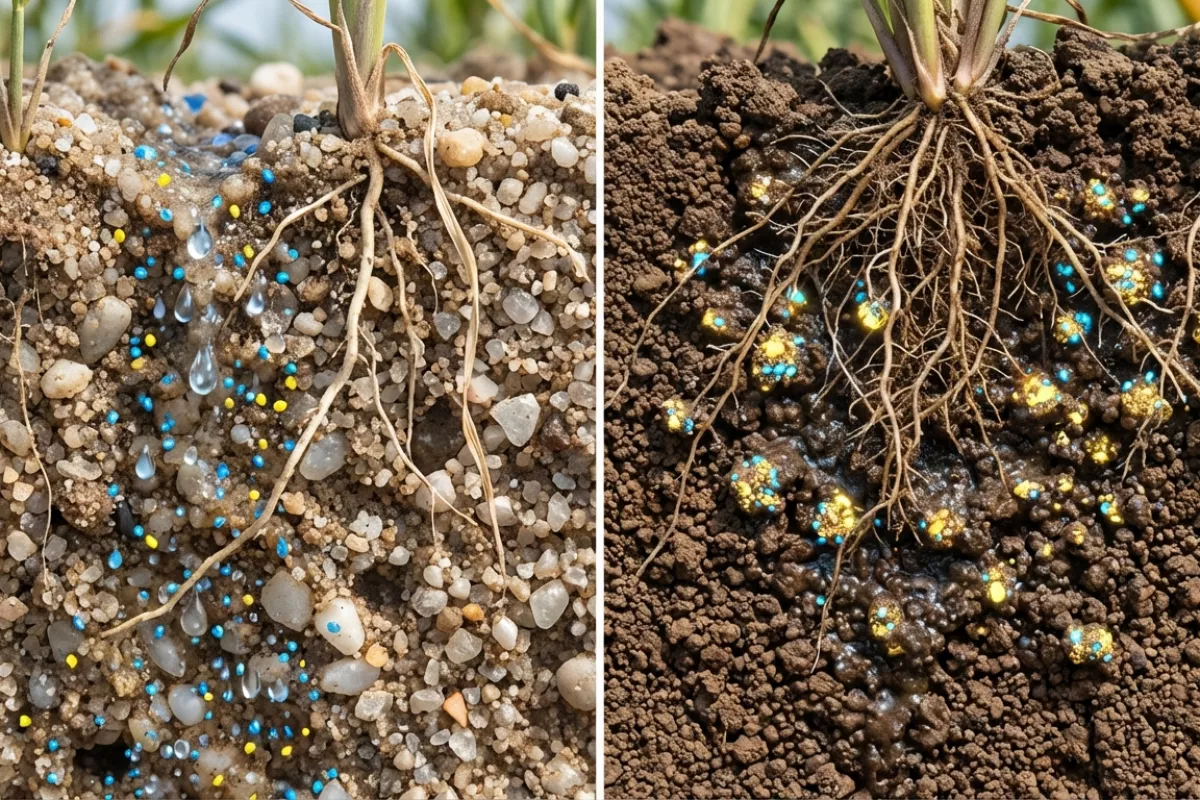
Soil texture changes how nutrients are held, released, and moved toward roots. Coarse sands have lots of big pores that drain quickly, so dissolved nutrients can wash below the root zone after heavy watering or rain. Fine clays and silts have far more surface area, which helps them hold onto nutrient ions, but that same “stickiness” can slow how fast plants can access them—especially when the soil is compacted or stays cold and wet.
A useful way to think about it is the balance between storage and delivery. Sandy soils tend to deliver nutrients quickly right after fertilizing but store less long-term. Clay-heavy soils store more, yet the delivery can be limited by poor aeration, slow diffusion, and roots that struggle to penetrate dense layers.
| Texture type | How nutrients behave | Common root-zone outcome | Practical adjustment |
|---|---|---|---|
| Sandy (coarse) | Low nutrient-holding capacity; high leaching risk for nitrate and potassium | Short-lived fertility spikes; deficiencies show up sooner after rain or irrigation | Apply smaller, more frequent feedings; add organic matter to improve retention |
| Loam (balanced mix) | Moderate storage with steady release; good water and air balance supports uptake | More consistent nutrient supply across the season | Maintain structure with compost and avoid over-tilling when wet |
| Silty (fine, smooth) | Holds nutrients fairly well but can crust and compact, limiting movement to roots | Good fertility potential, but uptake drops if the surface seals after storms | Mulch to reduce crusting; keep traffic off beds when soil is moist |
| Clay (very fine) | High nutrient-holding capacity; some nutrients (like phosphorus) can become tightly bound | Soil tests may show nutrients present, yet plants still struggle to access them | Improve aggregation with organic matter; avoid working soil when wet to prevent compaction |
Texture also influences which nutrients are most likely to cause trouble. Nitrate moves with water, so it’s most prone to loss in fast-draining soils. Phosphorus doesn’t leach as easily, but in clay-rich ground it can be held so tightly that roots can’t pull enough from solution. Micronutrients (like iron and manganese) are often more about drainage and oxygen: waterlogged fine textures can shift soil chemistry and change what’s available, sometimes to the point of toxicity in sensitive plants.
- After a soaking rain: sandy beds are more likely to lose soluble nutrients below the active rooting depth, while clay soils may keep nutrients but limit uptake if pores stay water-filled.
- During dry spells: coarse textures can run out of plant-available water quickly, slowing nutrient transport to roots; fine textures may hold water longer but can become hard, reducing root exploration.
- When fertilizing: quick-release products tend to be riskier in sand; slow-release sources and organic amendments often create a steadier supply across textures.
Identifying your soil type
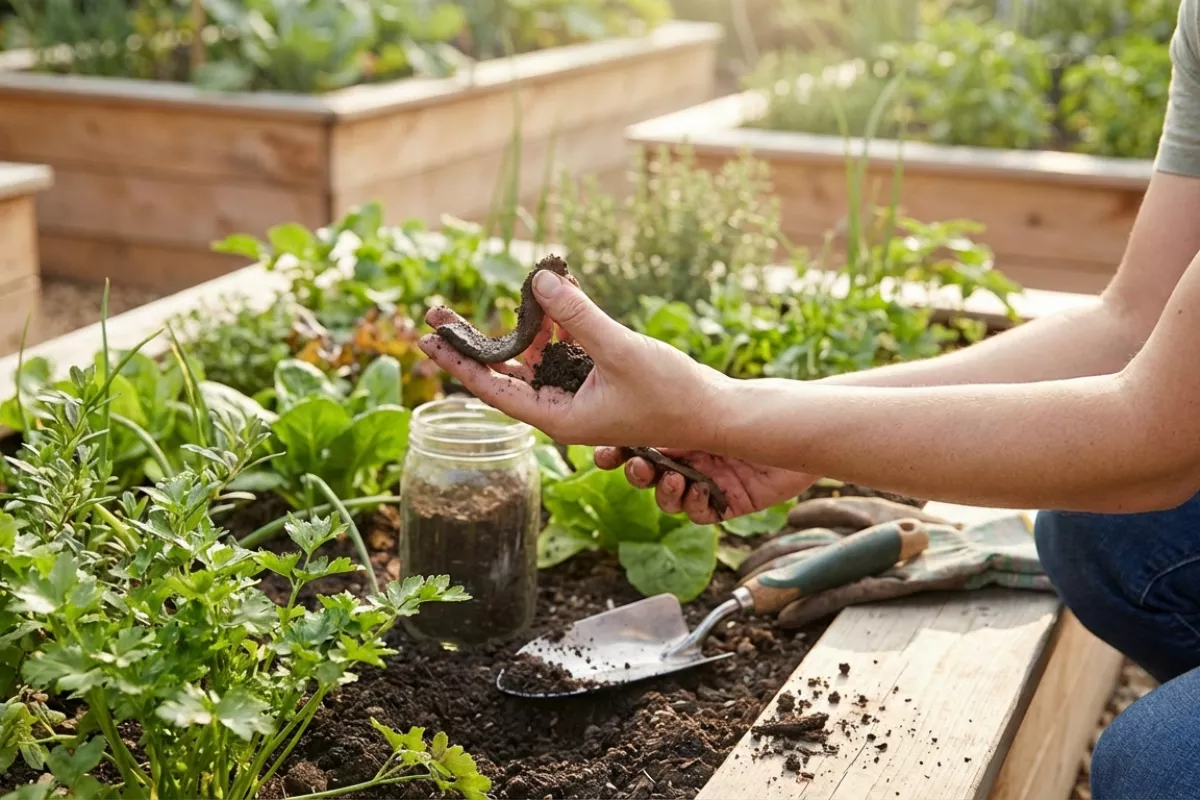
Start with what you can observe and feel. Soil texture is about the relative amounts of sand, silt, and clay, and that mix controls how quickly water drains, how much air reaches roots, and how tightly nutrients are held. You don’t need lab gear to get a useful answer—just a quick “feel test” plus a simple jar check can get you close enough to make better planting and amendment decisions.
1) The quick feel-and-ribbon test (fast, surprisingly accurate)
- Grab a sample from root depth. Dig 15–20 cm (6–8 in) down, avoiding the very top crust and obvious organic debris.
- Moisten it to the right consistency. Add a little water until it feels like putty, not soupy. If it won’t hold together at all, it’s likely sand-dominant.
- Try to form a ball.
- If it won’t form a ball and falls apart: mostly sandy.
- If it forms a ball but crumbles with a light poke: more loamy (balanced).
- If it forms a firm ball that stays intact: higher clay content.
- Make a ribbon. Press the soil between thumb and forefinger to squeeze out a flat “ribbon.” Note how long it gets before breaking:
- Under 2.5 cm (1 in): sand or sandy loam (drains quickly, can dry out fast).
- 2.5–5 cm (1–2 in): loam to clay loam (often a good middle ground for many plants).
- Over 5 cm (2 in): clay-heavy (holds water longer, can limit oxygen to roots when wet).
- Check “grit” vs. “silk.” Rub a pinch between fingers:
- Gritty = sand.
- Floury/silky = silt.
- Sticky/plastic = clay.
2) The jar settling test (more visual, good for comparisons)
This method helps you estimate proportions. Use a straight-sided jar and do it when you can leave it undisturbed.
- Fill the jar. Add about 1/3 jar of soil (remove stones and large roots), then add water to near the top. A pinch of mild dish soap can help particles separate.
- Shake thoroughly. Shake for 1–2 minutes, then set it down on a level surface.
- Watch the layers form. Sand settles first, then silt, then clay (the finest) last. After 24 hours, measure the thickness of each layer.
- Estimate percentages. Divide each layer thickness by the total settled thickness to get rough proportions.
| What you notice | What it usually suggests for texture | Root-zone implications |
|---|---|---|
| Water disappears quickly; soil feels gritty; won’t hold a ball | Sand-dominant (sandy or sandy loam) | Fast drainage and good aeration; roots may dry out between waterings |
| Soil feels smooth/silky; forms a weak ball; ribbon is short | Silt-leaning (silt loam) | Holds moisture better than sand; can crust/compact, slowing young root penetration |
| Sticky when wet; hard clods when dry; long ribbon | Clay-heavy (clay loam to clay) | High water-holding but slower oxygen movement; roots can struggle in waterlogged periods |
| Crumbly, dark, and easy to work; forms a ball but breaks with pressure | Balanced mix (loam) | Often the best compromise: steady moisture with enough pore space for root respiration |
3) A few common pitfalls (so you don’t misread the results)
- Test when it’s not saturated. Very wet soil can feel “clay-like” even when it isn’t; very dry soil can seem more sandy than it is.
- Separate texture from structure. Texture is particle size mix; structure is how those particles clump into aggregates. Compaction can make a loam behave like a clay in terms of root restriction.
- Sample more than one spot. A bed can vary over a few meters/yards. Take 3–5 subsamples from the same area and mix them for a representative test.
- Don’t confuse organic matter with silt. Decomposed organic material can feel smooth; the jar test helps distinguish it because organic bits may float.
Once you know whether you’re working with sand-leaning, silt-leaning, clay-heavy, or a balanced loam, you can predict how roots will behave: whether they’ll chase water downward, stall in dense layers, or spread widely near the surface. That’s the practical payoff of figuring out your soil texture before you change watering, choose plants, or add amendments.
Improving texture for better roots
Better root growth starts when soil has a balanced mix of particle sizes, stable aggregates, and enough pore space for both air and water. You don’t have to “replace” your ground to get there; small, consistent changes usually work better than one big overhaul, especially if you’re trying to avoid compaction and drainage problems.
Before you amend anything, figure out what you’re working with. A quick jar test (soil + water in a clear jar) can show whether you’re dealing with mostly sand, silt, or clay, but the practical test is how it behaves: does it crust, puddle, or dry into bricks (often clay-heavy), or does it drain so fast it won’t hold moisture (often sandy)? From there, choose fixes that change structure and pore space rather than chasing a “perfect” texture.
- Add organic matter regularly (compost, leaf mold, well-rotted manure). This helps sandy soils hold water and helps clay soils form crumbs that let roots breathe. Spread about 2.5–5 cm (1–2 in) on the surface and let worms and weather pull it down over time.
- Reduce compaction first. If the soil is dense, amendments won’t move far and roots still struggle. Use a broadfork or garden fork to loosen to roughly 20–30 cm (8–12 in) when the soil is slightly moist, not wet, to avoid smearing and clods.
- Keep living roots in the ground with cover crops or dense plantings. Roots and their exudates help build aggregates and create channels that later roots can follow. Mow or cut and leave residues as mulch instead of yanking everything out.
- Mulch to protect structure. A 5–8 cm (2–3 in) layer of shredded leaves, straw, or wood chips buffers temperature swings, reduces crusting, and slows evaporation so fine roots don’t dry out between waterings.
- Use gypsum only for specific problems. Calcium sulfate can help flocculate certain sodic or dispersive clays, but it won’t “fix” ordinary clay by itself. If drainage is poor because of compaction or a high water table, gypsum won’t replace loosening and organic inputs.
- Avoid the sand-into-clay trap. Mixing small amounts of sand into clay can make a concrete-like blend. If you truly need a lighter medium, it’s usually better to build a raised bed with a well-mixed soil/compost blend rather than trying to re-engineer heavy subsoil in place.
- Water in a way that encourages deeper rooting. Fewer, deeper soakings generally promote roots to explore. Aim to wet the root zone to about 15–25 cm (6–10 in) for many vegetables, then let the surface dry slightly before the next irrigation.
- Create permanent paths and keep foot traffic off beds. Repeated stepping is one of the fastest ways to collapse pore space, even in soils that started out loose.
| What you notice | Likely texture/structure issue | What to do next (root-focused) |
|---|---|---|
| Water puddles; surface crusts after rain | Fine-textured soil with weak aggregation or compaction | Loosen to 20–30 cm (8–12 in) when moist; topdress 2.5–5 cm (1–2 in) compost; keep mulch on bare soil |
| Soil dries quickly; plants wilt soon after watering | Coarse texture with low water-holding capacity | Add organic matter regularly; mulch 5–8 cm (2–3 in); water more deeply to 15–25 cm (6–10 in) |
| Roots circle near the surface; digging hits a hard layer | Compaction layer or plow pan restricting penetration | Broadfork or deep fork to break the layer; avoid traffic; use deep-rooted cover crops to maintain channels |
| Soil forms hard clods when dry, sticky when wet | Clay-heavy soil with poor structure | Work it only when slightly moist; add compost in thin layers over time; plant densely to keep roots active |
Expect gradual change. Texture itself (sand/silt/clay percentages) shifts slowly, but structure can improve within a season when you combine organic inputs, less disturbance, and protection from pounding rain. The payoff is practical: easier digging, steadier moisture, and roots that can branch and explore instead of stalling in airless or droughty zones.