Adiantum — Delicate Fern Requiring Humid Growing Conditions

 This article explains Adiantum ferns, their delicate traits and rainforest origins, frond structure, and graceful growth. It covers light needs, steady soil moisture and watering, temperature and humidity, routine care, propagation, seasonal rhythm, and common health issues.
- Adiantum fern overview and delicate traits
- Native rainforest habitats and distribution
- Frond structure and graceful growth habit
- Light needs for Adiantum fern foliage
- Soil moisture and Adiantum watering consistency
- Temperature and humidity requirements for Adiantum
- Routine care for fragile ferns
- Propagation through division and spores
- Seasonal growth rhythm indoors and outdoors
- Common issues affecting Adiantum health
Maidenhair ferns such as Adiantum are loved for their delicate, airy fronds, but they do best when moisture is steady and humidity stays high. In dry rooms or with missed watering, the leaf edges can brown and crisp quickly. This guide shares simple, repeatable steps to keep conditions consistent, including smart placement, reliable watering habits, and easy humidity boosts that fit into everyday care.
Adiantum fern overview and delicate traits
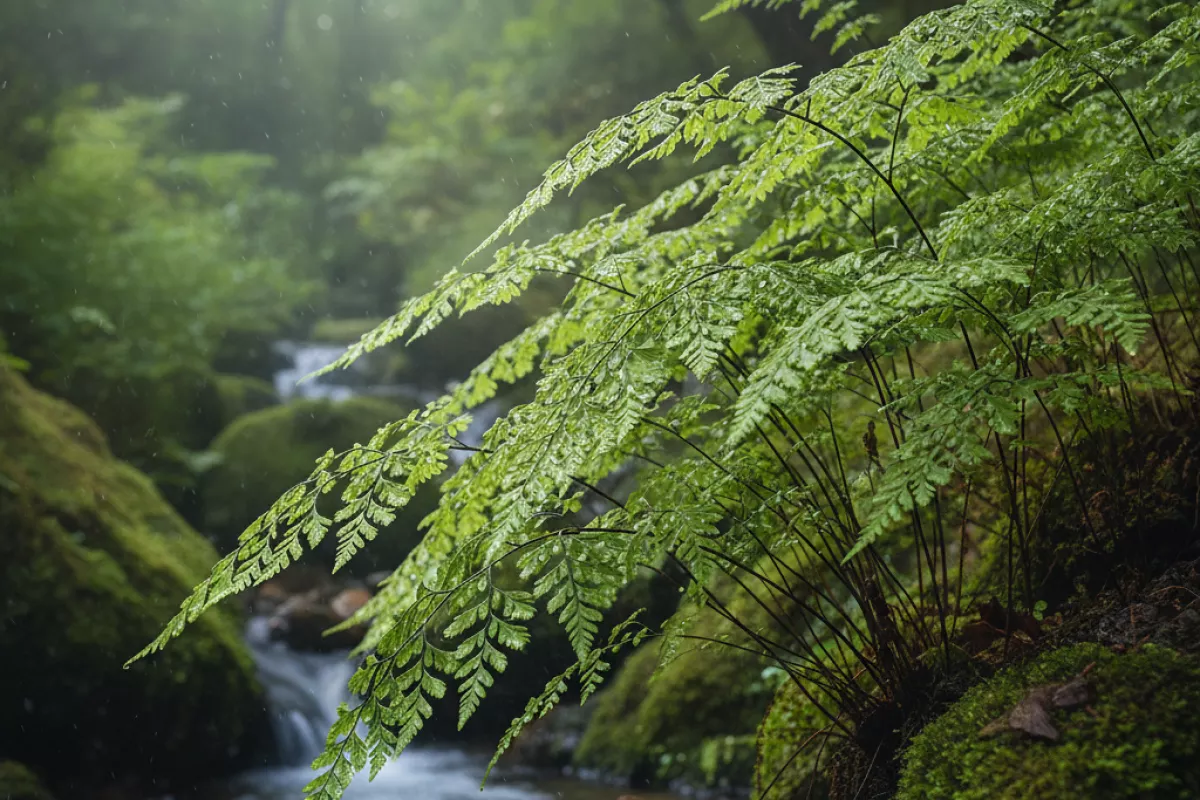
Maidenhair ferns (Adiantum) are known for airy, fan-shaped leaflets held on thin, dark stems that look almost wire-like. That contrast is part of the appeal, but it also hints at why the plant can seem “fussy”: the fronds have little tolerance for drying out, hot drafts, or sudden swings in moisture.
In nature, many Adiantum species grow where the air stays damp and the root zone remains evenly moist—think shaded stream banks, seepage areas, and humid rock crevices. Indoors, they behave similarly: they’re happiest with steady humidity, gentle light, and a potting mix that stays lightly moist without turning soggy.
- Fronds are thin and quick to dehydrate: once the leaflets crisp, they usually don’t rehydrate, so missed watering shows fast.
- Dark, delicate stipes (stems): they look sturdy but can snap if handled roughly during repotting or cleaning.
- Preference for stable conditions: frequent moves between rooms, vents, or sunny windows can trigger browning edges and frond drop.
- Moisture sensitivity in both directions: too dry leads to crispy foliage; too wet can invite root stress and decline.
- Shade-adapted foliage: bright, indirect light is ideal; direct sun can scorch the leaflets, especially through glass.
A quick way to recognize a maidenhair fern is the “floating” look of the leaflets—small segments attached like little fans along the stem. New growth often unfurls as tight curls and expands quickly when humidity is adequate, while low humidity tends to produce smaller fronds and more frequent browning at the tips.
Although Adiantum is delicate, it isn’t fragile in the sense of being impossible. It simply rewards consistency: keep it away from heating/cooling vents, avoid letting the pot dry fully, and aim for a humid microclimate rather than occasional heavy misting.
Native rainforest habitats and distribution

Adiantum (maidenhair ferns) is most often found where the air stays moist, light is filtered, and the ground never fully dries. In the wild, many species tuck themselves into sheltered rainforest niches rather than exposed forest floors, using rock faces, streambanks, and mossy crevices as natural humidifiers.
These ferns tend to favor consistent humidity and gentle airflow over heat alone. You’ll commonly see them in places where water is always nearby—mist zones around waterfalls, seepage lines on shaded cliffs, and the edges of slow-moving creeks—because those microhabitats keep delicate fronds from desiccating.
- Typical microhabitats: damp ravines, shaded gorges, waterfall spray zones, stream margins, and moist limestone or volcanic rock outcrops.
- Light conditions: bright shade to dappled sun under canopy; direct midday sun usually scorches fronds.
- Substrates: humus-rich leaf litter, mossy rocks, and well-drained but constantly moist soils; some species are lithophytic (growing on rock) where mineral seepage is steady.
- Moisture pattern: frequent wetting with quick drainage—think “never stagnant, never bone-dry.”
| Region where Adiantum occurs | Common rainforest or humid-forest setting | Notes on local niche |
|---|---|---|
| Central & South America | Lowland to montane rainforests | Often along quebradas (shaded stream gullies) and wet cliff bases where mist is frequent. |
| Caribbean islands | Cloud-forest edges and humid ravines | Thrives in wind-sheltered pockets with constant leaf-litter moisture and spray from small cascades. |
| Sub-Saharan Africa & Madagascar | Moist evergreen forests and gorge systems | Common in shaded rock fissures and along perennial watercourses; drought exposure is the main limiter. |
| South & Southeast Asia | Tropical wet forests, limestone hills | Limestone-associated species frequently occupy seepage lines and cave-mouth shade with high ambient humidity. |
| Australasia (including Pacific islands) | Rainforest understory and fern gullies | Found in deep shade with reliable moisture; fronds stay finer and more delicate in cooler, misty sites. |
| Southern Europe & parts of the Mediterranean | Humid refuges within otherwise dry landscapes | Persists near springs, grottoes, and shaded canyon walls—microclimates that mimic rainforest humidity. |
Because Adiantum is spread across many continents, the exact species changes by region, but the pattern is consistent: it occupies protected, moisture-buffered corners of forests. If you can picture a spot where rock stays cool to the touch and the air feels damp even when nearby areas dry out, that’s the kind of natural setting maidenhair ferns are built for.
Frond structure and graceful growth habit
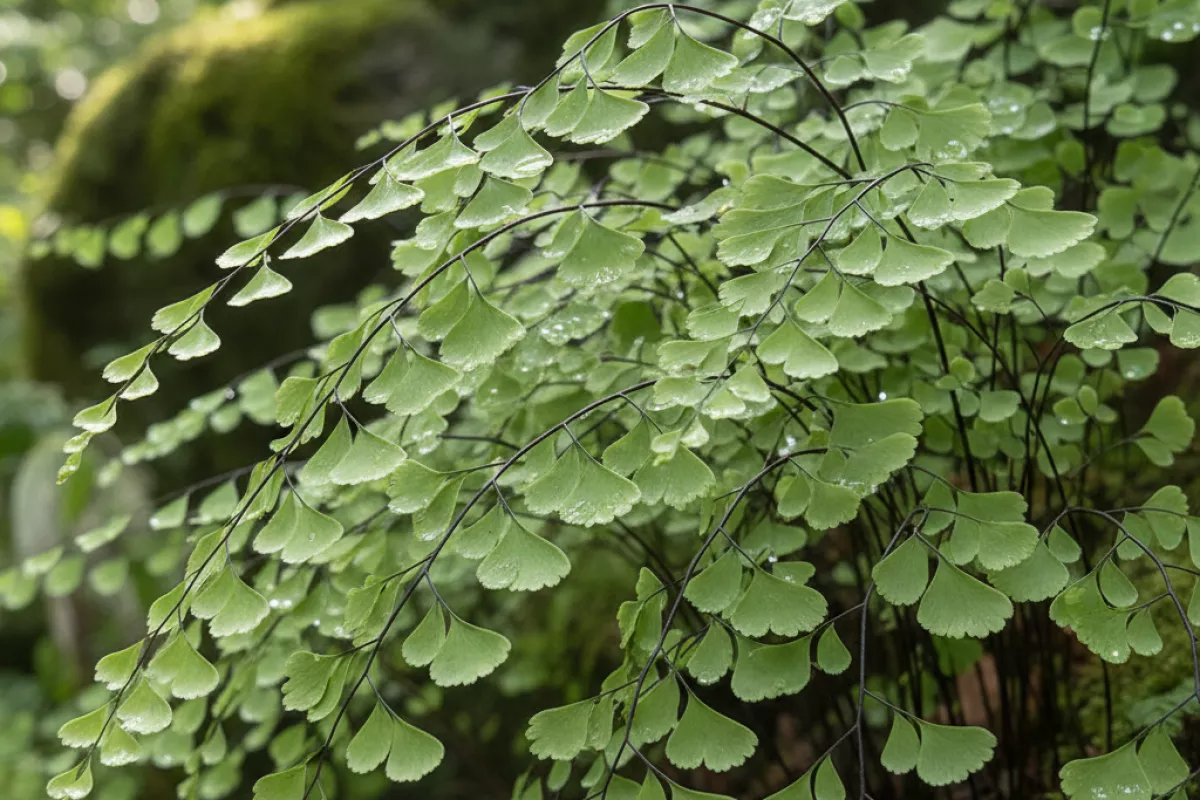
Maidenhair ferns (Adiantum) look airy because the leaflets are held on thin, dark, wiry stalks that arch and sway instead of standing stiffly upright. The contrast between the glossy “black” stems and the soft green segments is part of what makes the plant read as light and lace-like, even when it’s fairly full.
Each frond is divided into many small leaflets (pinnae) that are often fan- or wedge-shaped, with gently scalloped edges. Those little segments are attached in a way that lets them flutter with minor air movement, which is why Adiantum tends to look more fluid than many other house ferns.
- Stems (rachis and petiole): Typically slender and dark brown to nearly black; they stay flexible, so fronds drape rather than spike.
- Leaflet arrangement: Many small pinnae spaced along branching side-stems, creating a layered, feathery outline without dense, heavy foliage.
- New growth behavior: Fresh fronds unfurl gradually and are more delicate at first; they firm up as they mature, but still keep a light, arching posture.
- Where spores form: Sporangia are usually tucked along the leaflet margins on the underside, often protected by a rolled edge (a subtle detail you’ll notice when fronds are mature).
The overall silhouette depends a lot on moisture and light. In steady humidity, fronds extend evenly and hold a smooth arc; in dry air, the plant often shortens its reach, with leaflet tips crisping or folding inward. If you want the most graceful “fountain” shape, give it room for the fronds to spread—many Adiantum types can reach about 30–60 cm (12–24 in) tall and wide in a pot when conditions stay consistently humid.
Light needs for Adiantum fern foliage
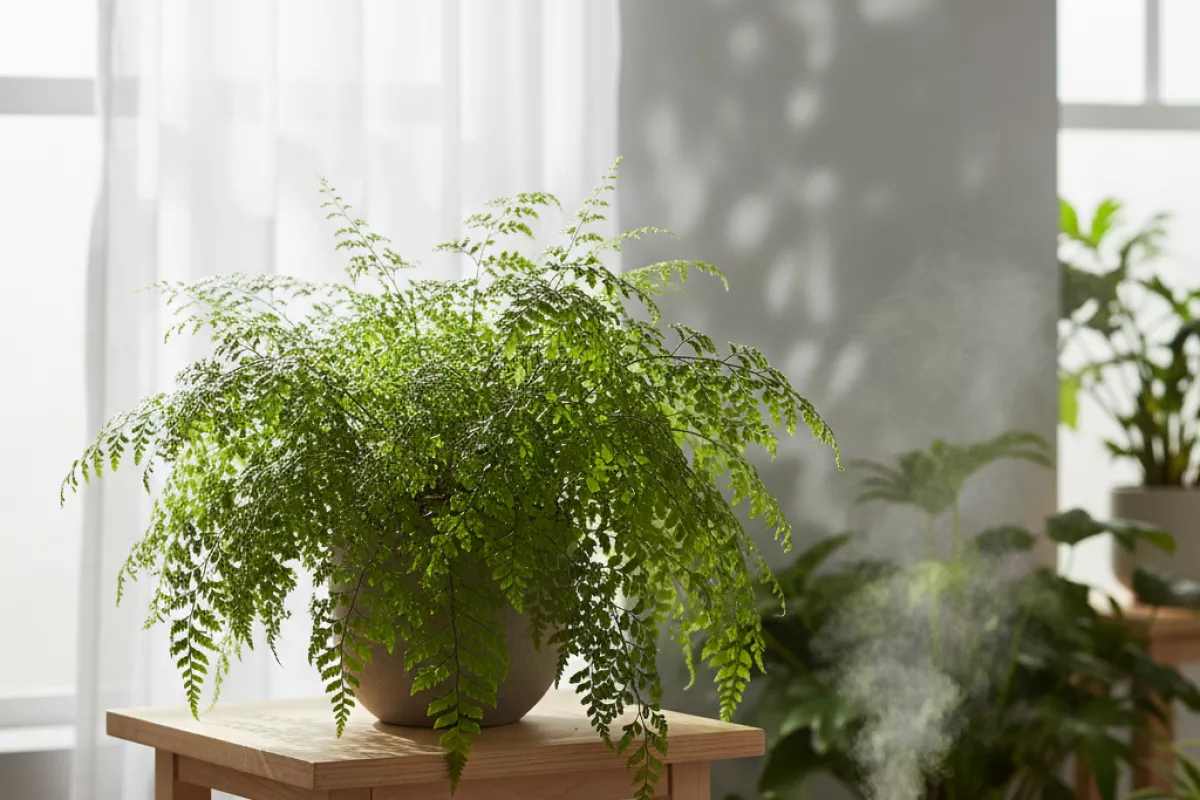
Give maidenhair ferns bright, filtered light and they’ll hold their delicate, fan-shaped leaflets much longer. Think of the dappled conditions under a tree canopy: plenty of illumination, but very little direct sun hitting the fronds.
Direct midday rays are the fastest way to crisp the edges, especially if the air is dry. On the other hand, if the plant sits too far from a window, growth slows, new fronds emerge smaller, and the plant can look sparse even when watering is consistent.
- Best placement indoors: near an east-facing window for gentle morning sun, or a few steps back from a bright south- or west-facing window behind a sheer curtain.
- What to avoid: harsh afternoon sun on the foliage, and deep shade where you can’t comfortably read during the day.
- Rotation helps: turn the pot about a quarter turn weekly so fronds don’t lean strongly toward the light source.
| Light situation | What you’ll likely see | Adjustment to make |
|---|---|---|
| Bright, indirect light most of the day | Steady new frond production; fuller, more even canopy | Maintain position; keep humidity high to match the brighter exposure |
| 1–2 hours of gentle morning sun (east window) | Good color and compact growth with minimal stress | Usually fine as-is; pull back slightly if leaflet tips pale or dry |
| Direct midday/afternoon sun | Scorched patches, crispy margins, rapid leaf drop | Move 30–90 cm (12–36 in) back from the glass or add a sheer curtain |
| Low light (far from windows) | Slow growth, sparse fronds, leggy stems reaching toward light | Move closer to a window or supplement with a grow light set 20–30 cm (8–12 in) above the plant |
If you use a grow light, aim for a moderate schedule rather than intense output: about 10–12 hours per day is typically enough to mimic a long, bright day without overheating the foliage. Keep the lamp high enough that the fronds stay cool to the touch, and watch the newest growth—Adiantum will tell you quickly whether the brightness is comfortable.
Soil moisture and Adiantum watering consistency
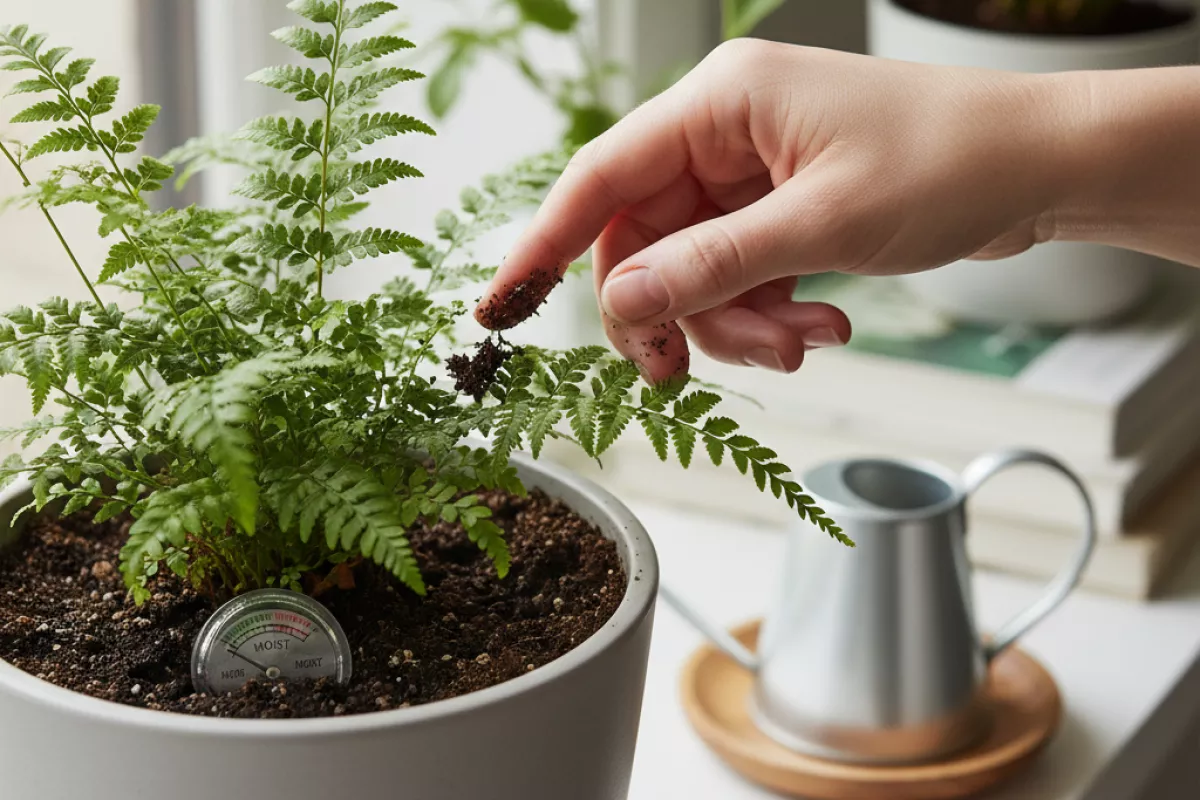
Keep the potting mix evenly damp, not soggy, and avoid big swings between “bone dry” and “soaked.” Adiantum (maidenhair fern) has fine, delicate roots and thin fronds that lose moisture quickly, so irregular watering shows up fast as crispy edges, sudden leaf drop, or stalled growth.
A good target is a mix that feels lightly moist when you press a finger 2–3 cm (1–1.2 in) into the surface. If that zone feels dry, water; if it feels cool and moist, wait. Don’t rely on a calendar—light, temperature, pot size, and airflow change how fast the plant uses water.
- Water thoroughly, then drain. Water until it runs from the drainage holes, then empty the saucer after 5–10 minutes. Sitting in runoff keeps the lower roots waterlogged.
- Use room-temperature water. Cold water can shock roots; aim for roughly 20–22°C (68–72°F).
- Choose the right mix texture. A moisture-retentive but airy medium helps: fine bark or coco chips plus peat/coco coir and perlite/pumice. If the mix compacts, it stays wet at the bottom and dry on top.
- Match pot type to your habits. Terracotta dries faster; plastic holds moisture longer. If you tend to forget, plastic can be more forgiving; if you tend to overwater, terracotta adds a buffer.
- Adjust with seasons. In brighter months you may water more often; in winter, growth slows and the top layer may stay moist longer even though indoor air is drier.
| What you notice | Likely moisture pattern | What to change |
|---|---|---|
| Crispy tips and edges, fronds browning from the outside in | Mix dries too far between waterings; dry indoor air often adds to it | Water when the top 2–3 cm (1–1.2 in) just starts to dry; increase humidity and reduce hot drafts |
| Sudden leaf drop after missing one watering | Pot dries very fast (small pot, terracotta, bright window, warm airflow) | Switch to a slightly larger pot or less porous container; add more moisture-holding component to the mix; check moisture daily during heat |
| Yellowing fronds, soft or dark stems near the base | Constantly wet mix; poor drainage or compacted soil | Let the top layer dry a bit more; ensure drainage holes are clear; repot into a lighter mix if it stays wet longer than 5–7 days |
| Moldy surface, fungus gnats hovering | Surface stays wet with low airflow | Bottom-water occasionally, then let the top 1–2 cm (0.4–0.8 in) dry; improve air circulation without blasting the plant |
| Top looks dry but pot feels heavy; roots struggling | Hydrophobic or unevenly wet medium (water runs down the sides) | Soak the pot for 10–15 minutes, then drain; gently break up the surface crust; consider repotting if the mix won’t re-wet evenly |
If you’re unsure, use a simple “lift test”: pick up the pot right after watering and again when you think it needs water. The weight difference becomes an easy cue. For maidenhair ferns, it’s better to water a little sooner than you would for most houseplants, but always with drainage so the roots get both moisture and oxygen.
Temperature and humidity requirements for Adiantum
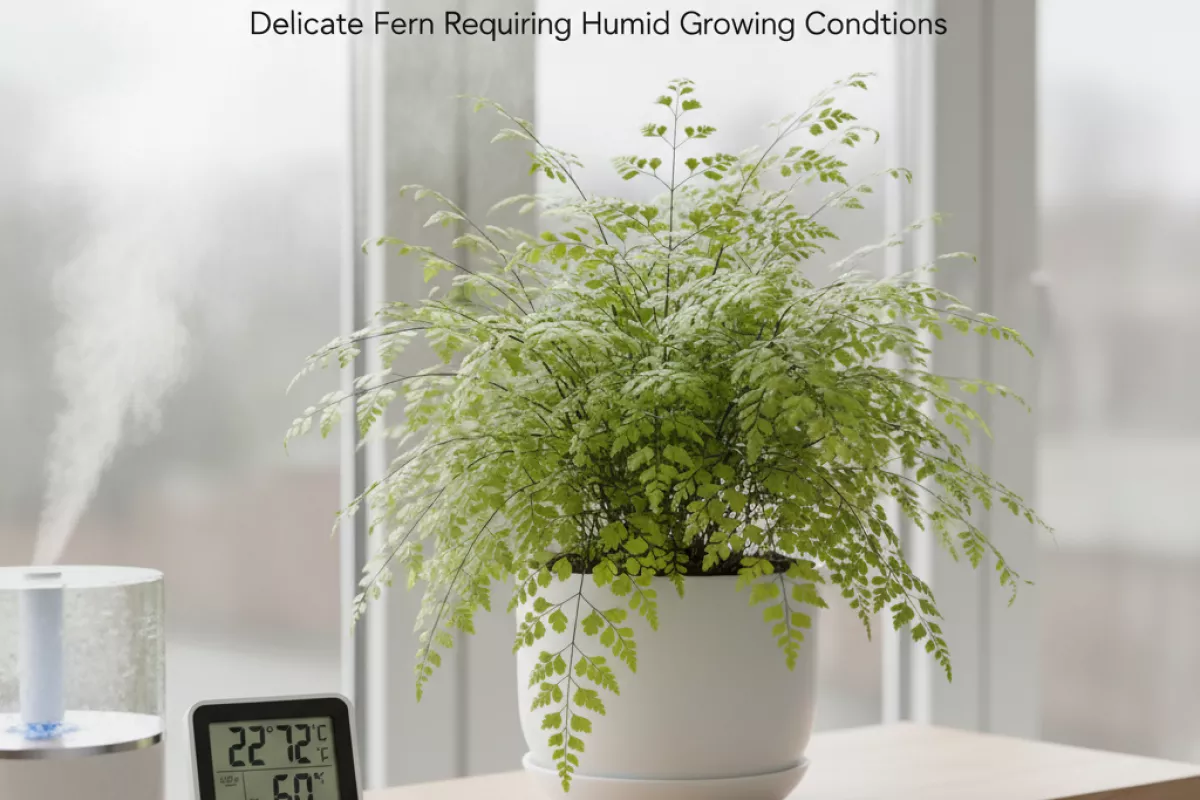
Keep maidenhair fern comfortable by aiming for steady warmth and consistently moist air. It reacts quickly to swings: a cold draft, a hot radiator, or a few days of dry indoor heat can lead to crispy edges and rapid leaf drop.
| Factor | Best range | What to avoid | Common signs it’s off |
|---|---|---|---|
| Day temperature | 18–24°C (65–75°F) | Prolonged heat above 27°C (81°F) | Wilting despite moist soil, faster drying, pale fronds |
| Night temperature | 15–18°C (59–65°F) | Drops below 10°C (50°F) | Sudden frond collapse, blackened tips after chilling |
| Humidity | 50–70% (ideally 60%+) | Dry air under 40% | Brown, papery margins; fronds shedding from the outside in |
| Air movement | Gentle circulation | Direct blasts from vents, fans, or open winter windows | Uneven browning on the side facing the draft |
Humidity matters more than occasional misting. If your room sits around 30–40% in winter, raise moisture around the plant rather than spraying the fronds and hoping for the best.
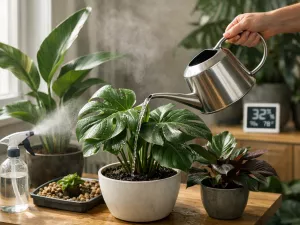
- Use a humidifier to hold 55–65% near the plant; place it 30–60 cm (12–24 in) away so leaves don’t stay wet.
- Create a microclimate by grouping plants; the combined transpiration keeps the air a bit more forgiving.
- Pebble tray approach: set the pot on a tray with stones and water, keeping the pot base above the waterline so roots aren’t sitting in it.
- Choose the right room: kitchens and bright bathrooms often run warmer and more humid than living rooms.
For placement, keep Adiantum away from heaters and AC outlets, and don’t let leaves touch cold glass in winter. A stable spot with bright, filtered light usually also provides the most stable temperature, which helps the plant keep its delicate fronds intact.
Routine care for fragile ferns
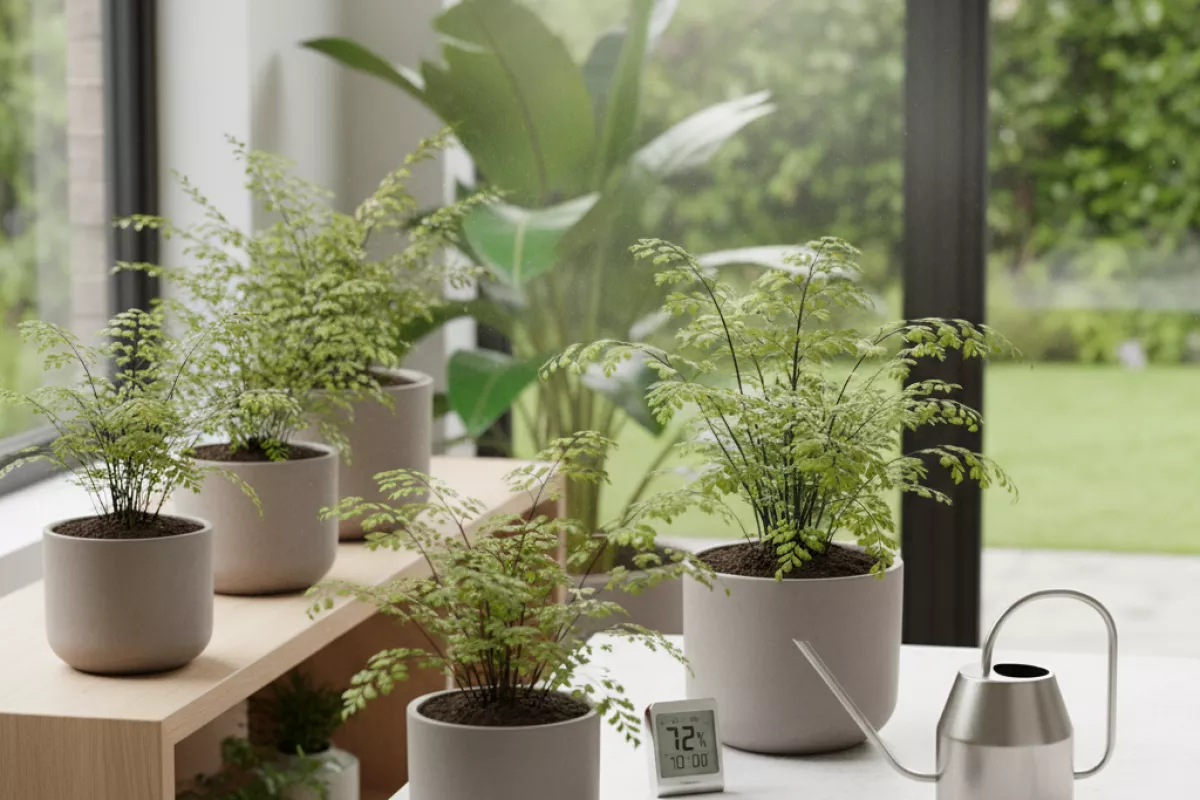
Keep Adiantum looking good by focusing on steady moisture, high humidity, and gentle handling. This fern reacts quickly to dry air, missed watering, or hot sun, so small, consistent adjustments work better than occasional “rescues.”
- Watering: Keep the potting mix evenly damp, not soggy. Water when the surface feels just barely dry, then water thoroughly until excess drains. Don’t let the pot sit in a saucer of water for more than 10–15 minutes (10–15 min).
- Humidity: Aim for 60–80% humidity. If your home runs drier, cluster plants, use a humidifier, or place the pot on a pebble tray with water below the pot base. Avoid misting as your main strategy; it’s brief and can spot delicate fronds.
- Light: Provide bright, filtered light. A spot near an east-facing window is often ideal; keep it out of direct midday sun, which can scorch leaflets.
- Temperature and drafts: Keep it stable at about 18–24°C (64–75°F). Protect from heating vents, AC blasts, and cold windows; sudden swings often trigger frond drop.
- Soil and pot choice: Use a moisture-retentive but airy mix (for example, peat or coco coir with perlite and fine bark). A pot with drainage holes is non-negotiable; shallow, wider pots can suit the fern’s spreading habit.
- Feeding: Fertilize lightly in spring and summer with a diluted balanced feed at 1/4–1/2 strength every 4–6 weeks. Skip feeding in winter or whenever growth slows.
- Grooming: Snip brown or crispy fronds at the base with clean scissors. Don’t tug; Adiantum stems are wiry but the crown can be damaged by pulling.
- Repotting: Repot when roots fill the pot or the mix compacts, typically every 12–24 months (1–2 years). Move up only one size to avoid a wet, under-rooted pot that stays soggy.
| What you notice | Likely cause | What to do next |
|---|---|---|
| Leaflets turning crisp at the edges | Low humidity or missed watering | Raise humidity to 60–80%, water more consistently, and keep the mix evenly damp |
| Fronds yellowing, soil stays wet | Overwatering, compacted mix, poor drainage | Let the top layer dry slightly, check drainage holes, and repot into a lighter mix if needed |
| Sudden frond drop after moving it | Drafts, temperature swing, light change | Return to stable 18–24°C (64–75°F) and bright filtered light; avoid vents and cold glass |
| Brown patches or scorched areas | Direct sun or heat stress | Move to indirect light, use a sheer curtain, and keep away from hot windowsills |
| Slow growth with pale new fronds | Low light or underfeeding during active growth | Increase filtered light and feed at 1/4–1/2 strength every 4–6 weeks in spring/summer |
| Fine webbing or stippled leaves | Spider mites (often in dry air) | Rinse fronds gently, raise humidity, and treat with insecticidal soap if needed |
If you’re unsure what to change first, prioritize air moisture and watering rhythm. Once humidity and soil moisture are steady, most other issues become easier to diagnose and correct without stressing this delicate fern further.
Propagation through division and spores
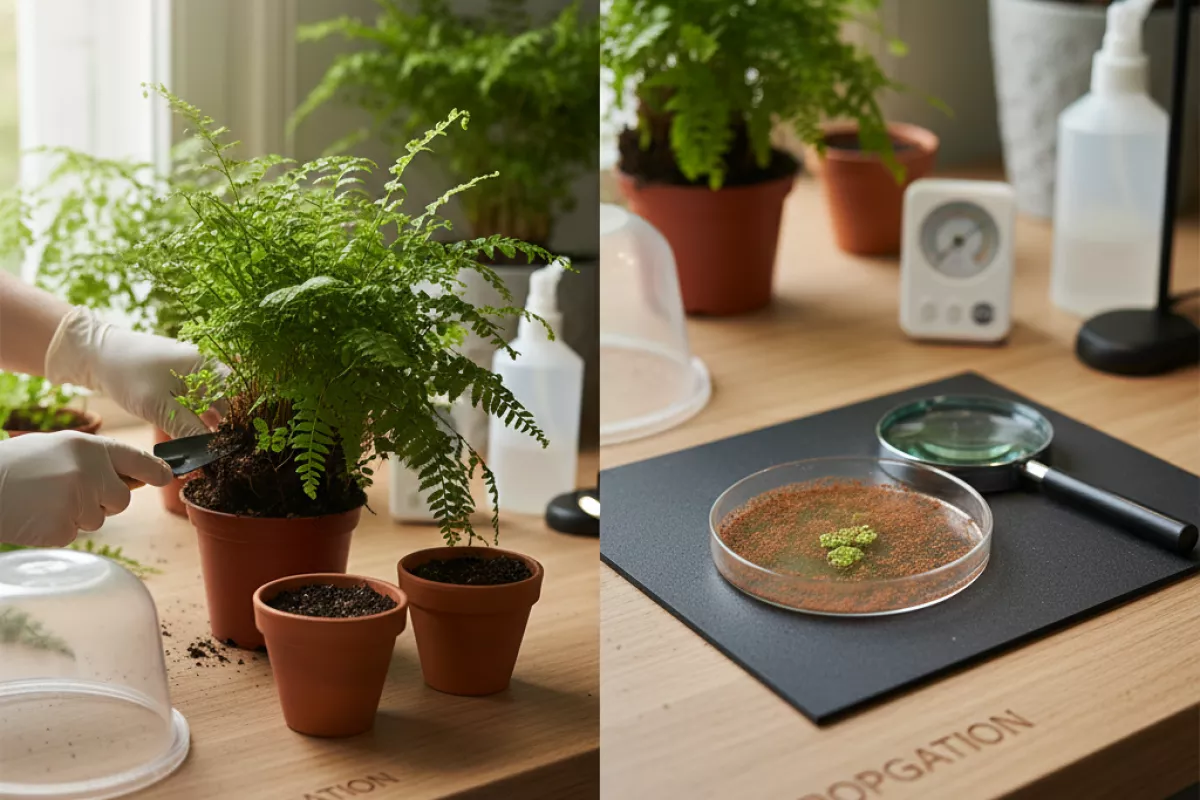
The easiest way to make more Adiantum is to split an established clump, while the most rewarding (and slowest) method is raising plants from spores. Both approaches benefit from the same baseline: consistently moist mix, high humidity, and gentle light so the delicate fronds don’t dry out while they recover.
Division (the reliable, fast method)
Divide when the fern is actively growing and crowded in its pot. Spring is usually the least stressful time because new roots and fronds form quickly.
- Water first: Moisten the pot thoroughly 30–60 minutes before you start so the rootball slides out with less tearing.
- Remove and inspect: Tip the plant out and gently tease the outer roots apart. Look for natural “sections” with their own crowns (growing points).
- Split into modest pieces: Each division should have several healthy fronds and a good root portion. Tiny fragments often stall or collapse in dry air.
- Pot up: Use a small pot only slightly larger than the division, with a moisture-retentive but airy mix. Firm lightly—don’t compress the roots.
- Aftercare: Keep evenly damp (not waterlogged) and raise humidity for 2–3 weeks. A clear bag or propagator works well if there’s some daily ventilation.
If fronds wilt after splitting, trim the worst-damaged ones and focus on stable moisture and humidity. New growth usually resumes once roots re-establish.
Spore propagation (slow, but fascinating)
Growing maidenhair ferns from spores takes patience because the fern first forms a tiny, flat stage (the gametophyte) before true fronds appear. Cleanliness and steady moisture matter more than speed.
- When spores are ready: Check the underside of mature fronds. When the sori look dry and dusty rather than firm, they’re close to releasing.
- How to collect: Cut a fertile frond and place it in a paper envelope for a few days. Tap gently to release the fine spores.
- Sowing setup: Use a shallow container with a lid. Fill with a fine, sterile medium and pre-moisten it. Sprinkle spores thinly on the surface—do not bury.
- Conditions: Bright, indirect light and warm room temperatures are ideal; aim for about 21–24°C (70–75°F). Keep the surface consistently moist and the container mostly closed to hold humidity.
- What you’ll see: A green film develops, then heart-shaped gametophytes. After fertilization (helped by persistent moisture), tiny fern fronds emerge.
- Potting on: Once small plants have several true fronds and can be handled, transplant carefully into small pots and keep humidity high while they adjust.
| Method | Best time | Difficulty | What to expect |
|---|---|---|---|
| Division | Spring or early summer (active growth) | Easy to moderate | New fronds in weeks if humidity stays high |
| Spores | Any time indoors with stable conditions | Moderate to advanced | Gametophytes first; true fronds can take months |
| Division | When the pot is crowded and roots circle | Easy | Clones of the parent plant |
| Spores | After sori mature and release dust-like spores | Advanced | Variable results; very slow but high plant count |
Whichever route you choose, the main cause of failure is letting the medium swing from wet to dry. For Adiantum, steady moisture plus humid air is what turns a division into a thriving clump—or a spore tray into a new generation of ferns.
Seasonal growth rhythm indoors and outdoors
Maidenhair fern (Adiantum) doesn’t follow the calendar as strictly as many houseplants; it follows light, temperature, and moisture. Outdoors, those cues change sharply between seasons, so growth comes in clear waves. Indoors, the shifts are softer, but the plant still tends to speed up in brighter months and slow down when days are short or air is dry.
| Season / situation | What the fern tends to do | What to adjust |
|---|---|---|
| Spring (indoors & outdoors) | New fronds unfurl; roots become more active; older fronds may be replaced. | Increase watering gradually; begin light feeding; repot if rootbound; keep humidity steady. |
| Summer (especially outdoors) | Fastest growth when moisture is consistent; heat and wind can scorch fronds quickly. | Protect from midday sun; water more often; maintain high humidity; watch for crisp edges from drying air. |
| Autumn (transition period) | Growth slows as light drops; frond production tapers; the plant becomes less forgiving of missed watering. | Reduce feeding; keep soil evenly moist (not soggy); move closer to bright, indirect light; avoid cold drafts. |
| Winter indoors (heated rooms) | Near-dormant to slow growth; frond drop is common if air is dry or watering becomes irregular. | Prioritize humidity; water a bit less but never let the root zone fully dry; keep away from radiators/vents; use supplemental light if needed. |
| Winter outdoors (mild climates) | May stay evergreen in sheltered, humid spots; in colder areas it can die back and return later. | Mulch to buffer temperature swings; keep evenly moist; protect from frost and drying winds; don’t fertilize. |
- Indoors, “winter” is often a humidity problem, not a temperature problem. Even at 20°C (68°F), forced-air heat can dry fronds as if the plant were in a drought.
- Outdoors, the biggest seasonal stress is exposure. A spot that’s perfect in spring can become too bright or windy in summer; shifting to deeper shade often prevents frond burn.
- Use growth pace to guide care. When you see frequent new fronds, the fern can handle slightly more water and gentle feeding; when growth pauses, keep moisture consistent but ease off fertilizer.
- Expect some frond turnover. Older fronds naturally fade as new ones appear; sudden, widespread browning usually points to dry air, missed watering, or a cold draft rather than normal cycling.
A practical rule: if the plant is producing fresh fronds, treat it like it’s in its active phase; if it’s holding steady with little new growth, focus on stability—steady moisture, stable temperatures, and humidity that doesn’t swing from day to day.
Common issues affecting Adiantum health
Most problems with maidenhair ferns show up fast because the fronds are thin and react quickly to dry air, inconsistent watering, or harsh light. When something is off, focus on the pattern of damage (crispy edges vs. yellowing vs. sudden collapse) and check humidity, soil moisture, and temperature swings before reaching for treatments.
| Symptom you’ll notice | Likely cause | What to do |
|---|---|---|
| Brown, crispy leaflet edges; fronds feel papery | Low humidity, warm drafts, or soil drying too far between waterings | Raise humidity (aim around 50–70%); keep the mix evenly moist, not soggy; move away from heaters/AC and from hot windows. |
| Yellowing fronds, soft stems, musty smell from the pot | Overwatering, poor drainage, or compacted mix leading to low oxygen at the roots | Let the top 1–2 cm (0.4–0.8 in) of mix dry slightly, then water; repot into an airy medium and a pot with drainage; trim rotted roots. |
| Sudden frond drop after moving the plant | Shock from a change in light, humidity, or temperature | Stabilize conditions for 2–3 weeks; avoid repeated relocations; keep temperatures steady around 18–24°C (64–75°F). |
| Bleached patches or scorched areas on fronds | Direct sun or very bright, hot light | Shift to bright, indirect light; use a sheer curtain; keep it back from south/west windows (or the brightest exposure in your home). |
| Leaf tips browning despite “enough” watering | Mineral buildup from hard water or excess fertilizer | Use rain/filtered water when possible; flush the pot with 3–4× the pot volume of water every 4–6 weeks; feed lightly at 1/4 strength during active growth. |
| Fine webbing, stippled pale dots, fronds look dusty | Spider mites, often encouraged by dry air | Rinse fronds thoroughly; increase humidity; repeat washing every 5–7 days for 3 rounds; isolate the plant while treating. |
| Sticky residue, small bumps on stems, or cottony clusters | Scale insects or mealybugs | Wipe pests off with cotton swabs; prune heavily infested fronds; follow up weekly until no new insects appear. |
| Fronds stay small, pale, and sparse over time | Too little light, depleted mix, or a rootbound pot | Increase indirect light; refresh the top layer of mix or repot; divide if crowded, keeping divisions well-watered while they re-establish. |
If you’re unsure which issue fits, start with the basics: check that the root ball is evenly damp (not waterlogged), confirm the plant isn’t in a draft, and measure the room’s humidity if you can. Adiantum often recovers once conditions are steady, but damaged fronds won’t “green back up,” so trim the worst ones and watch for healthy new growth.