Water Plants Safely in Containers Without Root Stress

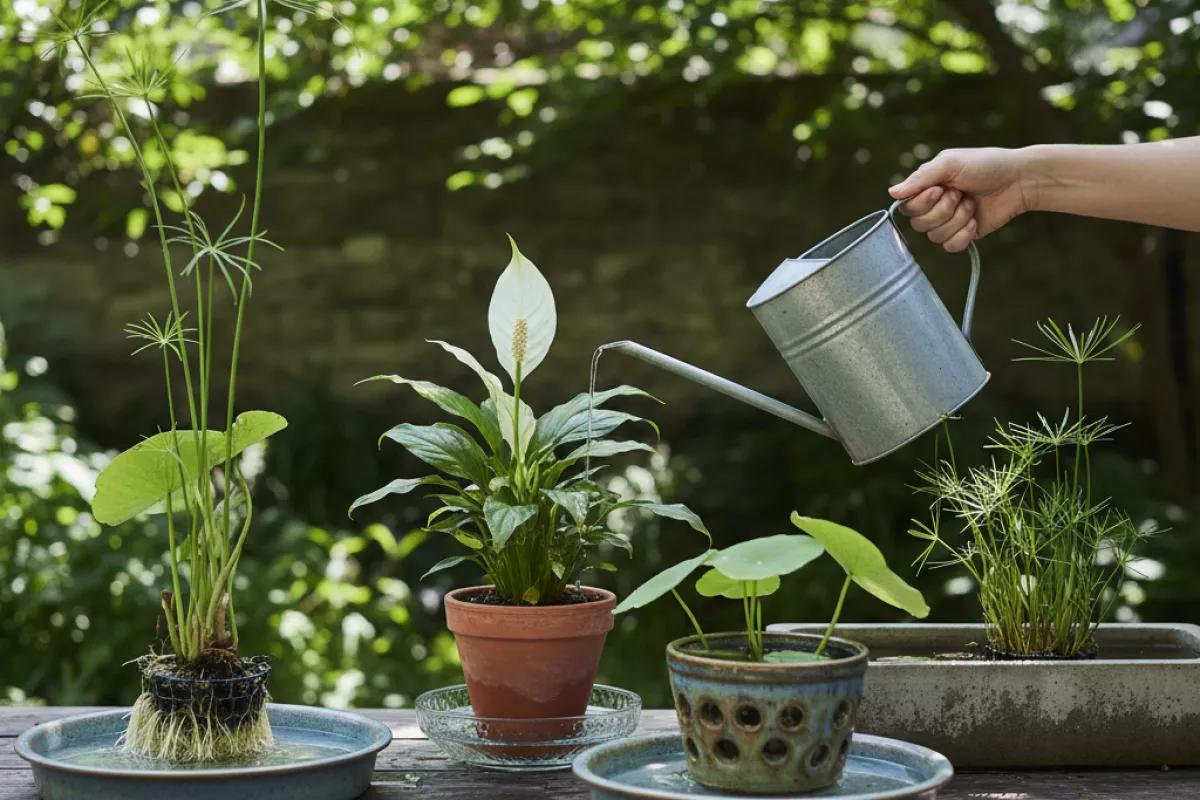 Explains why container plants dry out differently, how to water without drowning roots, and key drainage principles. Covers watering methods for plastic, terracotta, and fabric pots, how temperature affects moisture, warning signs of root stress, and safe fixes.
To water container plants without stressing roots, follow a steady routine that fits the pot size, soil mix, and season. Both overwatering and letting pots dry out too fast can damage roots, causing wilting, slow growth, and rot. Check moisture with a finger test, water thoroughly until it drains, then wait until the top layer dries slightly before watering again.
Why container plants dry out differently
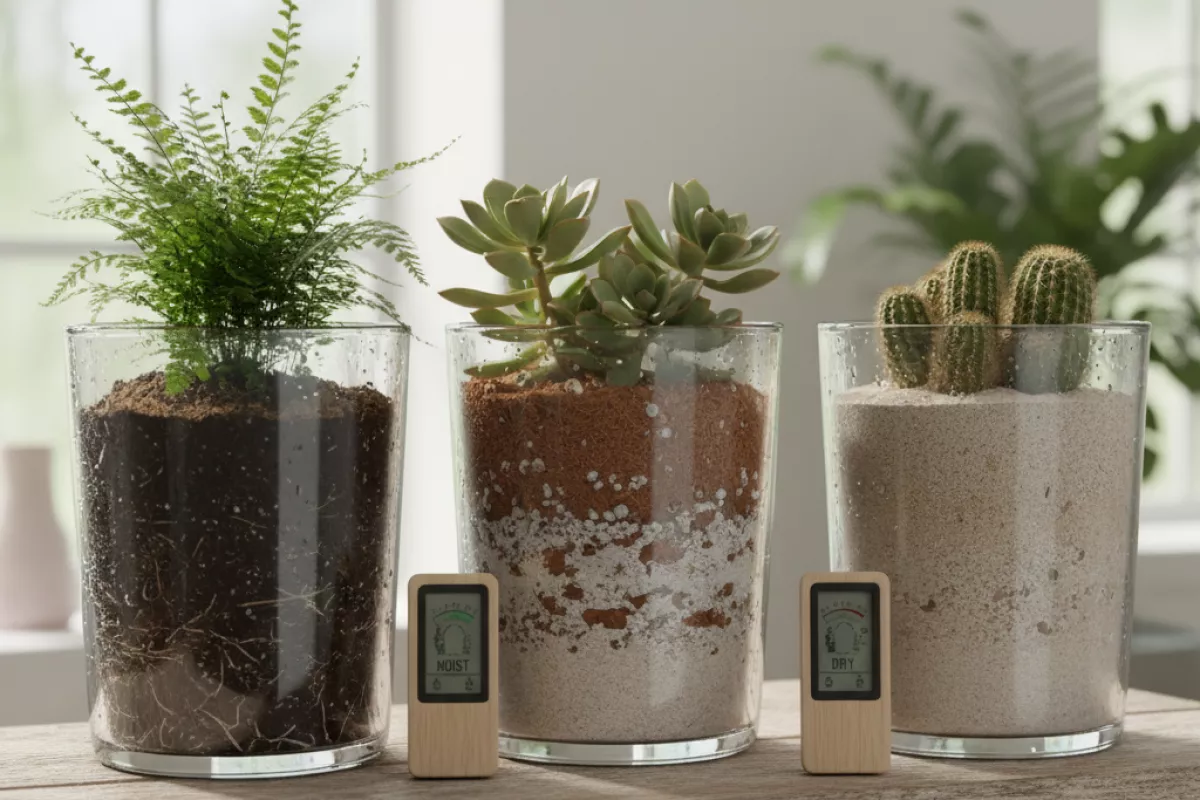
Potted plants don’t have access to the steady moisture reserves that exist in open ground. A container is a small, exposed system: water enters from the top, leaves through the bottom and sides, and the root zone can swing from wet to dry quickly. Those fast shifts are what often cause root stress, even when you feel like you’re watering “often enough.”
Several forces work together to change how quickly a pot dries, and they don’t always line up with what the surface looks like. The top 2–5 cm (1–2 in) can be bone-dry while the center is still damp, or the opposite can happen in very airy mixes where water drains so fast the whole root ball dries evenly.
- Limited soil volume means there’s less water stored after each watering. A 3 L (0.8 gal) pot can dry in a day of sun and wind, while a 30 L (8 gal) pot buffers moisture swings much longer.
- Gravity-driven drainage pulls water downward, leaving the upper zone drier and the lower zone wetter. If roots sit mostly in the top half, the plant can wilt even when the bottom is still moist.
- Pot material changes evaporation: unglazed terracotta “breathes” and loses moisture through the walls, while plastic and glazed ceramic hold water longer. Fabric pots dry fastest because air reaches the entire sidewall.
- Heat and wind hit the container directly. Sun warms the pot, which warms the mix, which speeds evaporation. Wind strips humidity from the surface and can double the dry-down rate on exposed balconies.
- Potting mix structure matters more than garden soil. Chunky mixes drain quickly and may need more frequent watering; fine, peat-heavy mixes can stay wet longer but may become hydrophobic if allowed to dry too far.
- Root density creates “dry pockets”. When roots fill the pot, they take up space that used to hold water, and the mix can dry unevenly. A root-bound plant may need watering more often, but also more slowly so water actually penetrates.
- Plant size vs. pot size shifts demand. A leafy plant in a small pot transpires faster than the container can store water, especially during active growth or fruiting.
| What changes in containers | How it affects drying (and root comfort) |
|---|---|
| Small soil volume | Less water storage, faster wet-to-dry swings; roots experience sharper stress cycles. |
| Drainage + perched moisture near the bottom | Top can dry while the lower zone stays damp; encourages shallow roots and inconsistent uptake. |
| Pot material (terracotta, plastic, fabric) | More breathable walls dry faster; less breathable walls hold moisture longer and can stay cool/wet. |
| Exposure (sun, wind, hot surfaces) | Increases evaporation and warms the root zone; can cause midday wilting even after morning watering. |
| Mix texture and water repellency | Airy mixes drain quickly; dried peat-based mixes can repel water so it runs down the sides instead of soaking in. |
| Root crowding | Creates channels where water bypasses the root ball; some roots stay dry while others sit wet. |
The practical takeaway is that container moisture is less predictable than garden beds. Checking deeper than the surface and adjusting for pot size, material, and exposure helps you water in a way that keeps the root zone evenly moist without leaving it soggy.
How to water containers without drowning roots
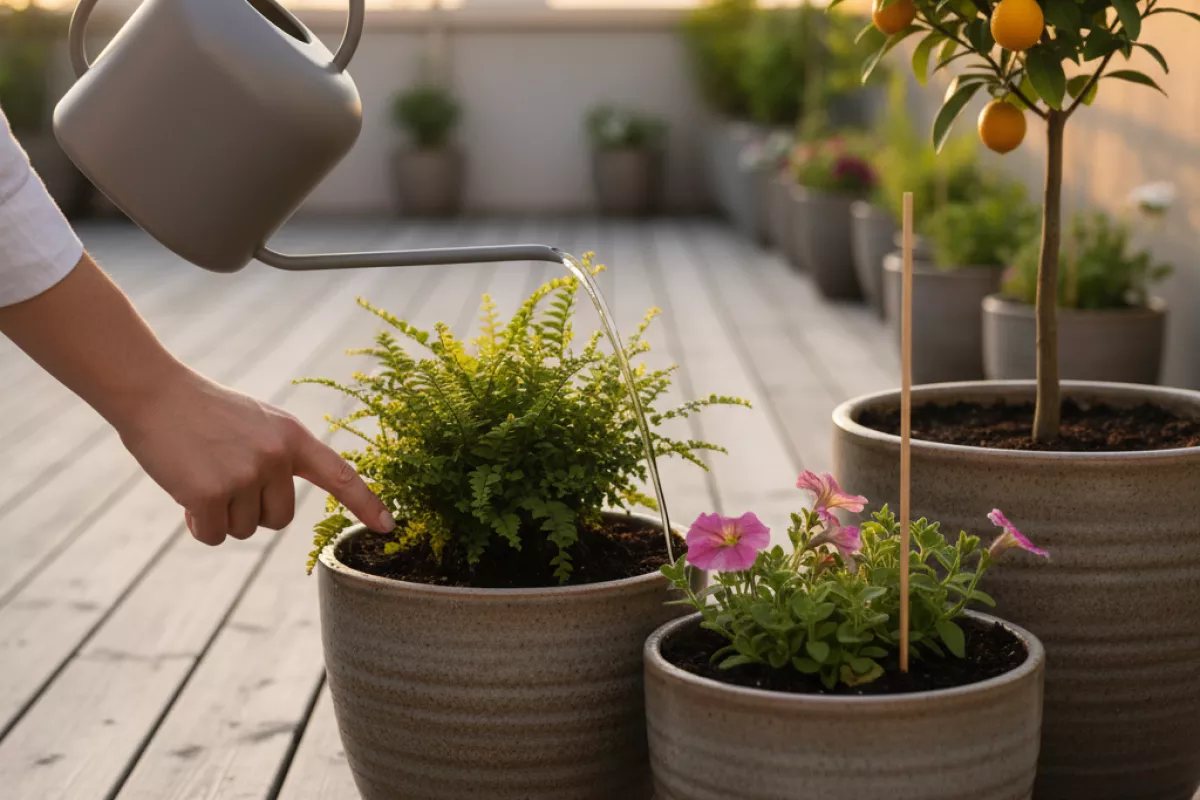
Container plants do best when the pot cycles between “evenly moist” and “slightly drying,” not when it stays soggy. The goal is to wet the entire root zone, then let excess drain fast so roots can breathe. That balance depends on your pot, soil mix, and how you apply water.
- Check before you pour. Push a finger 2–5 cm (1–2 in) into the mix. If it feels cool and damp at that depth, wait. If it’s dry or barely moist, it’s time. For larger pots, a wooden skewer works too: insert it 10–15 cm (4–6 in), then check for damp soil stuck to it.
- Water slowly and in passes. Fast watering can run down the pot’s sides and exit the holes without soaking the center. Apply about 1/3 of what you think you need, pause 30–60 seconds, then repeat until the mix is evenly wetted.
- Use the “drain-and-empty” rule. Water until you see a steady trickle from the drainage holes, then stop. If the container sits in a saucer or cachepot, empty it within 5–10 minutes so roots aren’t left in standing water.
- Avoid the “daily splash.” Small, frequent sips keep the top wet while the lower root zone stays stale and oxygen-poor. Instead, aim for thorough watering, then allow partial drying. In hot weather you may still water often, but make each session count.
- Match the method to the plant and pot. Top-watering is simplest for most plants. Bottom-watering (setting the pot in 2–3 cm (1 in) of water for 10–20 minutes) can help re-wet a dried-out mix, but don’t leave it soaking longer—remove and let it drain fully.
| What you notice | What it usually means | What to do next |
|---|---|---|
| Water rushes out immediately, soil still dry in the middle | Hydrophobic (water-repellent) mix or channeling along the sides | Water in 2–3 slow passes; consider bottom-watering 10–20 minutes; gently loosen the top 1–2 cm (0.5–1 in) |
| Soil stays wet for days, pot feels heavy | Poor drainage, too dense mix, or pot too large for the root mass | Let it dry further before watering again; ensure clear drainage holes; switch to a chunkier mix or smaller pot at next repot |
| Leaves droop but soil is wet | Low oxygen around roots (early root stress) or cold, saturated mix | Stop watering; increase airflow/light; verify drainage; keep temperatures above 18°C (65°F) if possible |
| Top looks dry but plant perks up after watering | Normal drying cycle; plant is using water faster than expected | Water thoroughly; consider mulching the surface 1–2 cm (0.5–1 in) with bark or coco chips to slow evaporation |
| Crusty surface, water beads and runs off | Salt buildup and compacted top layer | Flush with 2–3× pot volume of water (e.g., 2 L (0.5 gal) for a 1 L (0.25 gal) pot) occasionally; scrape and refresh the top layer |
If you’re unsure, choose “wait a day” over “add more.” Overwatering in containers is usually about frequency, not the amount used in one proper watering. A well-draining potting mix, clear drainage holes, and a habit of checking moisture at root depth will prevent most root problems.
Drainage principles for stress-free watering
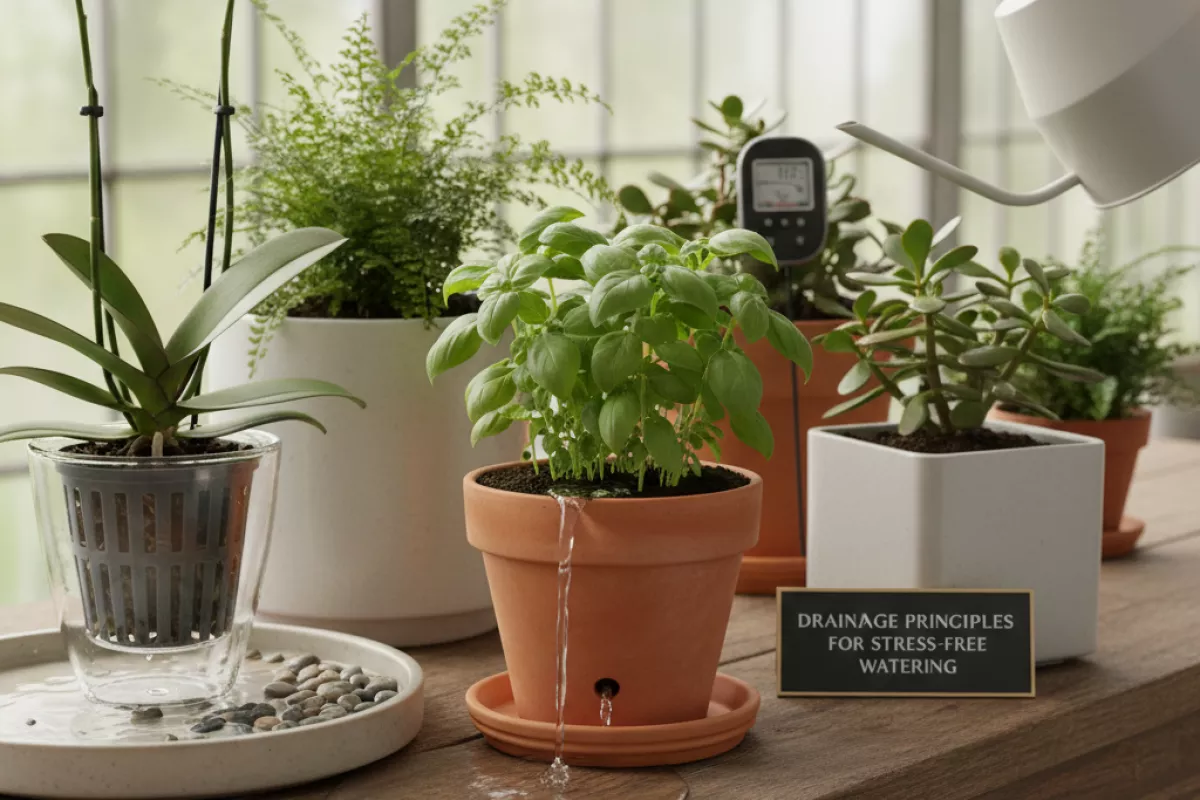
Good container watering starts with a simple goal: water should move through the pot at a predictable rate, leaving the root zone moist but not airless. When excess water has nowhere to go, roots sit in a low-oxygen mix, which is a fast track to stress, leaf drop, and rot.
- Always use a pot with a real drain hole. “Self-draining” cachepots and decorative outer pots are fine only if the inner nursery pot can drain freely and you empty the outer pot after watering.
- Match pot size to the root ball. Oversized containers hold a larger volume of wet mix that dries slowly, so roots stay cold and soggy longer. As a rule of thumb, step up by about 2–5 cm (1–2 in) in diameter at a time for most houseplants.
- Skip the gravel layer myth. Putting stones at the bottom doesn’t improve drainage; it often creates a perched water zone higher in the pot. Use a well-structured mix instead, and keep the hole clear.
- Use a mix that keeps air pockets after watering. Roots need both water and oxygen. If your potting mix compacts into mud, amend it with chunky material (for example bark, perlite, or pumice) so water can pass and air can return quickly.
- Keep the drain hole from clogging without blocking it. A small piece of mesh or a shard of broken pot over the hole can prevent mix loss while still letting water escape. Avoid packing the bottom tightly.
- Water to runoff, then stop. Apply water until you see a steady trickle from the bottom, wait 30–60 seconds, then discard the collected water. Leaving 5–10 mm (0.2–0.4 in) of standing water in a saucer can keep the lower mix saturated.
- Account for material and environment. Terracotta dries faster than plastic; tall pots dry slower at the bottom than shallow ones. Cooler rooms below about 18°C (65°F) slow evaporation, so drainage and aeration matter even more.
| What you notice | Likely drainage issue | Low-stress fix |
|---|---|---|
| Water pools on top for 10–20 seconds | Mix is compacted or hydrophobic | Gently loosen the top 2–3 cm (0.8–1.2 in); consider repotting into a chunkier blend |
| Pot feels heavy for many days after watering | Container is too large or mix holds too much fine material | Downsize at next repot or add aeration components; water less frequently but thoroughly |
| Roots smell sour; lower leaves yellow quickly | Oxygen-poor root zone from slow drainage | Let the mix dry more between waterings; repot and trim damaged roots if needed |
| Water runs straight out immediately | Severely dry, shrunken mix pulling from pot walls | Bottom-water for 10–20 min (600–1,200 sec) or soak until evenly moist, then resume normal watering |
| Drain hole drips, then stops while the saucer stays wet | Saucer water is being reabsorbed | Empty the saucer after 1–2 min (60–120 sec); raise the pot on feet or a rack |
If you build the pot, mix, and drain setup to behave consistently, you can water more confidently: saturate the mix, let the excess escape, and trust that the roots will have both moisture and air afterward.
Watering techniques for different pot materials
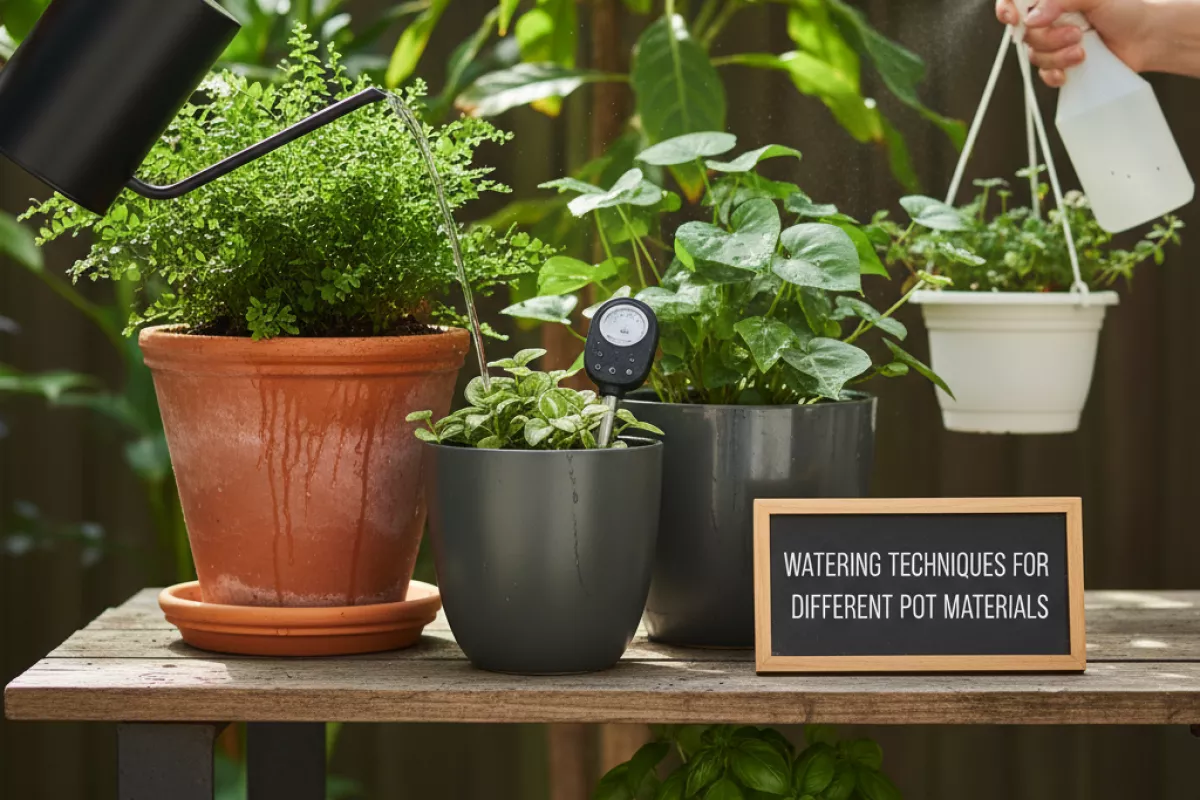
Container material changes how fast moisture leaves the root zone. Some pots “breathe” and dry quickly, while others hold water longer and can trap heat. Adjusting how you water (amount, speed, and timing) helps prevent the wet-dry swings that lead to root stress.
| Pot material | How it behaves | How to water to reduce root stress | Common mistake to avoid |
|---|---|---|---|
| Unglazed terracotta (clay) | Porous; wicks moisture and salts to the surface; dries faster, especially in wind and sun. | Water a bit more often, but in smaller doses. Use a slow pour until the mix is evenly damp, pause 30–60 seconds, then top up until a little drains out. In hot weather, check daily. | Soaking once and letting it go bone-dry; the next heavy watering can shock roots and cause runoff down the pot wall. |
| Glazed ceramic | Less breathable; holds moisture longer; temperature swings are milder than thin plastic. | Water only when the top 2–5 cm (1–2 in) of mix is dry for most houseplants. Pour slowly and stop once you get steady drainage; empty saucers after 10–15 minutes. | Keeping the base sitting in water; roots stay oxygen-starved even if the surface looks dry. |
| Plastic | Non-porous; retains moisture; can heat up in direct sun; lightweight so it dries unevenly if the mix shrinks. | Use a “two-pass” watering: first pass lightly to re-wet the surface, wait 2–3 minutes, then water thoroughly to runoff. In sun, water earlier in the day so roots aren’t sitting in warm, saturated mix. | Watering on a schedule; plastic can stay wet longer than it appears, leading to chronic sogginess. |
| Fabric grow bags | Very breathable; air-prunes roots; dries quickly from sides and bottom. | Water more frequently and evenly around the whole surface. In heat, consider splitting the daily amount into two sessions (morning and late afternoon) to keep moisture steadier without waterlogging. | Only watering the center; the edges dry out first and roots retreat, reducing uptake. |
| Wooden planters | Moderately porous; can wick water; soil near the walls dries faster; rot risk if constantly saturated. | Water slowly along the perimeter as well as the center. Aim for consistent dampness, not saturation; ensure drainage holes stay clear so the base never stays flooded. | Over-lining with plastic without drainage; it turns the box into a bathtub and stresses roots. |
| Concrete / stone | Heavy; can buffer temperature but may heat in full sun; often holds moisture longer due to thick walls and cooler interiors. | Water deeply but less often. Check moisture 5–8 cm (2–3 in) down before watering again. If the pot sits in strong sun, shade the container wall or mulch the surface to slow evaporation. | Assuming “big pot means more water”; thick containers can stay wet below while the top looks dry. |
| Self-watering / reservoir pots | Moisture rises from a reservoir; keeps the lower mix consistently damp; salts can accumulate. | Top-water once every 2–4 weeks to flush, letting at least 10–20% drain out. Refill the reservoir only after it empties, then give roots a short air break (about 12–24 hours) before refilling again. | Keeping the reservoir full all the time; roots can adapt to constant wetness and become more rot-prone. |
Whatever the container, your best cue is moisture depth, not the surface color. If you don’t have a meter, use a finger or a wooden skewer: check 5 cm (2 in) down for small pots and 8–10 cm (3–4 in) down for larger ones before deciding.
- Water slowly so the mix absorbs evenly; fast pours often channel straight to the bottom and leave dry pockets.
- Prioritize drainage: if water doesn’t exit within 30–60 seconds, the mix may be compacted or the holes may be blocked.
- Match timing to heat: in hot weather above 29°C (85°F), morning watering reduces the chance of warm, saturated soil stressing roots.
How temperature changes container moisture
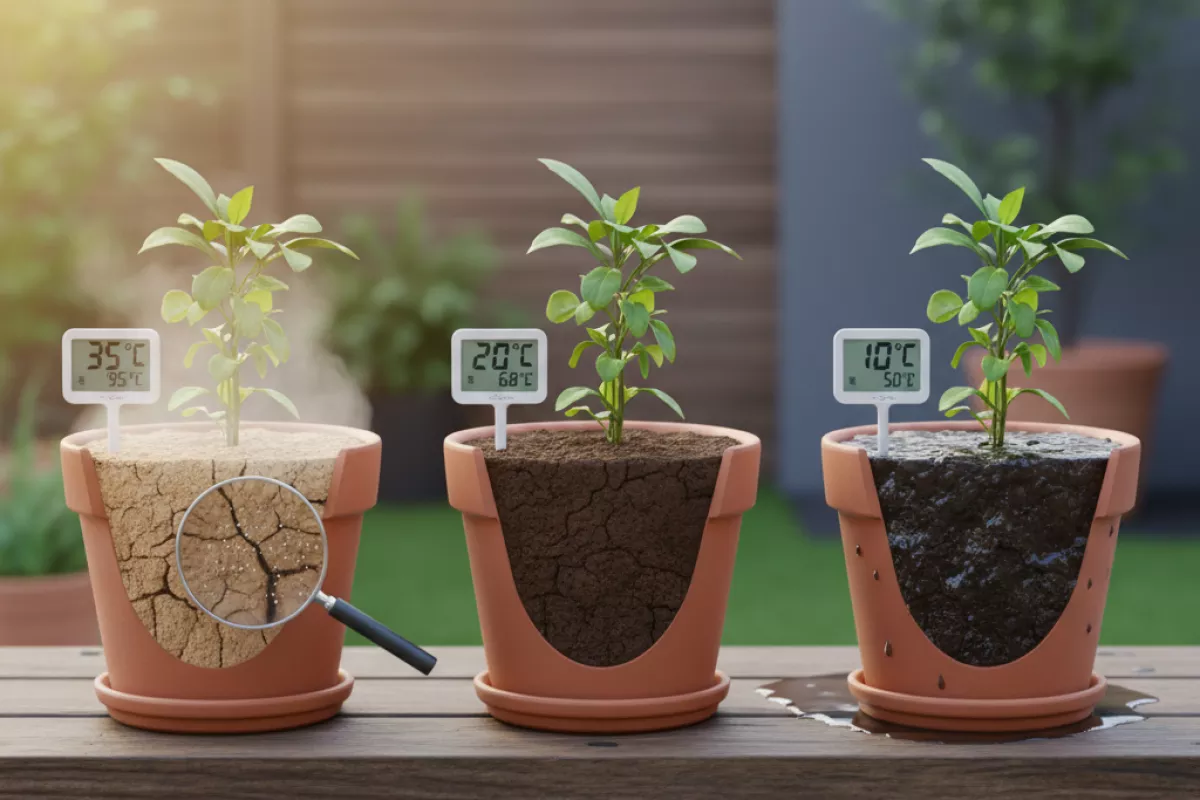
Heat and cold change how fast water moves through a pot: warm air pulls moisture out of the mix, warm roots drink faster, and the container itself can heat up enough to dry the outer edge while the center stays damp. Cooler conditions slow evaporation and plant uptake, so the same watering routine can suddenly leave roots sitting in soggy soil.
- Hot days speed up drying from the outside in. When air temperatures climb above about 27°C (81°F), the top 2–5 cm (1–2 in) can look bone-dry even if the lower zone is still moist. Watering lightly and often can keep re-wetting only that surface layer, encouraging shallow roots and increasing stress when the pot dries quickly later.
- Cool spells make “normal” watering too much. Below roughly 15°C (59°F), evaporation and transpiration drop. Containers can stay wet for days longer than expected, especially in shade, which raises the risk of low-oxygen conditions around roots.
- Container material changes the temperature swing. Dark plastic heats fast in sun, which can spike root-zone temperature and accelerate moisture loss. Terracotta “breathes,” so it dries faster in warm, windy weather but can be helpful if you tend to overwater. Glazed ceramic and thick resin buffer changes a bit more, keeping moisture steadier.
- Wind and sun act like a temperature multiplier. A breezy 24°C (75°F) afternoon can dry a pot faster than a still 29°C (84°F) day because moving air strips away humid air at the surface of the mix and leaves.
- Night temperature matters as much as daytime highs. Warm nights (for example 21°C/70°F) keep plants transpiring longer, so pots can be surprisingly light by morning. Cool nights slow water use, so evening watering may linger into the next day.
| Temperature pattern | What happens in the pot | Root-stress risk | Safer watering adjustment |
|---|---|---|---|
| Heat wave: 30–38°C (86–100°F) days | Rapid edge drying; salts concentrate as water evaporates | Dry pockets + sudden re-wetting can shock fine roots | Water early; soak until a little drains, then recheck in 30–60 min for a second small top-up if the mix shrank |
| Warm, windy afternoon: 24–32°C (75–90°F) with breeze | Fast surface evaporation; leaves transpire hard | Frequent “sips” can leave the core dry | Use a slower pour to wet evenly; consider moving pots out of direct wind during peak hours |
| Cool, cloudy stretch: 10–16°C (50–61°F) | Moisture lingers; oxygen drops in heavy mixes | Root suffocation and rot in consistently wet media | Wait for the top 2–3 cm (1 in) to dry and the pot to feel lighter before watering again |
| Big day–night swing: 32°C (90°F) day / 13°C (55°F) night | Daytime drying, nighttime slowdown; uneven wet/dry layers | Alternating stress can stall growth | Check moisture mid-morning; aim for deep watering less often rather than daily small amounts |
| Cold snap: 2–7°C (36–45°F) nights | Very slow uptake; wet mix stays cold | Cold, wet roots are easily damaged | Keep the mix slightly on the dry side; water earlier in the day so excess drains before night |
A simple habit that prevents temperature-driven mistakes is to use two cues instead of a calendar: feel the pot’s weight and check below the surface. If the top looks dry but the pot still feels heavy, wait or water more slowly and deeply so moisture spreads evenly instead of bouncing between drought and saturation.
Warning signs of root stress
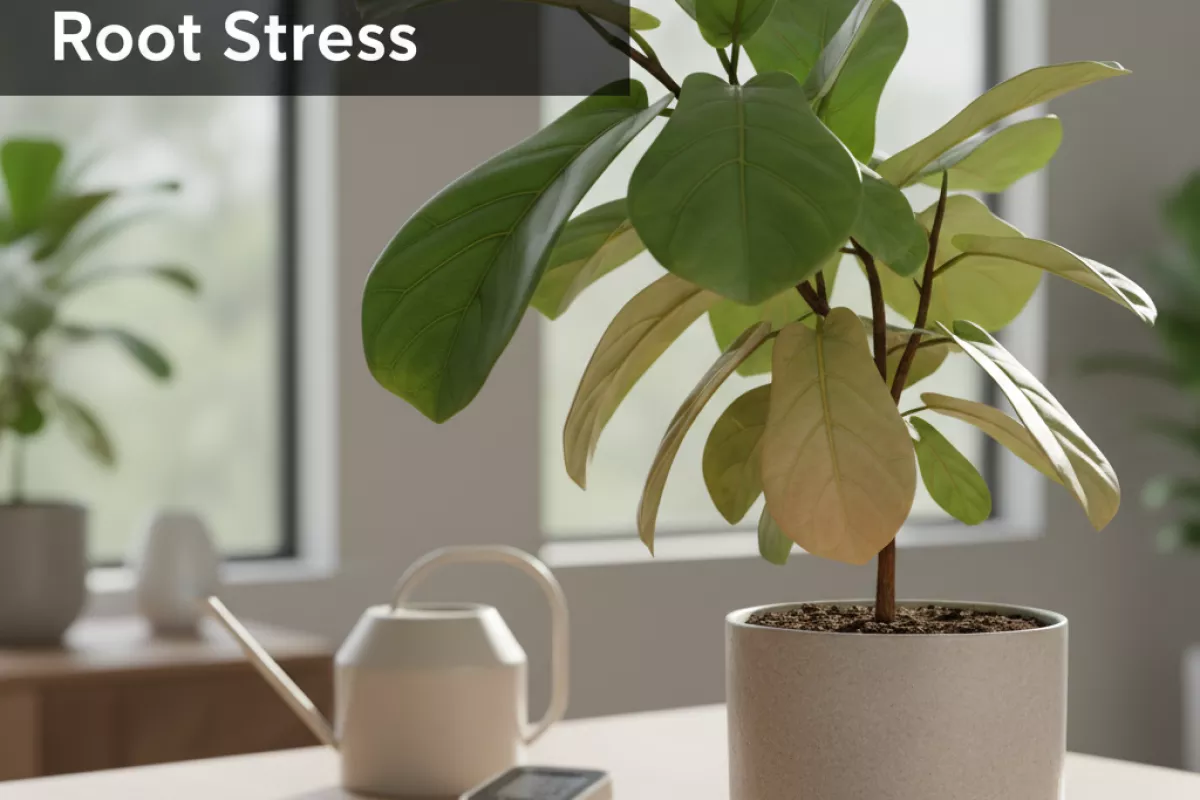
Root problems in pots usually show up above the soil line first. The key is noticing patterns: a plant that looks thirsty even after watering, or one that stays droopy in wet mix, is often telling you the roots can’t take up oxygen and moisture normally.
- Wilting that doesn’t match the soil moisture: Leaves droop when the potting mix is still damp, or they stay limp even after a thorough soak. This often points to suffocation from waterlogged media or damaged feeder roots.
- Yellowing lower leaves plus slow growth: Older leaves fade first, new growth is small, and the plant seems “stuck.” In containers, this can happen when roots are stressed by poor aeration or a salty buildup from frequent light watering.
- Brown, crispy edges on otherwise green leaves: Margins scorch while the center stays green. This can be a sign of irregular watering cycles (too dry, then too wet) that disrupt water uptake.
- Soft stems or a “collapsed” look: When stems feel mushy near the base, suspect prolonged saturation and early rot. This is more urgent than simple droop.
- Fungus gnats or a sour smell from the pot: Persistent gnats and a musty odor often mean the mix is staying wet too long, reducing oxygen around the roots.
- White crust on the soil surface or pot rim: Mineral salts accumulate from tap water or fertilizer, especially when you water in small sips. This can burn fine roots and cause leaf tip browning.
- Roots circling or pushing the plant upward: If you slide the root ball out and see thick roots spiraling, the plant may be root-bound. Water can run down the sides without soaking in, leading to alternating drought and saturation.
- Leaves dropping soon after watering: Sudden leaf drop following irrigation can happen when stressed roots can’t handle a rapid change in moisture levels, particularly in compacted or peat-heavy mixes.
| What you notice | What it usually suggests in containers | Quick check you can do |
|---|---|---|
| Droop while mix is wet | Low oxygen from overwatering or poor drainage | Push a finger 5 cm (2 in) down; if it’s wet and cool for days, the pot is staying saturated |
| Dry mix but plant still looks thirsty | Hydrophobic (water-repellent) mix or root-bound channels | Water slowly; if it runs out in under 10 seconds, the root ball may not be absorbing |
| Leaf tips brown + white crust | Salt buildup stressing fine roots | Check for crust on rim; if present, flush with 2–3× pot volume (e.g., 2 L for a 1 L pot) (68 fl oz for a 34 fl oz pot) |
| Musty smell or gnats | Mix staying wet too long; early rot risk | Lift the pot: if it’s heavy 48 hours after watering at 20°C (68°F), drying is too slow |
If you see more than one of these at the same time, treat it as a watering-and-drainage issue first, not a fertilizer problem. Correcting how the container dries out between waterings is usually the fastest way to stop root decline before it becomes rot.
How to correct watering problems safely
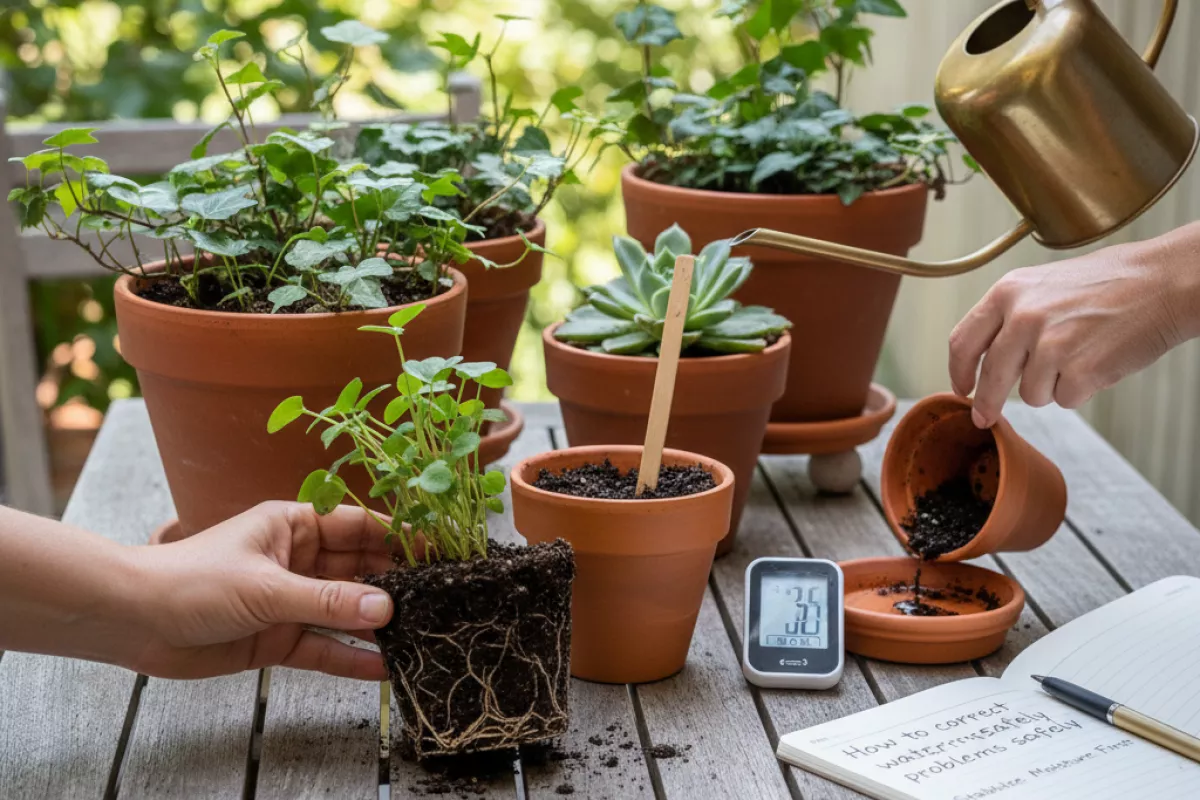
Fix issues gently rather than swinging between drought and a soak. In containers, roots live in a small, fast-changing zone, so the safest approach is to stabilize moisture first, then adjust the potting mix, drainage, and routine.
| What you notice | Most likely cause | Safe correction (low root stress) | What to avoid |
|---|---|---|---|
| Soil stays wet for days; leaves yellow; pot feels heavy | Poor drainage, compacted mix, oversized pot, low light/cool temps | Pause watering until the top 2–5 cm (1–2 in) dries; empty saucers; increase airflow/light; consider repotting into a chunkier mix and a pot with clear drainage | “Flushing” repeatedly, adding fertilizer, or keeping it in a decorative cachepot with standing water |
| Water runs down the sides; center stays dry; plant wilts quickly | Hydrophobic (peat-heavy) mix or severe dry-down | Bottom-water 15–30 min (0.25–0.5 hr) until the surface darkens; repeat once after 24 hours if needed; then resume smaller, more frequent watering | Pouring more and more from the top and assuming it soaked in |
| Leaf tips brown/crispy; soil dries very fast; pot is light | Underwatering, root-bound plant, hot sun/wind, small pot | Water thoroughly until a little drains out; recheck after 10 minutes and top up if the mix settled; consider moving 30–60 cm (12–24 in) back from harsh sun or potting up one size | Letting it swing from bone-dry to flooded, or jumping to heavy misting as the main fix |
| Wilting even though soil is wet; musty smell; dark, soft roots | Root rot from chronic saturation | Unpot, trim mushy roots, and repot into fresh airy mix; keep slightly on the dry side for 7–10 days; water only when the top 3–5 cm (1–2 in) dries | Keeping the same soggy mix, or “saving” it by watering more often |
- Confirm what’s happening before changing anything. Check moisture 5–8 cm (2–3 in) down with a finger or chopstick, and lift the pot to judge weight. This prevents “double watering” a pot that only looks dry on top.
- Reset to a steady baseline. For most container plants, aim for an even cycle: water deeply, let excess drain, then wait until the top layer dries (often 2–5 cm (1–2 in), depending on the plant). Consistency is gentler on roots than dramatic swings.
- Improve drainage without shocking the plant. If the mix is dense, repot when the plant is not already severely wilted. Choose a container with drainage holes and a mix that holds moisture but still has air pockets (adding coarse perlite or bark is often enough).
- Use bottom-watering as a repair tool, not a permanent crutch. It’s ideal for re-wetting a dried-out mix, but don’t leave pots soaking for hours. After 15–30 min (0.25–0.5 hr), let it drain well so roots aren’t deprived of oxygen.
- Delay fertilizer until growth looks normal again. When roots are stressed, salts can burn them. Wait 1–2 weeks, then feed lightly if the plant is actively growing.
If you’re unsure whether you’re dealing with too much or too little water, treat it like a diagnosis: measure moisture below the surface, look for drainage and smell issues, and adjust one variable at a time. Small, deliberate changes are what keep container roots calm.