Full Sun Plants for Front Yard Landscaping

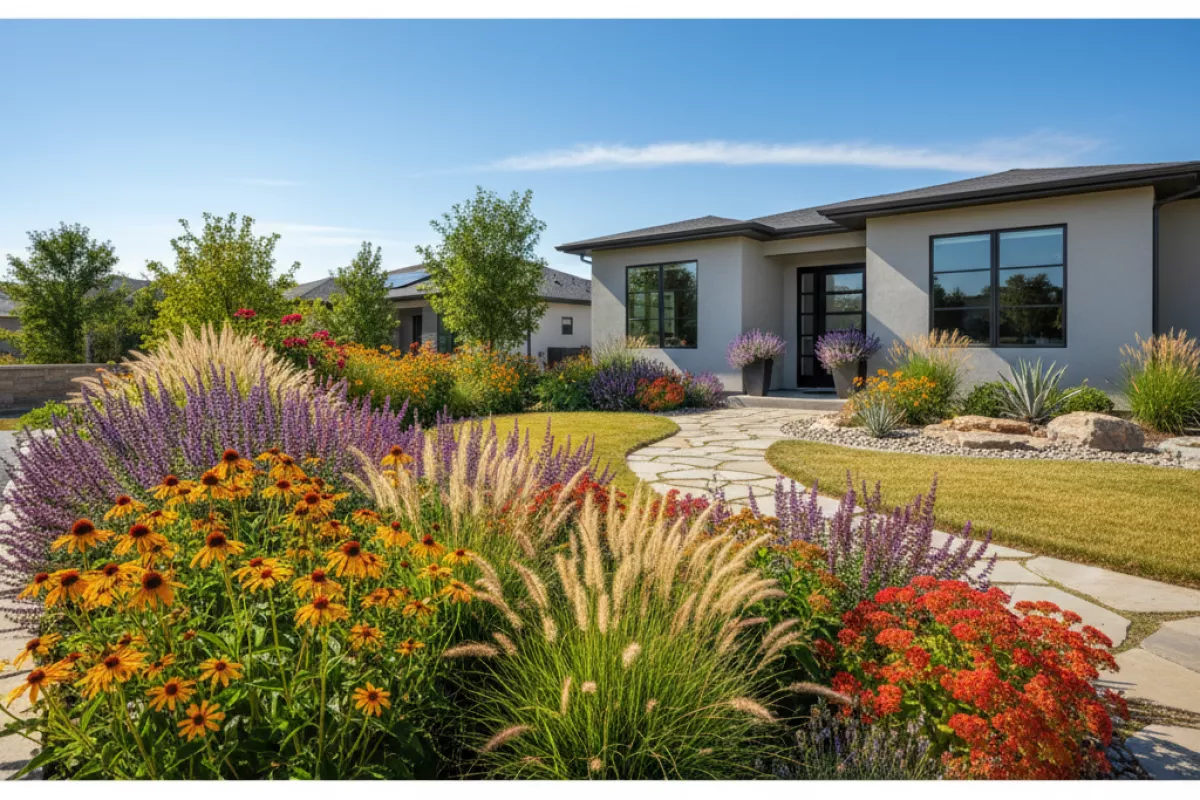 Front yards often get full sun, so the article explains how to pick curb-appeal plants, build layered combinations, and coordinate colors. It also covers soil and drainage basics, maintenance plans for high-visibility areas, and simple seasonal rotation ideas.
Choosing front yard plants that thrive in all-day sun can keep your landscape looking polished without constant upkeep. In bright, exposed areas, a smart mix of heat- and drought-tolerant perennials, shrubs, and annuals will maintain color, structure, and blooms through the season. This guide highlights dependable choices and easy placement tips to boost curb appeal.
Why front yards often receive full sun
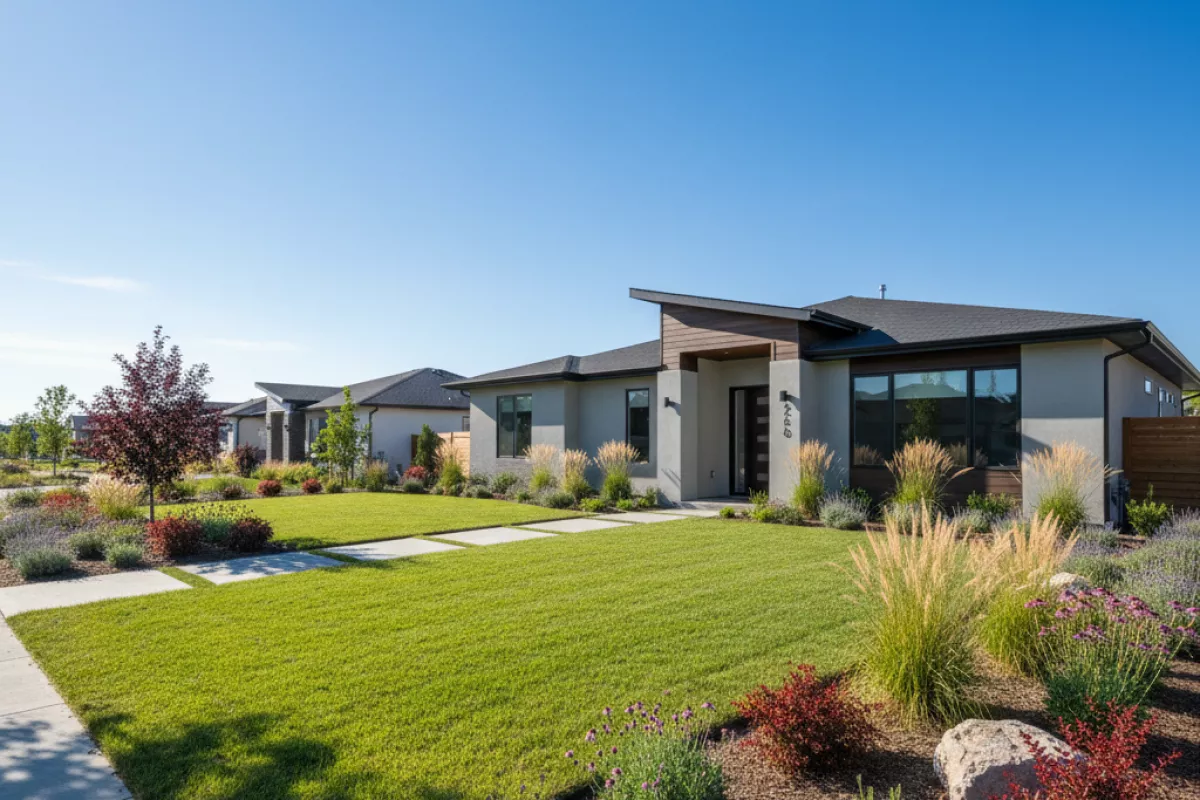
Street-facing landscapes are frequently the brightest part of a property because they’re designed to be open and visible. Builders and homeowners tend to keep the area near the curb clear of tall trees and dense hedges, which means there’s less overhead canopy to filter light. The result is long stretches of direct exposure that can easily add up to 6+ hours of sun on clear days.
- Fewer shade structures up front: Backyards often have pergolas, patios, play sets, and mature trees; the front is usually simpler, with fewer features that cast broad shade.
- Setbacks create open space: Many homes sit back from the street, leaving a wide, unobstructed lawn or planting bed. That open “runway” lets sunlight reach the ground for more of the day.
- Tree placement favors the rear: When shade trees are planted, they’re commonly placed behind or beside the house for privacy and cooling outdoor living areas, leaving the front garden more exposed.
- Driveways and walkways reflect heat and light: Concrete and asphalt can bounce light into nearby beds and raise temperatures, which makes a sunny site feel even more intense in summer.
- Orientation matters: A south-facing (in the Northern Hemisphere) or north-facing (in the Southern Hemisphere) front yard tends to receive stronger, longer-duration sun, especially when the house doesn’t block midday light.
- Neighboring buildings may not provide much cover: If nearby houses are set at similar heights and distances, their shadows may only sweep across the yard briefly, leaving most of the day unshaded.
If you’re unsure how bright your space really is, watch where shadows fall at three times: morning, midday, and late afternoon. A spot that looks “partly sunny” at 9:00 a.m. can still be full sun by noon, especially near reflective pavement or light-colored siding.
Choosing plants for curb appeal
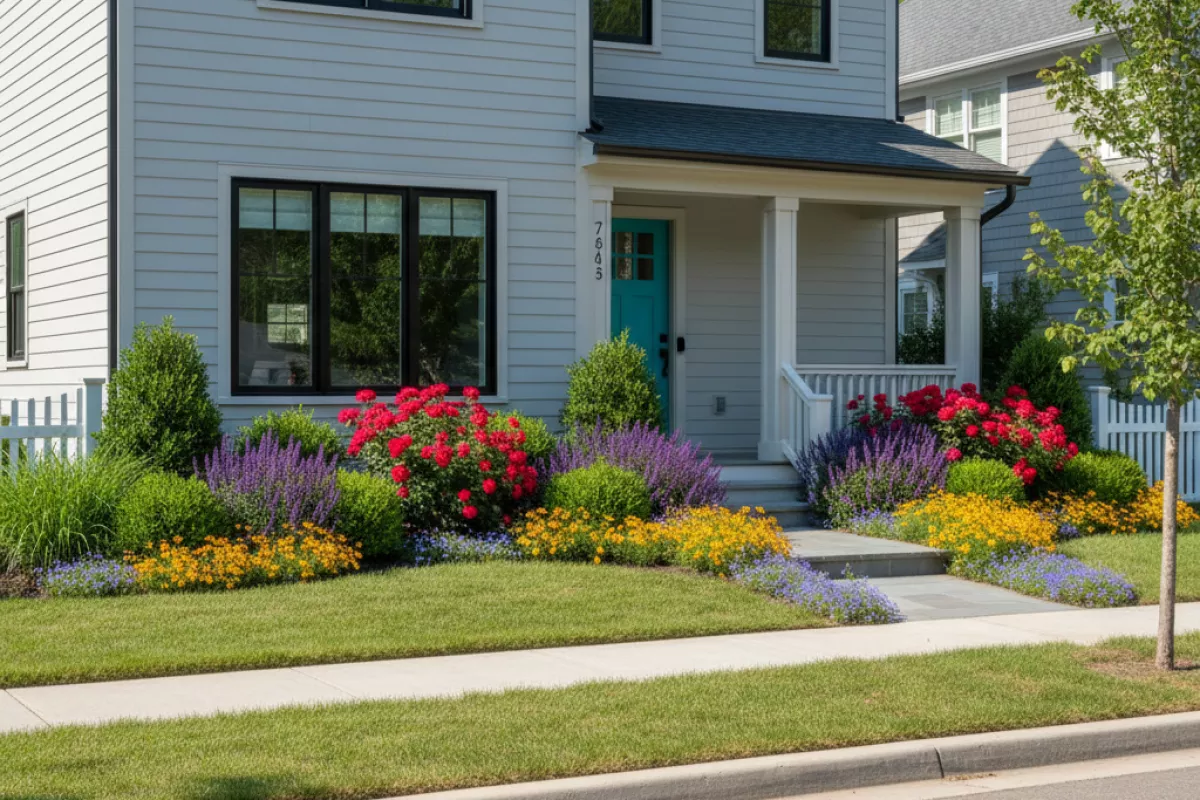
Pick sun-loving plants the same way you’d design a good outfit: a clear base, a few standout pieces, and repeats that tie everything together. For a front yard, that usually means choosing a small set of reliable performers for structure, then adding seasonal color where it will be noticed from the street and the walkway.
- Start with the “view from the curb.” Stand across the street and note what’s most visible: the front door, windows, and corners of the house. Put your boldest full-sun bloomers near those focal points, and use calmer foliage elsewhere so it doesn’t look busy.
- Match plants to the site, not the wish list. Full sun is typically 6–8 hours of direct light per day (6–8 h). If the bed bakes against a south- or west-facing wall, prioritize heat-tolerant choices; if it’s windy and dry, choose tough, low-water options.
- Use layers for instant “finished” structure. Place taller shrubs or upright perennials in back (or at the house), mid-height mounding plants in the middle, and low edging plants along the sidewalk or driveway. This keeps blooms visible instead of hidden behind foliage.
- Repeat a few plants for cohesion. Repeating the same 2–4 varieties across multiple beds looks intentional and is easier to maintain than a collection of one-offs. You can still add variety through color shifts or alternating textures.
- Choose a simple color plan. Two main colors plus one accent reads clearly from a distance. Warm palettes (yellow/orange/red) pop in bright light; cool palettes (blue/purple/white) feel calmer and often look crisp against hardscape.
- Prioritize foliage and form, not just flowers. Blooms come and go, but leaf color and plant shape carry the landscape all season. Mix fine textures (grasses, threadleaf foliage) with bold leaves (salvia, daylily-type straps) for contrast.
- Plan for bloom timing. Aim for at least one standout in spring, summer, and fall so the front yard doesn’t peak for only a few weeks. If you’re unsure, pick long-blooming full-sun staples and add a couple of seasonal “guest stars.”
- Keep maintenance realistic. If you don’t want weekly deadheading, lean into plants that self-clean or look good as they fade. Also check mature size so you’re not pruning constantly to keep windows and paths clear.
- Mind spacing and sightlines. Leave room for airflow and growth, and keep plants lower near corners of walkways to avoid blocking views when backing out. As a rule of thumb, keep path edges to roughly 30–60 cm (12–24 in) tall, and reserve taller plants for deeper beds.
| Front-yard goal | What to plant in full sun | Why it helps visually |
|---|---|---|
| Year-round backbone | Evergreen shrubs, compact conifers, or tidy ornamental grasses | Keeps the yard looking “put together” even when flowers aren’t blooming |
| Color that reads from the street | Massed flowering perennials or tough annuals in groups of 3–7 | Large blocks of color look cleaner and more intentional than scattered singles |
| Clean edges | Low mounding plants or groundcovers along borders | Defines beds and makes mowing and trimming easier |
| Low-water look | Drought-tolerant perennials, silver/gray foliage plants, and deep-rooted natives | Stays attractive through heat and dry spells without constant watering |
| Pollinator-friendly impact | Nectar-rich bloomers with staggered flowering times | Adds movement and life while still looking tidy when planted in repeating drifts |
Before you buy, sketch the bed and label each plant’s mature width so you can space correctly from day one. A front yard in bright light looks best when plants have room to fill in, rather than being crammed and then cut back all season.
Best combinations for layered design
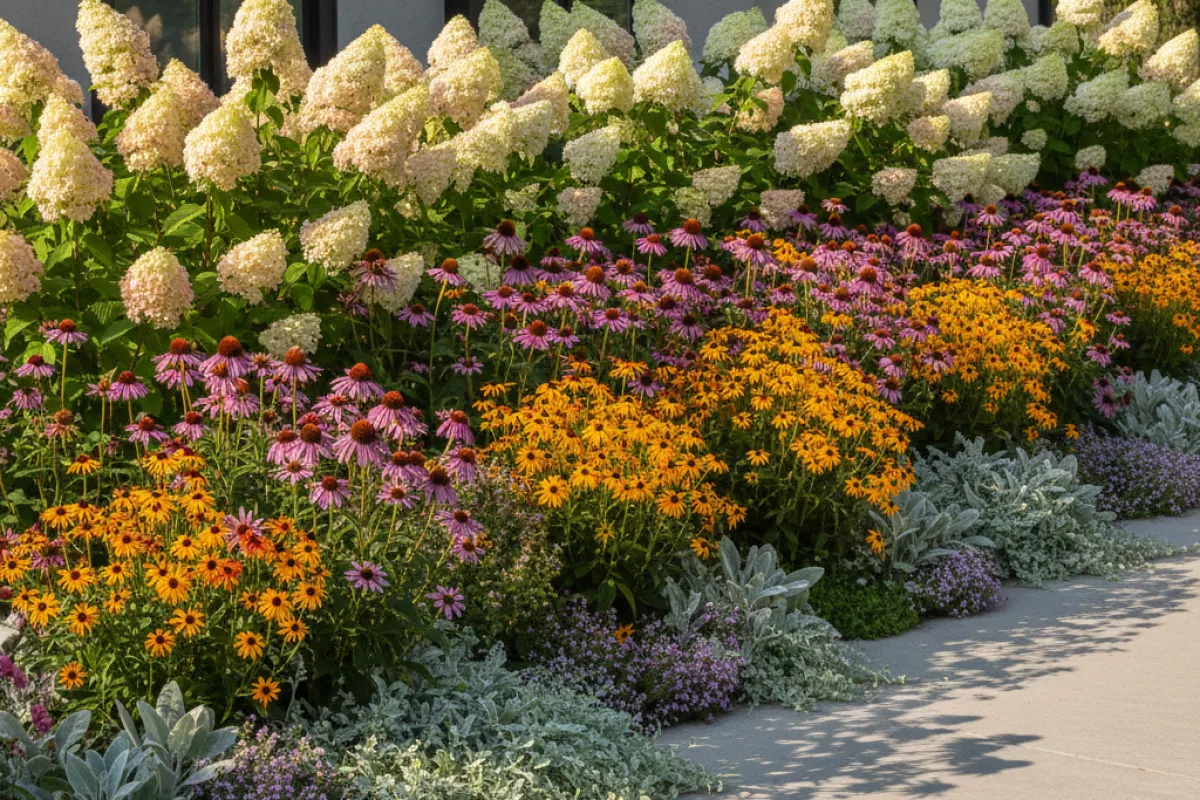
Layering in a sunny front yard works best when you pick plants by height, texture, and bloom timing, then repeat that pattern in a few spots so the bed looks intentional. A simple rule: place the tallest plants at the back (or center of an island bed), mid-height fillers in the middle, and low edging plants up front—then weave in one “spiller” that softens hard lines along a walkway or curb.
| Layered combo (back → middle → front) | Why it works in full sun | Notes for spacing & upkeep |
|---|---|---|
| Panicle hydrangea (sun-tolerant types) → coneflower (Echinacea) → creeping thyme | Big structure plus long summer color; thyme forms a tidy, heat-proof edge. | Give shrubs about 1–2 m (3–6 ft) between plants depending on variety; shear thyme lightly after bloom for a clean border. |
| Switchgrass (Panicum) → black-eyed Susan (Rudbeckia) → sedum (stonecrop) | Grasses add movement; Rudbeckia carries mid-to-late season color; sedum handles reflected heat near pavement. | Cut grass back in late winter; deadhead Rudbeckia for longer bloom or leave seed heads for birds. |
| Rose (shrub rose) → salvia (perennial) → lamb’s ear | Classic flower-forward look with contrasting leaf texture; salvia and lamb’s ear are reliable in hot, bright sites. | Keep airflow around roses (about 60–90 cm / 24–36 in apart for many shrub types); trim lamb’s ear to prevent flopping. |
| Yarrow (Achillea) → coreopsis → blue fescue | All thrive in leaner soils and sun; blue fescue gives a neat, mounded edge that reads “finished.” | Avoid overwatering; divide fescue every 2–3 years if the center thins. |
| Russian sage (Salvia yangii) → daylily (Hemerocallis) → dianthus | Airy purple haze behind bold daylily foliage; dianthus brings a crisp, low front with early color. | Russian sage can reach 90–150 cm (36–60 in); place it where it won’t swallow smaller plants. |
| Juniper (upright or spreading) → lavender → ice plant (Delosperma) | Evergreen backbone with drought-tolerant bloomers; great for hot slopes and curb strips. | Lavender needs sharp drainage; keep mulch pulled back 5–8 cm (2–3 in) from crowns to reduce rot risk. |
- Repeat, don’t collect. Choose 2–3 main plants and repeat them every 1.5–3 m (5–10 ft) to avoid a “one of everything” look.
- Mix leaf shapes. Pair spiky (salvia, grasses) with broad (daylily) and fine (Russian sage) so the bed still looks good between bloom cycles.
- Stagger bloom seasons. Combine early (dianthus), mid (coneflower), and late (sedum, grasses) so the front yard stays colorful without constant replanting.
- Plan for mature size. It’s tempting to plant close for instant fullness, but leaving room reduces disease and keeps full sun plants from shading each other out.
Color coordination strategies
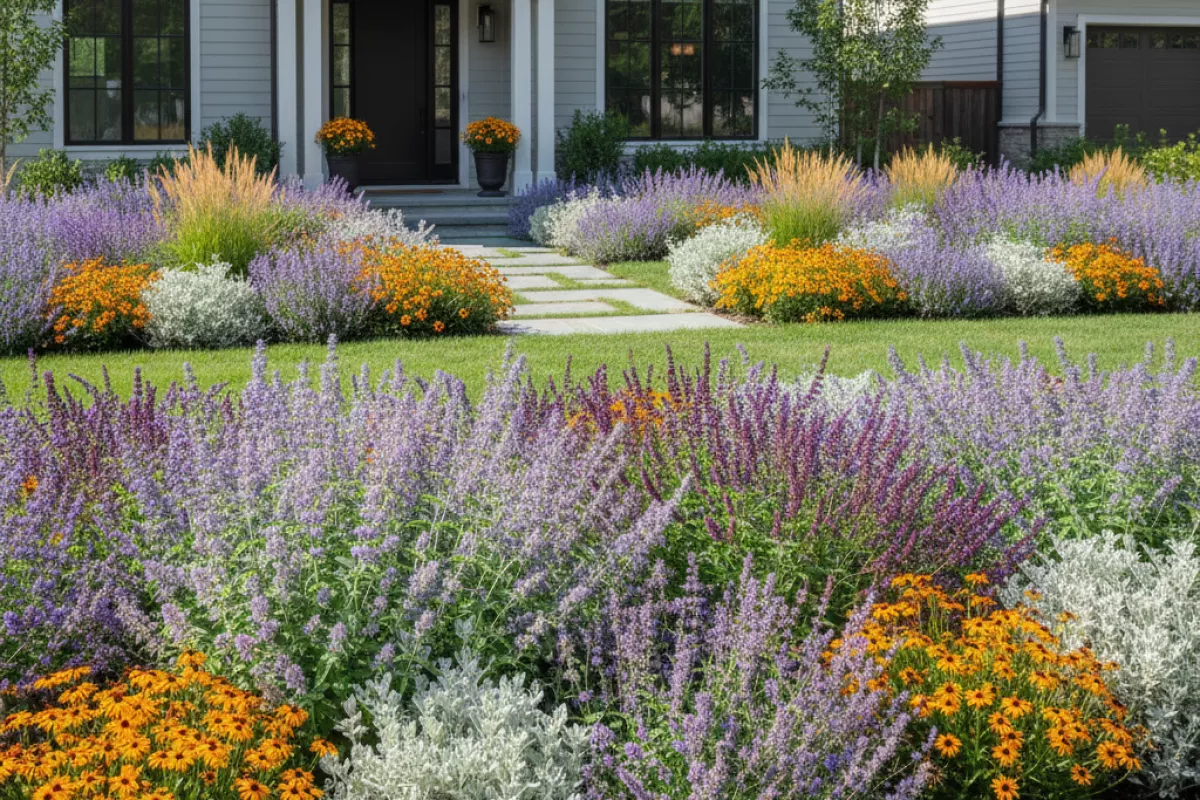
Pick a simple palette first, then choose full-sun plants that repeat those hues across the yard. Repetition is what makes a front yard look intentional from the street, especially in bright light where colors can read louder than you expect.
A practical approach is to limit yourself to one dominant color, one supporting color, and one accent. In full sun, cool tones (blues, purples, silvers) tend to feel calmer, while hot tones (reds, oranges, yellows) feel more energetic and can visually “advance” toward the viewer.
- Use the 60–30–10 rule: about 60% of the planting in a dominant hue (or foliage tone), 30% in a secondary color, and 10% as a punchy accent. This keeps bright blooms from turning into visual noise.
- Repeat, don’t scatter: place the same color in at least three spots so the eye moves smoothly. A single isolated clump of a bold color often looks accidental.
- Let foliage do the heavy lifting: silver, chartreuse, and deep burgundy leaves provide color even when flowers pause. Foliage-based color is also more consistent across the season.
- Balance warm and cool: if you love hot colors, temper them with white blooms or gray-green leaves so the bed still reads clean at midday.
- Match the house, not the trend: echo one exterior element (roof, trim, door) with flowers or leaves, then keep everything else quieter. This ties full-sun plantings to the architecture.
- Plan for distance viewing: high-contrast combos (purple/yellow, blue/orange) show up from the curb, while subtle pastels are better near the walkway where you’ll see them up close.
| Palette goal | What to combine | Why it works in full sun |
|---|---|---|
| Calm, modern | Blues/purples + white + silver foliage | Cool hues and reflective leaves stay crisp in harsh light and look tidy from the street. |
| Cheerful, cottage | Warm mix (yellow/orange/red) + plenty of green | Sun intensifies warm blooms; green massing prevents the look from getting chaotic. |
| Elegant, low-contrast | One color family (pink-to-magenta) + dark foliage | Monochrome reads cohesive; dark leaves add depth when petals fade. |
| Bold, high-contrast | Complementary pairs (purple/yellow or blue/orange) used in repeated blocks | Strong contrast holds up at a distance; repeating blocks keeps it intentional, not busy. |
For bed layout, keep the brightest accents closer to the entry path and use calmer tones toward the edges. If you’re unsure, test with small groupings first: plant in drifts about 60–90 cm (24–36 in) wide, then repeat that drift elsewhere rather than adding new colors.
Soil and drainage considerations
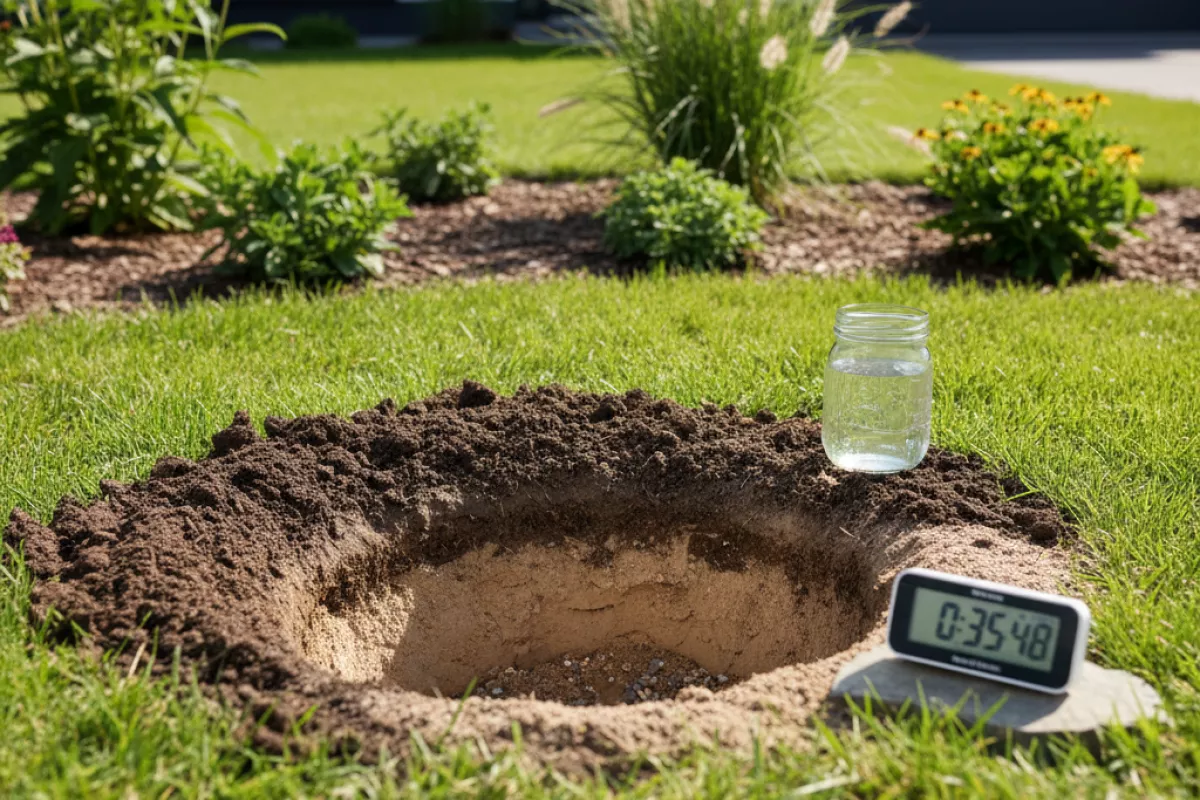
Healthy front-yard plantings in full sun start with how water moves through your ground. Too much standing moisture can rot roots, while overly fast drainage can leave sun-loving plants stressed and crispy. Before you buy anything, figure out what you’re working with and make small, targeted improvements.
- Do a quick drainage test: Dig a hole about 30 cm (12 in) deep and wide, fill it with water, let it drain once, then refill. If the second fill drains in roughly 2–6 hours, you’re in a good range for many ornamentals. Much faster suggests very sandy soil; much slower points to clay or compaction.
- Check texture with a simple “squeeze” test: Moisten a handful of soil and squeeze. If it forms a tight ribbon that holds its shape, you likely have clay. If it falls apart immediately, it’s sandy. If it forms a weak ball that crumbles with a poke, it’s closer to loam and usually easier to work with.
- Watch for compaction near sidewalks and driveways: Construction traffic often compresses soil. If a trowel is hard to push in, loosen the top 15–20 cm (6–8 in) and mix in organic matter to restore pore space for air and water.
- Improve structure, not just “fertility”: Blend in 5–8 cm (2–3 in) of compost across beds to help clay drain better and help sand hold moisture longer. Avoid burying compost in deep layers; mixing it into the top zone is usually enough for roots of most front-yard perennials and shrubs.
- Use the right kind of mulch: A 5–7.5 cm (2–3 in) layer of bark or shredded leaves reduces evaporation and moderates temperature swings. Keep mulch 5–10 cm (2–4 in) away from stems and trunks to prevent rot.
- Match plants to “wet” and “dry” micro-spots: Low points, downspout areas, and the base of slopes stay wetter; spots under eaves or next to reflective pavement dry out faster. Choosing plants that fit each pocket often works better than trying to force uniform conditions.
- Consider a raised bed when drainage is chronically poor: Lifting the root zone by 15–30 cm (6–12 in) can keep sun plants out of saturated soil after storms. This is often more reliable than repeated amendments in heavy clay.
| What you notice | What it usually means | Practical fix for a sunny front yard |
|---|---|---|
| Puddles linger for 24+ hours after rain | Slow percolation, clay, or compaction | Loosen top 15–20 cm (6–8 in), add 5–8 cm (2–3 in) compost, consider a 15–30 cm (6–12 in) raised bed |
| Soil cracks and turns hard in summer | Clay shrinking as it dries | Compost + consistent mulch at 5–7.5 cm (2–3 in); water deeply but less often |
| Water disappears immediately; plants wilt fast | Sandy soil with low water-holding capacity | Add compost annually, mulch 5–7.5 cm (2–3 in), group drought-tolerant plants in the hottest zones |
| Yellowing leaves despite watering | Root stress from poor aeration or nutrient lockout | Check drainage first, then adjust watering; avoid overwatering compacted spots and improve structure |
| Runoff flows off the bed during irrigation | Hydrophobic dry soil or crusted surface | Water in shorter cycles, break the surface crust, top-dress with compost, keep mulch in place |
If you’re unsure about pH, a basic soil test is worth it before adding lime or sulfur. Most full-sun landscape plants tolerate a fairly broad range, but drainage and structure problems usually cause more trouble than minor pH imperfections.
Maintenance planning for visibility areas
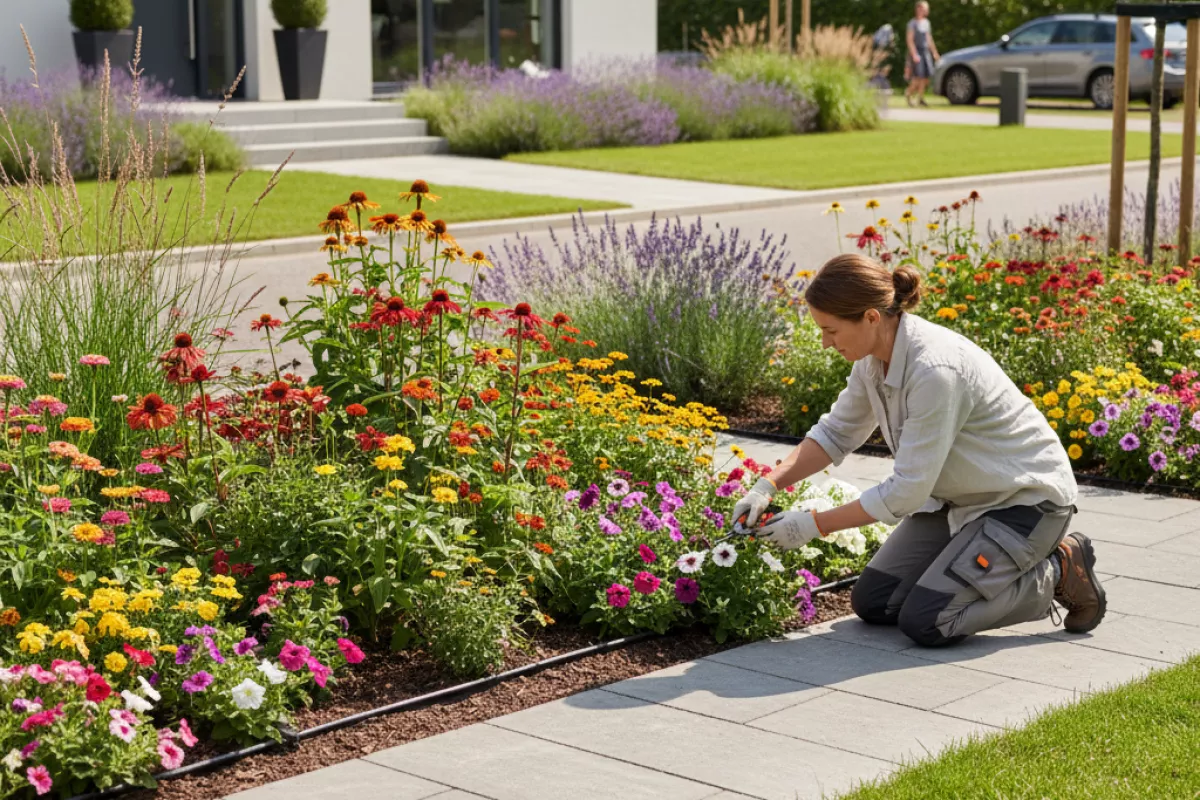
Keep the front-of-house beds looking intentional by planning for the spots everyone sees from the street and the walkway. In full sun, growth is fast, blooms can be nonstop, and irrigation mistakes show quickly. A simple routine built around sightlines helps you avoid the “one weekend it looked great” problem.
- Design for easy reach first. Limit deep beds you can’t access without stepping on soil. As a rule of thumb, keep planting depth to about 60–90 cm (24–36 in) from the edge so you can deadhead, weed, and check drip lines without trampling roots.
- Put the highest-maintenance plants closest to where you pass. Place deadheading-heavy bloomers and thirsty containers near the door or path; put tougher, drought-tolerant full-sun plants farther out where you won’t notice a missed day.
- Use mulch as a scheduling tool. Refresh organic mulch to roughly 5–8 cm (2–3 in) to cut weeds and slow evaporation, but keep it a few centimeters away from crowns and stems to reduce rot.
- Plan a “clean edge” you can maintain in minutes. A crisp border along the sidewalk or driveway hides a lot of garden chaos behind it. Recut edges every 4–6 weeks in peak season, or whenever grass starts creeping in.
- Water with visibility in mind. In hot spells, prioritize the plants that frame the entry and mailbox area; they set the impression. Water early morning, and aim for deep soakings rather than daily sprinkles (for many landscapes, that’s 2.5–4 cm (1–1.6 in) per week including rain, adjusted for soil and heat).
- Stake or support before flopping happens. Add discreet supports when plants are 20–30 cm (8–12 in) tall so stems grow through them; waiting until flowering often makes supports obvious.
- Keep a “swap zone” for seasonal gaps. Reserve a small pocket (or two containers) for quick replacements when something finishes blooming or gets sun-scalded. It’s easier than trying to make every perennial look perfect all season.
- Prune for sightlines, not just plant health. Trim back anything that blocks house numbers, porch steps, or driveway views. For shrubs, remove a few older stems at the base instead of shearing the outside into a boxy shape.
| Area you see most | Typical issue in full sun | Fast check (2–5 minutes) | Deeper task (monthly or seasonal) |
|---|---|---|---|
| Entry path and porch border | Spent blooms and legginess | Deadhead and pinch tips; remove yellow leaves | Cut back by 1/3 after a bloom flush; add a thin compost top-dress of 1–2 cm (0.4–0.8 in) |
| Mailbox/house-number planting | Heat stress, crispy edges | Check soil moisture 5 cm (2 in) down; spot-water if dry | Adjust emitter placement; increase mulch to 5–8 cm (2–3 in) if thin |
| Driveway edge | Weed invasion and salt/heat splash | Pull small weeds before they seed; sweep debris away from crowns | Recut edge; replace weak plants with tougher sun performers or groundcovers |
| Street-facing foundation bed | Overgrowth covering windows/vents | Look for stems touching siding; snip back offenders | Thin shrubs by removing older canes; maintain 30–45 cm (12–18 in) clearance from the house |
| Open-lawn focal bed (island bed) | Uneven height and midseason gaps | Rotate your viewing angle from curb and sidewalk; note bare spots | Divide or relocate plants in fall/spring; add a “gap filler” annual or a small ornamental grass |
If you want the front yard to stay tidy without constant work, set a realistic cadence: a quick walk-through twice a week during peak growth, plus one longer session every 3–4 weeks. The key is to treat the most visible strips like a small, high-priority garden and let the less prominent areas be more relaxed.
Seasonal rotation ideas
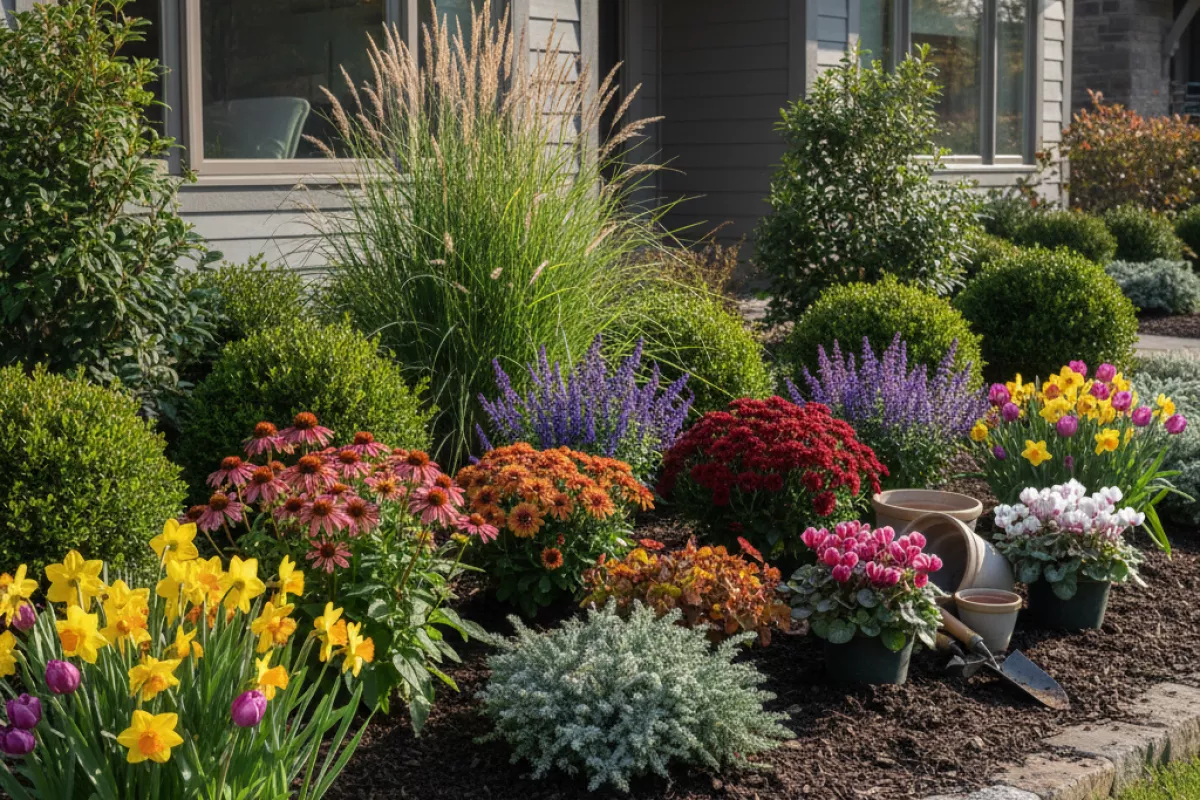
Keep a front-yard bed in full sun looking intentional all year by swapping a few “feature” plants each season while leaving your structural backbone in place. Think of it as rotating color and texture in the gaps between shrubs, ornamental grasses, and evergreens, rather than redoing the whole planting every few months.
A simple way to plan it is to reserve about 20–30% of your planting area for change-outs and keep the rest evergreen or long-blooming. In practice, that might be one or two containers plus a narrow strip along the walkway, or a pocket bed near the mailbox where you can refresh plants without disturbing roots elsewhere.
| Season | What to add for full sun | What to pull back or cut down | Quick care notes |
|---|---|---|---|
| Early spring | Cold-tolerant color like pansies/violas; early bulbs; cool-season annuals in containers | Cut back last year’s ornamental grass stems to 10–15 cm (4–6 in) if you didn’t in late winter | Mulch lightly after soil warms; protect tender starts if nights dip below 0°C (32°F) |
| Late spring to early summer | Heat-ready annuals (zinnias, lantana, salvia); sun-loving perennials coming into bloom | Remove fading bulb foliage only after it yellows; thin crowded seedlings | Water deeply 2.5 cm (1 in) per week from rain/irrigation; pinch some annuals for branching |
| Peak summer | Drought-tough fillers (portulaca, angelonia) and bold foliage (coleus varieties rated for sun) | Shear back leggy annuals by about 1/3; deadhead heavy bloomers | Refresh mulch to 5–7.5 cm (2–3 in); water early morning to reduce evaporation |
| Early fall | Mums, asters, ornamental peppers; late-season grasses for movement | Pull tired summer annuals; leave seedheads you want for winter interest | Plant perennials while soil is still warm; aim for 4–6 weeks before hard frost |
| Late fall to winter | Evergreen boughs in pots, hardy winter pansies where climate allows, stems/berries for cut arrangements | Cut back only what flops or looks messy; keep some structure for snow and birds | Water evergreens until ground freezes; protect containers with insulation if temps drop below -7°C (20°F) |
- Use “anchors” so the swaps look cohesive. Repeat one or two plants (like a compact evergreen, a clump-forming grass, or a low edging perennial) and rotate everything else around them.
- Rotate by height, not just color. Keep a consistent pattern: low edging, mid-height bloomers, and one taller accent. That way, replacing plants doesn’t change the bed’s shape.
- Lean on containers for the fastest refresh. A pair of pots in full sun can carry most of the seasonal change with minimal digging—spring violas, summer zinnias, fall mums, winter greens.
- Plan for heat and glare near hardscapes. Beds next to driveways and south-facing walls can run hotter; choose tougher summer replacements there and save thirstier options for spots that get a bit of afternoon shade.
- Stagger bloom windows. Mix early, mid, and late bloomers so you’re not forced into a full change-out when one wave finishes.
If you’re unsure where to start, pick one “rotation zone” and keep it small: a 1–1.5 m (3–5 ft) section near the entry. Once you see how the timing and maintenance feel through a year, expand the swap-out area without sacrificing the reliable, full-sun plants that give the front yard its year-round structure.